Alzheimer’s blood tests are good news when they stay inside the clinic
FDA-cleared blood biomarkers can make diagnosis less invasive for symptomatic patients, but they are not a wellness screen or a one-tube verdict.

A blood test for Alzheimer’s disease sounds like the kind of headline that can easily become too hopeful or too frightening. The better reading is more useful: the diagnostic route for people who already have cognitive symptoms is moving from a world dominated by PET scans and spinal-fluid tests toward a broader laboratory infrastructure. That is real progress. It is also not a home screening shortcut, not a standalone diagnosis, and not a prediction that a healthy person will or will not develop dementia.
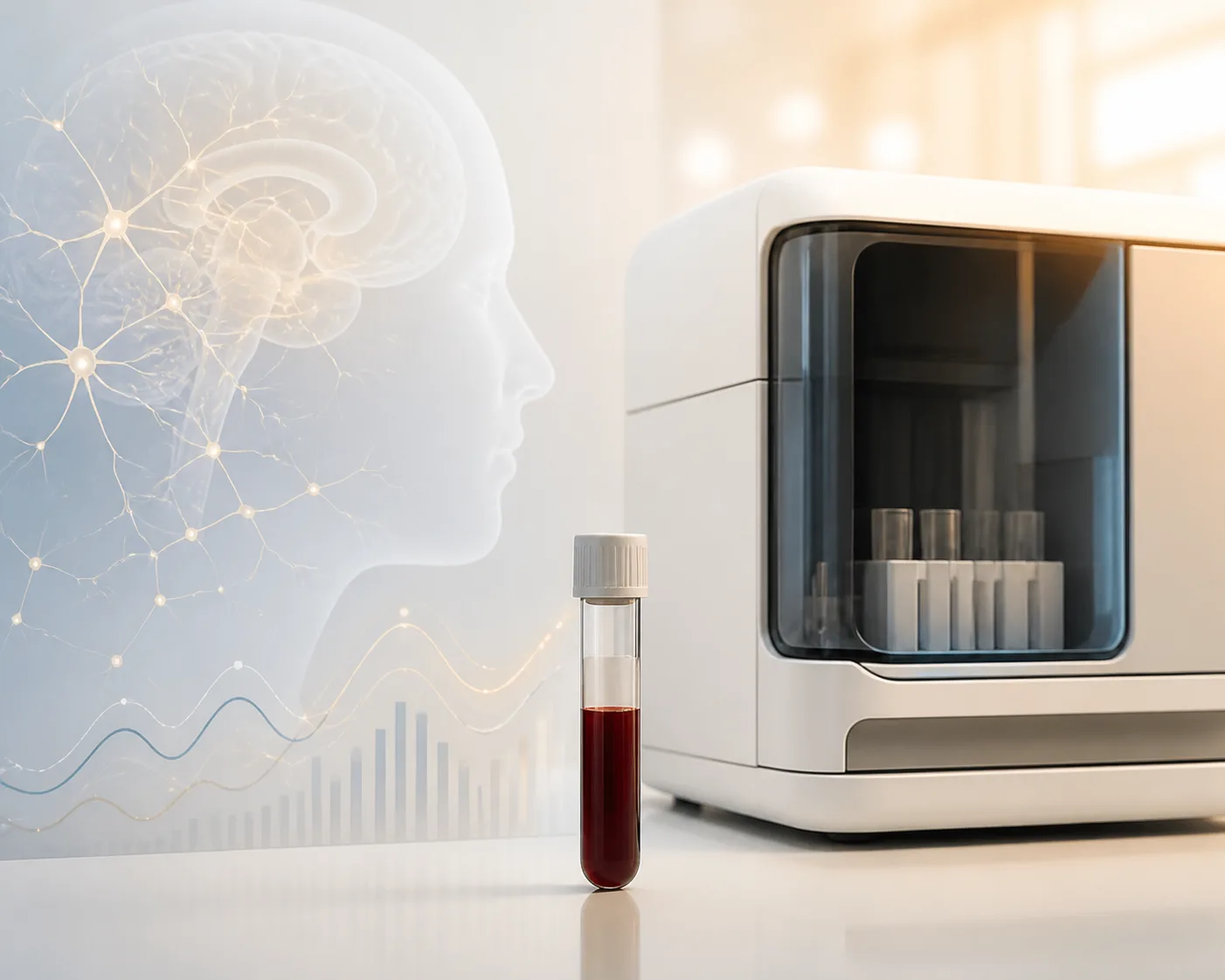
The timing matters because August 2026 brought two additional U.S. FDA clearances into public view. Alzheimer’s Association announced FDA clearance for C2N Diagnostics’ PrecivityAD2, a blood test for adults 40 and older with signs or symptoms of cognitive impairment. Days later, Alzheimer’s Association, CNN and MedPage Today covered clearance for Roche Diagnostics’ Elecsys pTau217 plasma test, developed with Eli Lilly, for people 55 and older with signs or complaints of cognitive decline. Together with earlier clearances such as Fujirebio’s Lumipulse plasma ratio test, the field is clearly entering a new phase.
What actually changed
For years, biomarker confirmation of Alzheimer’s pathology often meant access to an amyloid PET scan or cerebrospinal-fluid testing through a lumbar puncture. Those tools are valuable, but they are expensive, unevenly available and intimidating for many families. A blood-based biomarker does not make the disease simple. It can make the first diagnostic path less invasive and easier to order when a clinician is already evaluating memory, language, attention or daily-function problems.
PrecivityAD2 is built around measurements of amyloid and tau-related markers. WashU Medicine described the test as using high-resolution mass spectrometry to quantify amyloid beta 42 and 40 as well as phosphorylated tau 217 and total tau 217. The point is not to diagnose a person by one number in isolation; it is to estimate whether the pattern is consistent with amyloid pathology, a core feature associated with Alzheimer’s disease.
Elecsys pTau217 focuses on plasma phosphorylated tau 217. MedPage Today described its clearance as a tool for identifying amyloid-beta pathology in symptomatic people 55 and older, supporting both rule-in and rule-out assessments with validated cutoffs in primary and specialty care. CNN highlighted a practical reason this matters: Roche says the test can run on thousands of Roche laboratory analyzers already installed in the United States, with large lab networks such as Labcorp and Quest Diagnostics expected to offer it.
Why this is good news
The positive part is not that a test tube can replace a neurologist. It is that a patient with symptoms may reach the right next step sooner. A primary-care doctor or memory clinic that can use a validated blood biomarker may be able to decide whether to pursue specialist referral, imaging, treatment eligibility, trial enrollment, vascular-risk management or a different diagnostic path with less delay.
For families, speed and clarity matter. Cognitive decline is frightening partly because the diagnostic journey can be slow and ambiguous. A less invasive biomarker can reduce the number of people sent through unnecessary scans or procedures, and it can help direct scarce specialist resources toward the patients most likely to need them.
For medicine, this is an infrastructure achievement. It reflects years of biomarker research, assay development, regulatory review, laboratory quality systems and clinical interpretation work. Good Tech News should not treat that as magic. The achievement is more concrete: a complex biological signal is becoming measurable enough to enter routine diagnostic workflows, under defined conditions.
Why the caution is just as important
The FDA’s 2025 announcement for the first cleared Alzheimer’s blood test, Lumipulse G pTau217/β-Amyloid 1-42 Plasma Ratio, included the warning that such tests are not intended for screening or as standalone diagnostic tests. It also named the harms of false positives and false negatives: psychological distress, unnecessary costs, inappropriate treatment or delayed care. Those warnings still frame the newer clearances.
A blood biomarker is one piece of evidence. A clinician still needs the history, symptom pattern, cognitive testing, medication review, neurological examination and often imaging or other laboratory work to rule out different causes. Depression, sleep disorders, vitamin deficiencies, medication effects, vascular disease, infections and many other conditions can affect cognition. A result that points toward Alzheimer’s pathology does not erase the rest of the diagnostic job.
The opposite error is also dangerous. A negative or uncertain result does not mean a patient’s symptoms should be dismissed. It may redirect the investigation, but it should not end it. The value of these tests depends on the medical process around them.
The screening trap
The most dangerous misunderstanding is the idea of a casual wellness test for healthy people. CNN’s coverage captured the key caution: p-tau217 blood tests can strongly predict amyloid plaques, but amyloid positivity is not the same as inevitable dementia. Not everyone with amyloid pathology progresses to clinical dementia in a simple or predictable way, and treatment choices for asymptomatic people remain a separate, unsettled question.
That is why age and indication matter. PrecivityAD2’s public framing is for adults 40 and older with signs or symptoms of cognitive impairment. Elecsys pTau217 is framed for patients 55 and older with cognitive symptoms or complaints. Those are not the same as population-wide screening invitations. A test can be valuable in a diagnostic pathway and harmful when sold as a way to learn one’s future without a clinician, counseling or a plan.
This boundary is also where public discussion becomes emotional. Hacker News commenters reacting to the WashU Medicine story raised questions about price, anxiety, the amyloid hypothesis, treatment limits and whether knowledge helps if a cure is not guaranteed. Those questions are not anti-science. They are exactly the questions that decide whether a new diagnostic tool becomes helpful medicine or a market for fear.
What families should ask
A patient or caregiver does not need to memorize biomarker chemistry. They should ask practical questions. Is the test cleared for this age group and symptom profile? Is it meant to rule in, rule out or triage amyloid pathology? What happens after a positive, negative or indeterminate result? Who explains the result: a primary-care doctor, neurologist, memory clinic or lab report alone?
Cost and access also matter. FDA clearance is not the same as universal insurance coverage, and public list prices may not match what a patient pays. Before ordering, families should ask whether the test is covered, what the out-of-pocket range is, and whether the result would change treatment, referral, research eligibility, care planning or risk-factor management.
The last question is the most human one: what decision will this information support? A result can help when it leads to a clearer diagnosis, a safer medication choice, access to disease-modifying therapy when appropriate, participation in research, planning of finances and care, or attention to vascular and metabolic risks. It is less helpful if it only creates a label that nobody can interpret.
What clinicians and health systems need
Blood biomarkers will push Alzheimer’s evaluation closer to primary care, but that only works if systems build guardrails. Clinicians need ordering criteria, interpretation pathways, referral rules, patient education and a plan for uncertain results. A lab network can scale the assay; it cannot automatically scale counseling, neurology appointments or longitudinal care.
Primary-care teams may benefit from a rule-out tool that reduces unnecessary specialist referrals. Specialists may benefit from faster triage of patients who need PET, CSF confirmation, treatment evaluation or trial screening. But both groups need clarity about cutoffs, pretest probability and the difference between amyloid pathology and a complete dementia diagnosis.
Health systems should also avoid creating two unfair tracks: one for people who can pay for clarity and one for people who wait months for evaluation. A less invasive test can improve access only if coverage, ordering practices and follow-up capacity are handled responsibly.
Treatment makes diagnosis more valuable, but not simple
The rise of disease-modifying Alzheimer’s therapies is one reason biomarkers matter. If a therapy is aimed at a biological process linked to amyloid pathology, clinicians need to know whether that pathology is likely present. Earlier and more accurate triage can help identify patients who may be candidates and spare others from unnecessary risk.
But current therapies are not a cure, do not fit every patient and can involve serious monitoring and side effects. A blood test should therefore be treated as a doorway into a careful pathway, not a shortcut to medication. The better the test becomes, the more important shared decision-making becomes.
This is the mature version of the good news: more people may get answers with less invasion, but the answer still needs interpretation. The technology improves the map; it does not drive the patient through the whole journey by itself.
The real achievement
The meaningful improvement is that Alzheimer’s diagnosis is becoming less dependent on rare, expensive or invasive tools. A family facing real symptoms may soon have a faster route from confusion to a structured evaluation. Researchers may recruit more precisely. Clinicians may triage more confidently. Labs may turn a once-specialized biomarker question into a routine, quality-controlled measurement.
The limit is equally clear. These tests should not become an anxiety product for asymptomatic people. They should not be marketed as destiny. They should not replace the clinical work of understanding a person’s life, symptoms, risks and choices.
A good medical technology earns trust by making a hard decision clearer without pretending the decision is easy. The new Alzheimer’s blood tests are good news because they can shorten a difficult diagnostic path. They remain good news only if medicine keeps the guardrails around who should be tested, how results are explained and what action follows.
Comments
Sign in to comment.
No comments yet.