A Battery for Medical Capsules That Works Inside the Body and Then Breaks Down
MIT researchers have demonstrated a magnesium–molybdenum battery that powers ingestible devices in pigs, transmits signals from the stomach, and dissolves over time. It is a meaningful engineering step, but not yet a human-ready medical product.

A medical capsule can be small enough to swallow and still leave behind a difficult problem: what happens to its battery? Conventional cells provide reliable power, but a damaged casing can expose the digestive tract to metals, electrolytes or sharp fragments. If a device is designed to pass through the body without retrieval, the power source has to be treated as part of the medical safety problem, not as an interchangeable component.
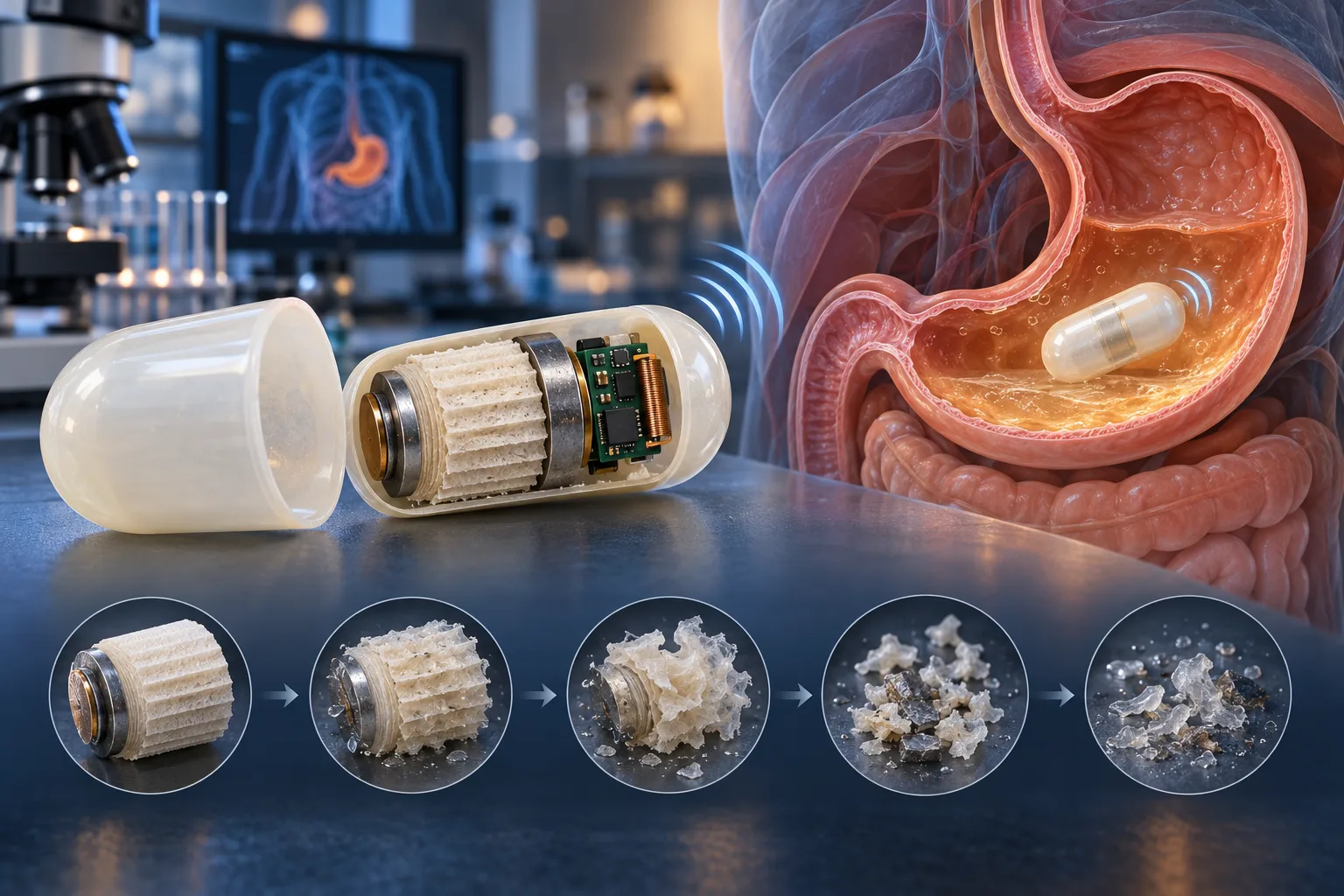
A study published on 21 September 2026 in Nature Chemical Engineering describes a battery designed around that constraint. The MIT-led team built a magnesium–molybdenum trioxide cell with a cellulose-based structure, a biodegradable ionic-liquid gel electrolyte and wax protection. The battery produced a peak open-circuit voltage of 1.84 volts and powered two different kinds of ingestible electronics in swine: a radio-frequency identification tag that could transmit from inside the gastrointestinal tract, and a capsule that electrically stimulated the stomach.
The useful part of the result is not that a battery has been made to look edible. It is that the researchers connected a bioresorbable power source to functions a future medical capsule might actually need: communicating its location and delivering a short-lived electrical treatment. The work remains an animal study. It does not show that people can safely swallow these batteries, that the electronics will work reliably in human digestive conditions, or that a treatment based on the capsule is effective for a disease. Its significance is narrower and more practical: one of the hardest components in transient medical electronics has moved beyond a benchtop chemistry demonstration.
Why the battery is the bottleneck
Ingestible electronics are useful precisely because they can enter places that are difficult to reach with an external sensor or a conventional implant. A capsule might measure conditions in the gut, release a drug at a selected location, monitor whether a medication has passed through the digestive tract, or deliver a local electrical stimulus. Each application has to solve the same basic engineering questions: how to power the device, how long the power should last, how to communicate with equipment outside the body, and what remains after the job is complete.
The battery is often the least forgiving answer. Lithium, silver-oxide and alkaline cells have advantages in energy density and predictability, which is why related chemistries are used in established medical devices. They are not automatically appropriate for an object that may be swallowed and then exposed to stomach acid. A protective package can reduce risk, but the package itself can fail, fragment or remain in the gastrointestinal tract. A conventional battery also creates a disposal problem when the rest of the device is intended to degrade or pass naturally.
That does not mean every conventional battery in a capsule is unsafe. Commercial ingestible devices are evaluated as complete systems, with specific materials, seals, dimensions and operating conditions. The point is that a battery designed to be retrieved or permanently isolated is a poor fit for a device whose purpose is to disappear. A fully or mostly bioresorbable power source could simplify the safety case for short-duration devices, provided its chemistry, degradation products and electrical behavior are all well controlled.
What the MIT team built
The new cell uses a magnesium alloy as the anode and molybdenum trioxide in a paper-like composite cathode. Magnesium is a familiar biological element in small amounts, while molybdenum is also present in the body as a trace nutrient. That description should not be mistaken for a blanket safety claim: a material can be tolerated in one dose, location or chemical form and still be harmful at another concentration or exposure time. The researchers selected these materials because they offered a plausible route to a high-voltage cell made from components that could be broken down and absorbed or excreted.
The battery also contains an ionic-liquid gel electrolyte. The electrolyte is important because electrodes alone do not make a useful cell; ions must move through the battery while electrons travel through the external circuit. The team used a formulation intended to perform better than simple buffered saline under physiological conditions. A cellulose-derived structure gives the cell its paper-like character, and natural waxes help slow contact with acidic gastric fluid so the battery does not dissolve before it has completed its intended task.
The researchers made more than one physical format. One design was a disc about 7.5 millimeters in diameter, suitable for a small tracking system. Another was a rectangular bar about 24 millimeters long, giving the electrode area needed for a more demanding stimulation device. The difference matters because a battery for a radio tag does not have the same current requirements as a battery that must drive an electrical waveform through a biological interface.
In laboratory tests using acidic fluid designed to approximate gastric conditions, the batteries retained useful function for roughly three days before their performance began to decline. The devices then broke down over the following weeks. MIT’s report describes separate images showing dissolution within about 90 days, while the paper emphasizes that operation is transient and that the parts are designed to degrade rather than remain as a permanent object. The exact lifetime depends on geometry, encapsulation, acidity, fluid access and electrical load. It is therefore better understood as a tunable operating window than as a single expiration time.
The first demonstration: communication from the stomach
The team incorporated the smaller battery into a bioresorbable RFID system. Radio-frequency identification is a useful test because it exposes a common weakness of passive ingestible tags: they can harvest energy from an external reader, but the available power and communication range are limited by the coupling between the reader and the tag. A battery-assisted tag can transmit more reliably while it remains inside the body.
In the swine experiments, the battery-powered tag transmitted from the gastrointestinal tract over a range of up to 1.5 meters. The researchers describe the application as a possible way to track medication capsules and support adherence monitoring. A system could, for example, tell an external reader that a capsule had entered or passed through a particular part of the digestive system. That would not by itself prove that a drug was absorbed, that a patient took it correctly, or that the treatment worked. It would provide a better record of where the device went and when it transmitted.
This is a modest but valuable distinction. Medication adherence systems often fail at the gap between a patient swallowing a dose and a clinician knowing what happened afterward. A disposable, short-lived transmitter could reduce that gap without requiring a patient to retrieve a device or undergo a procedure to remove an implant. The benefit would be greatest for carefully selected medicines and clinical studies where location and timing are clinically meaningful. It would not justify putting an electronic tracker into every pill.
The researchers are planning a clinical trial of the related SAFARI system in roughly two years, according to MIT News. That statement concerns the broader system and its development path, not proof that the new battery itself is ready for routine use. A clinical trial would still need to establish device performance, material safety, manufacturing consistency, signal reliability and appropriate handling of failed or partially degraded capsules.
The second demonstration: a short electrical stimulus
The larger battery powered a degradable capsule that delivered a small electrical current to the stomach lining. The approach builds on earlier work from the same research group showing that electrical stimulation can activate endocrine cells in the stomach and raise levels of ghrelin, a hormone involved in hunger and appetite regulation. In the new animal experiment, 20 minutes of stimulation increased measured ghrelin levels by about 50 percent.
That finding is a demonstration of system function, not a treatment result. Raising a hormone level in a small group of pigs does not establish that the same intervention would help people with nausea, loss of appetite or cachexia, the muscle and weight loss that can accompany cancer and other chronic disease. It also does not answer whether repeated stimulation would remain effective, whether it would have unwanted metabolic effects, or whether a different electrical pattern would be safer.
The value of the experiment is that the battery supplied continuous stimulation for up to three days while the capsule was retained in the stomach. The battery was not merely connected to a meter in a dish; it was integrated into a device with a biological target and tested in an animal model. That makes the engineering result more relevant to translation, even though the medical claim remains untested.
The authors report that the stimulation system was nearly bioresorbable, but not completely so. The printed circuit board still contains components that are not absorbed by the body. This is a crucial limitation. A biodegradable battery can reduce the hazard and waste associated with the power source without making the entire capsule disappear. Future versions will need bioresorbable conductors, switches, sensors, packaging and circuit elements, or a clear plan for the safe passage of the parts that remain.
Why the animal model helps, and why it is not enough
The researchers used Yorkshire pigs because the pig gastrointestinal tract has anatomical and physiological similarities to the human system. The animals were fasted, anesthetized and given capsules endoscopically. The study measured electrical output, capsule behavior, signal transmission and biological responses under controlled conditions. Those tests are more informative than a purely artificial gastric-fluid experiment because they include movement, tissue contact and the mechanics of a living digestive tract.
They also create boundaries around the evidence. The animals were studied under controlled feeding and procedural conditions, and the cohorts for some measurements were small. The paper specifically identifies future work involving fed animals, changes in pH, mucus, altered motility and more representative gastrointestinal conditions. Food can change gastric chemistry and transit time. Mucus can reduce contact between a device and tissue. Motility can move a capsule faster or slower than expected. Each factor may change both battery lifetime and the electrical dose delivered to a target.
A human digestive tract is not simply a larger pig digestive tract. Human patients vary in age, medication use, disease state, diet, anatomy and transit time. Any clinical system would also have to handle unexpected retention, incomplete degradation, manufacturing defects and patients who need imaging or other procedures while the capsule is present. These are not details to be cleaned up after the headline; they are part of the product.
The chemistry has its own questions. Magnesium can corrode in aqueous environments, and the corrosion rate depends on the surrounding fluid and the materials used to control access. Molybdenum trioxide, the electrolyte, waxes and degradation products would need toxicology studies that examine dose, location and clearance. The fact that an element is a trace nutrient does not guarantee that a particular compound or local concentration is harmless. A safe design would need to show what is released, how quickly it is released, where it goes and how the body handles it.
What is genuinely better in this design
The clearest improvement is alignment between the power source and the intended life of the device. A capsule that operates for a few days does not necessarily need a battery engineered to last for years. A transient application can trade long-term stability for controlled degradation, reducing the need for retrieval and limiting the amount of persistent electronic waste left in the gastrointestinal environment.
The second improvement is electrical performance. The reported 1.84-volt peak open-circuit voltage is high enough for the demonstrated low-power systems, and the paper reports stable operation around 1.6 volts during relevant discharge conditions. The researchers also report an areal capacity of about 2.43 milliampere-hours per square centimeter and an areal energy density of about 4.13 milliwatt-hours per square centimeter for the larger design. Those figures do not make the battery a general replacement for lithium-ion cells. They show that a bioresorbable cell can deliver useful power within the severe size and chemistry constraints of an ingestible capsule.
The third improvement is that the platform supports more than one use case. A power source that can operate a radio tag and a therapeutic stimulator gives designers a common foundation for sensing, tracking and local treatment. That could make future devices easier to develop, because teams would not have to redesign the entire energy system for every capsule. It could also expose weaknesses earlier: communication, stimulation and sensing impose different current profiles, so a platform must be characterized under realistic loads rather than one favorable laboratory condition.
There is an environmental benefit, but it should be stated precisely. If a capsule’s battery breaks down into materials that are safely absorbed or excreted, the amount of persistent battery waste entering sewage systems could fall. The paper presents this as a way to reduce electronic waste in the gastrointestinal environment. It does not establish the full environmental footprint of manufacturing the cells, producing the waxes and electrolytes, or handling the remaining non-bioresorbable electronics. A disposable medical device can be safer after use while still carrying manufacturing and disposal impacts elsewhere.
The problems that remain before human use
The most immediate challenge is reliability. A battery that lasts three days in a controlled experiment may not last three days in a patient who has eaten recently, takes acid-suppressing medication, has unusually fast transit, or has a gastrointestinal disorder. A therapeutic device must deliver a predictable electrical dose, not merely produce a voltage in the right range. Researchers will need to connect battery chemistry, geometry and encapsulation to a statistically defined operating time.
The next challenge is full-system safety. The paper’s battery is only one part of a capsule. The electrodes and electrolyte may be bioresorbable while a circuit board, antenna, connector or sensor remains. Those parts can affect local tissue, pass through the intestine or become lodged. A clinical design will need a complete inventory of everything that can remain in the body, together with evidence about its degradation and clearance.
Manufacturing will be just as important as chemistry. A research cell can be assembled and tested individually; a medical product has to be made repeatedly with tight control over thickness, electrode loading, encapsulation, voltage, current output and degradation time. Small variations could change when a capsule communicates, how much stimulation it delivers or whether it remains intact long enough to reach its intended site. Sterilization can also change natural waxes, polymers, electrolytes and adhesives.
Regulatory evaluation will likely be complicated because the product combines a battery, an ingestible device, a wireless transmitter and, in some versions, an active therapeutic function. Regulators would need to assess both the device and the biological effects of what it releases. A tracking capsule may face a different risk-benefit analysis from a stomach-stimulation capsule. The first successful clinical application may therefore be a narrow monitoring task rather than a therapy.
There is also a communication problem for patients. The word bioresorbable can sound like completely harmless and fully edible, but it is a technical description of how a material is intended to break down under specified conditions. It does not mean that a laboratory battery should be swallowed, that a damaged capsule is safe, or that every material in a prototype is food-grade. Clear labeling and clinical supervision would be essential if these devices move toward patient testing.
Where the work could lead
The most credible near-term applications are short-duration devices where retrieval is inconvenient and the required power is low. Medication tracking is one example because a small amount of energy can improve communication without powering a complex computer. Local sensing is another: a capsule might measure temperature, pressure, acidity or a chemical marker and transmit a limited data record before the power source degrades. The battery could also support a drug-delivery mechanism that needs energy only at a defined point in the digestive tract.
Electroceutical applications are more demanding because they require controlled electrical contact with tissue and a reason to deliver that stimulus. The stomach experiment suggests a path for local modulation of gut signals, but it is far too early to predict clinical benefit. The idea will need dose-finding studies, repeated-exposure studies and comparisons with existing treatments. A device that avoids surgery could be useful, but less invasive does not mean risk-free.
The broader lesson is about designing medical electronics around their entire life cycle. In many consumer devices, the battery is the part expected to outlast the product. In transient medicine, the desired outcome is reversed: the device should perform a specific job, then leave as little lasting material as possible. That change in design goal affects the chemistry, packaging, electronics, software, clinical workflow and environmental assessment at once.
For now, the strongest claim is also the most defensible one. The MIT-led team has shown in pigs that a bioresorbable magnesium–molybdenum battery can provide enough controlled power for capsule-scale communication and stomach stimulation, then degrade over time. That is useful progress because it addresses a practical failure point in ingestible medicine. The next milestones are less theatrical: larger and more varied animal studies, complete device biodegradability, reproducible manufacturing, toxicology, regulatory review and carefully designed human trials. If those steps succeed, a battery that disappears could make some medical capsules safer and simpler. Until then, it is an encouraging engineering platform, not a finished treatment.
Related articles
Useful technology is having a quiet week, and that is the good news
A grounded look at open-source maintenance, health AI, batteries and assistive tools where progress means fewer everyday failures.

Quiet technology that reduces daily failure
A constructive technology article about open maintenance, health tools, accessible design and energy systems that quietly reduce daily friction.


Thailand on a Budget After 15 September 2026: Check Your Entry Period Before You Book a Long Stay
Thailand remains workable for a low-cost trip, but the visa-exemption framework changes on 15 September 2026. The practical budget question is no longer only airfare and hotels: it is whether your passport permits the stay your itinerary actually needs.


Should You Buy the Apple Watch Series 12? The Health Sensors Are New, but the Upgrade Case Is Narrow
Apple’s Series 12 adds higher-frequency heart sensing and a readiness score, but its everyday case remains familiar. Here is who should buy now, who should wait, and when an older or cheaper Apple Watch makes more sense.
Comments
Sign in to comment.
No comments yet.