Clean power is learning to work after sunset
New solar-plus-storage projects in Abu Dhabi, molten-salt storage in China and home batteries in Germany show the clean-energy story moving from megawatts to hours.

The old complaint about solar power was simple: what happens when the sun goes down? The best answer in 2026 is no longer a slogan. It is a set of engineering projects measured in gigawatt-hours, hot salt tanks, grid software and household batteries.
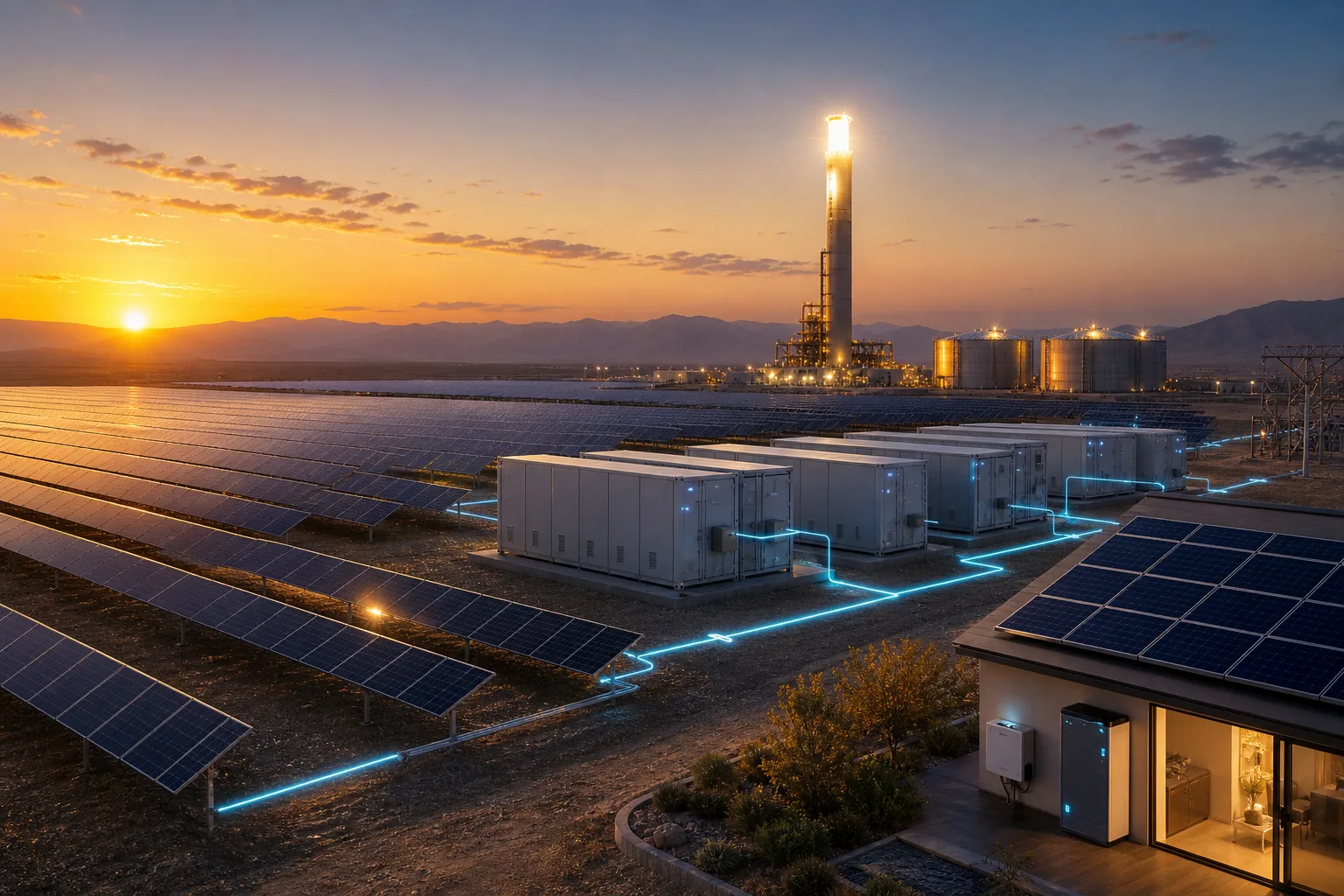
That is why the most interesting clean-energy news this week is not just another record solar farm. It is the shift from cheap daytime generation to useful electricity at the right hour. Abu Dhabi is pushing a solar-plus-battery project designed to deliver continuous clean power. China is testing a huge solar hybrid that keeps part of its output running after dark with molten salt. German households are adding batteries behind the meter because rooftop solar is more useful when the evening load arrives.
This is good news, but not fairy-tale news. Storage does not make every grid problem vanish. Batteries degrade. Concentrated solar power has cost and location limits. Grid connections, permitting, supply chains and fair access still matter. The progress is that clean power is moving from "can generate cheaply" toward "can show up when needed." That is a different stage of the energy transition.
The story is moving from megawatts to hours
For years, renewable-energy announcements were mostly about capacity: another 500 MW solar farm, another 1 GW wind project, another annual installation record. Capacity still matters, but it does not tell the whole story. A grid needs power in time, not only power in theory.
A solar plant has a power rating in watts. A battery has both a power rating and an energy capacity. The first says how hard it can discharge at a given moment. The second says how long it can keep doing it. That is why gigawatt-hours now deserve as much attention as gigawatts. They tell you whether a project can shift solar from noon into evening, ride through a cloudy interval, reduce curtailment, or replace some fossil generation during peak demand.
Dispatchability is the useful word here. It means power that grid operators can call on when they need it. A coal or gas plant is dispatchable because fuel can be burned on demand. Solar and wind are variable, but storage turns some of their output into dispatchable supply. Not all of it, not for free, and not at infinite duration. Still, enough to change the economics of many grids.
Abu Dhabi is trying the brute-force battery route
Electrek reported on July 10 that BYD Energy Storage won a contract to supply 11.275 GWh of batteries for Masdar's Round the Clock project in Abu Dhabi. The project pairs a 5.2 GW solar array with a 19 GWh battery energy storage system and is intended to deliver 1 GW of continuous clean power.
The scale is the headline. BYD's share alone is described as a 1,644 MW / 11,275 MWh battery station using the company's Haohan storage system. Electrek says Sungrow had already signed for the remaining 7.5 GWh. Together, those contracts account for the 19 GWh storage package around the solar plant.
The point is not that every sunny region can copy this exact project tomorrow. Abu Dhabi has land, sun, capital and a buyer willing to structure a very large clean-power contract. The point is that solar-plus-storage is no longer a boutique pairing. It is being designed as system power.
There are still questions. "1 GW continuous" needs to be understood as a project delivery promise under a specific power-purchase structure, not a magic property of solar panels. The usable energy, discharge profile, degradation assumptions, maintenance strategy and grid requirements will decide how the plant performs over years. But the direction is clear: when solar gets paired with storage at this scale, it begins to compete not only on cheap energy, but on reliability hours.
The supply-chain message is also clear. The flagship storage contracts are going to Chinese manufacturers. That is good for deployment speed and price competition. It is also a strategic question for Europe, the United States and Gulf buyers that want domestic manufacturing, supply diversity and labor-standard assurance. Good technology still has geopolitics attached.
China's Hami project answers a different evening problem
Batteries are not the only way to move solar into the evening. Electrek reported on July 9 that China Three Gorges Corporation put the Hami project in Xinjiang into commercial trial operation. The complex combines 900 MW of standard solar PV with a 100 MW concentrated solar power unit in the Gobi Desert.
The CSP part uses tracking mirrors to heat molten salt to about 550°C. That stored heat can later make steam and run a turbine after sunset. Electrek says the unit can generate for up to eight hours after dark.
The caveat matters: the eight-hour output comes from the 100 MW CSP unit, not the full 1 GW complex. This is not a gigawatt plant running all night. It is a large PV plant paired with a dispatchable evening block. That precision makes the story more useful, not less. It shows where molten-salt storage fits: not as a universal battery replacement, but as a way to supply longer evening duration in places with strong sun, enough land and suitable economics.
CSP has disappointed before. In many markets, photovoltaic panels plus lithium batteries became cheaper faster than tower or trough projects could scale. Hami is interesting because China appears willing to industrialize thermal storage anyway, especially in desert renewable bases where grid utilization and evening delivery matter.
The real test is not whether the physics works. It does. The test is whether the plant can produce useful evening power at a cost that competes with ever-cheaper batteries and upgraded transmission. If it can, grids may end up using a mixed storage toolbox: lithium for fast response and shorter peaks, thermal storage for longer evening blocks, pumped hydro where geography allows, and demand response wherever loads can move.
Household batteries make the same idea personal
At the other end of the grid, Euronews reported on July 8 that German households are turning to battery storage to shield themselves from fossil-fuel price shocks and grid volatility. The story is smaller than Abu Dhabi's 19 GWh battery system, but it may be easier for readers to feel.
A rooftop panel makes electricity when people are often away from home. A home battery saves some of that generation for dinner, heat pumps, EV charging, evening work and backup during outages. That does not make a household energy-independent in every season. It does make solar feel less like an export machine and more like useful infrastructure inside the home.
Germany is a good example because it has a large base of rooftop and balcony solar, changing tariffs, grid bottlenecks and a public that has already felt fossil-fuel price risk. Euronews cites SolarPower Europe arguing that flexibility has become the enabler of further progress as grid expansion lags renewable deployment. It also cites clean-tech startup 1KOMMA5° saying German battery storage capacity rose from 21.8 GWh to 29.83 GWh since June 2025, a 37% increase.
Household batteries are not automatically fair. Homeowners benefit first. Renters, apartment dwellers and lower-income households may see fewer direct gains while still paying grid costs. Subscription or leasing models may help some users, but they need careful math. A battery can lower bills under the right tariff and usage pattern. It can also be an expensive box if incentives, prices or load profiles do not line up.
Even with those caveats, the direction is practical. Storage is becoming a consumer product, not only a utility asset.
The global milestone behind the week
The week sits on top of a broader change. Electrek reported in May, citing Ember analysis, that wind and solar generated more electricity than gas globally for the full month of April 2026. The reported figures were 22% of world electricity from wind and solar, compared with 20% from gas. Wind and solar produced 531 TWh that month, 54 TWh more than gas plants.
One month does not end fossil power. April is a favorable month for such a milestone because parts of the northern hemisphere have strong wind and solar while heating and cooling demand can be lower. Gas and coal remain large. Hydro conditions, demand growth and regional differences matter.
But the milestone still matters. Ember's Global Electricity Review 2026 says clean electricity met all global demand growth in 2025 and that renewables overtook coal for the first time in the modern era. The next phase is making sure that extra clean generation is not wasted at noon while fossil plants cover the evening.
That is why storage is no longer a side note. It is the bridge between renewable records and real operating displacement.
What people are arguing about
The public debate is healthier than simple optimism. On Hacker News, the thread around wind and solar surpassing gas drew hundreds of comments. Many readers did not argue about whether solar exists. They argued about payback, batteries, rooftop economics, air-conditioning loads, grid faults, insulation, excess midday power and what society should do with cheap electricity when it arrives at the wrong hour.
Reddit's energy communities are having similar conversations around residential battery subscriptions, project cancellations, electrification and policy risk. These discussions are not primary evidence for technical claims. They are useful signals of what people are trying to understand: reliability, cost, control and fairness.
The skepticism is useful. A 19 GWh battery project does not solve winter dunkelflaute in Europe. A molten-salt plant in Xinjiang does not prove CSP will beat batteries everywhere. A German home battery does not make renters whole. A month when wind and solar beat gas does not mean gas plants retire the next day.
Good news gets stronger when it can survive those objections.
The caveats are part of the progress
Battery storage brings material and manufacturing questions. Lithium iron phosphate batteries avoid some nickel and cobalt issues, but they still need mining, factories, transport, recycling and fire-safety systems. China dominates much of the supply chain, which helps cost and scale but raises strategic dependence for other regions.
CSP brings different trade-offs: desert siting, capital cost, optical maintenance, water or dry-cooling choices, and thermal-system complexity. It can store heat for longer than many battery installations, but it needs excellent sun and a project design that justifies the extra machinery.
Grids also need wires, software and market rules. Storage can reduce curtailment and support evening peaks, but interconnection queues and transmission bottlenecks can still delay clean energy. Dynamic tariffs and virtual power plants can make distributed batteries useful, but only if customers trust the rules and share in the savings.
Policy can speed this up or slow it down. Subsidy changes, permitting delays, trade disputes and cancelled projects can matter as much as cell chemistry. The technology is improving, but deployment is still a political and industrial process.
What to watch next
Watch storage duration, not only solar capacity. A 5 GW solar project without storage tells one story. A 5 GW solar project with 19 GWh storage tells another.
Watch power rating and energy capacity together. A battery with a huge MWh number but a small MW rating behaves differently from a high-power short-duration system.
Watch curtailment. If sunny regions are throwing away midday power, batteries, flexible demand, transmission and heat storage become more valuable.
Watch household adoption alongside tariffs. Home batteries make sense faster when electricity prices vary by hour, outages are common, exports are poorly paid, or heat pumps and EVs shift demand into the evening.
Watch supply chains. The clean-energy transition is not only a climate story. It is also an industrial race over batteries, inverters, grid equipment, software, minerals and manufacturing know-how.
The clean-energy story is becoming less about belief and more about engineering. The world has learned how to make a lot of cheap clean electricity when weather cooperates. Now it is learning how to store those electrons, heat, and control signals so clean power arrives at the hour people actually need it. That is slower than a slogan. It is also more real.
Related articles
Mistral’s one-camera robot model is good news, with limits
Robostral Navigate is not a robot butler. Its promise is more practical: cheaper, simpler navigation for useful machines if benchmark progress survives real-world tests.

Will your smart home survive when the app disappears?
Wemo’s cloud shutdown is a practical warning for anyone buying smart plugs, bulbs, switches or appliances: the safest smart home is the one whose basic controls do not depend on one vendor server.

When does an electric bicycle stop being a bicycle?
Fast e-bikes are forcing buyers, parents, police, and riders to face the line between a bicycle, a moped, and a loophole.

The travel gadget worth buying in 2026 is a better USB-C charging kit
A practical buyer guide to chargers, cables, power banks and adapters that keep the rest of your devices alive.
Comments
Sign in to comment.
No comments yet.