New York's data-center pause is a useful kind of tech progress
The state’s one-year hold on some hyperscale projects is not anti-AI by default. Done well, it is a test of whether AI infrastructure can pay its real energy, water and community costs.

A pause can be a technology story. New York's new one-year hold on some large data-center permits is not as exciting as a faster chip or a new AI model, but it may matter just as much for the next phase of AI infrastructure.
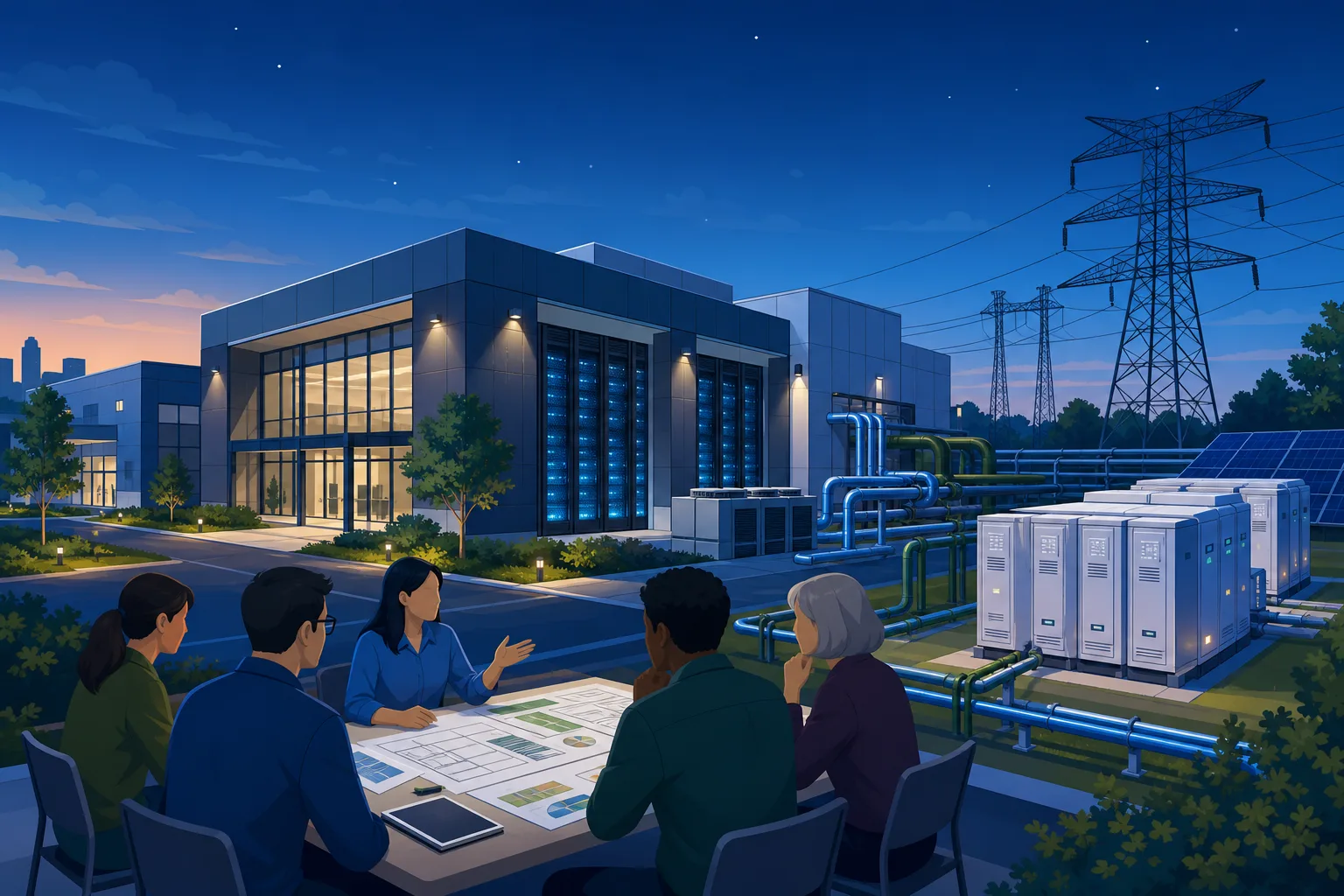
On July 14, Governor Kathy Hochul announced what her office called the nation's first statewide moratorium on new hyperscale data centers. Reuters described New York as the first U.S. state to halt new projects of this kind. The measure is not a permanent ban. It is a temporary stop while the state writes standards for energy, water, permitting, community benefits and who pays for grid upgrades.
That is why this belongs in Good Tech News. The positive part is not that construction slows down. The positive part is that a state is trying to treat AI infrastructure as infrastructure, not as magic. If cloud and AI systems create value, they should be able to pay for the power, cooling, transmission, noise control and local benefits that make them possible.
What New York actually did
The order and the governor's announcement describe a one-year pause on new large data centers while state agencies prepare a Generic Environmental Impact Statement. Reuters reported that the construction ban applies to data centers using 50 megawatts or more, according to an official. The Department of Environmental Conservation is expected to hold discretionary permit applications in abeyance if they were not already deemed complete before the order.
That legal scope matters. This is not a shutdown of existing data centers. It is not a ban on all computing facilities. It is aimed at new hyperscale projects that need state-level discretionary permits and large amounts of electricity.
The state also plans a Community Investment Framework within 60 days. The outline includes community investment funds, local infrastructure, child care, K-12 programming, public infrastructure, labor standards, local hiring and apprenticeships. The governor's office also discussed a possible Grid Acceleration Fund and ways for data centers to support new clean electric generation, distributed energy resources and battery storage.
Hochul also said she would pursue legislation to repeal sales-tax exemptions for massive data centers. That is politically sensitive, but the basic idea is plain: public incentives should not hide private infrastructure costs.
The number that explains the timing
The order points to almost 12 gigawatts of data-center load requests in the NYISO interconnection queue as of May 2026, with more than 8 gigawatts entering the queue in 2025. Those are not small add-ons to the grid. They are industrial-scale loads arriving quickly.
A data center does not only need a building and servers. It needs power around the clock, backup systems, cooling, fiber, substations, transmission planning, water or alternative cooling designs, emergency access and noise limits. Some sites can handle that well. Others push costs into the utility system and onto local residents.
That is the hidden bill New York is trying to expose before it becomes permanent.
Why communities are pushing back
This fight did not start with New York. The Guardian reported in early July that local opposition to data centers has become a bipartisan grassroots issue in parts of the United States, with recall efforts against officials who approved controversial projects. Data Center Watch says $18 billion in projects were blocked and $46 billion delayed over the last two years amid local opposition, and tracks groups organizing across many states.
Those figures come from advocacy and tracking organizations, so they should be read as a signal rather than a government census. Still, the pattern is hard to miss. People are not only arguing about AI in the abstract. They are arguing about water, rates, land, noise, secrecy and tax deals.
Hacker News picked up the Reuters story the same day. The thread had about 137 points and dozens of comments when checked. The debate was predictable and useful. Some readers saw a reasonable pause to protect ratepayers and grid planning. Others saw a slow, anti-growth move that could send investment elsewhere. Both concerns are real.
A good moratorium buys time to write better rules. A bad moratorium becomes a symbol, a bargaining chip or a way to push projects into places with weaker oversight.
Why this can be a good technology story
Good technology is not only invention. It is also deployment that survives contact with the real world.
The AI boom has made compute look weightless. A prompt appears in a browser, a model answers, and the physical stack disappears from view. But the stack is very real: substations, transmission lines, cooling systems, land-use hearings, construction labor, backup generation and monthly utility bills.
New York's move says the physical layer deserves rules before it scales further. That is not anti-technology. It is the same logic that applies to roads, factories, ports, rail, battery plants and chip fabs. When a project is large enough to change local infrastructure, the public needs to know what it costs and who carries the risk.
The useful standard is not "no data centers." The useful standard is: data centers should disclose load, pay for grid upgrades they cause, reduce water stress, control noise and light, build or buy clean capacity that actually matches their demand, and fund local benefits that are enforceable rather than decorative.
The clean-energy promise needs a grid reality check
Many technology companies buy renewable energy certificates or sign power purchase agreements. Those tools can help finance clean energy. They do not automatically solve the local physics of a large new load.
A data center can claim clean power on an annual accounting basis while the local grid still needs new wires, firm capacity, batteries, gas peakers or demand management to keep the lights on hour by hour. That distinction is easy to blur in marketing and hard to ignore in utility planning.
New York's planned review gives agencies a place to ask harder questions. Is the project bringing new clean generation or competing for existing supply? Will storage be available when the site needs it? Who pays for transmission upgrades? Are customers protected if speculative projects reserve grid capacity and then never build?
These are not anti-AI questions. They are engineering questions.
Water, noise and local benefits are not side issues
Energy gets most of the attention, but the order also points to water use and quality, air quality, noise and disproportionate impacts on disadvantaged communities. That is the right list.
Data-center water use varies widely. Some facilities use little operational water; others rely on evaporative cooling or systems that can draw heavily during hot periods. A national average can mislead because climate, design and workload change the answer. The standard should force project-specific disclosure instead of letting either side fight with generic numbers.
Noise also matters. A data center may look quiet from a distance, but cooling equipment, backup generators and substations can affect nearby homes. Light, traffic and emergency planning matter too. A project that is clean on a corporate slide can still be unpleasant if it is poorly sited.
Community benefits are often promised late in the process, when trust is already gone. A better framework would put benefits, labor standards, local hiring and public reporting into enforceable agreements before approval.
The risks of New York's approach
A pause does not guarantee better policy. It can fail in several ways.
Projects may move to states with looser rules, shifting the problem instead of solving it. Developers may lobby for exemptions. Agencies may write vague standards that communities cannot enforce. Utilities may still socialize costs if rate design is weak. A year may not be enough to understand the full impact of the AI load curve.
There is also a real risk that useful infrastructure gets delayed. Hospitals, universities, financial systems, scientific computing and public services all depend on data centers. AI is not the only workload. A policy that treats every large facility as a villain would be lazy and counterproductive.
That is why the New York pause should be judged by what it produces. If it produces transparent load accounting, fair cost allocation, clean-power requirements, water standards and community agreements, it will have been productive. If it produces only press releases, it will not.
A checklist other regions can steal
Other states and cities do not have to copy the moratorium. They can copy the questions.
Require developers to disclose peak load, expected annual energy use, backup generation, water design, noise profile and the true end customer where possible. Separate very large loads into rate classes that prevent ordinary customers from paying for speculative upgrades. Require clear interconnection deposits or guarantees. Tie tax incentives to measurable local benefits, not vague job claims.
Ask whether the project brings new clean generation or only buys credits. Ask how much battery storage or demand flexibility the site can provide. Ask what happens during heat waves. Ask how water use changes during drought. Ask whether construction and operating jobs go to local workers. Ask whether nearby residents can see the monitoring data after the project opens.
These questions do not stop useful technology. They make it harder to build bad infrastructure in the name of useful technology.
The bigger lesson
AI infrastructure is leaving the era of invisible growth. The next stage will be negotiated in utility hearings, planning boards, state agencies and community meetings.
That may sound slower. It is slower. But it is also how technology becomes durable. The internet, cloud computing and AI all rely on physical systems. If those systems raise bills, drain water, add noise or consume tax incentives without clear public value, the backlash will get worse.
New York's pause is a test. It could become a template for smarter standards, or it could become another fight over whether a region is "pro-tech" or "anti-tech." The better answer is neither. Be pro-useful technology and pro-honest infrastructure.
If AI data centers are as valuable as their backers say, they can meet that bar.
Related articles
Australia's Solar Sharer turns midday surplus into a household benefit
A three-hour free-power window is not magic; it is a practical test of whether homes can help use renewable energy when the grid has too much of it.

Pixel 11 is coming on August 12. The price leak is the real story.
Google has confirmed its next Pixel event, but the bigger question is whether a 256GB base model and possible price increase make the Pixel 11 worth waiting for.

Smart glasses have a people problem, not just a privacy problem
Meta, Snap and Google can make camera glasses look normal. The harder question is whether bystanders will accept them.


AI browsers create a new trust boundary. Treat them that way
New research on agentic browsers, same-origin policy and BioShocking does not mean panic. It means AI browser agents need isolation, limits and explicit confirmation before they touch sensitive sessions.

Comments
Sign in to comment.
No comments yet.