Mistral’s one-camera robot model is good news, with limits
Robostral Navigate is not a robot butler. Its promise is more practical: cheaper, simpler navigation for useful machines if benchmark progress survives real-world tests.

Robots do not become useful because a demo video looks human. They become useful when a few basic capabilities get cheaper, safer and easier to deploy. Navigation is one of those capabilities.
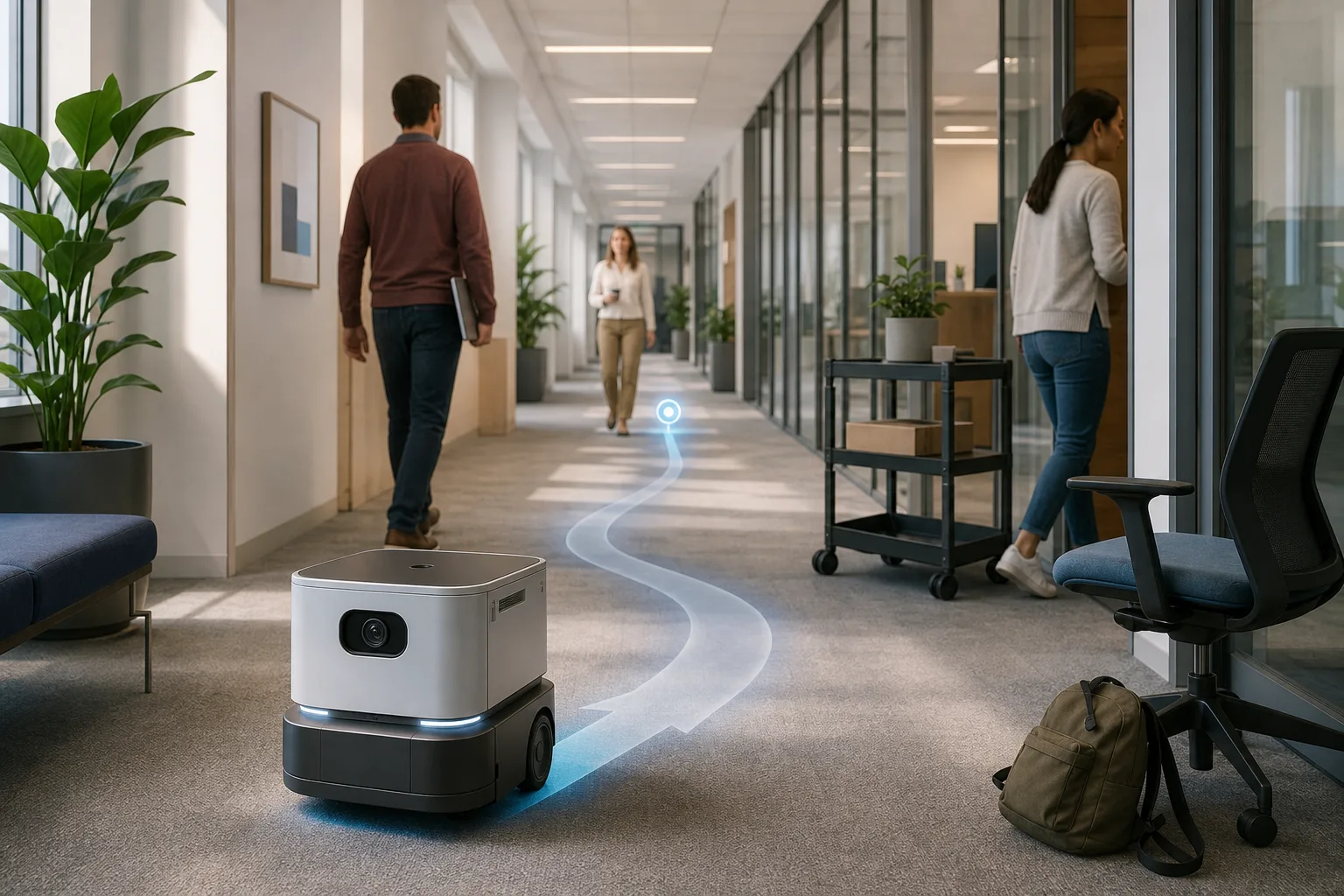
That is why Mistral's Robostral Navigate is a genuinely good piece of technology news, with one important caveat: it is not a finished household robot and it should not be sold as one. It is an 8B model for embodied navigation. Mistral says it can take a plain-language instruction and a normal RGB camera view, then guide a robot through an environment without LiDAR, depth sensors or multiple cameras.
The headline number is 76.6% success on R2R-CE validation unseen, a benchmark for following navigation instructions in environments held out from training. Mistral also reports 79.4% on validation seen, a 9.7 point lead over the best single-camera approach, and a 4.5 point lead over the best system using depth or multiple cameras. The model was trained in simulation on roughly 400,000 trajectories across 6,000 scenes.
Those are vendor-reported benchmark results, not a guarantee that a robot will behave safely in a crowded office, hospital corridor or warehouse tomorrow morning. But they point to a useful direction: capable robot navigation may not always require a large, expensive sensor stack. If that holds up in independent tests and real deployments, the practical impact could be boring in the best way. Cheaper cleaning robots. Easier indoor delivery. More flexible warehouse carts. Service robots that can understand instructions such as "go down the corridor and stop by the second shelf" without every building being mapped in advance.
Good tech news should survive contact with skepticism. Robostral does.
Why navigation matters more than the robot shape
Most public robot excitement still centers on humanoids. They wave, fold a shirt in a staged clip, or walk through a lab while people argue about whether the movement is autonomous. That makes for good video. It is not where most useful robotics begins.
A mobile robot first has to know where it is, where it should go, what is in the way, and how to avoid becoming a hazard. That sounds simple until the world changes. A cart blocks the corridor. Someone leaves a bag near a door. A glass wall confuses perception. A person walks across the path. Lighting changes. A room layout moves after a renovation.
Traditional robotics solves parts of this with maps, SLAM, depth cameras, LiDAR, wheel odometry, beacons and carefully engineered local planners. Those tools are not going away. In safety-critical settings, extra sensors are often the right answer. The interesting part of Robostral is narrower: can a learned navigation model use language and a single camera well enough to reduce the cost and complexity of some indoor robots?
If yes, the result will not look like science fiction. It will look like a service robot that is cheaper to install and less brittle when the building changes.
What Mistral is claiming
Mistral describes Robostral Navigate as its first model built for embodied navigation. The inputs are ordinary RGB images and a text instruction. The output is not a paragraph. It is a navigation decision.
The company says the model uses "navigation via pointing." Given the task and a history of observations, the model predicts image coordinates for where the robot should move next, along with the desired orientation when it gets there. The idea is appealing because pointing into the image can be less tied to a particular camera calibration or world scale than pure metric commands. When the target is not visible, the model falls back to local displacements.
Mistral also says training was entirely in-house and entirely in simulation. The company reports token-efficient training through prefix caching, with a 22 times reduction in training tokens compared with one sample per time step. It also says online reinforcement learning through CISPO improved success rate by 3.2 percentage points.
For non-roboticists, the useful translation is this: Mistral is trying to make navigation less dependent on hand-built maps and expensive perception stacks, while keeping the model small enough to be plausible for real robotics work. 8B is not tiny in the embedded systems sense, but it is small compared with frontier language models and easier to imagine in a robot stack than a huge cloud-only model.
Why one camera is a big deal, if it works
A single RGB camera is cheap, light and already common. It does not mean the whole robot becomes cheap, but it removes one source of cost and integration work. It also makes the method easier to adapt across wheeled, legged and flying robots, at least in principle. Mistral explicitly says the model runs across robot types and is robust to different camera intrinsics.
This is the positive part of the story. Many useful robots do not need to manipulate fragile objects or pass for humans. They need to move through indoor spaces, carry things, inspect areas, guide visitors, clean floors, deliver supplies or patrol predictable routes. If navigation becomes more language driven and less dependent on a custom map for every site, deployment gets easier.
That matters for smaller organizations. A hotel, clinic, school, warehouse or office building may not have a robotics team. It may not want a months-long mapping project. It may accept a robot that does one narrow task well if the setup is simple and the failure modes are contained.
This is where Robostral feels like good technology news rather than a flashy AI claim. It points toward robotics becoming more modular. Not one grand general-purpose robot, but reusable abilities: move through a corridor, follow an instruction, recognize when a goal is in view, adapt when the path is blocked.
The 76.6% question
The same number that makes Robostral impressive also keeps the story grounded. A 76.6% success rate on validation unseen is strong for a benchmark. It is not enough for an unsupervised robot near people, stairs, pets, glass doors, medical equipment or expensive inventory.
Benchmarks are abstractions. R2R-CE is useful because it tests vision-and-language navigation in continuous environments, with held-out environments for generalization. It is still not the same as a real building with messy edge cases, changing floor conditions, reflective surfaces, emergency procedures and liability.
The Hacker News discussion captured this split well. Some readers saw a step toward map-less navigation and cheaper robots. Others asked what happens in the remaining failures, whether compute runs on the robot or a nearby server, how latency and energy affect deployment, and whether LiDAR might still be cheaper than debugging a learned visual policy in the field.
Those skeptical questions are not negativity. They are the right questions.
Simulation is useful, not magic
Simulation has made embodied AI move faster because researchers can run many more experiments than they could with physical robots. Habitat and VLN-CE exist partly for that reason: simulation is safer, cheaper and easier to reproduce than repeatedly sending real machines through buildings.
But simulation-to-real transfer remains the hard part. A model trained in simulated scenes can learn useful structure, yet real environments bring sensor noise, lighting differences, motion blur, humans who do unexpected things, and objects that were not modeled. Mistral says Robostral can adapt to real-world obstacles unseen during training, and its post includes office-style demonstrations. Those are encouraging signals. They are not the same as independent long-term deployment data.
The right conclusion is not "simulation results do not count." They do count. The right conclusion is that simulation results are a starting line for real tests, not the finish.
Where this could help first
The near-term uses are likely narrow. Indoor logistics is an obvious one: moving small items inside offices, labs, hospitals, hotels or warehouses where routes are semi-structured but not perfectly static. Cleaning and facility inspection are another fit. A robot that can receive a natural-language goal and navigate a corridor without a special sensor rig could reduce deployment friction.
Retail and hospitality may also benefit, but only where the job is constrained. A robot that guides visitors to a meeting room is easier than one that can safely handle every human interaction in a crowded lobby. A robot that checks whether a hallway is blocked is easier than a robot that reorganizes a storage room.
That is not a weakness. Useful robotics often advances by narrowing the task until it becomes reliable.
The open robotics context
Robostral also fits a broader trend. Tools such as Hugging Face's LeRobot are making datasets, policies and hardware experiments more accessible. Academic benchmarks such as VLN-CE and platforms such as Habitat give researchers common ways to compare progress. More labs are treating robotics as a software and data problem as much as a hardware problem.
Mistral has not, in the sources checked, presented Robostral Navigate as an open-weight release for anyone to download and run. That distinction matters. The positive trend is not that every part is open. It is that the field is moving toward reusable components, shared benchmarks and smaller models that more teams can reason about.
If robotics becomes less dependent on bespoke hardware and more dependent on trainable, inspectable modules, the number of people who can build useful systems goes up.
How to read future robot breakthroughs
Robostral is a good reminder to ask five boring questions whenever a company announces an AI robot breakthrough.
Where was it tested? A benchmark, a lab, a staged office route and a customer pilot are different evidence levels.
Which sensors are required? A single camera result is different from a robot that quietly depends on LiDAR, depth, motion capture or a prebuilt map.
Where does inference run? On the robot, on an edge box, or in the cloud? Latency, power and reliability change the answer.
What happens on failure? Does the robot stop, ask for help, choose a safe fallback, or keep moving with false confidence?
Has anyone replicated it? Vendor demos are useful, but independent tests decide whether the result is a product direction or a research milestone.
A good step, not a miracle
Robostral Navigate is good news because it targets a real bottleneck and reports measurable progress without needing a humanoid fantasy. One camera, language instruction and simulation-trained navigation are not enough to solve robotics. They may be enough to make some useful robots cheaper and easier to deploy over time.
That is the kind of progress worth paying attention to. Not magic. Not a robot butler. A smaller, testable piece of the stack getting better.
Related articles

Robotics is still waiting for reliability, not another demo video
Physical AI has better models, cheaper developer robots and stronger industrial demand. The missing breakthrough is not spectacle — it is dependable work in messy real environments.

Slotstream makes a 104 GB local LLM a Mac SSD problem worth testing
The new MIT runtime streams Qwen3.8-Flash-Next experts from SSD, showing a clever path around memory limits — with speed, disk and license caveats.
Робототехнике нужен не новый демо-ролик, а надёжность
Physical AI получает модели, дешёвые платформы и заказы, но настоящий рубеж — полезная работа в реальной среде, а не эффектное видео.
La robotique n’a pas besoin d’une autre vidéo, mais de fiabilité
L’IA physique progresse avec modèles, plateformes moins chères et demande industrielle. Le vrai seuil reste le travail fiable dans le réel.
Comments
Sign in to comment.
No comments yet.