Sandia’s ETCRAM points to a quieter way to cut energy in sensor computing
Sandia researchers have demonstrated an analog memory that stores far more precise states across a wider range than earlier devices. The useful idea is not a faster server, but less raw sensor data moving between chips.

A promising memory technology is arriving from an unexpected direction: not as a faster version of conventional digital RAM, but as a device that behaves a little like a rechargeable battery. Sandia National Laboratories says its electro-thermo-chemical random-access memory, or ETCRAM, can store analog values with 100 times the precision of existing state-of-the-art analog memory and at least three orders of magnitude greater dynamic range.
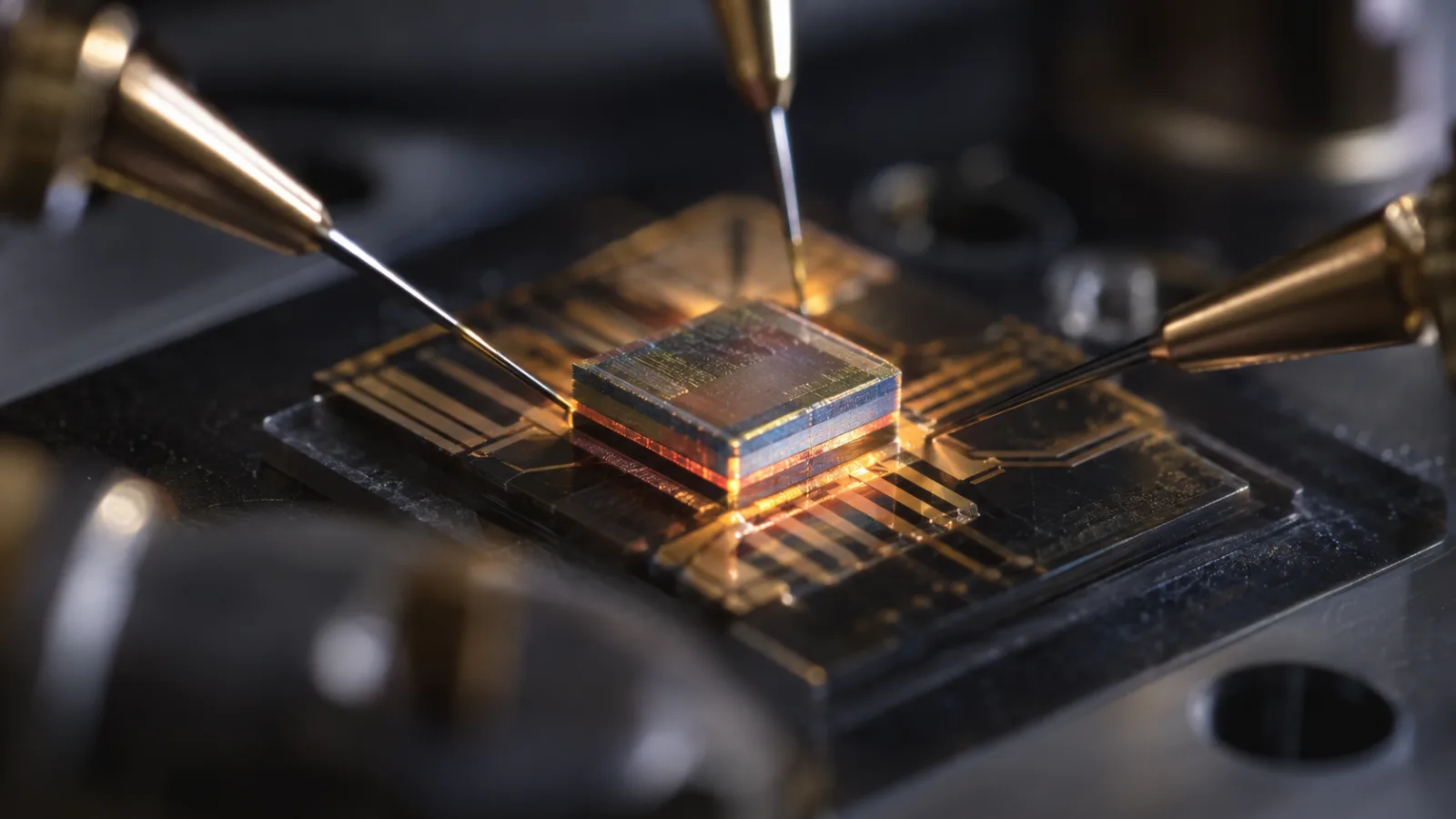
Those numbers come from Sandia’s own announcement, so they should be read as a reported laboratory result rather than a product benchmark. The device has not replaced mainstream memory, and there is no demonstrated consumer product. The more measured reason to pay attention is that ETCRAM targets a specific bottleneck in modern electronics: the energy and time spent repeatedly moving sensor data to a separate processor.
If the approach survives testing at array and manufacturing scale, some calculations could happen where data are collected. A camera might reduce or classify visual information before sending it onward. A machine sensor could detect a change locally instead of transmitting a continuous stream. The benefit would come from reducing movement, not from making every individual transistor dramatically more powerful.
The problem is often the journey, not the calculation
Most computing systems separate memory and processing. A sensor records a measurement, memory stores it, and a processor fetches the data to perform an operation. The result then travels through another part of the system. Each transfer consumes energy, and the cost becomes significant when a device is collecting large amounts of data continuously.
This arrangement works well for general-purpose digital computing, but sensors increasingly produce information faster than a small device needs to transmit it. Cameras, microphones, industrial monitors, vehicles and wearable devices all create streams in which most individual measurements are uninteresting. Sending every raw value to a central processor or a remote service can be wasteful when the desired result is a simple decision: is something moving, is a machine vibrating abnormally, or has a chemical concentration crossed a threshold?
The field known as in-memory computing tries to reduce this traffic by placing useful mathematical operations inside or close to memory. Analog memory is one route. Instead of holding only a zero or a one, a cell can represent a range of conductance values. That conductance can act as a numerical weight in operations such as multiplication and accumulation, which are central to neural networks and many signal-processing tasks.
The attraction is straightforward. A digital processor typically represents a number with several bits and moves those bits through interconnects. An analog array can represent many weights in the physical properties of its cells and perform parts of a calculation in parallel. That does not make analog computing automatically better: noise, calibration, limited precision and conversion between analog and digital signals all matter. But it creates a path around the memory-processor traffic that dominates some workloads.
A 2024 review in Nano Convergence describes electrochemical random-access memory as a candidate for this kind of hardware. It notes that ECRAM devices can express analog states through the movement of ions, and that reported devices can reach more than 1,000 memory states. The same review also lists the engineering requirements that determine whether a laboratory cell can become useful hardware: retention, endurance, switching speed, linearity, symmetry, on/off ratio, device-to-device variation, area efficiency and compatibility with semiconductor manufacturing.
ETCRAM belongs to this broader family, but adds local heating to the electrochemical process.
What Sandia actually demonstrated
Sandia’s September 9, 2026 release says the team, led by Elliot Fuller and Alec Talin, demonstrated ETCRAM using tantalum and vanadium oxide materials. The device uses electrical pulses and localized heating to change the state of material inside the memory element. Rather than selecting between two fixed digital states, it can be programmed to a range of analog values.
The underlying comparison with a battery is useful. Charging a battery halfway leaves it in a state between empty and full. In ETCRAM, the chemical state of the material becomes the stored information. A later read operation measures the device’s electrical conductance, which reflects that state. The analogy is not exact—the device is a nanoscale memory component, not a power cell—but it explains why electrochemistry is involved.
In a conventional electrochemical memory, ions must move through materials and trigger changes in oxidation state. That movement can be controlled with a gate electrode, while separate source and drain electrodes read the channel. The three-terminal arrangement allows the operation that programs the device to be separated from the operation that reads it. This separation is one reason ECRAM research has attracted interest for analog computation.
The difficulty is that chemical processes can be slow. Sandia’s reported solution is to let the device heat itself when electrochemical activity is initiated. Higher temperature helps the relevant process proceed more quickly, expanding the range over which the memory can be tuned. Sandia says the result is 100 times higher precision than existing state-of-the-art technology and at least 1,000 times greater dynamic range.
Precision and dynamic range describe different aspects of the same practical challenge. Precision concerns how finely a device can distinguish neighboring values. Dynamic range concerns the span between its smallest and largest usable signals. A device may have a broad range but poor control within it, or fine control over a narrow range. A useful analog computing element needs both enough range to carry a meaningful signal and enough repeatability to keep calculations from drifting.
The primary research paper associated with this work, published in 2026, describes a vertically integrated ETCRAM with a channel and reservoir based on phase-separated vanadium oxide. The authors report that programming proceeds through conversion between two stable vanadium-oxide phases, VO2 and V2O5, and that the behavior persists as the channel thickness is reduced to about 20 nanometers. That scaling result is important because a memory element that works only as a large isolated laboratory structure would have little chance of fitting into dense electronics.
The paper’s result is still a device-level demonstration. It does not establish that a complete chip made from ETCRAM will deliver a particular number of operations per watt, nor that it will outperform commercial digital accelerators on real applications. Those questions require arrays, peripheral circuits, software mapping, thermal analysis and fabrication tests.
Why the chemistry matters
The materials are not a decorative detail. They determine how reliably information can be written, how long it stays in place, how quickly the device responds and how much energy the operation requires.
Earlier ECRAM work has explored lithium, hydrogen, oxygen, copper and other mobile ions. Each choice creates a different compromise. Lithium is familiar from batteries and can support reversible ion insertion, but its diffusion and retention behavior must be controlled. Protons can move quickly in suitable materials, yet moisture, interfaces and environmental stability become important. Oxygen vacancies can produce useful changes in metal oxides, but the thermal and chemical conditions of programming must be managed.
The Sandia design focuses on oxygen-related electrochemistry in oxide materials and uses heat as part of the control mechanism. The team’s earlier work and the new paper frame ETCRAM as a hybrid between electrochemical memory and thermally assisted switching. The goal is to get the precision and nonvolatile behavior associated with controlled chemical states while reducing the speed penalty that comes with ion motion at room temperature.
Phase separation is another part of the story. If a material can settle into distinct, stable compositions, the device may preserve its programmed resistance more reliably than a system in which ions are always drifting through a uniform medium. Research on ECRAM has repeatedly treated retention as a central problem. A memory that gives beautiful analog updates but loses its value quickly cannot serve as long-term storage, and it may be unsuitable even for inference workloads if the weights must be constantly restored.
The recent research paper reports a structure designed to stabilize the programmed state through coexistence of phases. That is evidence of an engineering strategy, not proof that every ETCRAM cell will retain a value indefinitely. Real arrays add leakage paths, manufacturing variation, temperature changes and interactions with addressing circuits. Retention must be measured across many cells and over long periods under realistic conditions.
The plausible near-term use is near the sensor
Sandia highlights edge computing as a possible application. Edge computing means that data are processed close to the place where they are generated rather than sent immediately to a distant server. In this setting, ETCRAM does not need to replace all memory in a phone or industrial controller. It could serve as a specialized block for a narrow operation, such as filtering, feature extraction or a small machine-learning model.
Consider a camera. The image sensor produces a large amount of raw information. A conventional pipeline may move that information through several stages before a system identifies a person, detects a defect or decides that nothing relevant happened. An analog memory array positioned near the sensor could encode weights and carry out part of the recognition operation locally. The system would still need digital control and likely analog-to-digital conversion, but it might transmit only a compact result or a selected portion of the data.
The same logic applies to industrial monitoring. A vibration sensor can produce a continuous waveform even though maintenance software ultimately needs an alert about an unusual pattern. Local hardware could calculate features or compare the signal against learned weights, reducing network traffic and potentially lowering latency. In a vehicle, local processing could help interpret information from cameras and other sensors before the data reach a larger computing unit.
There are also privacy implications, although they should not be overstated. If a device can classify or summarize data locally, it may not need to upload every raw image or audio sample. That can reduce exposure, but it does not guarantee privacy. A system still needs sound data governance, secure firmware, clear retention rules and protection against attacks on the local model. Hardware location changes the data path; it does not solve security by itself.
The strongest case for ETCRAM is therefore not “analog memory will make AI free.” It is narrower: workloads that repeatedly apply the same or slowly changing mathematical operations to high-volume sensor data may benefit if a reliable analog array can perform those operations without repeatedly shuttling data between separate components.
What remains difficult
The headline precision number leaves out the parts of a system that often decide whether a new memory becomes practical.
First, an isolated cell is not an array. A useful chip needs thousands or millions of elements connected to word lines, bit lines, selectors, drivers and readout circuits. Cells must be addressed without disturbing their neighbors. Their responses must remain predictable when they share power, heat and wiring. A device that is impressive one at a time may become difficult to calibrate when integrated.
Second, analog accuracy is not the same as digital accuracy. Analog cells naturally face noise, drift, nonlinear updates and variation from one device to the next. The circuit may need calibration, redundancy or algorithmic techniques that tolerate errors. Those support circuits consume area and energy. The correct comparison is not the memory cell against a digital transistor; it is a complete task-specific system against an existing complete system.
Third, self-heating creates a thermal design question. Heating can accelerate the electrochemical reaction, but heat must be generated, confined and removed in a controlled way. If neighboring cells warm each other, their states may interfere. If the heat pulse is too strong, it may damage materials or reduce endurance. The same feature that gives ETCRAM its range could impose limits on density, speed or duty cycle.
Fourth, writing and reading are not the whole manufacturing problem. The device must be fabricated with repeatable thin films, compatible interfaces and acceptable yields. The 2026 paper’s observation that the vanadium-oxide behavior remains at roughly 20 nanometers is encouraging for scaling, but it is only one ingredient in a manufacturable process. Integrating the stack with conventional logic, packaging it and testing it across temperature and lifetime are separate challenges.
Fifth, the energy claim needs system boundaries. A memory cell may use little energy for a particular update, while the drivers, converters, interconnects and control logic consume much more. Conversely, moving less data can produce a substantial system-level saving even if the analog operation itself is not extraordinarily efficient. Future demonstrations will need to report complete workloads, not only favorable cell measurements.
Finally, the best applications may not be general-purpose computing. Analog hardware is most compelling when its physical behavior matches the calculation. Neural-network inference, filtering and sensor fusion are more natural targets than arbitrary office software or tasks requiring exact, easily inspected arithmetic. Digital memory will remain valuable for control, storage, communication and high-precision operations. ETCRAM would complement those systems rather than make them obsolete.
How to read the “good news”
The good news is that researchers are improving a real bottleneck with a design that connects materials science to a clear computing problem. Sandia is not merely proposing that future devices should be more efficient; it reports a specific memory element, identifies the materials, explains the role of self-heating and points to a measurable gain in precision and dynamic range. The associated research paper adds evidence about phase behavior, vertical integration and nanoscale thickness.
The necessary caution is equally concrete. The announcement describes a technology under further development, and Sandia says the team is testing designs with multiple materials. It also reports that ETCRAM was named a finalist for a 2026 R&D 100 Award, which is recognition of technical promise, not a guarantee of commercialization.
The next meaningful milestones are easy to name: larger arrays, repeatability across wafers, endurance over many programming cycles, retention across temperature, lower and better-controlled write energy, compatibility with standard fabrication, and demonstrations on actual sensor workloads. A convincing result would show the entire pipeline—from sensor input to useful decision—and account for the energy used by every supporting circuit.
That is why ETCRAM is worth following without turning it into a miracle story. Its immediate achievement is not a new consumer feature. It is a better-controlled analog memory concept that may let some electronics process information closer to where it appears. If the engineering continues to hold up, the eventual benefit could be pleasantly unglamorous: fewer transfers, less duplicated data movement and longer battery life for devices that spend their days watching, listening and measuring.
Sources and reporting basis
The primary technical claims in this article are based on Sandia National Laboratories’ September 9, 2026 release on ETCRAM and the open-access research paper “Multifunctional electrochemical memory stabilized by phase coexistence”. Broader explanation of ECRAM architectures, analog states and system requirements follows the review “Electrochemical random-access memory: recent advances in materials, devices, and systems towards neuromorphic computing”.
Related articles

Cara menyiapkan pelacak GPS: dari kartu SIM hingga lokasi pertama di peta
Urutan praktis untuk menyiapkan SIM, APN, perintah, server dan port, memeriksa pengiriman data, lalu menghubungkan perangkat ke LiveGPSTracks.

Cara menyiapkan pelacak GPS dengan perintah SMS
Urutan praktis konfigurasi awal pelacak GPS: kartu SIM, APN, server, port, interval pengiriman, dan pemeriksaan respons perangkat.

Cara menemukan dan memahami perintah SMS pelacak GPS
Pelajari tempat menemukan perintah SMS untuk pelacak GPS, cara membaca strukturnya, dan alasan setiap karakter harus tepat. Disertai contoh APN, server, reset, dan interval pengiriman.


Pflanzen im Herbst nach einem heißen Sommer: So wachsen Bäume und Sträucher an, ohne Wasser zu verschwenden
Der frühe Herbst kann die bessere Pflanzzeit als das Frühjahr sein – vorausgesetzt, Boden, Wurzelballen und Bewässerung sind vorbereitet. Diese Checkliste zeigt, was jetzt ins Beet darf, was warten sollte und welche Fehler junge Pflanzen gefährden.

Comments
Sign in to comment.
No comments yet.