OpenMandriva shows the open source risk hiding behind maintainer access
The alleged repository sabotage is not just distro drama. It is a reminder that open source projects need access control, backups and offboarding before trust breaks.

The OpenMandriva incident is worth reading as more than Linux-project drama. The useful story is duller and more important: open source projects run on trust, but users install the results as infrastructure. When one contributor relationship breaks, repository access, package publishing rights and backups suddenly stop being boring admin details.
OpenMandriva published a forum statement on July 8 saying it had experienced several disruptions and what it called an attempted distribution sabotage. The project alleged that former contributor Davide Beatrici, known for work on Mumble, used remaining administrative privileges after an internal conflict to delete part of OpenMandriva's GitHub repository work and publish an empty package in Cooker that obsoleted GNOME and COSMIC packages.
That wording is serious, so it needs careful attribution. OpenMandriva is making the allegation. BleepingComputer later reported Beatrici's denial of the word "sabotage", while also quoting him as saying he deleted Cosmic and GNOME repositories from GitHub, removed the corresponding Cooker development branch packages, and pushed a package obsoleting them. I am not going to adjudicate motive from the outside. For maintainers, motive is not the only point. Infrastructure has to survive anger, burnout, misunderstandings and ordinary human conflict.
What happened, carefully stated
OpenMandriva is an independent community Linux distribution maintained by the OpenMandriva Association. BleepingComputer notes that it forked from Mandriva Linux in 2012 and is unusual among Linux distributions because it builds much of the system with LLVM/Clang rather than GCC.
According to the official forum post, Beatrici had joined the project and offered to migrate or mirror repository infrastructure to his private OneDev instance. Some team members were uneasy about putting repository infrastructure into one person's private hands and preferred public infrastructure such as GitHub. The post then describes a wider interpersonal conflict involving abusive behavior, people leaving the distribution, and a decision to sever at least some links to the private mirror.
OpenMandriva says the aftermath included deletion of part of its GitHub repository work and an empty package in Cooker that obsoleted GNOME and COSMIC packages. Cooker is the rolling development branch, not the conservative stable path. That matters. Development branch users accept more risk, but a distro's development branch is still a package channel real people can update from.
The project said it was restoring deleted repositories and package functionality. It also said it performed a full system audit and found no other violations beyond the removed packages. Linuxiac and LWN repeated the main claims, while BleepingComputer added the reported response from Beatrici and noted that it had not heard back directly from him or the Mumble team by publication time.
Why this belongs in Open Source Radar
This is not a new library to try. It is an event that changes how maintainers should think about the projects they already run.
Supply chain risk is often discussed as malware in npm, typosquatting, compromised CI tokens or the xz Utils backdoor attempt. Those are real. But the OpenMandriva case points at a less exotic path: ordinary maintainer access. Who can delete a repository? Who can publish a package that obsoletes a desktop stack? Who can remove mirrors? Who can keep admin rights after a temporary task ends?
Hacker News picked up the thread because those questions are uncomfortable. The Algolia item for the discussion showed more than a hundred points, and comments quickly moved away from gossip toward access control: where did admin access come from, why do temporary privileges become permanent, can small distros afford serious RBAC, and can they afford not to have it?
That last question is the hard one. Small projects do not have enterprise security teams. They have volunteers, jobs, family emergencies and old build scripts. Still, a Linux distribution is not just a hobby repo. It publishes packages that users install. Once a project ships updates, the package pipeline becomes part of the user's machine.
The uncomfortable access problem
Open source projects often grant access because someone shows up to do thankless work. Migrating repositories, cleaning packages, maintaining mirrors, fixing CI, keeping a build farm alive. These jobs are boring until they fail.
The failure mode is familiar. A contributor needs broad access for a migration. The migration drags on. Nobody schedules an expiry date. The person becomes busy or unhappy. The team forgets which tokens, teams and package permissions still exist. Then a conflict happens, and the question becomes: what can this account still do?
The correct answer should be "less than you think." In many projects, it is "more than anyone remembered."
This is not about distrusting every volunteer. It is about making trust survivable. Good access control lets a maintainer leave angrily without being able to damage users. It also protects honest contributors from suspicion, because the system can show what happened and limit the blast radius.
Linux distributions are special
A library repo can be painful to restore. A Linux distribution repository can push changes into installed systems.
That is why the Cooker package detail matters. An empty package that obsoletes GNOME and COSMIC packages is not merely symbolic. If it reaches users, it can remove or break large desktop stacks. Even if the affected channel is a development branch, this is a package-management event, not just a GitHub event.
Distributions need the same basic discipline that package registries and CI operators need: signed packages, protected branches, review on destructive package changes, separation between repository admin and release authority, and logs that survive the account doing the damage.
The point is not that OpenMandriva is uniquely weak. The point is that many community projects are one bad week away from discovering the same class of weakness.
A maintainer checklist
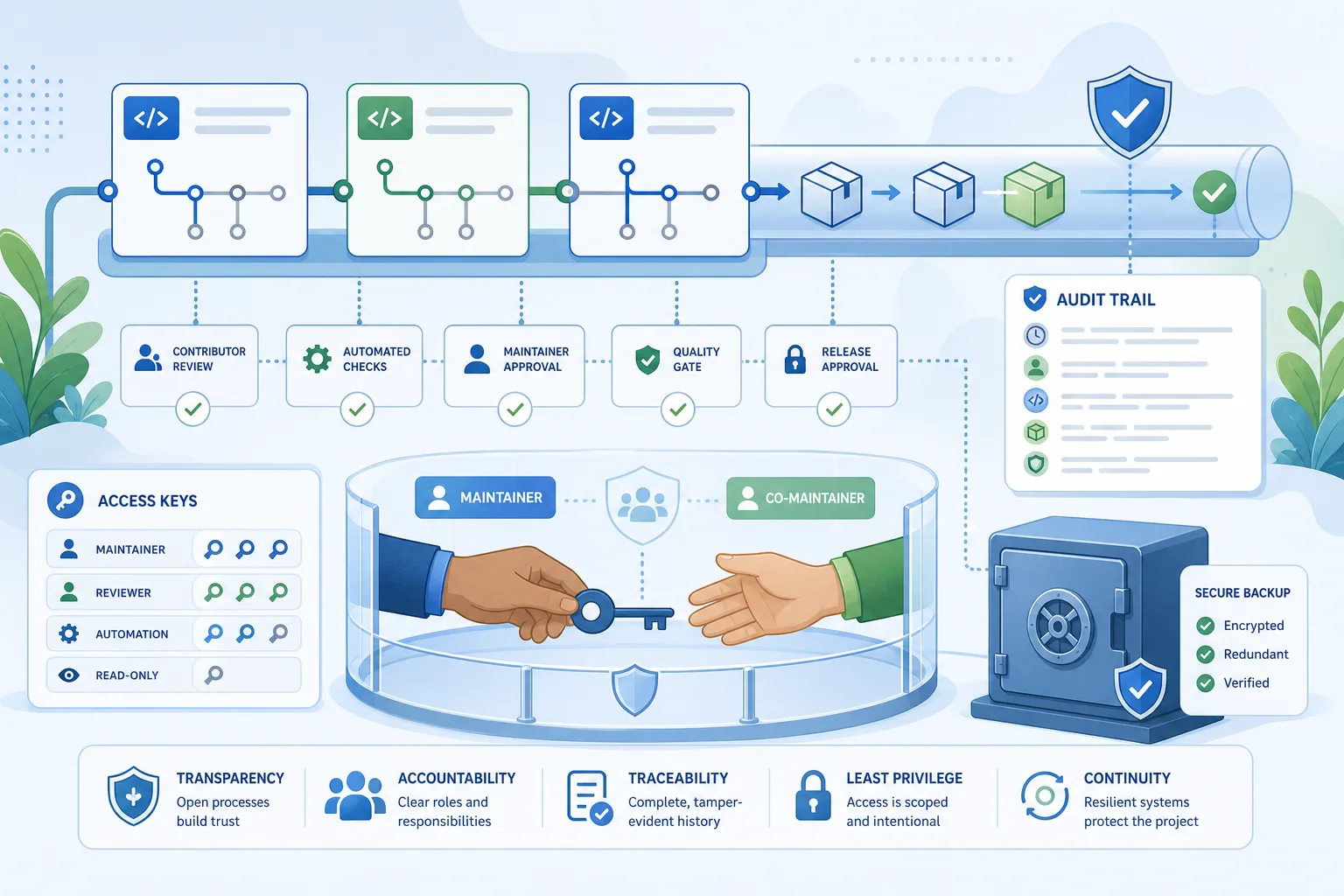
Start with least privilege. Give people the access needed for the task, not the access that is convenient for every future task. If someone is mirroring repositories, they may not need delete rights on the canonical organization.
Put expiry dates on temporary access. A calendar reminder is not security architecture, but it is better than "we will remember." For high-risk permissions, make expiry automatic where the platform allows it.
Use two-person review for destructive actions. Repository deletion, package obsoletes, signing-key changes, release-channel changes and CI secret rotation should not be one-click solo operations.
Protect the package pipeline. Branch protection is good, but package publishing is its own control plane. A project can have clean Git history and still be vulnerable if one account can publish a damaging package.
Keep backups outside the platform being administered. If an account can delete both the repo and the only backup, the backup is theatre. Restoration drills matter too. A backup nobody has tested is a comforting rumor.
Separate keys and roles. Maintainers who can merge code should not automatically control signing keys, package repositories, DNS, hosting, chat administration and mirrors.
Write offboarding down. When someone leaves, especially after conflict, remove GitHub teams, package permissions, CI tokens, deploy keys, registry credentials, mirror access and chat admin rights. Do it as a checklist, not as a mood.
Preserve an audit trail. Logs should answer who changed what, from which account, and when. They should not vanish when a private mirror, private server or personal account goes away.
A user and company checklist
For users, the lesson is not "avoid small open source projects." That would be lazy and wrong. Small projects build useful software all the time.
The better question is what kind of governance the project shows when something goes wrong. Does it publish incidents quickly? Does it distinguish stable users from development branch users? Does it explain recovery? Does it audit access? Does it avoid pretending that nothing happened?
For companies, stars and release cadence are not enough. Ask how critical dependencies are maintained. Is there a bus factor problem? Are releases signed? Are package repositories mirrored internally? Can you pin versions during an incident? Do you know which dependencies come from one-person or very small projects?
The OpenMandriva forum post was messy because real incidents are messy. It was also transparent. That counts. Silence is easier, but it leaves users guessing.
The wider pattern
The open source world has already seen protestware, maintainer burnout, dependency hijacking, social engineering and the xz Utils backdoor attempt. These cases are not identical. They should not be flattened into one morality tale.
The shared lesson is narrower: trust must be engineered. Human trust starts projects. Operational trust keeps users safe when humans disagree, disappear or make mistakes.
OpenMandriva's incident is a reminder that open source infrastructure is infrastructure. The interesting question is not whether one person was good or bad. The interesting question is whether a project can keep publishing safely when a trusted relationship breaks.
That is what is worth trying after this story: not a new tool, but a boring review. List your admins. List your package publishers. List your signing keys. List your backups. Then remove everything that exists only because nobody cleaned it up.
Comments
Sign in to comment.
No comments yet.