Semgrep 1.179.0 adds Bun lockfile support and fixes Python 3.14 parsing
Semgrep 1.179.0 is a practical dependency-scanning release: it understands Bun’s text lockfiles, handles more Python 3.14 exception syntax, and updates PyJWT compatibility. The useful question is where the new coverage fits—and where it still stops.

Semgrep 1.179.0 is a small release with a clear audience: teams that use Bun, Python 3.14, or both, and want their security checks to understand the code and dependency metadata they actually keep in the repository. The release landed on October 1, 2026, and the corresponding package appeared on PyPI on October 2. Its headline change is support for Bun’s text-format bun.lock files in Semgrep Supply Chain. The same release also improves parsing for Python 3.14 exception syntax, fixes a Dockerfile parsing case, and loosens Semgrep’s PyJWT requirement so installations can use newer compatible versions.
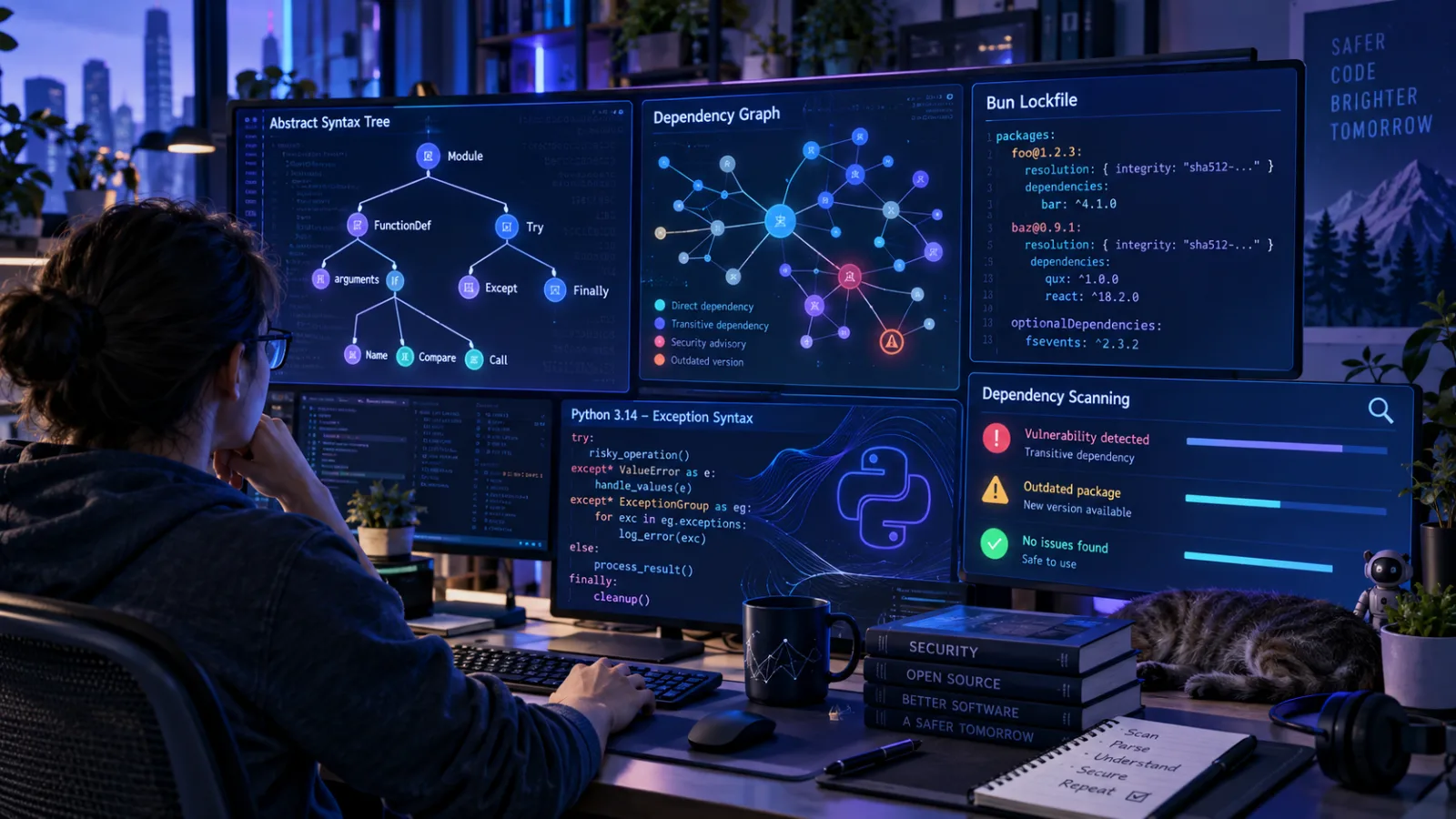
That is not a dramatic rewrite of the scanner. It is more useful than that for maintainers: a set of ecosystem-boundary fixes that determine whether a security tool can see the project in front of it. A dependency scanner that ignores the lockfile format your package manager writes is not merely missing a feature on a checklist. It is producing an incomplete model of the application.
What changed in Semgrep 1.179.0
The release notes describe one new Supply Chain capability and several parser and packaging changes. The dependency feature is the most consequential for new users. Semgrep now parses Bun bun.lock lockfiles in the text format, identified by lockfileVersion 1, when they are paired with a package.json manifest. It also reads the relationships between packages rather than treating the lockfile as an opaque file. The older binary bun.lockb format remains unsupported.
That distinction matters because Bun projects can contain both a manifest and a lockfile, but those files do different jobs. package.json records the ranges or direct dependencies the project declares. The lockfile records the concrete resolution chosen for an installation, including transitive relationships. A scanner that reads only the manifest can identify a broad dependency request while missing the exact graph that the build will install. The new support is aimed at the second problem.
The release also stabilizes file-processing order in inter-file analysis for Semgrep Pro. The notes call the previous order arbitrary but deterministic and say that the change is believed very unlikely to affect findings, while acknowledging a theoretical path in rare cases. That wording is worth taking seriously. Stable ordering can make results easier to compare between runs, but changing an analysis implementation can still expose differences in edge cases. Teams with baselined findings should compare results after upgrading instead of assuming that every identifier and output line will remain identical.
Several grammar updates are bundled as well. The C grammar moves to version 0.24.2 without verified user-facing improvements in the release assessment. The C++ grammar update adds support for more modern and less common constructs, including attributes on namespace definitions, reference typedef declarators, C++20 lambda pack init-captures, some GNU inline-assembly output operands, composite type arguments in alignas, and single-digit hexadecimal escapes. HTML is updated to version 0.23.2. The R grammar gains support for more help expressions, exponentiation, quoted namespace and slot names, additional literal forms, preserved newlines in strings, omitted argument positions, and better subscript representation.
The Python fix is especially relevant to teams moving to Python 3.14. Semgrep now parses except A, B: and except A, B, C: as tuples of exception types under the newer syntax described by PEP 758, instead of interpreting the form as Python 2-style exception binding or rejecting it. The except* variants receive the same treatment, and exception groups no longer depend on the fallback parser when the primary parser can handle them. There is still a limitation: the vendored tree-sitter Python grammar accepts only a single comma, so the three-type form can still fail if parsing reaches that fallback. The main parser runs first, but the release notes explicitly describe the grammar upgrade as follow-up work rather than a completely closed case.
Semgrep also fixes Dockerfile parsing for environment-expanded EXPOSE ports that include TCP or UDP protocols. Finally, the package now permits pyjwt[crypto]>=2.15.0,<3 instead of pinning to the ~=2.13.0 series. The change allows installations to pick up a newer PyJWT release with fixes for known vulnerabilities and helps projects that already require a newer compatible PyJWT version.
Why Bun lockfiles are the real story
Bun has become attractive to JavaScript and TypeScript teams because it combines a runtime, package manager, test runner, and bundler around a fast developer workflow. That convenience also makes the lockfile a particularly important security input. If the repository is built with Bun, the resolved dependency graph is represented in Bun’s own format. The scanner has to parse that format or ask the project to maintain a second, potentially divergent representation for security tooling.
Semgrep 1.179.0 addresses the text lockfile used by current Bun workflows, not every historical artifact. The release notes are precise about bun.lock, lockfileVersion 1, and the paired package.json; they also say that the deprecated binary bun.lockb remains unsupported. This is a good example of why a version number alone is not enough when evaluating a security release. “Bun support” does not mean every Bun repository will produce the same result. The format, file names, and project layout still matter.
The practical benefit is better dependency attribution. A direct dependency such as a web framework can pull in dozens or hundreds of packages. A vulnerability report is more useful when the scanner can connect the vulnerable package to the lockfile relationship that brought it into the build. It can then help a maintainer decide whether the issue is direct, transitive, reachable through the application’s chosen resolution, or merely present in a file that is not used by the relevant build. Semgrep’s new parser does not make that judgment automatically in every project, but it supplies the graph data required for a meaningful one.
There is also a maintenance benefit. Before native support, a team might have been tempted to convert Bun’s lockfile, run a second package-manager command, or rely on a service that understands a different project description. Each workaround creates another place for version drift. A scanner that reads the project’s real lockfile reduces that mismatch. It does not remove the need to inspect findings, but it makes the scan closer to the build engineers are trying to protect.
What to test before enabling it in CI
The safest way to evaluate the release is to treat it as a data-quality upgrade first and a policy change second. Run 1.179.0 against a representative Bun repository with its existing package.json and bun.lock. Keep the old scanner output. Then compare the dependency inventory, newly reported packages, finding paths, and exit status. A larger result set is not automatically a regression; it may simply mean that the scanner can now see transitive relationships that were previously invisible.
Use a repository that includes development dependencies, optional dependencies, workspace packages, and at least one known transitive dependency. If your organization has a monorepo, include the actual directory from which the scan runs. The release notes establish the supported lockfile and manifest pairing, but they do not promise that every workspace convention or generated lockfile arrangement will be interpreted identically. That is the part a project-level test must establish.
A useful test should include a deliberately controlled dependency change. Update or downgrade one package in a branch, regenerate the lockfile with the project’s normal Bun command, and check whether the scanner’s dependency graph changes in the expected place. Then remove the change and confirm that the original inventory returns. This catches a more important class of failure than a successful command: a scan that exits cleanly but reads the wrong file or attributes the graph incorrectly.
Do the same with a known vulnerable package only in a test branch. Confirm that the finding appears when the package is present in the resolved graph and disappears or changes attribution when it is removed. Do not use a production incident as the first validation of a new lockfile parser.
For Python projects, the upgrade test should be separate. Run Semgrep over code that uses the new exception syntax, exception groups, and ordinary older syntax. The release notes say the primary Python parser handles the new forms, but they also document the tree-sitter fallback limitation for multiple comma-separated exception types. That means a successful scan on one file does not prove that every parser path behaves the same way. Include files that force the relevant language-detection and parser behavior, and keep the results for comparison.
The PyJWT change deserves an installation test rather than a code-analysis test. Create a clean environment using the Python versions your build supports, install Semgrep 1.179.0 alongside the project’s declared dependencies, and verify that the resolver selects a compatible PyJWT version. This is particularly important when a repository has a lockfile of its own or uses constraints that were written around the older Semgrep requirement. The new range is more permissive; permissive is helpful, but it can expose a resolver combination that did not exist under the previous pin.
The release is useful, but it is not a complete security boundary
Semgrep’s repository describes the project as lightweight static analysis that matches patterns resembling source code. That is a useful model for deciding where it belongs. Semgrep can be excellent at finding known code shapes, enforcing local rules, checking configuration, and identifying dependency issues when the relevant package metadata is available. It should not be treated as proof that an application is secure.
The project’s own documentation warns that Semgrep Community Edition can miss true positives in security contexts because it analyzes code within the boundaries of a single function or file. That limitation is central, not incidental. A vulnerability that depends on authentication state crossing several modules, a value moving through a framework abstraction, or a business rule being applied in the wrong order may not match the kind of local pattern a lightweight scanner can see. Inter-file analysis and commercial features can change coverage, but they do not turn a pattern-based tool into a universal verifier.
The Bun support has a parallel boundary. Parsing a lockfile makes dependency information available; it does not establish whether a vulnerable package is reachable at runtime, whether a vulnerable code path is exercised, or whether a package is isolated behind a build-only boundary. Those questions require project context, runtime testing, dependency review, and sometimes manual investigation. The new parser should reduce blind spots in inventory, not become a reason to waive other controls.
There is also a distinction between the open-source repository and the broader Semgrep product. The public semgrep/semgrep repository contains the engine and command-line tooling, while parts of the company’s hosted platform and Pro capabilities are separate. The 1.179.0 release notes label the stabilized inter-file processing change as Pro, and the repository documentation describes limitations in Community Edition. Teams choosing Semgrep should map the desired workflow to the edition and license terms they will actually use. “The scanner is open source” is not the same as “every feature in the product is available under the same license.”
The repository’s license file and the package metadata should be read together with the feature documentation. PyPI lists the semgrep package as LGPL-2.1-or-later, while projects can contain multiple components, rulesets, integrations, and services with their own terms. A compliance review should therefore cover the exact package, rules, CI action, container image, and any hosted service involved in deployment.
How it compares with adjacent tools
Semgrep 1.179.0 is a sensible candidate for teams that want one readable rule language across several programming languages and configuration formats. Its strength is the ability to express structural patterns without writing a full compiler or relying only on text search. A rule can describe a code shape, bind metavariables, and report a finding with a message that is understandable in a pull request. That makes it approachable for application teams that want to encode internal conventions as well as security checks.
CodeQL is the better comparison when the central requirement is deeper semantic and data-flow analysis across a supported language. It uses a query model and language databases that can answer questions about relationships across a codebase. The trade-off is a heavier setup and a different learning curve. The choice is not necessarily exclusive: a project can use Semgrep for fast feedback and custom local rules while using CodeQL for a separate class of cross-file analysis.
Tree-sitter-based tools and language-specific linters occupy another neighboring space. They may offer fast syntax-aware checks or excellent framework knowledge for one language. Semgrep’s appeal is breadth and a common rule style, while a specialist tool may provide more precise diagnostics for its target ecosystem. For JavaScript and TypeScript dependency work, native package-manager auditing and lockfile-aware scanners remain relevant even when Semgrep is also present. For containers and infrastructure, image scanners, secret scanners, and configuration validators cover different inputs.
Opengrep is another relevant alternative for teams that prioritize an open-source code-security engine and want to investigate the ecosystem around a Semgrep-compatible approach. Its existence is a reminder that tool selection includes governance and licensing, not just detection quality. Compatibility claims, rule coverage, maintenance activity, and the operational cost of migrating configurations all need to be tested rather than inferred from a project name.
The best comparison is therefore not a feature-count table. It is a sample of the repository you need to protect. Give each candidate the same code, dependency graph, generated files, language versions, and CI constraints. Measure findings that a human reviewer agrees are actionable, the time needed to triage them, the number of false positives that block work, and the effort required to keep rules current. A tool that finds more patterns but creates an unmaintainable queue may be less useful than a narrower scanner whose findings teams actually review.
Who should try the upgrade now
Bun users are the clearest audience. If a repository has bun.lock in the text format described by the release, upgrading in a branch and comparing the dependency inventory is worthwhile. This is especially true for projects that previously had to exclude Bun lockfiles, maintain a parallel manifest, or accept that the scanner did not know the resolved transitive graph.
Python teams testing Python 3.14 should also try it, but they should focus on parser coverage rather than expecting a security revolution. The new exception handling fixes remove a concrete source of parse errors and misinterpretation. Projects with ordinary Python syntax may see no meaningful difference in their findings. Projects using the new forms can see a difference because the scanner can now analyze files it previously rejected or interpreted incorrectly.
Maintainers with Dockerfiles that use environment-expanded EXPOSE declarations can include the release in their normal validation cycle. So can teams whose dependency resolver is blocked by Semgrep’s previous PyJWT constraint. These are narrow cases, but narrow fixes are often the ones that determine whether a tool fits a real build.
Teams already running Semgrep successfully do not need to turn the release into an emergency production migration. Pin the version in a test job, compare outputs, and promote it when the results and installation behavior are understood. Security tooling is part of the build’s trust chain; reproducibility matters more than being first to install a point release.
Who should wait
A team with only bun.lockb, with an unusual generated lockfile pipeline, or with a monorepo that produces several manifests should wait until its own fixture passes. The release explicitly leaves the binary lockfile unsupported. A wrapper that renames or transforms files may make a scan appear to work while changing the data Semgrep sees. That is a poor foundation for a policy gate.
Organizations that rely on exact finding baselines should also schedule a review. The release changes grammar behavior and stabilizes processing order in one analysis mode. Even if the maintainers expect little effect, a baseline is an operational contract. Re-run the baseline, inspect new and disappeared findings, and record why any difference is accepted.
Finally, a project that needs whole-program reasoning should not use this release as an excuse to remove a deeper analysis tool. Semgrep can add valuable coverage and fast feedback, but its documented limitations remain. Use it as one layer in a security program whose other layers match the application’s risk.
A practical upgrade checklist
- Pin Semgrep 1.179.0 in a disposable or branch-based CI job.
- Confirm the project contains the supported text-format
bun.lockand a matchingpackage.jsonbefore expecting Bun dependency results. - Save the previous dependency inventory and finding output.
- Compare direct and transitive dependency attribution, finding identifiers, paths, and exit codes.
- Test a controlled Bun dependency change and verify that the graph changes where expected.
- Run Python 3.14 syntax fixtures, including
except*and the new comma-separated exception forms. - Test installation with the project’s actual Python versions, constraints, and lockfiles after the PyJWT range change.
- Review the license and edition of every Semgrep component used in CI.
- Keep deeper data-flow, dependency, secret, container, and runtime checks where the project requires them.
- Promote the version only after the result differences have an owner and an explanation.
The central advice is simple: try Semgrep 1.179.0 if your repository sits on one of the boundaries this release repairs, especially Bun dependency metadata or Python 3.14 parsing. For everyone else, it is a routine maintenance release with a few useful grammar and packaging improvements. Its value is not that it promises to find everything. Its value is that a scanner is more trustworthy when it can read the files your build actually uses, explain the limits of what it saw, and remain predictable enough for maintainers to review the result.
Related articles
Codex Security is open source, but maintainers should read the small print
OpenAI’s new security CLI looks useful for OSS review, but the first public day exposed access, cost, guardrail and package-name lessons.
Codex Security стал open source, но maintainers стоит читать мелкий шрифт
Новый security CLI от OpenAI полезен для OSS review, но первый день показал проблемы доступа, стоимости, guardrails и package naming.
Codex Security es open source, pero los maintainers deben leer la letra pequeña
El nuevo CLI de seguridad de OpenAI puede ayudar en OSS, pero el primer día dejó lecciones sobre acceso, coste y package naming.
Codex Security est open source, mais les maintainers doivent lire les détails
Le nouveau CLI sécurité d’OpenAI peut aider l’OSS, mais son premier jour a révélé accès, coût, guardrails et package naming.
Comments
Sign in to comment.
No comments yet.