Cooling Mats, Gel Packs and Pets: The New Household Hazard Owners Need to Check
A new ASPCA warning links some hydrogel cooling products with severe illness after pets chew or swallow the gel. Here is how to inspect mats and packs, reduce exposure, and recognize when a veterinarian is needed.

A cooling mat is easy to treat as harmless household furniture. It sits on the floor, feels useful in warm weather, and may be sold with words such as nontoxic, medical grade, or pet safe. But a warning published by the ASPCA in October 2026 describes a different risk: some cooling pads, reusable hot-and-cold packs, migraine caps, eye masks, and therapeutic wraps contain hydrogel materials that can be dangerous if a dog or cat chews through the outer layer and swallows the contents.
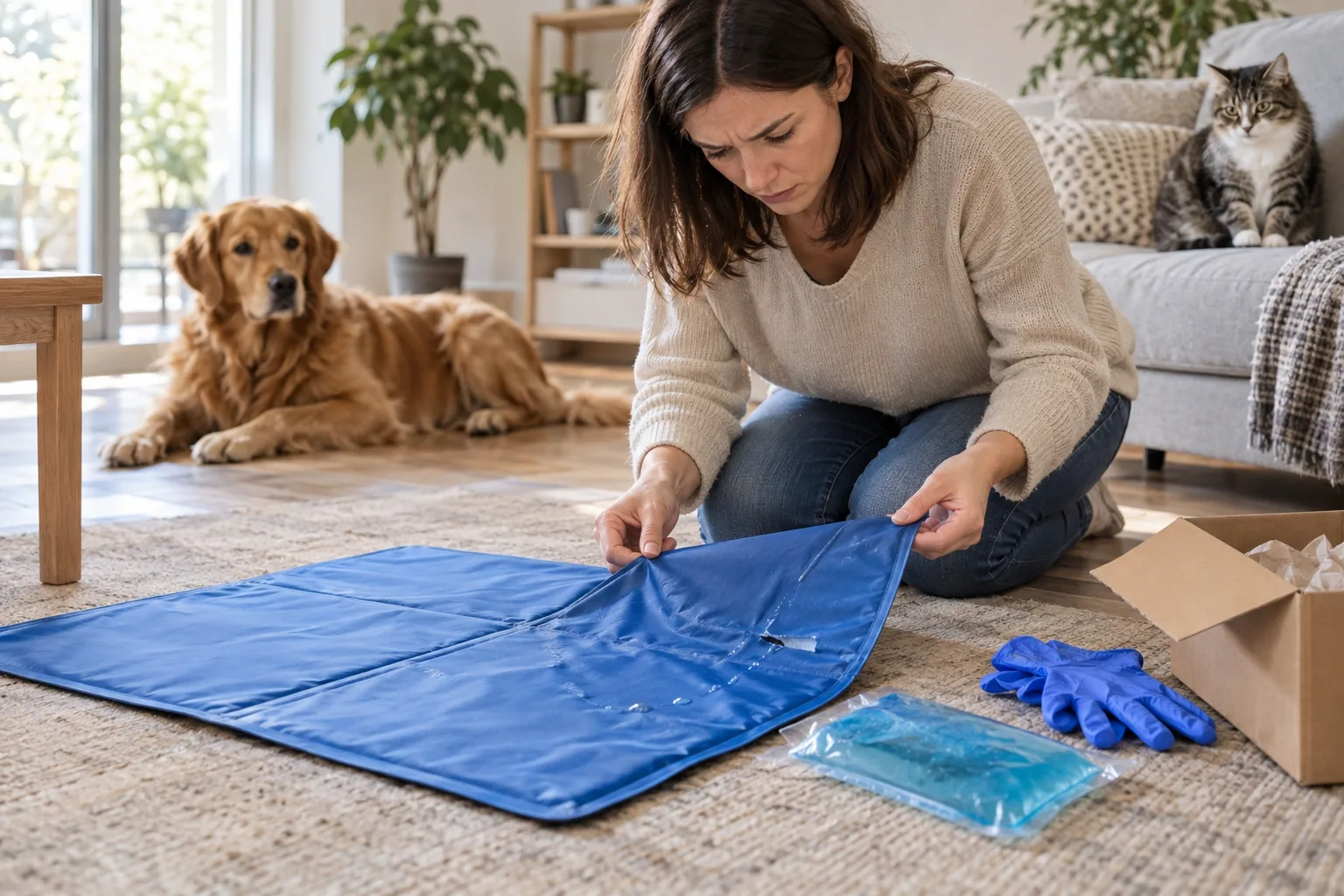
The warning is about ingestion, not ordinary contact with an intact product. A pet resting on an undamaged mat is not in the same situation as a pet that has punctured it, licked leaked gel, or swallowed pieces of the product. The practical message for owners is simple: inspect cooling products, prevent chewing, and treat a damaged mat as a possible poisoning and foreign-body hazard rather than as a minor household spill.
The ASPCA says its Poison Control investigations have involved severe signs after exposure to some polyacrylamide-based hydrogels. Reported signs include vomiting, tremors, unsteadiness, unusual sensitivity to sound or touch, low blood pressure, increased heart rate, seizures, and death. The organization also notes that some gel beads can expand after swallowing, creating a separate risk of blockage. These reports do not mean that every cooling mat contains the same substance or presents the same level of danger. They do mean that a reassuring label is not enough to decide what to do after a pet has eaten the contents.
Why this warning matters now
The products involved are ordinary objects that can be scattered across a home. A dog may find a cooling pad in a crate, a cold pack in a lunch bag, or a headache wrap in a bedside drawer. A cat may puncture a soft product while kneading it or investigate leaking gel with its mouth. The risk is easy to miss because the item may not resemble a chemical product. It looks like bedding, first-aid equipment, or a reusable comfort accessory.
The ASPCA warning follows a report involving 45 dogs with suspected acrylamide toxicosis after exposure to consumer hydrogel products. Researchers and veterinary toxicologists analyzed gel from associated products and found high concentrations of residual acrylamide in the samples they examined. Acrylamide is used to manufacture polyacrylamide. The concern is not that the polymer and the residual monomer are interchangeable, but that manufacturing residue can matter when a product is swallowed.
This is an emerging safety issue, so owners should avoid turning it into a blanket claim about every gel product on the market. The evidence describes particular exposures and tested products, not a universal finding that all cooling beds are poisonous. At the same time, the absence of a recall or a prominent warning on a package does not make a chewed product safe. Pet owners do not usually have the information or testing needed to identify the contents of leaked gel at home.
Start with an inspection of the products already in your home
Look at every cooling product your pet can reach, including items bought for people. Check the seams, corners, valves, zippers, and the surface underneath the mat. A small puncture may be hidden by a blanket or may only leak when the product is compressed. Look for wet patches, sticky residue, a chemical smell, missing material, bite marks, or fragments of an outer cover. Check whether a cold pack has been left inside an open lunch bag or whether a headache wrap is stored in a low drawer.
Do not rely on the product name alone. A cooling mat, cold pack, hydrogel eye mask, water bead toy, and therapeutic wrap may use different formulations. The phrase nontoxic usually describes a claim made for the intended use of the product; it does not answer the more specific question of what happens if a particular animal chews through it and ingests the gel. Packaging can also change between batches or sellers.
If you find damage, move children and animals away from the area. Prevent licking while you gather the packaging and identify the product. The ASPCA advises using nitrile gloves when handling leaked hydrogel because acrylamide can be absorbed through oral, skin, and inhalation exposure routes. Owners should follow the product label and veterinary or poison-control guidance rather than trying to improvise a cleaning or decontamination procedure.
Keep the package, ingredient panel, lot information, photographs, and any remaining product. Do not throw everything away immediately if a veterinarian or poison-control professional may need to identify it. Seal damaged material away from pets and people according to professional advice. If the gel has spread over bedding, flooring, fur, or paws, ask a veterinary professional what to do before attempting extensive washing or other treatment.
Supervision is more important than the marketing category
A cooling mat should be treated like any other product with a soft cover and an interesting interior. Some dogs will use it quietly for years. Others will test a corner once, especially when bored, anxious, teething, or left alone. The owner’s decision should be based on the individual animal’s behavior, not simply on whether the product was sold for pets.
Supervise the first sessions. Watch whether the dog paws at the surface, bites the edges, carries the mat, digs at it, or becomes frustrated when it does not move. A pet that repeatedly chews bedding, toys, blankets, or crate liners is a poor candidate for unsupervised access to a gel-filled mat. Remove the product when no one is available to notice damage. For cats, pay attention to kneading, clawing, and repeated licking of the cover.
The safest alternative for a determined chewer may be a cooling method with no liquid or gel inside, such as access to shade, a cool indoor room, fresh water, and a solid resting surface. That does not replace veterinary advice for a pet that is overheating or unwell. It simply removes one possible ingestion route. Owners should also avoid placing an untested product in a crate where a dog cannot move away from it or where a puncture might go unnoticed for hours.
No cooling product should be used as a substitute for recognizing heat stress. Heavy panting, weakness, collapse, breathing difficulty, confusion, vomiting, or a sudden change in coordination requires prompt veterinary attention. Cooling products can be useful comfort items, but they are not a treatment plan for a pet that is struggling in the heat.
What to do if the mat or pack has been chewed
If you know or suspect that a pet has swallowed gel, pieces of the cover, or gel beads, contact a veterinarian promptly. The ASPCA warning specifically recommends contacting a veterinarian or ASPCA Poison Control after a pet has chewed, punctured, or ingested the contents of a cold pack, hot pack, cooling mat, therapeutic wrap, hydrogel product, or gel-bead item. In the United States, the ASPCA Poison Control number listed in its warning is 888-426-4435.
Have the product and its packaging available when you call. Useful details include the animal’s species, approximate age and size, the product name, how much appears to be missing, when the exposure may have happened, and whether the animal has vomited or developed any unusual signs. Do not wait for a package label to confirm that the material is dangerous. Do not induce vomiting or give home remedies unless a veterinarian or poison-control professional specifically instructs you to do so.
If the pet is already showing tremors, wobbliness, unusual sensitivity, seizures, collapse, breathing trouble, repeated vomiting, marked weakness, or a sudden change in behavior, seek emergency veterinary care immediately. These signs can have many possible causes, and an owner cannot determine from appearance whether the cause is gel exposure, a foreign body, heat illness, another toxin, or a medical problem. The important fact for the veterinary team is that a damaged cooling product may have been involved.
A damaged product also creates a physical obstruction risk. A pet may swallow a piece of plastic, fabric, foam, or a packet as well as the gel. Some hydrogels or beads may expand after swallowing. That is why a pet that appears normal immediately after the incident should still be discussed with a veterinary professional. The absence of immediate symptoms does not prove that nothing was swallowed.
Why symptoms can be confused with other problems
Vomiting after a warm day may be blamed on food, travel, or exercise. Tremors may be mistaken for fear. Unsteadiness may look like fatigue. A cat that hides after an incident may be assumed to be annoyed by a bath or startled by noise. Those interpretations can delay useful information reaching a veterinarian.
The ASPCA materials describe a combination of gastrointestinal and neurological signs in suspected acrylamide exposures. That pattern is not a diagnosis for an individual pet. It is a reason to mention cooling products when a pet becomes ill after a puncture or unexplained leak. Veterinary teams often need a complete exposure history because several household products can look similar and ingredient lists may be incomplete or unfamiliar.
The same caution applies to cats. Many warnings about cooling mats are discussed in the context of dogs because dogs are more likely to chew and swallow large amounts of household objects, but cats can also be exposed. A cat may lick residue from its paws, puncture a product with claws, or swallow a small piece of cover. Species, body size, health history, and the product formulation all affect risk, so owners should not estimate safety from a dog’s experience or from a small amount missing from the product.
A practical home safety routine
Make a short inventory of cooling products before the next hot spell. Include pet mats, reusable ice packs, first-aid packs, migraine caps, eye masks, gel-filled wraps, water beads, and any product stored in a child’s room or home office. Record where each item is kept and whether it is accessible to a pet. Replace cracked, brittle, swollen, or damaged products rather than passing them to another household.
Store intact products behind a closed door or in a container that a pet cannot open. A high shelf is not always enough for a determined dog, and a drawer is not secure if the animal can pull it out. Keep lunch bags, backpacks, and first-aid kits closed. Remind visitors not to leave cold packs, medication wraps, or cooling accessories on the floor.
If your pet has a history of chewing, use environmental management first. Close the door to rooms containing human cooling products. Provide safe enrichment that matches the animal’s chewing style. Keep an eye on bedding and soft toys for damage. Avoid assuming that a product is safe simply because the manufacturer advertises it for animals. A pet product is still a product that must be inspected and matched to the individual animal.
If a household regularly uses cooling mats, add an inspection to the cleaning routine. Check the cover before each use, wash the exterior as directed, and remove the item when the pet is alone if there is any chewing history. Do not cover a damaged mat with another blanket and continue using it. The cover can hide a leak and make a small problem harder to see.
What the warning does not establish
The ASPCA warning does not establish that every cooling mat is contaminated with acrylamide. It does not say that resting on an intact mat causes poisoning. It does not replace a product-specific recall notice, and it does not provide a simple ingredient word that owners can use to approve or reject every product.
The useful conclusion is narrower and more practical. Products containing gels, beads, or hydrogels deserve more careful storage and supervision than their soft, domestic appearance suggests. When a product is punctured, the contents should be treated as unknown until a veterinarian or poison-control professional helps assess the risk. This is the same kind of ordinary household caution owners already use for medicines, cleaners, rodent bait, and damaged electrical cords.
It is also worth separating online anecdotes from verified evidence. A social-media post may correctly report that a pet became ill, but it may not identify the product, the formulation, the quantity swallowed, or other exposures. Conversely, the fact that a product has not appeared in a viral warning does not confirm that it is safe after ingestion. The ASPCA materials provide a reason to act cautiously while product testing, reporting, and regulatory review continue.
Questions to ask before buying a cooling product
Before buying a new mat or pack, ask how the product is constructed, whether the cover is replaceable, what happens if it is punctured, and whether the manufacturer provides a complete ingredient or material description. Consider whether your pet has the temperament to use it without chewing. Read instructions about supervision and discard the product if the cover is damaged.
Be especially cautious with products that contain loose beads or a liquid center and products that can be opened by a bite or claw. A product may still be suitable for a calm adult animal under supervision, while being unsuitable for a puppy, kitten, persistent chewer, or pet that is left alone for long periods. The right question is not whether the item is popular. It is whether the risk of access is controlled in your particular home.
If the manufacturer uses a broad safety claim but offers little information about the contents, treat that as a reason to seek clarification, not as proof of danger. Keep a screenshot or photograph of the product page and package. Product names and listings can change, and the information may help a veterinarian identify the item if an exposure occurs later.
The owner’s checklist
- Inspect every cooling mat and gel pack for punctures, leaks, missing pieces, and damaged seams.
- Store human and pet cooling products where dogs and cats cannot reach them.
- Supervise a new mat and remove it if the pet paws, bites, digs, or repeatedly licks it.
- Use nitrile gloves when handling leaked hydrogel, and keep the packaging for identification.
- Contact a veterinarian or poison-control service after suspected ingestion, even if the pet seems normal.
- Seek immediate veterinary help for tremors, wobbliness, seizures, collapse, breathing trouble, repeated vomiting, or sudden severe behavior changes.
- Do not induce vomiting or give medication or home treatment unless a veterinary professional instructs you.
The new warning is a reminder that pet safety often depends less on a product’s intended use than on what happens when an animal interacts with it in an unexpected way. An intact cooling mat may be an ordinary comfort accessory. A punctured mat is an unknown exposure, a possible foreign body, and a reason to call for professional guidance. That distinction is small, but making it quickly can protect both pets and the people cleaning up after them.
Related articles
Too hot for the usual dog walk? Paw protection, cooling products and warning signs
A practical summer walk plan for ordinary dog owners: cooler timing, safer surfaces, water, cautious gear choices and the symptoms that mean calling a veterinarian.

Window Air Conditioner Smells Hot or Trips the Breaker: A Safe Recall and Maintenance Checklist
A hot smell, repeated breaker trips, or weak airflow is not a prompt to keep resetting the unit. Use this cautious checklist to identify simple maintenance issues, check recent room-AC recalls, and know when the appliance should stay unplugged until a professional handles it.

Cheap N100 and N150 mini PCs: when the marketplace bargain is real
A practical buyer check for tiny N100/N150 marketplace PCs: RAM, SSD, cooling, 2.5GbE, BIOS, power adapters and return risk.


Should you buy a portable air conditioner in 2026?
A practical verdict on when a portable AC is a smart heat-wave backup and when it is just a loud compromise.

Comments
Sign in to comment.
No comments yet.