Halloween and Pets: A Calm, Practical Safety Plan for Candy, Costumes, Doors and Decorations
Halloween changes a home in ways pets may find confusing: open doors, unfamiliar visitors, tempting food and chewable decorations. A few simple preparations can prevent poisoning, escapes and unnecessary stress without excluding animals from the evening.

Halloween is easy for people to understand and surprisingly difficult for many pets. The house fills with unfamiliar smells, the doorbell rings repeatedly, visitors wear masks or costumes, and food that is normally kept out of reach may sit on low tables or spill onto the floor. A dog may treat the entire evening as a scavenger hunt. A cat may decide that the safest place is under a bed—or may slip through an open door while everyone is distracted.
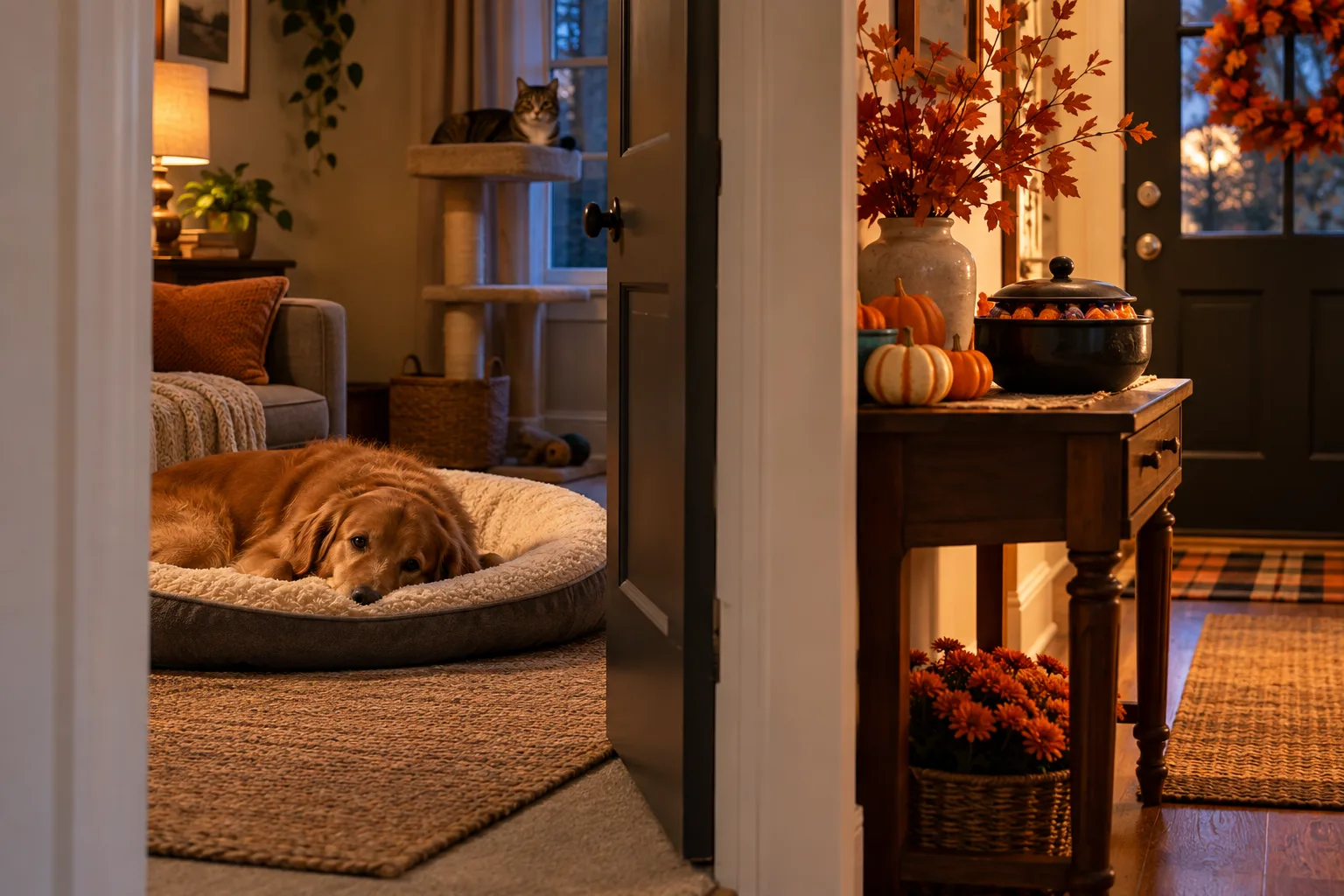
The most useful Halloween plan is not a costume plan. It is a household-safety plan built around four questions: What could the pet eat? What could frighten or injure the pet? How will the pet be kept away from the door? And what will the household do if something goes wrong? Veterinary and animal-welfare organizations repeatedly point to the same seasonal hazards: chocolate, sugar-free sweets containing xylitol, raisins, wrappers, glow products, candles, loose decorations, escape opportunities and stressful handling.
That advice is especially timely in October, when veterinary hospitals and poison-control services publish their annual reminders. The practical lesson is simple: prepare the environment before the first visitor arrives, then let the animal choose whether to participate.
Start with the food, not the costume
Halloween candy should be treated as human food that is unsafe for pets, not as an occasional reward. Chocolate contains methylxanthines, including theobromine and caffeine, which can affect a pet’s nervous system and heart. Dark chocolate, baking chocolate and cocoa-rich products generally contain more of these compounds than milk chocolate, but owners should not try to calculate safety from memory after an animal has eaten some. The product, ingredients, amount and size of the animal all matter.
Sugar-free gum, mints and sweets deserve a separate warning because some contain xylitol, also called birch sugar. Xylitol can cause a dangerous fall in blood sugar in dogs and may contribute to severe illness. Product formulas change, so read the label rather than assuming that a familiar brand is made the same way every year. Cats are less likely than dogs to seek out sweet foods, but that does not make an unattended bowl safe in a home shared by both species.
Raisins and grapes are also poor choices for sharing with dogs. Their risk is not made acceptable by calling them a natural or healthier snack. Candy wrappers, foil, plastic packaging and lollipop sticks create a different problem: they can irritate the digestive tract or contribute to an obstruction if swallowed. A bowl of sweets can therefore present several hazards at once—the ingredient, the packaging and the possibility of a frantic, large-volume meal.
The safest arrangement is to keep all candy in a closed cupboard or container that a pet cannot open. Do not rely on a kitchen counter if your dog can reach it by jumping, and do not leave a child’s trick-or-treat bag on the floor or beside a bed. Ask children to bring their candy to one designated place and to report a missing packet rather than quietly hoping the pet did not get it. A wrapper on the floor is worth picking up immediately.
If a pet may have eaten chocolate, xylitol, raisins, a large amount of candy or an unknown substance, contact a veterinarian, emergency veterinary hospital or an animal poison service promptly. Keep the package, ingredient list and any remaining material available. Do not wait for obvious symptoms before asking for guidance, and do not give home remedies or attempt to make the animal vomit unless a veterinary professional specifically tells you to do so.
Give the pet a room instead of a performance
Many pets do better when Halloween activity happens somewhere else. Frequent door openings create escape opportunities, while masks, hats, reflective clothing and sudden movement can make familiar people look threatening. Even a friendly dog may become overexcited when strangers appear at close range. A cat that normally greets visitors may retreat once the noise and movement become continuous.
Set up a quiet area before guests arrive. It might be a bedroom, office, laundry room or other secure space with a closed door. Provide familiar bedding, water, a litter box for cats, and an activity the animal already enjoys. For dogs, that may be a food puzzle or a safe chew that has been used successfully before. For cats, it may be a hiding place, a familiar scratching surface or a quiet interactive toy. The goal is not to force the pet to relax; it is to give the pet somewhere predictable to go.
A television, fan or low background audio may soften the sound of doorbells and voices, but it should not be used to mask signs of distress. Check on the pet periodically without turning the visit into another source of excitement. If the animal is hiding, pacing, vocalizing continuously, attempting to escape or refusing a normally appealing activity, reduce stimulation and leave the animal undisturbed as much as practical.
A closed room is safer than holding a nervous animal near the front door. It is also safer than asking every visitor to avoid touching the pet. People may forget, children may move quickly, and an animal that feels trapped can react in ways that are unusual for it. Separating the pet is not a punishment or a failure of socialization. It is a way to manage a high-stimulation evening.
Make an escape plan before the first doorbell
Halloween creates more door traffic than an ordinary evening. The front door may open dozens of times, and a frightened animal may move faster than anyone expects. Before the evening begins, check that doors, windows, gates and screens close securely. Confirm that the pet’s identification details are current and that collars, tags and microchip records have not been neglected. A microchip is not a tracking device, but it can improve the chance of being reunited if the animal is found.
If the pet stays in a separate room, put a note on the door so guests do not open it casually. If household members will move the pet through the home, use a leash or carrier as appropriate and close exterior doors first. Do not carry a cat through a crowded entryway without a secure carrier. Do not assume that a dog who normally waits at the threshold will do the same when a crowd, costumes and loud voices are involved.
Outdoor time also needs more planning. A walk before the busiest period can provide ordinary exercise before the streets become noisy, but it should not be treated as a guarantee that the dog will be calm later. Keep dogs supervised outdoors, use reliable equipment and watch for candy, wrappers, broken decorations and unfamiliar people. A fenced yard is not automatically secure if the pet is startled, a gate is left open or visitors can approach the fence.
Cats that normally roam outdoors are particularly vulnerable on a night when unfamiliar people, traffic and decorations change the environment. Keeping them indoors during the busiest hours reduces the chance of escape, injury or accidental contact with people who may not recognize their signals. Give an indoor cat a room or elevated hiding option rather than repeatedly bringing it out to show guests.
Costumes should be optional
A costume is safe only if the individual animal is comfortable wearing it and the garment leaves normal movement, breathing, hearing and vision unimpaired. Some pets tolerate a jacket or harness but dislike anything that covers the head, wraps around the neck or restricts the legs. Others show discomfort by freezing, scratching at the garment, trying to escape, lowering the body, panting, hiding or repeatedly licking the fabric. These are useful signals to stop, not challenges to overcome for a photograph.
If an animal is accustomed to clothing, introduce the costume well before Halloween. Let the pet inspect it, then try it for a brief period in a quiet room. Reward calm behavior with something appropriate for that animal, and remove the costume before the pet becomes frustrated. Do not wait until a party is underway to discover that a cape, hat or hood blocks a familiar sense or changes the way the animal moves.
Avoid loose ribbons, beads, buttons, bells, elastic, dangling pieces and detachable accessories. A pet may chew them, become tangled in them or swallow them. Check the fit around the neck, chest and legs, and make sure the garment does not rub the skin or interfere with a leash or harness. A costume that is too loose may catch on furniture; one that is too tight may restrict movement or breathing.
Never leave a pet unattended while wearing clothing or accessories. The animal can become caught, overheat, chew through the material or panic after a seemingly minor snag. For many pets, a plain bandana, a festive collar or no costume at all is a better choice. The animal does not need to wear a costume to be included in the family’s celebration.
Treat decorations as potential toys
Decorations are designed to attract human attention, which often makes them interesting to animals. Strings, fake spiderwebs, ribbons and dangling ornaments can become tangle or chewing hazards. Small plastic pieces may be swallowed. Electrical cords can be chewed, while batteries may cause serious injury if punctured or swallowed. Keep decorations above the pet’s reach or in rooms the pet cannot enter, and inspect them as the evening progresses.
Glow sticks and glow jewelry may look like toys. If a pet punctures one, the liquid can irritate the mouth and lead to drooling, pawing at the mouth or distress. These products should not be left where an animal can chew them, even if the package describes them as non-toxic for people. Human safety labels do not automatically mean that a product is suitable for ingestion by pets.
Candles and open flames add burn and fire risks. A curious cat can knock over a candle, while a dog’s tail can sweep through a low flame. Battery-operated lights are usually easier to place safely, but they still need to be kept away from chewing animals. Do not put a lit pumpkin, candle or electrical decoration beside a pet’s bed, food station or usual path through the room.
Pumpkins can also become a problem when pets chew the stem, candle, paint, wire or decorative attachments. Plain pumpkin flesh is different from a carved display covered in wax, paint or small objects. Keep carved pumpkins and seasonal arrangements where the animal cannot investigate them unsupervised.
Read the animal’s behavior accurately
Halloween behavior is often described as anxiety, but owners do not need to label it precisely to respond well. A dog that barks at every visitor may be overexcited, worried, protective, frustrated or simply unable to settle in the changing environment. A cat that disappears may be frightened, overstimulated or making a sensible choice to avoid contact. The immediate practical response is the same: reduce exposure, increase distance and provide a secure retreat.
Do not punish growling, hissing, barking or hiding. Those behaviors communicate that the animal is struggling with the situation. Punishment can suppress an early warning without making the underlying discomfort disappear, leaving owners with less information and the pet with fewer safe ways to create distance. Ask visitors not to chase, corner, stare at or reach toward an animal that is avoiding interaction.
A pet that appears relaxed may still need breaks. Repeatedly handling, photographing or inviting strangers to touch the animal can turn a tolerable event into an exhausting one. Let the pet approach on its own terms, and end the interaction at the first sign that the animal wants space. Children should be supervised around pets throughout the evening, including pets that are familiar with the family.
If a dog or cat has a known fear of visitors, loud sounds or clothing, plan for separation from the beginning. Halloween is not a good night for an untested behavior experiment. Owners who want to work on visitor-related fear can do so later in calmer conditions, ideally with guidance from a qualified behavior professional and with medical concerns discussed with a veterinarian.
A short preparation checklist
The day before Halloween, put candy, gum, raisins, chocolate and baking ingredients into closed storage. Check the labels of sugar-free products for xylitol or birch sugar. Move batteries, glow products, cords, ribbons and small decorations out of reach. Decide which room will be the pet’s quiet area and make sure it has water, bedding and species-appropriate enrichment.
On the day itself, confirm that identification information is current. Check gates, screens and doors. Exercise dogs at a normal time before the busiest period, but keep all outdoor activity supervised. Introduce any clothing early enough to remove it without pressure. Tell children and guests that candy is not for pets and that the animal may be staying in a separate room.
When visitors begin arriving, put the pet in the prepared area before the front door starts opening repeatedly. Use a sign on the door if needed. Keep candy bowls, trick-or-treat bags and dropped wrappers away from animals. Inspect the floor after guests leave and before releasing a pet into the main rooms.
After the evening, remove decorations, packaging and food from accessible surfaces. Watch for changes that persist beyond the event, such as continuing refusal to eat or drink, unusual hiding, repeated vomiting, diarrhea, marked lethargy, breathing difficulty, pain, injury or a sudden behavior change. These signs should not be dismissed as a Halloween hangover. Contact a veterinarian for professional advice, and seek urgent veterinary care for breathing trouble, poisoning concerns, serious injury, collapse or other severe symptoms.
What to do if something goes wrong
If candy or a decoration is missing, first secure the pet and identify what may have been eaten. Keep the original package or take a clear photograph of the ingredients. Note the approximate time, the product name and the amount that may be missing, but do not delay a call while trying to calculate a precise dose. A veterinarian or poison-control professional can decide what information matters and what action is appropriate.
Do not assume that a pet looks normal because the exposure is harmless. Some problems can develop after the initial ingestion, and early advice may be important. Conversely, do not panic based on an internet list of symptoms or try to treat the animal with household products. Online discussions can help an owner recognize that a situation deserves attention, but they cannot replace an examination or toxicology assessment.
If the pet escapes, search the immediate area calmly and ask household members to check secure rooms, garages and hiding places. Contact local shelters, animal-control services and veterinary clinics, and use current identification information. A frightened animal may hide nearby rather than respond to its name. Prevention remains easier than a search, which is why a closed quiet room and a door sign are among the most valuable Halloween preparations.
The best celebration may be deliberately boring
A pet-friendly Halloween does not require a pet to greet every visitor, wear a costume or share the family’s food. The most successful setup may look ordinary: the dog has a familiar chew behind a closed door, the cat has a quiet hiding space, the candy is stored in a cupboard, and decorations are placed where curious noses and paws cannot reach them.
That arrangement preserves the animal’s routine while allowing people to enjoy the holiday. It also makes the household’s decisions easier when the evening becomes busy. Keep the animal away from unsafe food, reduce unwanted contact, control the door and call a veterinarian promptly for poisoning, injury, breathing trouble, sudden behavior change or persistent symptoms. Those few habits cover most of the avoidable risks without turning Halloween into a stressful event for either pets or people.
Related articles

Halloween Candy in 2026: A Practical Parent Plan for Treats, Allergies and the Switch Witch
The Switch Witch is back in family conversations, but trading away a child’s Halloween haul is not the only option. Here is a calmer plan for candy, food allergies, toddlers, dental care and the social side of trick-or-treating.

AliExpress Choice Day in October 2026: How to Audit the Final Cart Price Before a Coupon Becomes a Bad Deal
Choice Day coupons are easy to notice and harder to value. This guide shows how to compare the real checkout total, test thresholds, account for shipping and tax, and decide when a sale price is worth the risk.

2026年10月 AliExpress Choice Day:优惠券变成坏交易前,如何核查购物车最终价格
Choice Day 的优惠券醒目,却不一定代表真正省钱。本文从准确规格、门槛、叠加优惠、运费、税费、替代价格和商品风险入手,帮助你判断结账总价是否真的值得。
Halloween-Süßigkeiten 2026: Ein praktischer Elternplan für Leckereien, Allergien und die Switch Witch
Die Switch Witch ist wieder Thema in vielen Familien. Doch die Halloween-Ausbeute eines Kindes muss nicht komplett eingetauscht werden. Dieser ruhigere Plan berücksichtigt Süßigkeiten, Allergien, Kleinkinder, Zahnpflege und die sozialen Seiten des Süßes-oder-Saures-Spiels.
Comments
Sign in to comment.
No comments yet.