Why Does the Internet Still Treat a Translation as a New Article?
Why do publishing platforms create a new article every time you add another language? Books and films don't become new works when they're translated. So why should articles? Maybe it's time to rethink what a publication actually is.

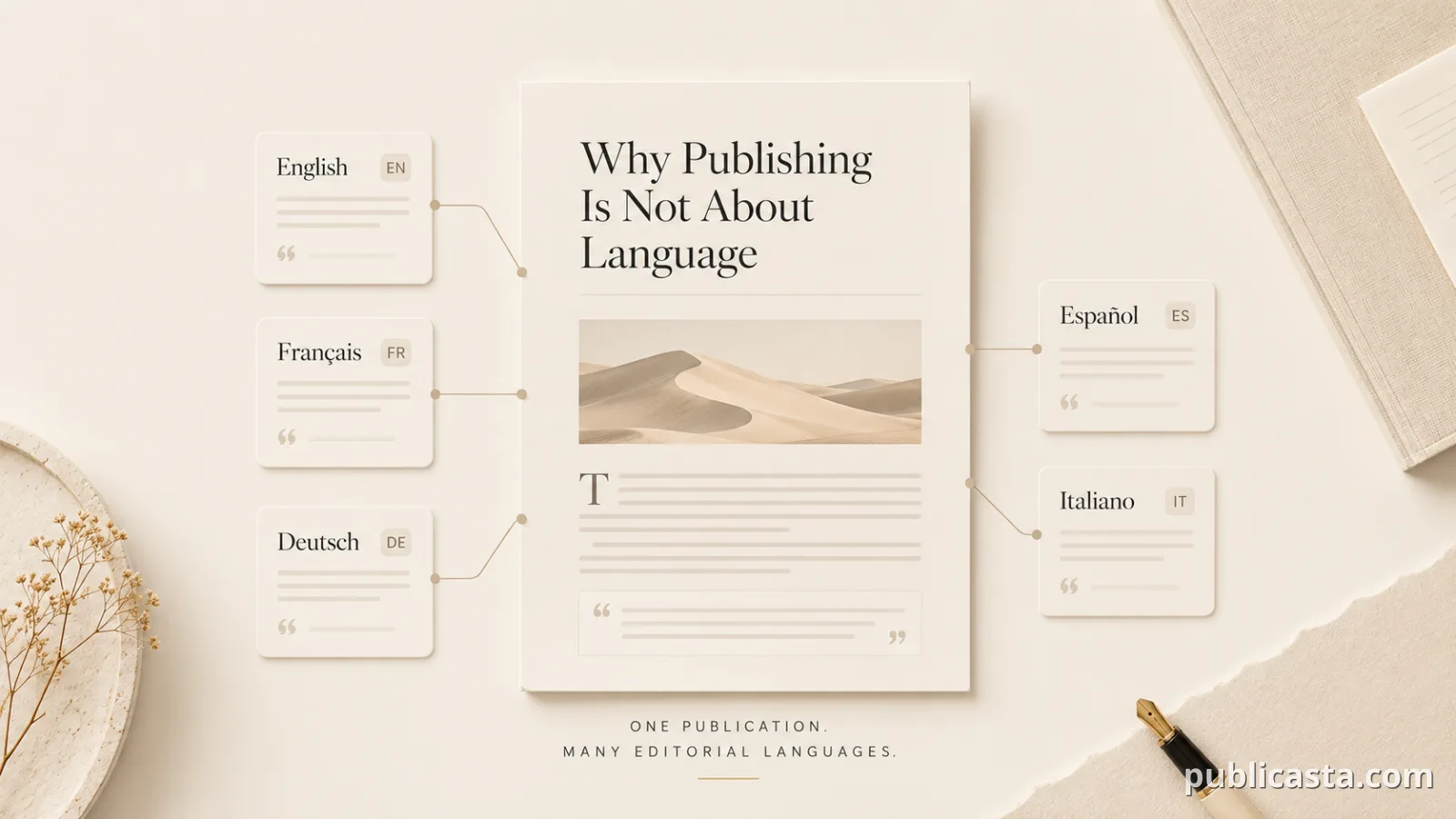
For decades we've been publishing translated articles as if each language were a completely different publication.
English article.
French article.
German article.
Spanish article.
Four URLs.
Four publication dates.
Four sets of statistics.
Four copies of what is, in essence, the same work.
But is it really four different articles?
Imagine you've written an article.
Later you prepare a French version.
You don't translate it word for word.
You replace an example with one that's more familiar to French readers.
You choose a different image.
You slightly rewrite the introduction.
Perhaps you even give it a better headline.
Has it become a new article?
Probably not.
It's still the same publication.
The same idea.
The same author.
The same story.
It simply speaks differently to a different audience.
Now imagine doing the same for Spanish readers.
Or German readers.
Or Japanese readers.
Each version may contain small editorial changes.
Different references.
Different examples.
Different wording.
That doesn't make them different publications.
It makes them different editorial versions of the same publication.
Curiously, we already understand this everywhere else.
A novel may be published in thirty languages.
No one says those are thirty different books.
A film may be released worldwide.
Nobody claims the French dub created a completely new movie.
Even when local publishers adapt titles, covers, marketing, or cultural references, we still recognise a single work behind them.
Only on the web do we suddenly behave differently.
The moment an article is translated, we often split it into independent publications.
Each language gets its own page.
Its own URL.
Its own identity.
As if language itself defined what the publication is.
But language is only one way to present an idea.
The idea exists independently of English, French, German, or Spanish.
Perhaps this made sense years ago.
Translation was expensive.
Websites usually supported only one language.
Duplicating pages was simply the easiest technical solution.
The model survived because it worked well enough.
Not because it reflected what a publication actually is.
Today the situation is different.
Publishing internationally is no longer unusual.
Authors increasingly write for global audiences.
Translations are easier to create, review, and improve.
Readers expect content in their own language.
Yet many publishing systems still force every language to become another article.
The technology has evolved.
The publishing model has not.
Maybe it's time to separate two ideas that have been treated as the same for too long.
A publication is the work itself.
A language version is simply one editorial expression of that work.
Those are not the same thing.
This is how we think about publishing.
A publication isn't defined by its language.
It's defined by its idea.
That idea can have many carefully edited language versions, each written for its own audience while remaining part of the same publication.
Because changing the language shouldn't mean creating another article.
It should simply allow more people to read the same one.
Related articles

When the cloud controls the air conditioner: the LG ThinQ smart-home lesson
A fresh LG ThinQ disruption shows why smart appliances should stay controllable when the vendor cloud slows down, blocks automation, or disappears.


Should You Buy the Samsung Galaxy S26 FE? Only at the Right Price
The Galaxy S26 FE offers a big 120Hz display, telephoto camera, wireless charging, IP68 protection, and long software support. Its familiar hardware and $699.99 starting price make the discount, storage choice, and alternatives more important than the new model number.

Should you buy Meta AI glasses now that useful features can hit a subscription meter?
Ray-Ban Meta-style AI glasses are useful for hands-free capture, but the new Conversation Focus cap and privacy-light backlash change the buying calculation.

Do Not Build the Smart Home on One Cloud Speaker
Fresh Google Home problems are a reminder to design smart homes with voice as a convenience, local logic for important routines, and physical fallback for the things people use every day.

Comments
Sign in to comment.
No comments yet.