Agility’s October Pivot: Why Humanoid Robots Now Need a Safety Architecture Around the Machine
Agility’s new defense-policy role and its expanded safety partnership with FORT Robotics point to the same practical lesson: humanoid deployment will depend as much on external controls, operating procedures, and accountability as on the robot’s learned skills.

Agility Robotics entered October with two announcements that look unrelated at first. On October 5, the company said CEO Peggy Johnson would join Project Meridian, a MITRE-led study commissioned by the U.S. Department of War to examine future warfare, logistics, and long-term capability priorities. Four days earlier, Agility and FORT Robotics announced a broader partnership to build the safety infrastructure for Digit 5, including a safety pendant, on-robot communications, and an interface to external safety systems.
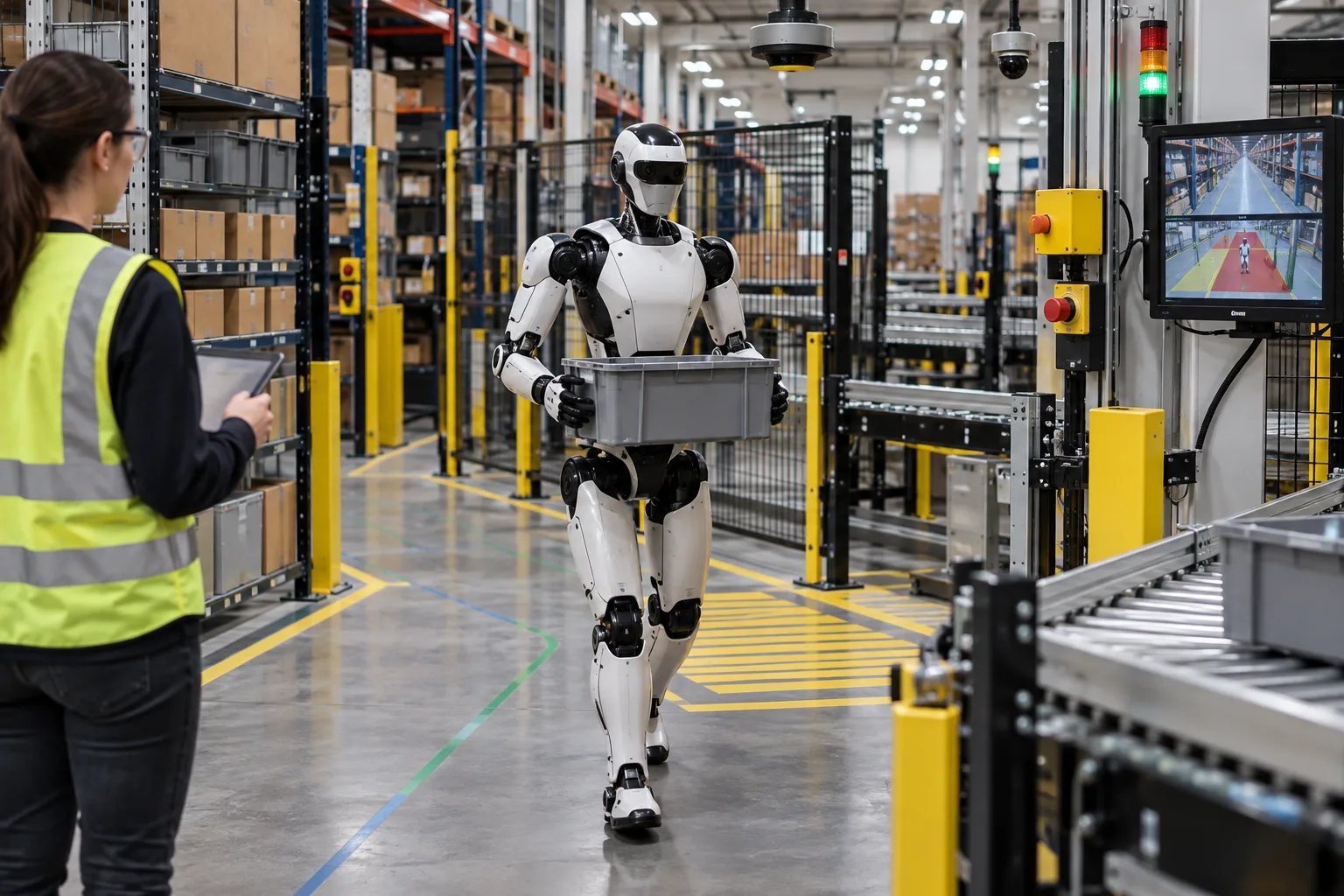
The connection is practical rather than political. Both announcements move the discussion away from whether a humanoid can perform a task in a controlled demonstration. They ask what has to surround a mobile, forceful, software-driven machine before an organization can put it into a workplace—or, eventually, a logistics environment where the consequences of a bad decision are higher.
That is a materially different problem from adding another degree of freedom to a hand or showing a robot walking through a factory. The difficult product is not only the body and the model. It is the operating envelope: who can stop the robot, what happens when sensors disagree, how a site configures safe zones, how a remote operator is brought into the loop, how an incident is reconstructed, and which party remains accountable when the system behaves outside its training distribution.
The immediate news is about infrastructure, not a new robot
Agility’s October 5 announcement says Johnson will participate in Project Meridian as an individual consultant. MITRE describes the initiative as an independent effort focused on technologies and operational concepts needed for future military operations, with recommendations intended to look 10 to 20 years ahead. Agility says Johnson will contribute experience from commercial humanoid deployments, particularly the use of robots for physically demanding and repetitive logistics work.
That announcement does not represent a military contract for Digit, a commitment to deploy humanoids in combat, or proof that humanoids are ready for defense operations. Agility explicitly separates Johnson’s consulting role from the company’s commercial operations. The useful signal is narrower: commercial robot makers are increasingly being asked to explain how their machines could fit into large operational systems, not just how they perform isolated tasks.
The more concrete development is the October 1 memorandum of understanding between Agility and FORT Robotics. According to the companies’ announcement, the partnership extends a relationship that began with a custom hardware component into a three-part architecture: a safety pendant, communications on the robot, and off-robot interfaces that connect Digit with external safety systems. The companies also expect to work together on hardware, engineering, regulatory compliance, and deployment support.
FORT describes the new off-robot component as an “Offboard Safety Bridge.” The name matters because it describes a boundary. A robot’s own perception and motion controller may recognize a person or an obstacle, but a customer may also need a separate way to impose a stop, enforce a site rule, or coordinate with the machinery around it. If every safety decision is embedded inside the same autonomy stack that is trying to complete the task, the system has fewer independent ways to fail safely.
The announcement is still a company statement and a memorandum, not a certification report. It does not publish failure rates, response-time measurements, validation protocols, or a detailed list of supported industrial configurations. Those omissions are normal for a commercial announcement, but they set the boundary around what can responsibly be claimed today. The partnership indicates a direction for Digit 5; it does not by itself prove that every future deployment will be safe.
Why a humanoid needs safety outside its model
A conventional industrial robot usually works inside a defined cell. Its reach, tooling, speed, payload, and operating sequence can be analyzed against a known layout. A humanoid is attractive partly because it can use environments designed for people: aisles, shelves, carts, doors, stairs, workstations, and tools. That flexibility also creates a larger safety surface.
The robot may be walking rather than fixed. Its balance can change while it carries a load. Its arms can move through a wider range of poses. Its task planner may choose among several actions, and a vision-language-action system may generalize from examples rather than follow a fully hand-authored sequence. The same flexibility that reduces the cost of rebuilding a facility can make it harder to enumerate every hazardous state.
A useful safety architecture therefore has to answer several different questions at once. The first is detection: can the system identify people, equipment, and unexpected objects quickly enough? The second is control: can it reduce speed, stop motion, or enter a stable state when a hazard is detected? The third is independence: can a separate mechanism intervene if the robot’s main software is confused, compromised, or simply wrong? The fourth is operations: can trained workers understand the robot’s status and stop it without needing to diagnose a neural-network failure?
These layers are related, but they are not interchangeable. A robot can have strong human detection and still need a physical emergency stop. It can have an emergency stop and still be unsafe if a falling arm, carried load, or unstable body creates a hazard before the stop takes effect. It can pass a test in an empty aisle and still require different controls when a human shares the workspace during maintenance or when the robot is connected to conveyor equipment.
That is why the FORT announcement’s division between onboard and offboard safety is more consequential than the branding language around a “trust layer.” It suggests that the robot should be treated as one component of a safety case rather than as a self-contained appliance. The site, integrator, network, operator controls, physical layout, and maintenance procedures all become part of the system being assessed.
The standards already point toward a system view
The regulatory context is less tidy than the marketing language. The U.S. Occupational Safety and Health Administration says there are currently no specific OSHA standards for the robotics industry. It points employers toward general workplace requirements and national consensus standards, including the ANSI/RIA and ISO frameworks for industrial robots, robot systems, safeguarding, and collaborative applications. OSHA also emphasizes that consensus standards are guidance rather than OSHA regulations.
ISO 10218-1:2025 addresses the robot as a machine and covers inherent safe design, risk reduction measures, and information for use. ISO 10218-2:2025 addresses industrial robot applications and integration. In other words, the basic structure already separates the robot from the complete cell or application around it. A humanoid that moves through a warehouse does not make that distinction disappear; it makes the integration problem more visible.
The limits of the standards are equally important. OSHA notes that ISO 10218 does not apply directly to several categories, including service and consumer robots, military and space robots, tele-operated manipulators, and robots on mobile platforms. ISO’s own description of the 2025 standard likewise excludes public-access environments and several specialized uses. A humanoid can borrow the principles without automatically receiving a universal compliance label.
This creates a practical obligation for buyers. They should not ask only whether a robot is “collaborative” or “safe by design.” They should ask which task, environment, speed, payload, tooling, and human-access pattern has been assessed. “Collaborative” describes an application and its safeguards, not a permanent property that makes a robot safe in every situation.
For humanoids, the risk assessment also needs to include behaviors that are less common in traditional fixed cells. What happens when the robot loses balance? Does it lower a carried object before stopping? Can its arms remain energized while its locomotion controller is disabled? Does a remote operator have enough information to distinguish a planned pause from a fault? Can the facility stop one machine without stopping an entire production line, or vice versa?
These are not questions that a benchmark score can settle. They require test plans, records, clear operating procedures, and a method for updating the safety case as the robot learns new tasks or receives new software.
Autonomy and intervention are not opposites
FORT’s announcement says Digit 5 will be capable of autonomous operation during normal work, while the pendant provides monitoring and a redundant manual override for setup, maintenance, or unexpected situations. That is a sensible division of labor. The goal of a safety layer is not necessarily to keep a human driving every movement. It is to make autonomy bounded, observable, and interruptible.
This distinction is often lost in public robot demonstrations. A task may be described as autonomous even when a supervisor is watching several machines, intervening only when needed, or supplying occasional commands. That does not make the system worthless. Many useful industrial systems are designed around exception handling rather than perfect independence. But the labor, staffing, and reliability assumptions must be visible to the customer.
A robot fleet can be economically useful with a human in the loop if the intervention rate is low, the interface is clear, and each operator can supervise enough machines. The same fleet may be uneconomic if workers must constantly resolve navigation conflicts, recover dropped objects, or re-teach tasks. Safety controls can expose that operational reality because every stop, override, and degraded mode becomes part of the deployment record.
The best question is therefore not whether a humanoid is autonomous in the abstract. It is: autonomous for which action, under which conditions, with what fallback, and at what intervention rate? A supplier that can answer those questions with site-level data is more useful than one that supplies a larger percentage in a press release.
The defense connection raises the evidence threshold
Project Meridian adds a second layer of scrutiny because it puts commercial robotics experience into a long-range defense discussion. Agility’s statement frames humanoids as potential tools for logistics, repetitive work, and supply-chain support. Those are plausible areas to examine, but they should not be confused with claims about battlefield autonomy.
Military logistics can involve environments that are less predictable than a warehouse: damaged infrastructure, poor communications, unusual loads, dust, weather, time pressure, and adversarial interference. A machine that is useful in a structured commercial facility may require substantial redesign, teleoperation support, or additional safeguards in those conditions. The failure modes are also different. A robot that pauses safely in a factory may create an unacceptable delay or exposure in a contested supply route.
The sensible near-term link between commercial humanoids and defense is not that one market proves the other. It is that commercial deployments can produce evidence about maintainability, human supervision, power consumption, recovery from faults, and the real cost of operating a mobile manipulator over long periods. Those are foundational facts. They can inform later military studies without implying that a warehouse robot is a defense system.
Johnson’s individual role also illustrates a governance issue. The expertise of a commercial executive can be valuable to a strategic study, but participation is not the same as product commitment. Readers should distinguish between a company announcement about executive participation, a government procurement decision, an evaluated prototype, and an operational deployment. They have very different evidentiary weight.
What Digit 5 buyers should demand
If humanoids are moving from pilots toward larger deployments, buyers should treat safety architecture as a procurement package. A credible proposal should make at least six things explicit.
First, define the operating domain. A robot intended for pallet movement in a marked warehouse should not be evaluated as though it were a general-purpose worker. The buyer needs a task list, site assumptions, permitted speeds, load limits, floor conditions, lighting limits, and rules for human access.
Second, document the stop behavior. “Emergency stop” is not a complete answer. The customer needs to know what motion is removed, how quickly, what happens to a carried load, whether the robot remains balanced, and how it is recovered afterward. A stop that prevents one hazard but creates another is not a finished safety function.
Third, separate normal autonomy from safety authority. The autonomy model may propose an action, but a safety-rated or otherwise independent layer may need the authority to veto it. The architecture should show which components can issue a stop, which signals they trust, what happens during a communications loss, and how software updates are controlled.
Fourth, measure intervention and recovery. The useful operational metrics are not only task completion and uptime. They include unplanned stops, human interventions, recovery time, dropped or damaged objects, near misses, false-positive detections, and the time required to return a robot to service. These measurements reveal whether a system is robust or merely impressive under supervision.
Fifth, specify the human interface. A pendant, remote console, or site control system should make the robot’s state understandable to trained workers. Operators should know whether the machine is autonomous, waiting for permission, being remotely controlled, in a protective stop, or in a fault state. Ambiguous status displays turn small failures into unsafe improvisation.
Sixth, assign responsibility. The robot maker, safety-system supplier, integrator, facility owner, and employer may each control different parts of the risk. Contracts and deployment documents should say who validates the application, who approves new tasks, who manages software updates, who investigates incidents, and who can authorize a return to operation.
These requirements do not eliminate risk or guarantee a successful business case. They make the risk legible enough to manage. They also help buyers compare a carefully bounded deployment with a broad claim about general-purpose autonomy.
The cost question is larger than the purchase price
Humanoid economics are often discussed as a contest between robot unit prices and human wages. That comparison is incomplete. A deployment also consumes integration engineering, floor-space changes, charging infrastructure, network capacity, supervision, maintenance, spare parts, safety validation, training, and downtime during recovery. External safety hardware and software add cost, but so does the absence of a reliable safety layer when every exception becomes an expensive manual intervention.
The right financial test is not whether a humanoid looks inexpensive next to a worker. It is whether the complete system performs a defined task with acceptable availability, intervention demand, safety controls, and maintenance cost. A robot that can perform ten tasks but needs frequent recovery may be less valuable than a constrained machine that performs one task for an entire shift.
This is another reason the Agility-FORT arrangement matters. It treats safety as a continuing deployment function rather than a one-time feature in a product brochure. The companies say the partnership will include solutions engineering, regulatory compliance, and deployment support as Digit 5 enters more complex environments. That approach may raise the initial implementation burden, but it reflects the reality that a mobile humanoid changes the workplace around it.
The maturity question remains open. Agility says earlier Digit versions have accumulated more than 65,000 hours of operation and have been deployed at customer sites including Schaeffler, GXO, and Toyota Motor Manufacturing Canada. Those are company-reported figures and should be read as evidence of field exposure, not as an independent certification of safety or proof of universal reliability. They show that the platform has moved beyond a laboratory-only stage; they do not settle how well it performs across every task and facility.
The next test is evidence at the boundary
The next meaningful announcements from humanoid companies should contain more than a new body design or a polished task video. They should show how a system behaves at the boundary of competence: when a person enters unexpectedly, when a load is different from the training examples, when a sensor becomes unreliable, when the network drops, when the robot falls, and when the facility changes.
That evidence does not need to expose sensitive customer information. It can be reported through defined operating domains, intervention distributions, test conditions, stop-response measurements, incident categories, and clear statements about what remains teleoperated. The more humanoids are sold into workplaces shared with people, the more valuable these details become.
Agility’s October announcements make that shift visible from two directions. Project Meridian asks what commercial robotics experience can contribute to long-range operational planning. The FORT partnership asks how a humanoid can be connected to independent controls and site-level safety systems. Neither proves that humanoids are ready for every environment. Together, they show where the deployment argument is heading.
The central product is becoming larger than the robot. It includes the model, the body, the safety controller, the operator interface, the facility integration, the maintenance process, and the record that explains what happened when the system did not behave as expected. Companies that can make those layers measurable will have a stronger case for real adoption than companies that only make autonomy look effortless.
Related articles
IROS 2026’s Digit Demo Shows the Next Humanoid Test Is Measurable Reliability
A first-try mobile-manipulation run on Agility’s Digit v4 is a meaningful research signal, but not proof of general warehouse autonomy. The real test is repeatability, recovery, safety and cost in a working facility.
Atlas’s New Hand Makes Humanoid Robotics a Factory Product Problem
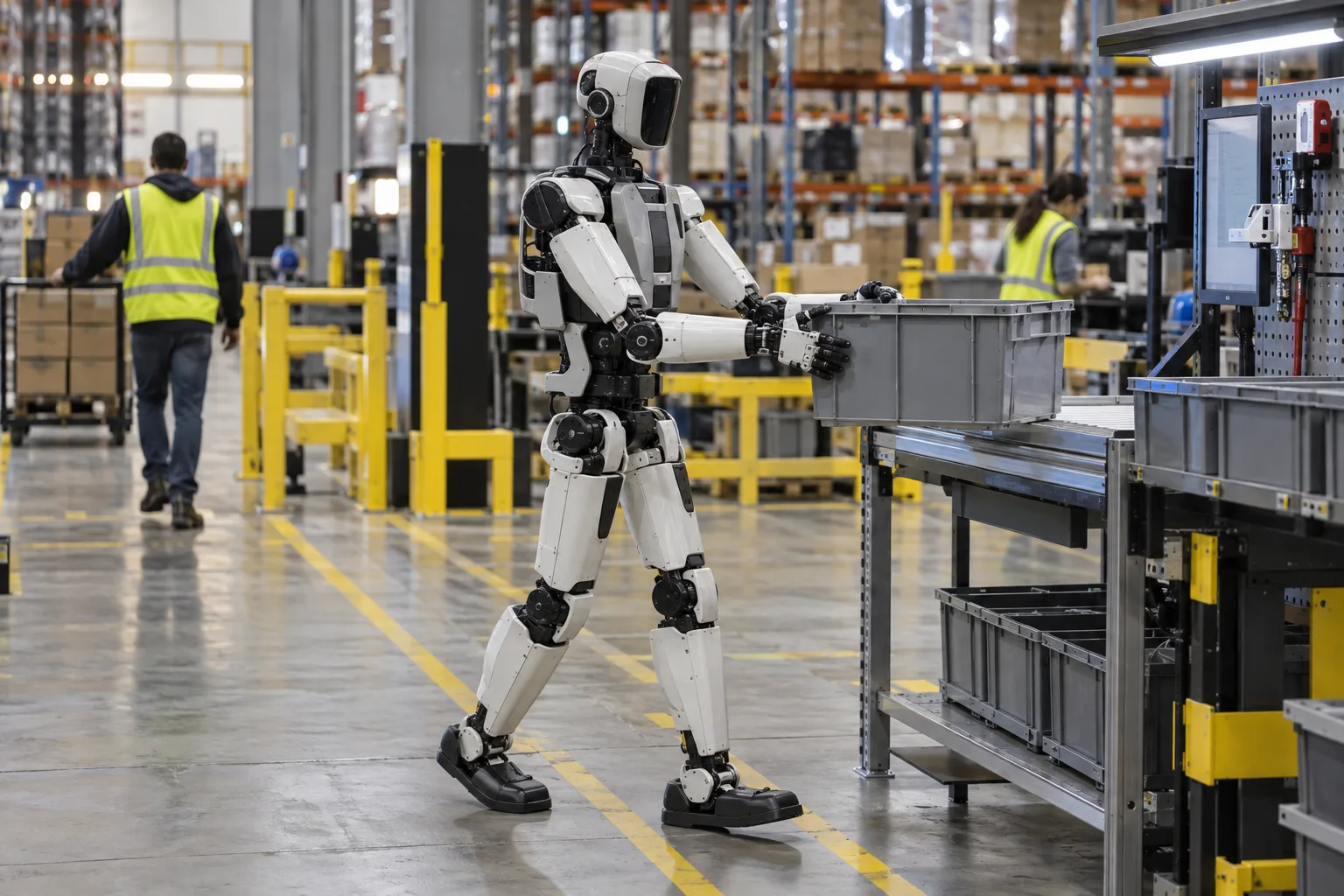
Boston Dynamics’ four-finger Atlas hand is less about looking human and more about surviving tools, shifts, repairs and safety audits. That makes it a useful signal for where humanoid robots are actually headed.

ShareFile Enterprise puts document collaboration inside the security operations workflow
Progress has launched ShareFile Enterprise with native DLP, UEBA, identity provisioning and SIEM integrations. The important change is operational: file-sharing activity becomes a security signal that teams can govern, investigate and respond to alongside the rest of their environment.

Hyundai’s Atlas strike is really about who writes the rules for humanoid robots
The Ulsan walkouts are formally about wages, but Atlas turns them into an early test of how factories should negotiate humanoid automation before it is fully mature.
Comments
Sign in to comment.
No comments yet.