Serve Robotics Opens Its Sidewalk Fleet to Developers — but the API Is Not Yet a Robot Service
Serve Robotics is exposing its delivery fleet through a public API and sandbox. The more important test is whether software access can turn sidewalk robots into dependable local infrastructure while coverage, supervision, pricing, and live approval remain tightly controlled.

What Serve actually opened on November 11
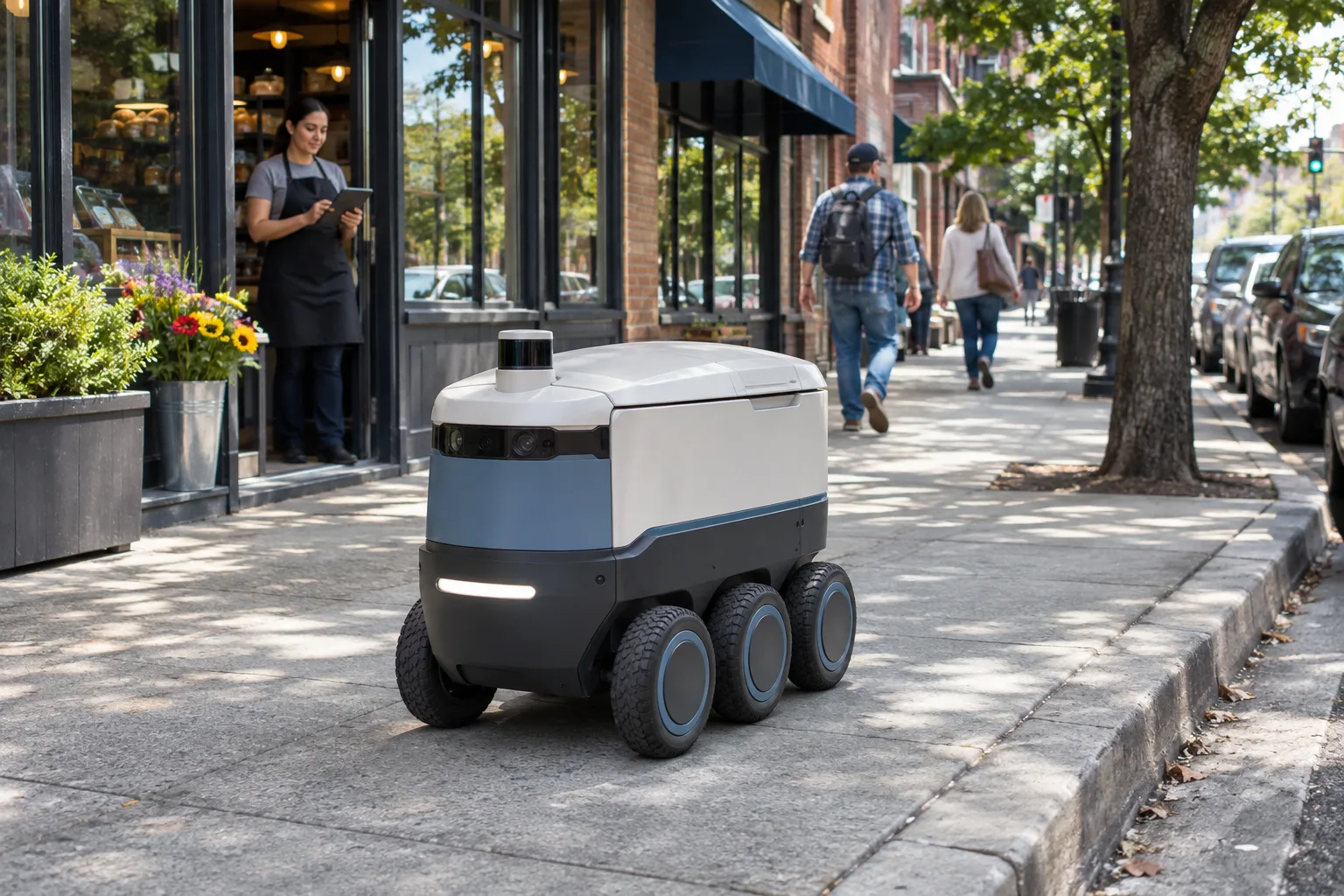
Serve Robotics’ November 11 launch is best understood as a new software-access layer over an existing delivery operation, not as the release of a robot that developers can independently control. The company opened its AV Delivery Developer Portal with a public API, documentation, and a sandbox intended for developers, businesses, hobbyists, and AI assistants. The proposition is straightforward: an application can ask Serve’s network to handle a pickup and dropoff, confirm the delivery details, and track the job through completion. The physical work remains inside Serve’s operating system. The developer supplies the use case and the software connection; Serve supplies the fleet and the operational machinery behind it.
That distinction matters because the announcement uses the language of infrastructure while preserving the boundaries of a managed service. Serve says its network includes 2,000 robots operating across more than 150 neighborhoods in 20 U.S. cities, and that those robots have completed hundreds of thousands of deliveries. Until this launch, access to that network had been mediated through third-party delivery partners. The new portal changes who can propose and build around a delivery workflow, but it does not turn the fleet into an open robotics platform. A developer can write the integration that requests a delivery. Serve still decides whether and how the live request is handled.
The public sandbox is the clearest way to see what has actually become available. It includes simulated robots, sandbox API keys, a Playground, documentation, and related tools. A developer can rehearse the delivery flow and explore edge cases without sending a real vehicle into a neighborhood. Under the sandbox terms, nothing performed there dispatches a real robot or creates a real delivery. The terms also state that sandbox access does not provide production access, real deliveries, or a partnership with Serve. Moving beyond the test environment requires Serve’s approval and a separate written production agreement.
That makes the portal useful even before a single third-party job reaches a sidewalk. It gives builders a place to test how an application would collect pickup and dropoff information, confirm the request, and follow its progress. It also gives them a way to discover where a seemingly simple physical transaction needs more than an API call: the right locations, an available delivery window, an item that fits, and a recipient who can complete the handoff. The simulated workflow can expose those integration questions, but it cannot by itself establish that a live route will be available or perform in the same way.
Serve’s role is deliberately broad. According to the company’s announcement and developer material, it retains responsibility for dispatch, routing, navigation, and supervision. Robots dispatched through the API remain subject to the same operating standards as other Serve deliveries, including remote monitoring by trained supervisors and the safety systems built into each vehicle. Live deliveries are also limited to Serve’s active service areas and operating hours, and to items that fit within the robot’s cargo compartment. In other words, the API exposes a request-and-status interface to the delivery operation; it does not expose the underlying navigation stack or grant control over the robot’s movement.
The sandbox’s legal terms reinforce that interpretation. Access is discretionary, can be limited or ended, and is provided for evaluating Serve and building an integration with its delivery API. Users may not share API keys, bypass rate limits, reverse engineer or overload the sandbox, publish performance benchmarks without written consent, or use the environment to build or train a competing product or model. They are responsible for activity carried out by their apps, scripts, automations, or AI agents. Test data rules also prohibit submitting real names, phone numbers, addresses, or other personal information. These are not the terms of an unrestricted public utility; they are the controls around an early-access developer program.
The practical change, then, is not that anyone can summon a robot on demand under any conditions. It is that more people can begin designing services around a delivery capability Serve already operates. The company’s examples include a local retailer delivering directly to customers, a business moving supplies between offices, and an AI assistant coordinating a real-world delivery. Those examples describe the category of workflow the portal is meant to support, not evidence that each use case is already available everywhere or has been proven in production. The opening test is whether software builders can turn the constrained, supervised service into dependable applications without having to build a fleet themselves.
The robot remains a managed service, not an open machine
Serve’s developer opening is meaningful precisely because it stops short of handing developers direct control of a sidewalk robot. The public interface is a software-access layer over a delivery operation that Serve continues to run. A developer can build an integration around the delivery workflow, but the company retains the operational decisions that determine whether and how a physical job is carried out.
That division matters. Serve’s API documentation describes a workflow in which an application can request a delivery quote, create a delivery job, and track its status. Those are useful primitives for a retailer, office system, or software agent that needs to move an item from one place to another. They are not commands for taking over navigation, choosing a route, or assigning a particular robot. The API exposes the transaction and its state; it does not expose the robot as an open machine.
Serve keeps dispatch, routing, navigation, and remote supervision on its side of the boundary. In practical terms, the developer is responsible for presenting the delivery request and handling the resulting software states, while Serve remains responsible for operating the fleet in the physical world. That includes the decisions and interventions required between an accepted request and a completed handoff. The distinction can be easy to miss in a developer portal: an endpoint may make a physical action look as simple as a function call, but the function call does not eliminate the managed service behind it.
The sandbox reinforces that boundary. It lets developers exercise the API workflow with simulated robots, but nothing performed there dispatches a real robot or creates a real delivery. A simulated quote, job, or status transition can help an engineering team validate authentication, request formats, application logic, and failure handling. It cannot establish that the same request will be accepted in a particular neighborhood, during a particular hour, for a particular item, or under the same operating conditions in the live network. The sandbox tests the integration surface; Serve’s production operation decides what can happen outside it.
The sandbox terms make the separation explicit: sandbox access does not provide production access, real deliveries, or a partnership with Serve. Production use requires a separate written agreement. Live-robot access is also subject to Serve’s approval. That makes the portal an invitation to build and evaluate an integration, not an unconditional route into the fleet. A developer may be able to learn the interface and prepare an application publicly, while access to the real robots remains conditional on Serve’s review and on the terms governing production use.
The constraints are physical as well as contractual. Deliveries are limited to Serve’s active service areas and operating hours, and the item must fit within the robot’s cargo compartment. The company’s materials describe availability at the level of the network it operates, not as universal geographic coverage. An application therefore cannot assume that an address is serviceable simply because it can be represented in a request, or that a job can be scheduled whenever a customer or employee wants it. Coverage and time availability are part of the service’s operating envelope, not details an external developer can override.
Cargo capacity creates another hard boundary. The robot fleet is intended for deliveries within the documented physical limits, so an integration has to account for the suitability of the package rather than treating the robot as a generic courier. A request may be valid from a software perspective and still be unsuitable for the available delivery service if the item does not fit. A useful integration consequently needs explicit handling for unavailable, declined, or otherwise unfulfillable requests; a successful API call is not the same thing as a successful physical delivery.
The result is a layered responsibility model. The developer can own the customer-facing or internal workflow: collecting pickup and drop-off details, requesting a quote, presenting availability, initiating the job, and communicating status. Serve owns the fleet-facing layer: dispatch, route execution, navigation, and remote oversight. The boundary allows software teams to build around a physical service without operating robots themselves. It also means those teams cannot independently change coverage, extend hours, select arbitrary routes, or guarantee that every software workflow maps cleanly to a live robot action.
That distinction should shape how the launch is evaluated. Serve is opening a way to build an integration with its delivery network, not releasing a general-purpose robotics platform whose machines developers can program at will. The test for developers is therefore less about whether they can issue a command that reaches a robot and more about whether their software can behave responsibly when the network says no, lacks coverage, reaches a capacity limit, or requires the operator’s intervention. Until those conditions are part of the design, an API connection remains the front end of a managed service.
Why the API matters for local businesses and AI agents
The practical significance of Serve’s developer portal is not that a business can suddenly buy or control a sidewalk robot. It is that a retailer, office, developer, or AI assistant can begin testing a physical delivery workflow without building a fleet, staffing a robotics operation, or solving neighborhood navigation independently. Serve describes an application as requesting a pickup and dropoff, confirming the delivery details, and tracking the robot through completion. That creates a software entry point for a task that previously depended on a delivery platform’s existing relationship with the robot network.
For a local retailer, the obvious use case is store pickup or delivery from a merchant’s own inventory. Serve also points to businesses moving supplies between offices and local companies extending their delivery footprint without hiring new staff. Those are plausible applications of the interface, but they should be read as design possibilities rather than evidence of established third-party deployments. The portal makes it possible to prototype the workflow; it does not, by itself, show that a particular merchant has achieved dependable service, customer adoption, or favorable economics.
That distinction matters because a physical delivery has more failure points than an API request suggests. A software system can submit a pickup and dropoff, but the goods still have to be prepared, placed in the right handoff location, and made available when the robot arrives. The recipient has to be reachable at the destination, and the delivery may need to be reconciled with a store, office, or customer-support process. If an item is missing, a pickup is late, a destination is inaccessible, or the recipient cannot complete the handoff, the application needs a way to detect the problem and decide what happens next. The API can expose the delivery workflow; it does not remove the surrounding operational workflow.
This is especially important for AI agents. An assistant could, in principle, coordinate a request in the physical world: identify a pickup and dropoff, submit the job, and monitor its status. But an agent acting through a key is still responsible for the actions it takes. Serve’s sandbox terms explicitly place responsibility for an app, script, automation, or AI agent on the user operating it, and prohibit the submission of real personal information in sandbox testing. That makes the sandbox useful for rehearsing the logic of a delivery integration, while also making clear that an automated request is not the same as an autonomous business operation.
The sandbox is therefore valuable less as a miniature fleet than as a place to test assumptions. Developers can work through the sequence of creating and tracking a delivery with simulated robots and examine edge cases before seeking access to a live robot. They can learn where their own application needs confirmation, status handling, exception paths, and human intervention. Yet the terms also say that nothing in the sandbox dispatches a real robot or creates a real delivery, and that simulated results, prices, estimated times, routes, and AI-generated answers may not reflect real-world performance or availability. A successful test run demonstrates that the integration can speak to the test environment. It does not validate the whole service a customer would experience.
The gap between those two things is where the operational work sits. Serve retains dispatch, routing, navigation, and supervision, so the builder does not manage the robot’s movement directly. That division is attractive for a small business: it reduces the amount of robotics expertise needed to experiment. It also means the business depends on a service whose availability is governed by Serve’s active coverage, operating hours, cargo limits, approval process, and supervision model. A merchant can design a polished customer flow and still face a failed request if the pickup or dropoff falls outside the service conditions, if the item does not fit, or if live access has not been approved.
For that reason, the API’s near-term value is as an integration layer and an operational test. It gives businesses and developers a way to find out whether robot delivery fits a particular workflow: where the handoffs occur, which events require a person, how exceptions reach support, and whether the physical service can be presented clearly to a customer. It also gives AI-agent builders a controlled surface for experimenting with actions that cross from software into the street. The important question is not whether a few lines of code can request a robot. It is whether the surrounding business can reliably prepare, receive, monitor, and recover from the delivery that code initiates.
The evidence still missing before this becomes infrastructure
A public developer portal can prove that software can reach a robot-delivery workflow. It cannot, by itself, prove that the workflow is dependable enough to function as infrastructure. That distinction is the important test for Serve’s launch. The company describes a network of more than 2,000 robots, while its developer materials expose a sandbox and an API-oriented path for requesting and tracking delivery jobs. Those facts establish access to an operating system and an opportunity to experiment. They do not establish that an outside application can depend on the service like it might depend on a mature payments, mapping, or logistics platform.
The missing evidence begins with the basic commercial question: what does a completed delivery cost, and under what conditions? A developer can evaluate an integration only if the service has a clear production price, a defined service area, and an understandable account or approval process. The launch materials describe live use as controlled rather than universally available, so a successful sandbox request is not evidence that the same request will be accepted by a production fleet. Public pricing would make that boundary measurable. Without it, a developer can test the shape of an interaction but cannot model whether the robot is viable for a retailer, office, or other local operation.
The next question is whether third-party requests have actually completed end to end. The portal makes it possible to build against the workflow, but the relevant proof is not merely that an API can return a quote or accept a job. A platform becomes operationally meaningful when an external application can repeatedly move from request to pickup to handoff, with predictable responses when a job is rejected, delayed, rerouted, or cannot be completed. Serve’s public materials do not disclose a count of completed third-party API deliveries or a comparable record of live users. That absence does not make the launch insignificant; it means the launch should be read as an invitation to generate that evidence, not as evidence already generated.
Reliability also has to be measured at the route level. A network can look impressive in aggregate while behaving differently from one neighborhood to the next. Useful reporting would show completion rates by service area, time window, and job type, alongside cancellations and failed handoffs. It would also show how often a person must intervene remotely. Serve retains responsibility for dispatch, routing, navigation, and remote supervision, which is a sensible way to operate a managed robot service. But that arrangement makes intervention rates part of the product’s economics. A low-touch delivery and one requiring repeated human attention may look identical to an API caller while representing very different costs to the operator.
Unit economics therefore matter as much as autonomy. The question is not only whether a robot can travel from one point to another, but whether the combined cost of fleet operation, supervision, maintenance, support, and failed or repeated attempts can support a repeatable service. The launch does not disclose enough to answer that question. Nor does it disclose the number of live users relying on the API. Those figures would help distinguish a developer experiment from a platform with sustained external demand, and show whether the API is becoming a meaningful source of work for the fleet or remains primarily a controlled test.
The sandbox is valuable because it reduces the cost of asking those questions. It gives developers a place to inspect the workflow and build software before depending on live coverage. But a simulator can demonstrate that an integration is well designed while leaving physical constraints untouched: whether an address is covered, whether the request fits operating hours, whether the cargo fits the stated capacity, whether a handoff succeeds, and what happens when the service cannot approve the job. Those are not details around the API. They determine whether the API represents a usable local service.
That is why the fleet number and the polished portal should be interpreted carefully. More than 2,000 robots indicate operating scale, and a public sandbox indicates an effort to make that scale legible to developers. Neither metric answers how consistently an independent business can obtain a delivery, how much it will pay, or how much human work remains behind the request. The infrastructure claim becomes credible only when third-party use produces repeatable evidence: completed production jobs, route-level reliability, intervention rates, transparent pricing, and a visible population of live customers or applications.
Serve has opened an important boundary between its physical network and outside software. The next milestone is not simply more endpoints or a larger developer audience. It is evidence that the boundary works under ordinary commercial pressure, across the limited areas and operating conditions where the service is available. Until that record exists, the most accurate description is narrower: Serve has made its managed delivery system available for developers to test and integrate with. That is a meaningful step toward robot infrastructure, but it is still a test of whether access can become dependable service.
Related articles
Qualcomm’s PickNik Deal Puts Open Robot Motion Planning at the Center of Physical AI
Qualcomm’s planned acquisition of PickNik is less about buying a robot than owning a critical layer beneath many of them. The outcome will depend on whether MoveIt can gain hardware acceleration without losing the openness that made it useful.
Faraday Future’s 919 Robot Launch Tests Whether a Portfolio Can Become a Deployment Business
Faraday Future is using its September 19 launch to present humanoids, quadrupeds, mobile manipulators, and industry packages as one robotics platform. The important question is not how many forms it shows, but whether customers can operate and measure them beyond a demonstration.

Hangzhou’s Hangxing No. 2 Turns a Marathon Crowd into a Public-Space Robot Test
Hangzhou deployed a humanoid robot around its 2026 marathon. The useful question is not whether it looks like a traffic officer, but whether a bounded patrol role can make embodied autonomy dependable in a crowded public setting.

AGIBOT’s Worken Metric Asks Whether Robots Deliver Work, Not Just Shipments
AGIBOT’s new Worken proposal tries to measure useful robot output through active units, autonomous hours and task efficiency. The practical question is whether a company-defined metric can become a credible tool for comparing deployments and calculating ROI.
Comments
Sign in to comment.
No comments yet.