Unitree AS2-W and the case for wheel-legged robots
Unitree’s new AS2-W is not just another robot dog clip. It shows why robotics companies are mixing wheels and legs, and why buyers should ask harder questions about autonomy, safety and developer access.
Unitree's AS2-W arrives at the exact moment when robot videos have become easy to admire and hard to trust. The official page shows a compact quadruped with wheels on its feet moving over flat ground, stairs, gravel and slopes. Hacker News picked it up on July 24, and the discussion quickly split into the familiar robotics camps: impressive hardware, staged demo skepticism, Boston Dynamics comparisons, developer access questions and anxiety about dual-use machines.
That reaction is useful. It treats AS2-W as more than another robot dog clip. The important idea is not that Unitree added wheels for drama. The important idea is that mobile robots are drifting toward hybrids: wheels where the world is smooth, legs where it is broken, and enough sensors and compute hooks to turn the chassis into an inspection, logistics or research platform.
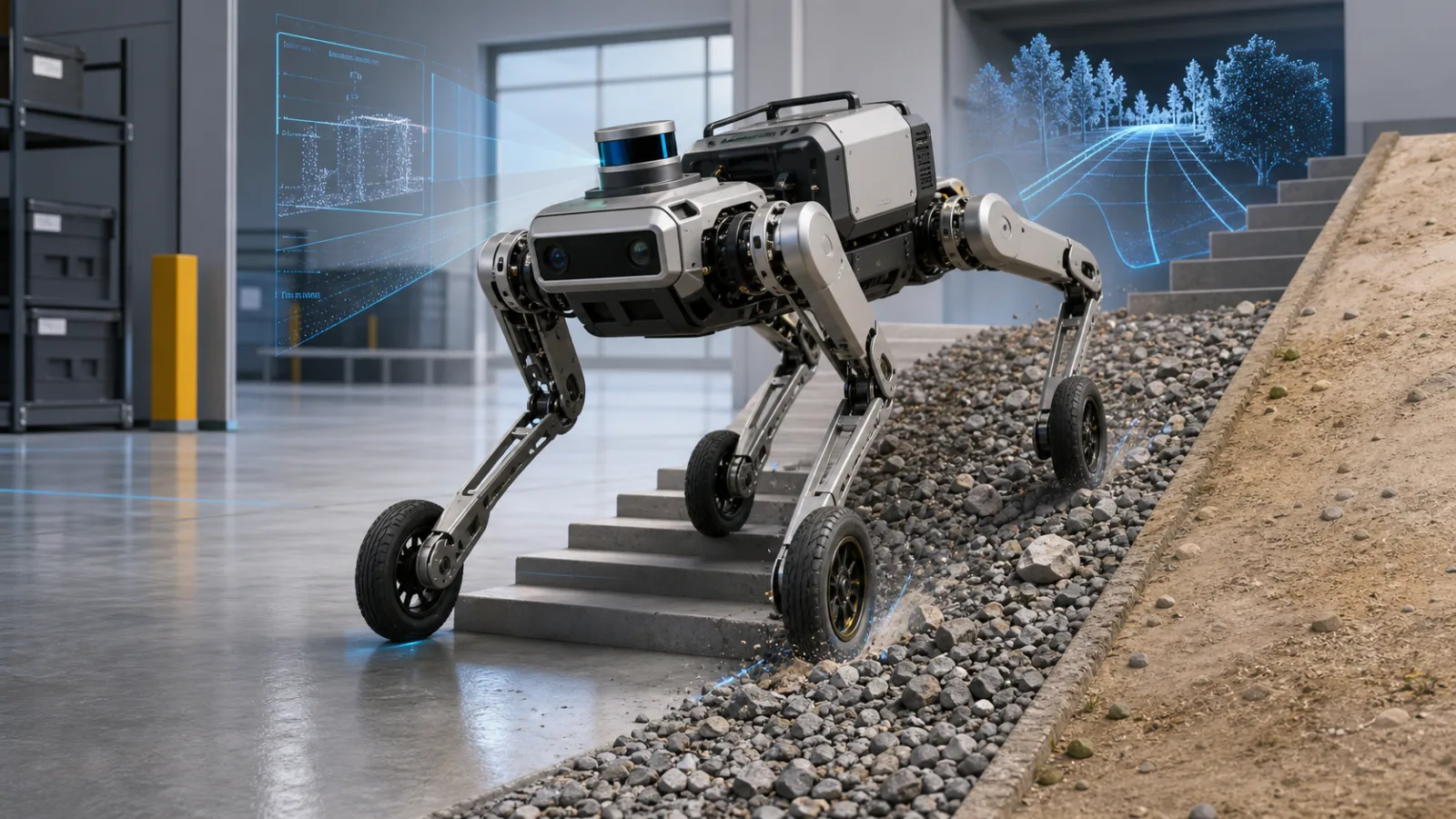
The official launch page, published by Unitree on July 24, describes AS2-W as a wheel-legged quadruped. Unitree lists a top speed over 6 m/s, roughly 25 kg weight with battery, 16 motorized degrees of freedom, about 95 N·m peak joint torque, 7-inch wheels, a 648 Wh battery, IP54 dust and water resistance, Wi-Fi 6, Bluetooth 5.2, speaker, microphone, HD camera and an industrial 64-to-128-line LiDAR. It also lists a static load around 150 kg and a continuous walking payload around 16 kg.
The range numbers need a careful reading. Unitree's hero summary says unloaded endurance is more than three hours and over 33 km, while the parameter table says about three hours and roughly 30 km. The hero copy says loaded operation is more than two hours and over 16 km; the table says a 16 kg load can run for more than two hours and about 25 km. That does not mean the robot cannot do it. It means readers should treat the numbers as lab-condition claims until independent field tests appear.
Price is also not settled. The official page says Contact Sales for AS2-W X and for AS2-W EDU/custom industry solutions. HN commenters asked about price and speculated, but there is no public fixed price on the Unitree page. Any article pretending otherwise is getting ahead of the evidence.
Why wheels on legs make sense
A pure wheeled robot is efficient. Wheels are old technology because they work. On a warehouse floor, campus path, parking lot, tunnel or factory aisle, rolling wastes less energy than repeatedly lifting and placing legs. A wheeled robot can cover distance, carry sensors and keep battery life sane.
A pure legged robot is flexible. Legs step over curbs, climb stairs, recover from awkward contact and keep moving when the ground stops being flat. Boston Dynamics Spot made that idea familiar in industrial inspection: send a legged platform into places where a small cart would get stuck or need extra ramps.
A wheel-legged robot tries to keep both advantages. It can roll when rolling is cheap, then use the legs for height, posture, balance and obstacle handling. That is why the form factor keeps appearing in research and commercial work, from Swiss-Mile-style wheel-legged quadrupeds to industrial inspection platforms and wheeled humanoid experiments. The engineering is harder, but the payoff is obvious: a robot that does not have to choose between speed and terrain.
AS2-W is interesting because it packages that idea in a compact quadruped rather than a one-off lab machine. It is not alone, and it is not proof that the category is solved. It is a sign that wheel-legged mobility is becoming a product strategy, not just a conference demo.
What Unitree is promising
The mechanical pitch is straightforward. Unitree says AS2-W can roll at 0 to 3.7 m/s in normal operation, with a maximum around 6 m/s. It claims 45-degree slope capability, 30 cm stair climbing and a maximum climb height listed as roughly 0.4 to 0.8 m. The marketing copy also says it can climb obstacles up to 80 cm. The safer reading is that the platform has strong obstacle claims, but the exact result will depend on surface, approach, load and controller behavior.
The sensor and compute pitch is equally important. Unitree lists an 8-core CPU, HD camera, ultra-wide-angle LiDAR, GPS and 4G disabled by default and enabled with user authorization, plus Ethernet and SBUS interfaces. It says the platform supports secondary development, UniStore, smart OTA upgrades, SDKs and APIs. It also mentions optional expansion modules, including high-compute modules around 150 TOPS and Orin NX-class options.
The autonomy claim should not be stretched. The page advertises ISS 3.0 Intelligent Side-follow System with centimeter-level positioning and stable tracking. That is useful for a robot that carries equipment beside a person. It is not the same thing as fully autonomous inspection in an unknown industrial site, fleet scheduling, certification-grade obstacle avoidance or safe operation around crowds. Follow mode is a feature; autonomy is a stack.
Unitree also includes a safety note. It calls the robot a civilian product, warns that it has complex structure and powerful dynamics, asks users to keep a safe distance, and says dangerous modifications or hazardous use are not allowed. That language matters because a fast 25 kg robot is not a toy, even without weapons or malicious intent.
Where a robot like this could be useful
The first credible market is inspection. Energy sites, mines, construction projects, factories and tunnels often have mixed terrain: flat floors, gravel, stairs, mud, slopes, pipes and temporary obstacles. A wheel-legged robot can roll through long stretches and still handle the awkward parts. Add LiDAR, cameras, microphones, thermal or gas sensors, and the robot becomes a moving sensor mast.
Outdoor logistics is another obvious fit. A robot that can carry 16 kg while following a person could move tools, samples, batteries or emergency supplies. The AS2-W page leans into backpack and supply carrying. That is a more realistic near-term use than the fantasy of a general household butler. It is a robotic mule, not a humanoid servant.
Security and patrol are possible too, but this is where the discussion becomes uncomfortable. A mobile platform with cameras, microphones, LiDAR, night operation and high speed is useful for perimeter checks. The same traits make people imagine weaponization, surveillance or crowd-control misuse. Unitree's civilian-use disclaimer is a start, but not a governance framework.
Rescue is harder than videos make it look, yet the mobility is relevant. Stairs, rubble, gravel and slopes are exactly the places where wheels alone fail. A robot that can bring a sensor or small payload into a risky area without sending a person first has obvious value. The proof will be reliability under dust, rain, heat, cold, bad communication and physical abuse.
Why the public is skeptical
The HN thread captured a useful skepticism: people wanted to know whether the demo was production capability, tuned prototype behavior or carefully edited promotional footage. That question is fair. Robotics demos often show the best run, not the tenth run, not the failed recovery, not the maintenance hour afterward.
The hardware specs are also only half the story. A robot can have good motors and still be hard to build on. Developers care about SDK access, ROS or ROS2 support, firmware limits, logs, simulation, remote operation, model deployment and whether advanced features require a much more expensive education or development package. HN commenters complained that dev access can cost much more than base hardware on some robots. That may or may not apply to AS2-W, but the concern is real in robotics.
Cybersecurity is another reason to avoid a pure hype reading. IEEE Spectrum and Hackaday have covered earlier Unitree security discussions and exploit claims involving other models. Those stories should not be treated as evidence that AS2-W itself has a known flaw. They do show why buyers of connected mobile robots should ask about updates, network exposure, credentials, logs, firmware signing and fleet management before deploying anything near people or industrial assets.
Then there is the geopolitical layer. Unitree is a Chinese robotics company moving quickly in a field where Western audiences often compare every quadruped to Boston Dynamics Spot. Some commenters read AS2-W through hardware-manufacturing momentum. Others read it through military fear. Both reactions can drown out the engineering question, which is more useful: what can this platform actually do, reliably, repeatedly, outside a video shoot?
How it compares with Spot, ANYmal and the wheel-legged trend
Boston Dynamics Spot is the reference point because it made industrial quadrupeds visible. Spot is sold as an industrial inspection platform with a mature ecosystem, payload options and years of field deployment. AS2-W should not be called a Spot killer just because a web page lists impressive numbers. Without price, independent reliability data and long-term support details, that comparison is premature.
ANYbotics' ANYmal sits in a similar industrial inspection world, aimed at plants, energy facilities and other harsh environments. Its value is not a viral backflip. It is repeatable autonomous inspection, safety processes, fleet operation and integration with industrial workflows. That is the bar AS2-W would need to clear for serious industrial buyers.
Swiss-Mile and related wheel-legged research point to the same mechanical compromise Unitree is now pushing: rolling efficiency plus legged adaptation. Wheeled humanoids and mobile manipulators are part of the same wider trend. Robots need to move through human-built spaces without asking humans to rebuild every space for them.
AS2-W's strongest contribution may be pressure. If Unitree can sell a compact wheel-legged platform broadly enough, competitors will have to answer with better pricing, better developer access and better field performance. That is how a flashy robot video can still matter, even before the first independent benchmark.
What AS2-W still has to prove
The first proof is boring: battery life under real load. Lab-condition range can collapse when terrain, temperature, payload, starts and stops, sensing, compute and communications are added. A 16 kg payload claim is useful only if the robot can carry it across the kind of site buyers actually have.
The second proof is autonomy. Side-follow is not inspection autonomy. A serious platform needs mapping, route repeatability, obstacle handling, mission planning, remote takeover, logging, recovery behavior and safe failure modes. It also needs to explain what happens when LiDAR is dirty, GPS is weak, Wi-Fi is gone or a wheel actuator is damaged.
The third proof is developer reality. "SDK and APIs" can mean anything from a generous robotics stack to a locked ecosystem with paid extras. Engineers will want manuals, simulation assets, ROS/ROS2 bridges, sample code, clear safety limits, firmware update policy and permission to build real applications.
The fourth proof is service. Field robots break. Wheels wear. Seals fail. Batteries age. A robot sold for outdoor inspection or logistics needs spare parts, repair procedures, support response and predictable software maintenance. A product page cannot prove that.
Dual-use is not a footnote
Any fast mobile robot that can carry payloads, traverse stairs, stream sensors and run onboard compute is dual-use by nature. That does not make AS2-W a weapon, and it does not justify panic. It does mean the robotics industry has to talk about restrictions, auditability, remote disablement, dangerous modification policies and customer screening before these machines become common.
The question is not only whether a robot can be armed. It is also whether it can be used for intrusive surveillance, unsafe patrol, intimidation or risky operation around bystanders. A 25 kg platform moving at several meters per second can injure someone by accident. Safety is mechanical, software, organizational and legal.
Unitree's disclaimer is useful because it acknowledges the issue. It is not enough by itself. Buyers, regulators and developers will need clearer norms for high-speed mobile robots, especially as prices fall and capabilities rise.
The near-term robot future looks less humanoid
AS2-W is a reminder that the next useful robot may not look like a person. It may look like a rugged sensor cart that learned to climb stairs. That is less glamorous than a humanoid making coffee, but it is more believable.
The path to everyday robotics probably runs through specialized platforms first: inspection robots, delivery robots, field assistants, mobile sensor carriers and machines that take a person or a camera into places too repetitive, dirty or risky for humans. Wheel-legged designs fit that path because they respect a boring truth: most of the world is easy for wheels until it suddenly is not.
So AS2-W should be taken seriously, but not swallowed whole. The specs are strong, the form factor makes sense, and the timing fits a real robotics trend. The unanswered questions are just as important: price, field reliability, software access, independent testing, safety and dual-use governance.
The robot dog era was about proving that legged machines could move convincingly. The wheel-legged era may be about making them useful enough to work. That is the harder test, and the one AS2-W now has to pass.
Related articles
The US robot ban is no longer theoretical: HoverAir and Unitree show the new robotics split
A flying pocket camera and a robot-dog distributor now show the same shift: robotics is moving from gadget hype into supply-chain regulation, national-security review and regional manufacturing choices.
Robotics is still waiting for reliability, not another demo video
Physical AI has better models, cheaper developer robots and stronger industrial demand. The missing breakthrough is not spectacle — it is dependable work in messy real environments.
Запрет на роботов стал реальностью: HoverAir и Unitree показывают новый раскол рынка
Карманная летающая камера и дистрибьютор робот-собак показывают один и тот же сдвиг: робототехника выходит из мира гаджет-хайпа в регулирование цепочек поставок и локальное производство.
Das US-Roboterverbot wird konkret: HoverAir und Unitree zeigen die neue Spaltung
Eine fliegende Taschenkamera und ein Roboterdog-Distributor zeigen denselben Wandel: Robotik wird zu Lieferketten-, Sicherheits- und Produktionspolitik.
Comments
Sign in to comment.
No comments yet.