SmartThings API is becoming paid. Check your smart home before October
Samsung says ordinary SmartThings app users are not affected, but Home Assistant and custom automation users should audit cloud-dependent devices now.
Samsung's SmartThings API change is not a reason to throw out your smart home. It is a good reason to open your device list before October and check what depends on somebody else's cloud.
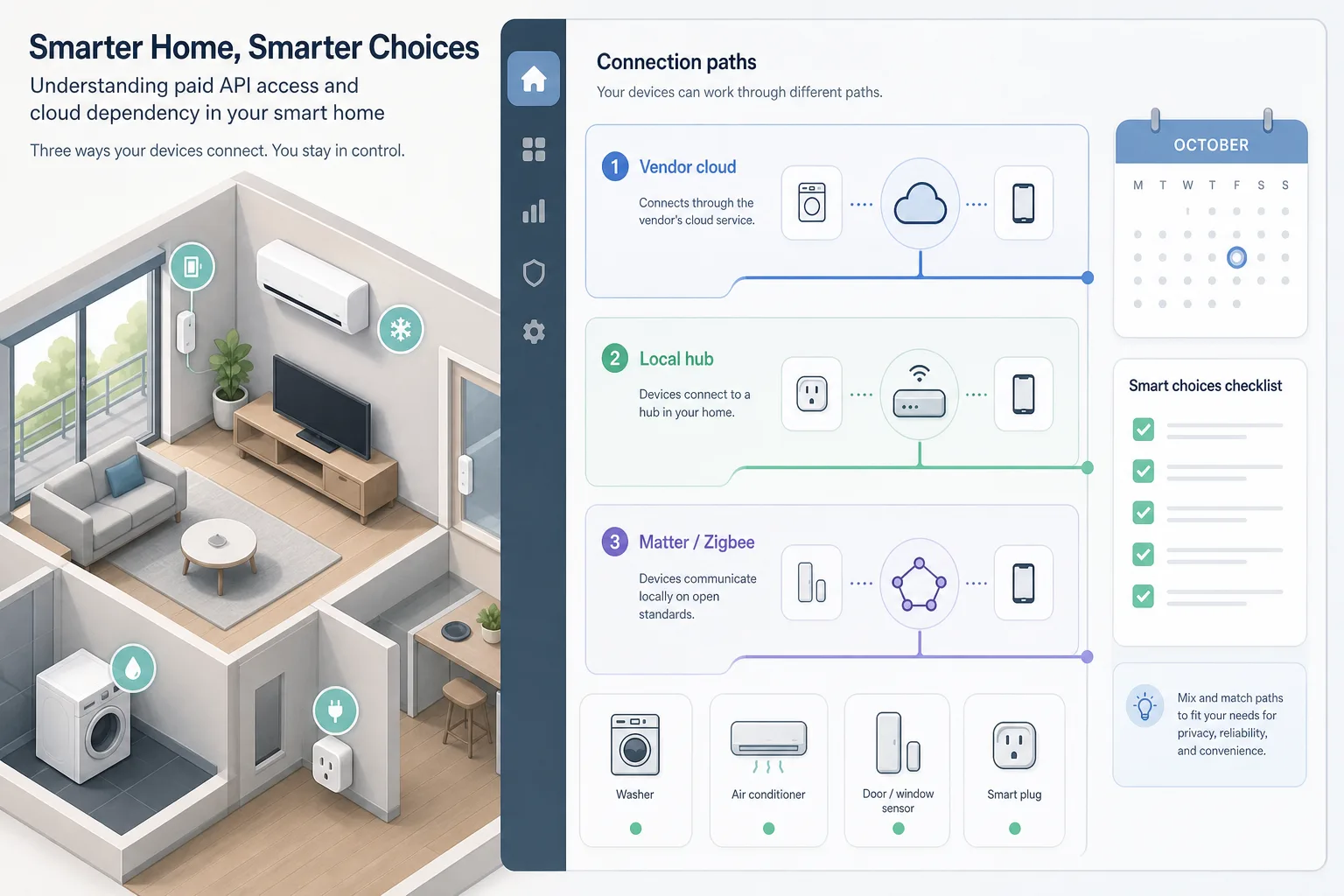
On June 23, SmartThings announced that it plans to introduce paid commercial API tiers and a $4.99 per month plan for non-commercial individual developers. Free access remains available through the third quarter, and SmartThings says new usage limits and the phase-out of free API access are targeted for October 2026.
Samsung also says ordinary users of the SmartThings app are not affected. If you only open the app to run your washer, check the air conditioner, switch a plug or see a TV status, nothing in the announcement says that suddenly stops working.
The people who need to pay attention are the ones who use SmartThings as part of a wider home system: Home Assistant users, custom dashboard builders, people with scripts, smartwatch controls, rental-property tools, energy dashboards, SharpTools-style services, or anything else that talks to SmartThings through the API instead of only through the official app.
What is actually changing
The SmartThings API is the door that lets third-party apps and platforms talk to devices and locations inside the SmartThings ecosystem. Samsung says commercial partners use it for short-term rentals, energy management, API aggregators and custom dashboards. Personal developers use it for their own smart homes.
The new plan separates that API use from ordinary app use. Commercial API users will get paid tiers. Non-commercial individual developers are expected to get a $4.99 per month personal plan. Samsung says the money supports platform stability, optimized integrations, expanded capabilities and a refreshed developer experience with usage dashboards.
The company has not, in the sources checked, published every practical detail people want. It is still important to verify whether pricing is per Samsung account, developer app, API project, region or location, what quota is included, and how existing personal access tokens or older integrations migrate.
That uncertainty is part of why smart-home communities reacted so strongly. A fee can be reasonable if it buys a reliable service. It feels different when it arrives after people bought hardware and built automations around free API access.
Why Home Assistant users noticed first
Home Assistant's SmartThings integration documentation already carries a warning. It says free access to the SmartThings API will be phased out starting in October 2026, and that after that date API access will require Samsung's paid Personal Plan subscription at $4.99 per month. It tells users to subscribe or migrate devices before October to avoid disruption.
That does not mean every Home Assistant user will owe Samsung money. It means people using the SmartThings integration path need to review their setup. If your Zigbee motion sensors are paired directly to Home Assistant through a local coordinator, this change is not about them. If your Samsung washer, air conditioner, lock, sensor or SmartThings hub-connected device appears in Home Assistant through SmartThings cloud, it probably deserves a closer look.
The Home Assistant docs show why this matters. The integration maps many SmartThings capabilities into Home Assistant entities: binary sensors, buttons, climate devices, covers, fans, lights, locks, media players, sensors, switches, vacuums, valves, water heaters and more. For some homes, SmartThings is not a decorative tile on a dashboard. It is how automations see appliance state and device events.
Why people are annoyed
The SmartThings community thread quickly filled with practical questions. Users asked about Rules API, CLI, personal access tokens, smartwatch apps, Home Assistant, SharpTools and other integrations. Some wanted more local control, not another cloud price point. One commenter joked about HTTP 402: Payment Required. Another used the word that tends to appear whenever a formerly free connected-home feature becomes paid.
There was also a fair counterpoint: cloud infrastructure is not free. Samsung runs servers, APIs, authentication, event delivery and developer tooling. Commercial services using SmartThings at scale should expect costs.
The tension is about who pays, when, and what control users keep. A home user may not think of a washer, air conditioner or door sensor as a developer platform. They bought a device. Then they discover that the useful automation path between that device and the rest of the home has a billing policy.
That is the real smart-home lesson. The device price is no longer the full cost. The API policy is part of the product.
Who is probably unaffected
If you use only the SmartThings app, Samsung says this change does not affect you. Your routines and device controls inside the official app are not the target of the paid API announcement.
If your local smart-home setup talks directly to devices through Zigbee, Z-Wave, Matter, Thread, MQTT, ESPHome or a local vendor API, SmartThings API pricing may be irrelevant for those devices.
If you have a few Samsung appliances and only check them inside the vendor app, you may not need to do anything before October. Still, it is worth knowing whether you depend on API access anywhere else.
Who should audit before October
Start with Home Assistant users who installed the SmartThings integration. Open the integration and list every entity it creates. Group them by device: washer, dryer, fridge, air conditioner, TV, sensor, lock, plug, thermostat, robot vacuum, water heater, whatever is present in your home.
Then ask a boring but useful question for each one: if the SmartThings API stopped working tomorrow, what would I lose?
For a washer, the answer might be status notifications. Annoying, but not critical. For an air conditioner, it might be climate control in automations. For a lock or leak sensor, it could be more important. For a dashboard in a rental or small property, the operational impact may be bigger than the $4.99 subscription itself.
Also check any custom scripts. Some people use the API from cron jobs, Node-RED flows, phone shortcuts, smartwatch controls or small apps they wrote years ago and then forgot. Those automations may not show up as a neat Home Assistant device list.
Your options
Pay for the personal plan if the value is there. Five dollars a month is not outrageous if SmartThings is central to your home and the integration saves real time. The important thing is making that choice consciously, not discovering it during a broken automation in October.
Keep some devices in the SmartThings app only. For appliances that are nice to monitor but not central to automations, the vendor app may be enough. A fridge water-filter alert does not always need to be in Home Assistant.
Move Zigbee and Z-Wave devices to a local coordinator where practical. If a sensor, plug or button is currently paired to a SmartThings hub only because it was convenient, it may be a good candidate for Home Assistant's ZHA, Zigbee2MQTT or Z-Wave JS path. Migration takes work and may break existing routines, so do not do it blindly.
Use Matter where it genuinely helps. Matter can reduce dependence on one vendor cloud for supported device classes, and Home Assistant's Matter work is moving quickly. But Matter is not a magic converter for every appliance. A washer, TV or refrigerator may expose only some features, or none, through local standards.
Prefer local APIs for critical automations. If a device controls heating, access, leak response or anything you would notice immediately during an internet outage, cloud-only should be a warning sign.
Replace slowly, not angrily. Most homes do not need a weekend purge. Mark cloud-dependent devices, decide which ones are worth paying for, and make local control a requirement for future purchases.
What Matter can and cannot fix
Matter is useful because it gives supported devices a common local language. Home Assistant's June Matter upgrade moved its Matter server to matter.js, added better diagnostics and moved support forward with newer Matter specs. That is the direction many smart-home users want: more local interoperability and fewer cloud toll booths.
But Matter does not solve everything. It helps only when the device category and the device implementation expose the functions you need. A simple sensor or smart plug is more likely to migrate cleanly than a complex appliance with vendor-specific modes, diagnostics and health parameters.
So the practical rule is simple: use Matter, Zigbee, Z-Wave or local APIs when they fit the device. Do not assume a logo on the box means every feature will appear locally in your dashboard.
A buying checklist for the next device
Before buying a smart appliance, ask how it behaves without the cloud. Can it still do the basic job? Can it be controlled locally? Does it expose standard protocols, or only a vendor account?
Check the integration path. "Works with SmartThings" or "works with an app" is not the same as "works locally with your automation system." Find out whether Home Assistant support is direct, cloud-based or dependent on a vendor API subscription.
Look for protocol choices. Zigbee, Z-Wave, Thread/Matter, MQTT and documented local APIs are not automatically perfect, but they give you more escape routes than a single cloud account.
Read the community before you buy. Search for the exact model name plus Home Assistant, local control, Matter, Zigbee2MQTT or API. If every thread says "works only through cloud," treat that as part of the price.
Think about criticality. A cloud-only washer notification is fine for many people. A cloud-only heating or leak-prevention setup is a different decision.
Watch the subscription history. If a vendor has already changed API access, blocked integrations or moved features behind subscriptions, assume it may happen again.
The calm takeaway
Samsung has not said the SmartThings app is becoming paid for ordinary users. The immediate risk is narrower: API-based integrations are moving toward a paid model, with October 2026 as the target.
That is still enough to justify a home audit. Smart-home reliability is not only about Wi-Fi range and battery levels. It is also about cloud terms, API access, and whether your automations have another path when a vendor changes the rules.
Before October, list your SmartThings-dependent devices, decide what is worth paying for, migrate what can reasonably go local, and make future purchases with one extra question in mind: am I buying a device, or renting the integration that makes it useful?
Related articles
Smart home by subscription: why SmartThings users are worried about Home Assistant integrations
Samsung says ordinary SmartThings app users are not the target. The worry is what happens to Home Assistant, dashboards, scripts, PATs and Samsung-appliance data when API access becomes paid.
Will your smart home survive when the app disappears?
Wemo’s cloud shutdown is a practical warning for anyone buying smart plugs, bulbs, switches or appliances: the safest smart home is the one whose basic controls do not depend on one vendor server.
Do Not Build the Smart Home on One Cloud Speaker
Fresh Google Home problems are a reminder to design smart homes with voice as a convenience, local logic for important routines, and physical fallback for the things people use every day.
When the cloud controls the air conditioner: the LG ThinQ smart-home lesson
A fresh LG ThinQ disruption shows why smart appliances should stay controllable when the vendor cloud slows down, blocks automation, or disappears.
Comments
Sign in to comment.
No comments yet.