The iPhone 18 Pro’s variable-aperture camera is useful, but it is not a reason for everyone to upgrade
Apple’s iPhone 18 Pro adds a mechanical variable-aperture main camera, manual exposure controls, a new chip and better claimed battery life. Here is what those changes mean in ordinary photos, video, upgrades and buying decisions before full reviews arrive.

Apple’s iPhone 18 Pro has a camera feature that is easy to oversell and surprisingly easy to misunderstand. The headline is not another computational photography mode. It is a mechanical variable aperture on the 48-megapixel main camera, paired with a new Pro Controls interface that lets owners adjust aperture, shutter speed and white balance themselves.
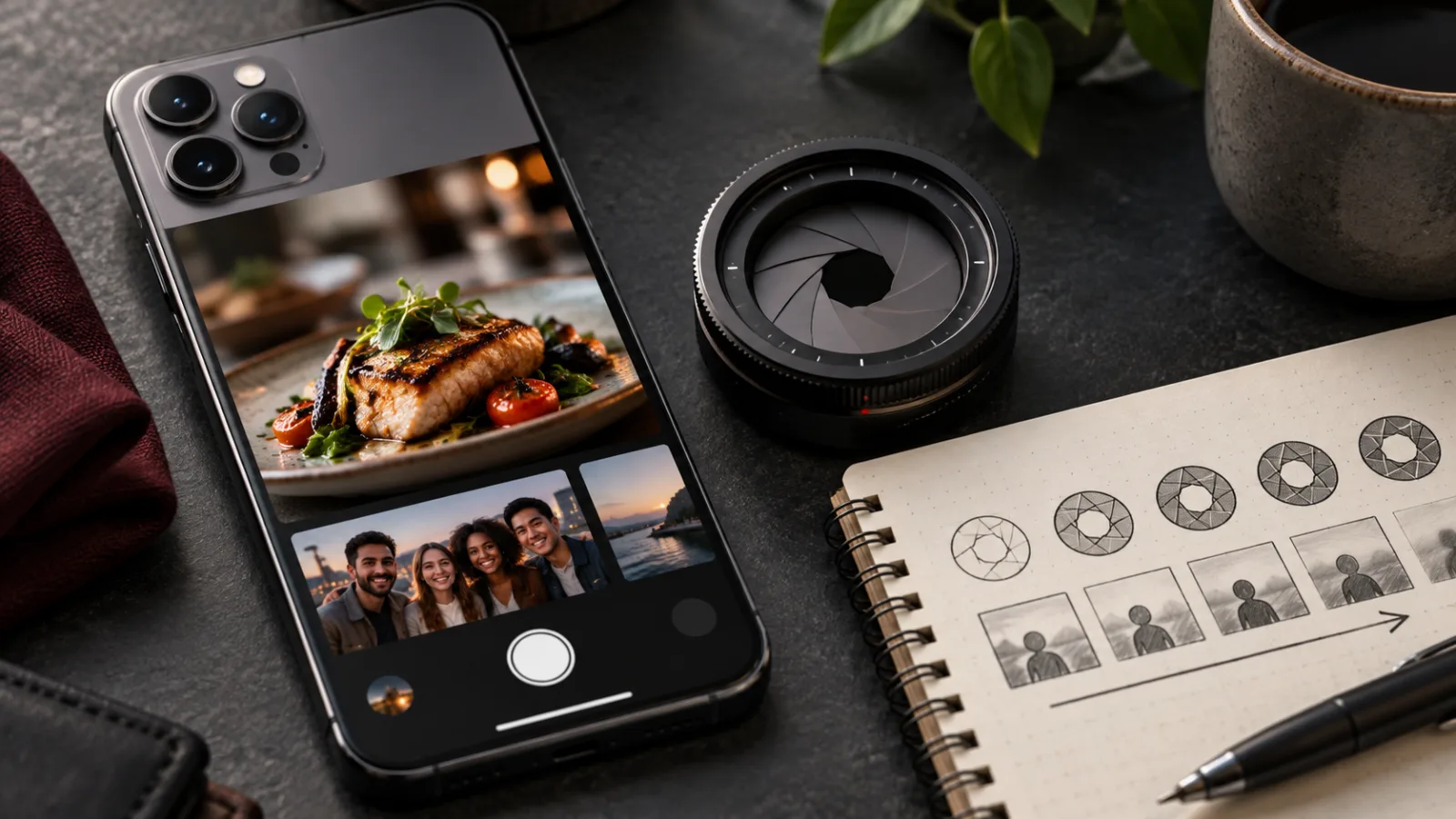
That matters because smartphone cameras have spent years solving optical limitations in software. The iPhone 18 Pro gives the main lens a small amount of physical control as well. It can open for more light, close down to keep more of a nearby scene sharp, and provide a more sensible starting point for video in bright conditions.
The practical question is narrower than Apple’s launch presentation: will this make enough difference to justify a phone that starts at $1,199 in the United States, or is it mainly a feature for people who already know why they want an adjustable aperture? The answer depends on what you photograph, which iPhone you have now, and whether you need a phone immediately.
What Apple actually changed
Apple announced the iPhone 18 Pro and iPhone 18 Pro Max on September 9. Both models have the new 48MP Fusion Main camera with variable aperture; the feature is not restricted to the larger Pro Max. Apple’s official specification page lists 6.3-inch and 6.9-inch displays respectively, storage options from 256GB through 2TB, and the same four finishes: black, silver, glacier and burgundy.
The iPhone 18 Pro starts at $1,199, while the Pro Max starts at $1,299. Pre-orders began on September 12 in more than 65 countries and regions, with retail availability scheduled for September 18. Apple says another 20 countries and regions will receive the phones on September 25. Local prices, taxes, storage pricing and carrier terms vary, so the US figures are useful as a baseline rather than a universal cost.
The main camera’s aperture range is the part that deserves attention. Early reporting and Apple’s launch material describe four user-facing positions: approximately f/1.48, f/1.78, f/2.8 and f/4. Apple can also let the system select an appropriate setting automatically. The lens does not turn the phone into a compact interchangeable-lens camera. The sensor remains much smaller than the sensor in a dedicated camera, and the range is modest. But a modest physical adjustment can still solve specific phone-camera problems.
The new A20 Pro chip is Apple’s first iPhone chip built on a 2-nanometer process, according to Apple and launch reporting. Apple describes a six-core CPU and a seven-core GPU, with performance improvements that are especially relevant to sustained workloads. A new vapor-chamber thermal system is intended to keep performance steadier during games, long video recordings and other demanding tasks.
Apple also claims substantial battery improvements, particularly for the Pro Max. Those numbers come from Apple’s own testing using preproduction devices and software. They are useful for comparing the company’s product positioning, but they are not the same as an independent battery test. The first wave of hands-on coverage was based on limited time with review units, not weeks of normal use.
Why an aperture matters on a phone
A lens aperture is the opening through which light reaches the camera sensor. A smaller f-number describes a wider opening. At f/1.48, the iPhone’s main camera can admit more light than it can at f/1.78, assuming the shutter speed, sensitivity and other conditions remain comparable. The wider setting can help in dim scenes, although the final result still depends on sensor performance, stabilization, subject movement and Apple’s image processing.
The aperture also affects depth of field: the range that appears acceptably sharp. On a phone sensor, the effect is more limited than it would be on a larger camera, but it is not meaningless. A wide setting can make a close subject stand out against a softer background. A narrower setting can keep more of a close scene sharp. That is particularly relevant to food, documents, small products, pets and groups of people who are not standing on precisely the same plane.
There is a third use in video. In bright daylight, a camera with a fixed, wide aperture may compensate for excess light by using a very fast shutter speed. That can make movement look unnaturally crisp or staccato. A narrower aperture gives the phone another way to control exposure while preserving a more natural shutter speed. Whether the iPhone 18 Pro’s automatic mode consistently makes that choice well will require testing outside Apple’s controlled demonstrations.
The aperture is not a zoom control. It does not give the phone more reach for distant subjects, and it does not turn the telephoto camera into a larger-sensor lens. It also does not guarantee a blurrier background in every portrait. Computational portrait effects, subject distance, focal length and the physical size of the sensor still have a major influence on the image.
The everyday situations where it could help
The most convincing case is close-up photography. With a fixed wide aperture, a phone can produce an image in which the front of a small object is sharp but the rear edge is already soft. That can look attractive for a single detail, but it is inconvenient when the object is a meal, a label, a watch, a keyboard or a repair part that you want to document. Closing the aperture can increase the zone of useful focus.
Group photos are another plausible use. A phone’s autofocus and computational processing can do a great deal, but people standing at slightly different distances from the lens remain a physical problem. A narrower aperture may help keep more faces within the sharp region. It will not fix someone who is moving, out of focus, poorly lit or partly hidden, and it may require the phone to raise sensitivity or slow the shutter in a dark room.
Video creators have a clearer reason to care. A camera that can adjust its opening gives the operator another exposure control without forcing every outdoor clip into a very fast shutter speed. That is useful for walking videos, interviews, performances and travel footage, especially when moving between shade and sun. The benefit is more about preserving a consistent motion signature than creating a cinematic look automatically.
Manual photographers may appreciate the interface even when they ignore the aperture most of the time. Apple’s Pro Controls can expose settings that were previously hidden behind automatic decisions. A live histogram, a deliberate shutter speed and a selected white balance can make the camera more predictable. Predictability is valuable when photographing a sequence, matching shots for a project or recording a product from the same setup over several days.
The feature is less important for casual snapshots. If most of your pictures are taken in daylight with the default Camera app, the phone will probably choose an acceptable aperture without asking you to understand f-stops. The upgrade may still bring better processing, battery life or thermals, but the variable aperture alone is unlikely to transform ordinary photos.
The limits Apple’s launch language cannot remove
A wider aperture does not automatically produce a brighter final photograph. The phone can already alter shutter speed and ISO, combine multiple frames and brighten shadows through computational photography. More light entering the lens gives the system more options, but the image pipeline decides how those options become a finished picture. In some scenes, the phone may prefer a different aperture and compensate elsewhere.
A narrower aperture does not create the deep focus of a small-sensor action camera or the dramatic background separation of a full-frame camera. Phones have short physical focal lengths, and that limits optical blur. The iPhone 18 Pro can give you more control over the balance between light and depth of field, but it does not erase the underlying geometry.
There is also a mechanical component now inside a part of the phone that is exposed to heat, dust, vibration and everyday drops. Apple describes the hardware as durable and says the device is built for long-term use, but durability claims are not a substitute for years of ownership data. A moving aperture adds capability as well as another mechanism whose long-term reliability will be worth watching.
Most importantly, the new feature applies to the main camera. It does not mean every camera on the rear of the phone has the same optical flexibility. Buyers who mainly use the ultra-wide or telephoto cameras should evaluate those cameras independently. A phone can have an impressive main lens and still be a poor match for someone whose real need is distant subjects, architecture or very wide interiors.
Pro versus Pro Max
The smaller iPhone 18 Pro is the more interesting model for buyers who want the camera without committing to a very large phone. Apple gives both Pro sizes the variable-aperture main camera, so choosing the Max is not required to obtain the headline photographic feature.
The Pro Max costs $100 more at the starting configuration and is physically larger and heavier. Apple lists the Pro at 211 grams and the Pro Max at 249 grams on its technical specifications page. The Max has a 6.9-inch display compared with 6.3 inches on the Pro, and its larger chassis permits a larger battery. Those differences are practical rather than cosmetic: one model is easier to carry and use one-handed, while the other provides more viewing area and potentially longer endurance.
A larger screen is useful for checking focus, reviewing video and editing photos. It is not a substitute for a better camera. If the phone spends most of its day in a pocket and most of its camera time involves quick snapshots, the lighter Pro may be the better fit. If you record long clips, travel without easy charging or edit on the handset, the Max’s extra size may be justified.
Storage requires the same discipline. A 2TB phone can be attractive to someone recording large 4K video files, but it is an expensive way to solve a workflow problem if the footage is regularly moved to a computer or cloud storage. On the other hand, buying too little storage is hard to repair later. Consider how much video you actually keep on the phone, not how much a launch event makes you imagine recording.
The upgrade decision by current phone
From an iPhone 17 Pro, this looks like a targeted upgrade rather than a total redesign. The physical appearance is familiar, the display sizes remain in the same general categories, and the most meaningful changes are the camera controls, A20 Pro performance, thermal management and claimed battery improvements. A 17 Pro owner who takes mostly automatic daylight photos should wait for independent testing unless battery life or sustained heat is already a daily problem.
The case is stronger for someone who shoots a lot of close-up work, manual stills or video. The new aperture offers a control that the older phone cannot gain through a normal software update, assuming Apple keeps the feature exclusive to the new hardware. That does not make the upgrade mandatory, but it gives the camera a concrete reason to exist beyond a faster benchmark.
From an iPhone 15 Pro or older model, the decision has more variables. Battery aging, USB-C already being present on the 15 Pro, camera improvements accumulated across generations, and the price of a replacement all matter. An older phone with a tired battery may feel dramatically better after any current flagship upgrade, which can make it difficult to identify how much of the improvement came from the new camera.
From a base iPhone, the Pro purchase should be tied to a real need for the camera system, display or sustained performance. Do not buy a Pro solely because the word “aperture” sounds like a professional feature. The base model may be the more sensible phone for people who want reliable snapshots, long software support and a lower total cost.
From Android, the question is not simply whether the iPhone has the newest camera hardware. Google’s Pixel 11 Pro line offers a different approach built around computational photography and Gemini features, while Samsung’s Galaxy S26 Ultra emphasizes a large display, long-range camera flexibility and Android customization. The best choice depends on the photos you take, the computers and accessories you already use, and how much you value iMessage, FaceTime, AirDrop or Apple’s broader device integration.
Price, trade-ins and the cost hiding behind the headline
The starting price is only the first number. Apple offers storage tiers up to 2TB, and the larger capacities can move the phone into a different spending category. A case, screen protection, charging accessories, cloud storage and AppleCare can add to the ownership cost. The phone includes a USB-C charge cable, but Apple’s faster wired charging requirements involve a suitable USB-C cable and compatible power adapter.
Apple says direct trade-in credit for an iPhone 13 or later can range from $175 to $885 in the United States, depending on the model and condition. Carrier promotions may advertise credits of up to $1,200 for eligible devices, but these offers commonly depend on a plan, installment billing, trade-in condition and a defined promotional period. Treat the headline credit as a conditional discount, not as the market value of your old phone.
A trade-in can also remove your fallback device. Before handing over an old phone, confirm that your data has been backed up, authentication apps have been transferred, eSIM service has been moved and the device has been removed from your account. The iPhone 18 Pro uses eSIM technology and is not compatible with physical SIM cards, according to Apple’s specifications. That is convenient for supported carriers, but it can complicate travel or activation in places where physical SIM availability is still important.
The most reliable value comparison is total cost per year. If a current phone is working well and its battery can be replaced at a reasonable cost, a $1,199 purchase is difficult to justify on the basis of a single camera feature. If your phone is unreliable, lacks the storage for your work, overheats during recording or no longer receives the software capabilities you need, the same purchase may be easier to defend.
Apple Intelligence is a separate buying question
Apple presented the iPhone 18 Pro alongside Apple Intelligence and Siri AI. Apple says Apple Intelligence becomes available with iOS 27 on September 14 for supported devices and languages, while Siri AI is rolling out as a beta in English and later support is planned for additional languages. Availability can vary by region and language, and some announced functions may arrive later than the hardware.
That timing matters. A launch presentation can make software sound like a property of the phone, but software schedules change and features may expand to older compatible devices. Do not pay for the iPhone 18 Pro assuming every AI demonstration is exclusive to it unless Apple explicitly identifies the hardware requirement. The camera’s physical aperture is a clearer example of a feature that cannot be reproduced on an older phone by simply installing iOS 27.
Privacy also needs a concrete reading. On-device processing, cloud processing, personal context and app permissions are separate questions. Check which feature runs on the phone, which requires an internet connection, what data an app can access and whether the setting is optional. A privacy label in a presentation is useful context, but the controls and regional availability are what determine the everyday experience.
What to test when independent reviews arrive
The first full reviews should answer questions that launch material cannot. Testers need to compare the same scene at each aperture setting, not just publish a single attractive sample. The useful comparisons include close-up objects, faces at different distances, low-light subjects, moving people, bright outdoor video and scenes with fine detail near the edges of the frame.
They should also check whether the camera changes aperture smoothly while recording. A visible brightness shift, a sudden change in sharpness or audible mechanical noise would reduce the value for video. Automatic behavior matters as much as manual control because most owners will leave the camera in an automatic mode much of the time.
Battery testing should separate normal use from video recording, gaming and navigation. Apple’s claims use a representative usage profile and preproduction hardware, while independent tests can expose differences caused by cellular reception, display brightness, heat and background activity. The improved vapor chamber deserves sustained-load testing, not a brief benchmark run.
Durability testing should pay attention to the aperture mechanism, camera cover glass, thermal system and repair process. A camera that is better on day one is not better ownership value if a minor drop makes an expensive repair unavoidable. Repair pricing, parts availability and battery replacement options should be part of the review, even if they are less exciting than the launch colors.
Finally, reviewers should test regional restrictions. Apple’s support pages already indicate that some image-related features can vary by country, including limitations around Apple Reference Image capture at launch in the European Union and China. A feature list without a region is incomplete buying advice.
Who should buy it now
The iPhone 18 Pro makes sense now for a photographer or video creator who wants a traditional iPhone shape, uses the main camera heavily and can make practical use of exposure control. It also makes sense for someone replacing a damaged or aging phone who values the strongest available Apple camera and does not want to wait for a later release.
The Pro Max is the better choice when endurance and screen size matter more than pocketability. Choose the smaller Pro if you want the same variable-aperture main camera in a lighter body. Neither model becomes automatically better because it has a larger storage tier or a more expensive finish.
The phone is a weaker purchase for an iPhone 17 Pro owner who takes ordinary automatic photos, is satisfied with battery life and does not record demanding video. That buyer should wait for full reviews, watch early pricing on the outgoing model and consider a battery replacement. The same advice applies to anyone tempted by a carrier trade-in offer whose monthly bill conceals a long contract.
It is also a weak purchase for an Android owner who is happy with a Pixel or Galaxy camera workflow. Switching platforms has costs that do not appear on a specification sheet: app purchases, accessories, cloud services, messaging habits, watch compatibility and file-transfer routines. A camera feature is not enough to justify that disruption unless it solves a problem you actually have.
The sensible conclusion
The iPhone 18 Pro’s variable aperture is a real hardware change with real use cases. It can give the main camera more light when conditions are dark, more depth of field for close subjects and another way to manage exposure in video. The new manual controls are arguably just as important because they make the camera more deliberate and repeatable.
But it is not a universal image-quality switch. Small sensors remain small, computational photography remains central, and the telephoto and ultra-wide cameras deserve their own evaluation. Apple’s battery and thermal claims are promising but need independent testing, while Apple Intelligence and Siri AI should be judged by availability and reliability rather than keynote demonstrations.
For most buyers, the right move on September 13 is to compare the camera feature with the actual reason for replacing a phone. If that reason is close-up photography, manual control, long video sessions or a failing older device, the iPhone 18 Pro has a credible case. If the reason is fear of missing one more annual upgrade, keep the current phone and wait for measured reviews.
The useful change here is not that an iPhone suddenly becomes a DSLR. It is that Apple has acknowledged a physical problem that software cannot always hide and given users a small, understandable control over it. Whether that control is worth $1,199 will depend less on the launch slogan than on the handful of scenes you repeatedly photograph.
Related articles
AirPods 5 bring noise cancellation to Apple’s open fit. The real choice is how much isolation you need
Apple’s AirPods 5 make open-fit earbuds more capable, but ANC cannot change the basic physics of an unsealed earbud. Here is who benefits, which $149 version makes sense, and when AirPods Pro remain the better buy.


Bonsai 27B shows what local AI can do before the cloud call
PrismML’s compressed 27B model is less about replacing the cloud than about moving private, routine AI work closer to the user’s device.
Don’t buy a foldable phone this week unless you have to
Foldables are getting better, but Samsung’s July 22 event, leaked price shifts, Motorola discounts and Apple rumors make patience the smartest gadget move right now.
People are buying smart-glasses detectors. That is the real warning for face-worn AI gadgets
Antizuck is not a perfect way to find camera glasses, but its popularity shows that smart glasses now have to win the trust of bystanders, venues and buyers alike.
Comments
Sign in to comment.
No comments yet.