Spotted lanternfly in the yard: what to do before you spray
Adult spotted lanternflies are easy to spot in late summer. The practical response is not panic spraying, but ID, reporting, inspection and targeted control.

Late July is when spotted lanternfly stops being an abstract quarantine notice and starts appearing where people actually live: on grapevines, maples, fences, patio furniture, grills, cars and porch steps. That is why the same question keeps showing up in local groups and bug-ID forums: is this the insect everyone says to smash, and what should I do after I find one?
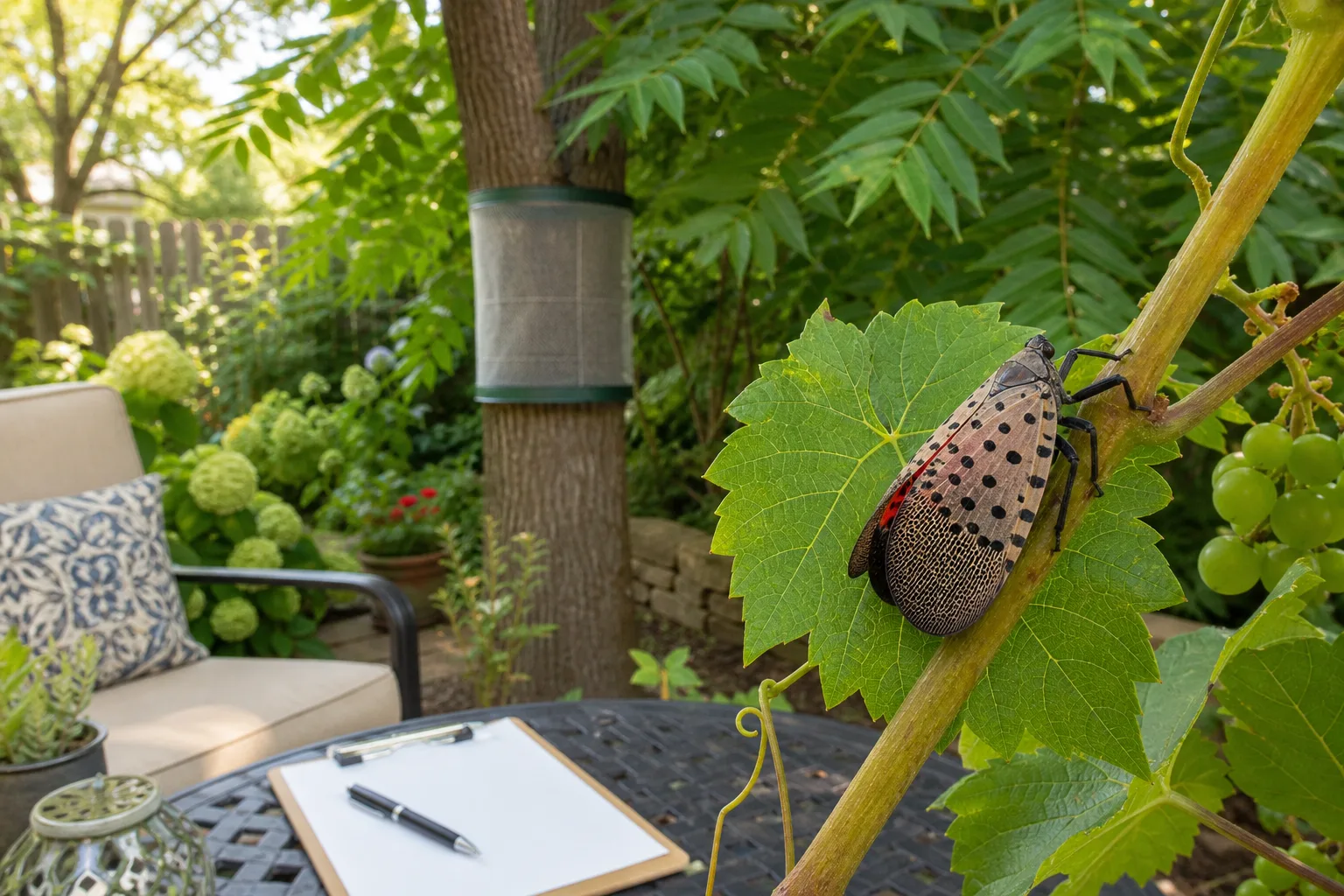
The short answer is: photograph it, confirm the identification, follow your local reporting rule, kill it if you can, and then inspect the things that might move it somewhere else. The longer answer matters because a panicked response can damage the yard more than the insect you found.
Spotted lanternfly, Lycorma delicatula, is an invasive planthopper first detected in the United States in Pennsylvania in 2014. USDA APHIS lists it as a pest of many plants, including grapevines, hops, stone fruit and hardwood trees. It feeds by piercing plants and drinking sap. Heavy feeding leaves sticky honeydew on leaves, decks, furniture and cars; that honeydew can grow sooty mold and turn an outdoor space into a mess.
The insect’s favorite host is tree-of-heaven, Ailanthus altissima, another invasive species. That pairing is one reason spotted lanternfly spreads so efficiently around disturbed edges, rail lines, roads, parking lots and unmanaged property lines. But it does not stay politely on tree-of-heaven. Penn State Extension treats it as a serious grape pest and a stressor for many backyard and landscape plants. It may not kill most established trees by itself, but it can weaken plants that are already dealing with drought, disease, other insects or bad site conditions.
The timing explains the current wave of sightings. Penn State’s lifecycle guidance places egg laying from roughly September through December, hatch from late April into June, and adult activity from July until hard freezes. Fairfax County’s July public alert made the same seasonal point: the insect starts its final transformation from nymph to adult in July. By late summer the adults are larger, easier to notice, and more likely to gather where homeowners can see them.
That visibility is why 2026 local coverage has picked up again. NorthJersey warned residents that adults are back and should still be stomped out. Farm and Dairy reported spotted lanternfly in Kanawha County, West Virginia, calling it the 22nd West Virginia county with detections. News and Sentinel’s Mid-Ohio Valley gardening column pointed to Wood County and repeated the practical concern for orchards, vines and backyard trees. These are local signals, not proof that every yard is in the same risk category. Reporting rules differ by state and even by county.
For a gardener, identification comes first. Young nymphs are black with white spots. Later nymphs add red patches. Adults are about an inch long, with gray forewings marked by black spots and darker brick-like markings near the wing tips; when the wings open, the red, black and white hindwings are obvious. Egg masses look less dramatic: a flat, muddy gray or beige smear on bark, stone, metal, plastic, patio furniture, vehicles, firewood, trailers, toys or outdoor equipment.
Do not assume every spotted insect is a spotted lanternfly. Good identification matters because “kill it” advice spreads faster than careful context. A mistaken ID can mean killing harmless native insects, cutting the wrong tree or spraying when there is no spotted lanternfly problem at all. If you are outside an established infestation area, take a clear photo before destroying the insect. Include the date and location, then use your state agriculture department, extension service or local invasive-pest reporting form.
The next question is whether to report. In a new or watch area, reporting a confirmed sighting can be more important than stomping the single adult. Agencies need location data to track new counties and quarantine edges. In heavily established areas, local guidance may simply ask residents to destroy the insects and reduce spread. If you are not sure which category you are in, check USDA APHIS, StopSLF, your state agriculture department or your county extension office before assuming the internet’s rule applies to your address.
Then check movement. Spotted lanternfly spreads partly because people move its life stages without noticing. USDA and Penn State both stress checking vehicles and outdoor equipment when moving into or out of quarantine areas. The boring list is the important list: cars, trailers, campers, grills, patio furniture, plant pots, bikes, toys, lawn equipment, firewood and building materials. Egg masses on hard surfaces are easy to miss. If you are taking a grill to a cabin, hauling firewood, moving potted plants or driving a camper out of an affected county, inspect first.
For plants, prioritize the ones that actually need protection. Grapevines deserve attention. So do young black walnut, tree-of-heaven, fruit trees and stressed ornamentals. Look for clusters of insects on trunks and stems, sticky honeydew, sooty mold and increased wasp or ant activity attracted to the sugar. A single adult on a fence does not mean every tomato, rose and hydrangea needs treatment.
Mechanical control is the safest first step in most home landscapes. Adults and nymphs can be crushed or knocked into a container of soapy water. Egg masses can be scraped into alcohol or hand sanitizer, or bagged and disposed of according to local guidance. Traps can help on trees with heavy activity, but the trap type matters.
Open sticky bands are a common mistake. They can catch birds, squirrels, beneficial insects and other wildlife if used carelessly. Extension guidance increasingly favors circle traps, or sticky bands only when they are properly guarded with mesh or a wildlife barrier. If a trap looks like it could catch anything that touches the trunk, it is not a set-and-forget solution for a backyard with birds and pollinators.
Tree-of-heaven control is useful but easy to do badly. First, identify the tree correctly. Tree-of-heaven can be confused with native sumac and black walnut by people working too fast. Look for smooth leaflet edges with small glandular teeth near the base, a strong unpleasant odor when crushed, and the overall leaf pattern. If you are not confident, ask extension, a local arborist or an invasive-plant group before cutting.
Second, do not just cut a mature tree-of-heaven and walk away. It can resprout aggressively from roots. Many extension programs recommend a planned treatment approach, often involving targeted herbicide at the right season and leaving treated trees standing long enough to move the herbicide through the root system. Homeowners who are uncomfortable with herbicides or dealing with large trees should get local advice instead of improvising near property lines, utilities or desirable trees.
Insecticides are the part where restraint matters. Penn State’s management guide is clear that chemical control can be appropriate, but it is not a blanket summer ritual. Never spray blooming plants, because pollinators can be exposed. Do not treat nymphs early and assume that prevents new arrivals later in the season. Follow the product label, local law and extension guidance. If the problem is a few adults on patio furniture, a broad spray over flowers and lawn edges is a poor trade.
A better yard plan is boring and targeted. Keep plants healthy with watering and mulch where appropriate. Remove or manage tree-of-heaven if it is truly present and you can do it correctly. Protect grapes and high-value young trees first. Use mechanical removal where numbers are low. Use guarded traps where activity is concentrated. Save insecticides for heavy pressure on important plants, and choose timing and products that reduce harm to pollinators and beneficial insects.
The social-media anger around spotted lanternfly is understandable. It is invasive, it spreads on human stuff, and it can hurt vineyards and nurseries. But garden work is full of unintended consequences. A homeowner can accidentally move eggs on a trailer, trap a bird on an exposed sticky band, remove a native tree mistaken for tree-of-heaven, or spray blooming plants because a stranger said “kill them all.”
Use this one-minute check when you see a suspect insect. First, take a photo. Second, confirm the stage: black-and-white nymph, red-and-black older nymph, gray spotted adult, or mud-like egg mass. Third, check your local map and reporting rule. Fourth, kill the insect or destroy the egg mass if guidance supports it. Fifth, inspect the items most likely to travel: vehicle, trailer, grill, outdoor furniture, firewood, pots, bikes and tools. Sixth, look at grapes, tree trunks and tree-of-heaven before treating the whole yard.
That is the useful middle path: do not ignore spotted lanternfly, and do not turn one insect into a chemical emergency. A careful gardener can slow the spread, protect the plants that matter, and avoid becoming the bigger problem in the yard.
Related articles
Late blight turns one tomato plant into a neighbourhood problem
Confirmed regional alerts change the home-garden response: diagnose carefully, check local disease reports, and remove truly infected tomatoes or potatoes before they spread spores.


Plantain pancakes in Spain: a simple way to cook plátano macho
In Spain, plátano macho is the banana you buy when you want to cook rather than peel and eat. Here is what makes it different, where it fits in Spanish kitchens, and how to turn a ripe one into tender, crisp-edged pancakes.

Comments
Sign in to comment.
No comments yet.