Wire-free robot mowers in 2026: buy now, wait, or keep the trimmer?
The newest robot mowers can map lawns without a buried wire, but trees, edges, slopes, setup cost and nighttime wildlife safety still decide whether they save your summer or create a new chore.

A wire-free robot mower sounds like the perfect August purchase: the grass keeps growing, weekends are already full, and the newest machines promise app mapping instead of a buried perimeter wire. The category really has changed. Current consumer tests and manufacturer lines now talk about RTK-GPS, cameras, vSLAM, LiDAR, all-wheel drive and hybrid navigation rather than one loop of cable around the lawn. But the useful question in 2026 is not whether these mowers exist. It is whether your specific yard is simple enough, safe enough and supported enough for a robot to become a helper rather than another summer project.
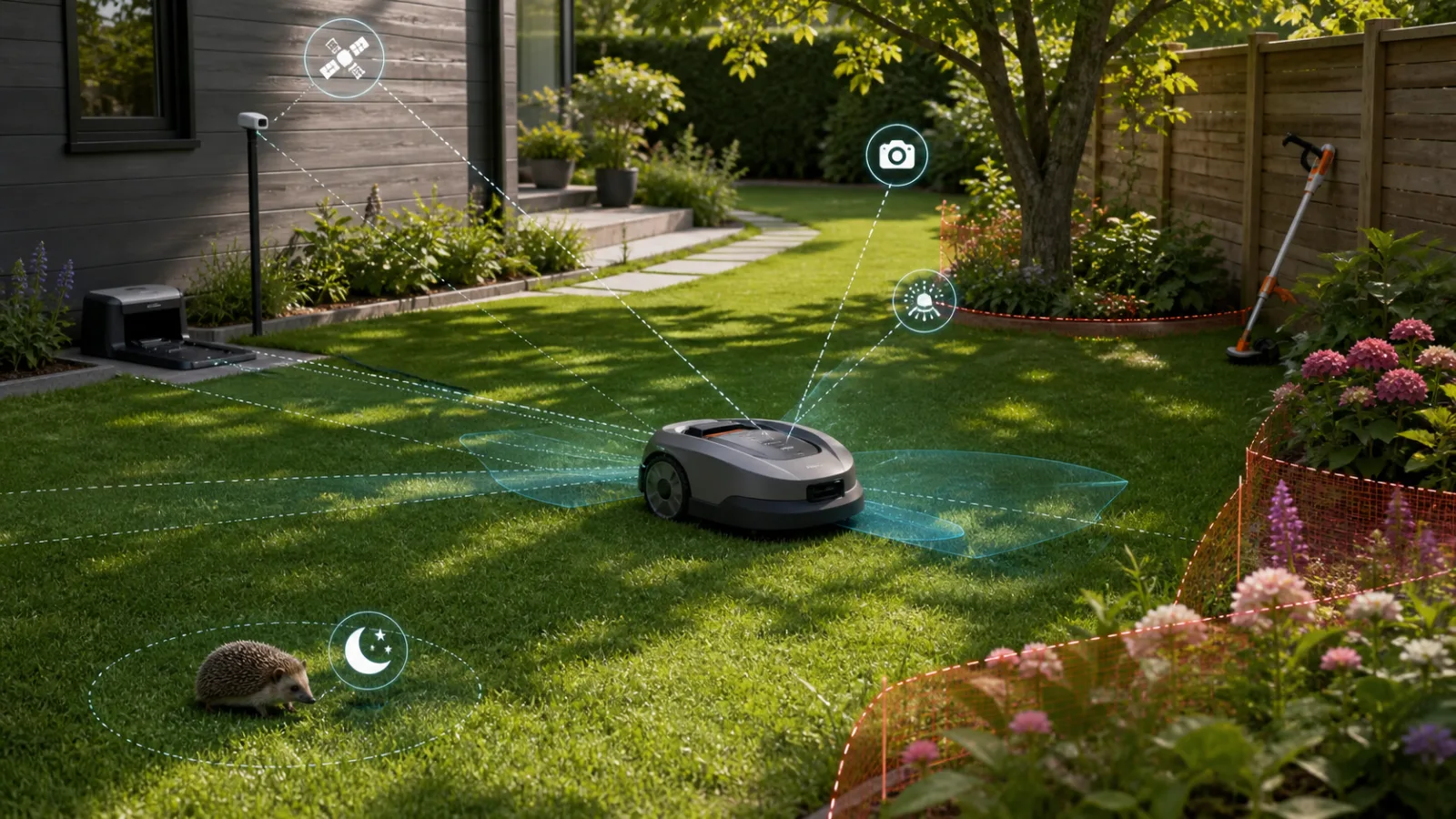
What changed: the wire is no longer the only map
Older robotic mowers usually depended on a boundary wire. The wire was reliable once installed, but installation could mean trenching, stapling, repairs after aeration, and extra loops around beds, paths or ponds. The new selling point is wire-free setup: drive or draw the boundary in an app, let the mower localize itself, then set zones, no-go areas and schedules. Consumer Reports notes that newer tested robotic mowers can use AI vision, GPS, vSLAM, lidar or other sensors, and that the models in its 2026 tests did not require perimeter wire. WIRED’s August 2026 mower guide makes the same broader point from the buyer side: smart mowers are expensive, but the best current machines are finally good enough to consider for people who want the lawn tamed without doing all the mowing themselves.
That does not mean every wire-free mower navigates the same way. RTK systems use satellite positioning corrected by a base station or antenna, so they need a decent view of the sky and careful station placement. Camera and vision systems read the lawn from the mower’s perspective, which can help near objects but can be weaker in darkness, glare, rain or visually confusing edges. LiDAR can give a mower a more geometric sense of obstacles and borders. Hybrid designs try to combine these strengths, yet none of them repeal physics: trees, walls, narrow passages, metal structures, steep slopes, wet turf and badly defined edges still matter.
What a robot mower does well
A good robot mower is best understood as a maintenance tool, not a rescue tool. It works by cutting little and often, usually leaving tiny clippings that disappear into the turf rather than producing heavy bags of grass. On a reasonably open lawn, that can keep the surface looking more even than a rushed once-a-week cut. It can also move a recurring chore out of the hottest part of Saturday, reduce petrol fumes compared with a gasoline walk-behind mower, and let a person with limited time or mobility keep a small lawn under control.
The time saving is real when the yard suits the machine. Consumer Reports quotes the robot-mower value proposition plainly: it is for someone looking to save an hour or two a week, but it will not do everything. Owners still need to learn the app, place the dock, remove obstacles, change blades and decide when the mower should not run. The best outcome is boring: the mower leaves the dock on a sensible schedule, trims a few millimeters, returns to charge, and the owner mostly notices that the lawn stopped becoming a weekend emergency.
What it does not do
A robot mower will not turn a rough meadow, tall weeds or neglected holiday lawn into a finished lawn in one pass. Many models are designed for frequent upkeep and a limited cutting height, not for knocking down overgrown grass. If you return from a long trip to a knee-high patch, you may need a normal mower first and the robot afterward. That point matters in August because buyers often reach for automation precisely when they are tired of catching up.
Edges are the second reality check. Fences, raised beds, walls, drainage channels, gravel borders and tree rings can leave strips that still need a string trimmer. Some models cut closer than others, some use edge modes, and some need the boundary drawn very carefully. Even so, a robot’s spinning blades are inside its body for safety. That geometry is good for feet and pets; it is bad for shaving every centimeter beside a wall. If your definition of a finished yard includes crisp borders around every bed, keep the trimmer in the budget.
Obstacles are the third check. A mower that can avoid a ball in a test may still dislike hoses, low toys, fallen branches, dog mess, loose stones, irrigation flags, garden netting or a sandal hidden in long grass. Before buying, walk the yard at mower height. Anything that could snag a deck, confuse a camera or become a projectile belongs on the setup list, not in the marketing fantasy.
The yard checklist before you compare models
Start with shape, not brand. A plain rectangle with open sky is a much easier robot yard than a charming garden with three separated lawns, fruit trees, a narrow side passage, raised beds, a trampoline, a slope and a gravel path between zones. Measure the actual mowable area, then add margin. A mower rated for the exact size of your lawn may be forced to run too often, especially if slopes, obstacles or zones slow it down.
Check the route from dock to lawn. The charging station needs power, drainage, a stable surface and enough straight approach space. An RTK antenna may need a higher or clearer location than the dock itself. If the front yard and back yard are separated by steps, gates, a driveway or a public sidewalk, ask whether the mower can move between zones safely or whether you will have to carry it. Carrying a heavy robot every few days is not automation; it is a new chore with a handle.
Then look upward. RTK guidance can be excellent on open ground but vulnerable beneath dense trees, close to tall buildings or under deep eaves. A camera-based mower may be happier under tree cover but weaker at night or in harsh contrast. LiDAR and hybrid systems can help, but you still need a plan for signal shadows. If your best lawn is under mature maples, do not buy from a spec sheet alone; look for owners with similar tree cover and a return policy that survives a real test week.
Finally, list the sensitive places: ponds, vegetable beds, wildlife corners, children’s play areas, dog runs, irrigation heads, cables, slopes that stay damp, and any spot where a stuck mower would be more than an inconvenience. Good app mapping lets you draw no-go zones. Good ownership means drawing them generously at first and tightening the map only after several daylight runs.
Cost realism: the mower is not the whole bill
The headline price can run from roughly the high hundreds to several thousand dollars or euros depending on size, drive system, navigation and brand. That purchase has to be compared with your real alternative: a battery walk-behind mower, a lawn service, a shared neighborhood tool, or simply less lawn. But hidden costs matter too. Expect replacement blades, occasional repairs, battery aging, protective storage, possible cellular or cloud features, antenna accessories, a trimmer for edges and your own setup time.
Sizing is also a cost issue. Buying the smallest model that technically covers the area can turn into long daily runs, more visible wheel paths, more weather interruptions and faster frustration. Buying a larger or all-wheel-drive model may be sensible for slopes and complicated yards, but it can also be overkill on a flat townhouse lawn. The right question is not “Which mower is best?” It is “Which failure mode is most likely in this yard: navigation, traction, edges, area, support or safety?”
Safety is not only a spec line
Modern robotic mowers include lift sensors, tilt sensors, blade-stop behavior and obstacle detection, and reputable tests include scenarios with toys, balls, lawn debris, slopes and safety stops. Those features matter. They still do not justify sending a mower through a busy yard while children are playing, a dog is carrying toys across the grass, or guests are walking barefoot after dinner. The safest schedule is usually when people and pets are indoors and the lawn is visible enough for the mower’s sensors to work well.
Night mowing deserves special caution. Some owners like the idea because the yard is empty and the machine is quiet. Yet camera-based navigation may perform worse at night, and wildlife risk rises precisely when many small animals are active. The Leibniz Institute for Zoo and Wildlife Research has warned that nighttime collisions with robotic lawn mowers are a significant animal-welfare and conservation problem for hedgehogs. Its researchers analyzed 370 reported cut-injury cases in Germany; among the reported injured animals, 47 percent did not survive. The institute also notes why hedgehogs are especially vulnerable: they are nocturnal and often freeze rather than flee.
That data should not be inflated into a universal claim about every animal in every country, but it should change the default setting. In hedgehog regions and in any yard with nocturnal small wildlife, do not run a robot mower at night. Some German local authorities have already implemented night restrictions, and German mayors have called for broader bans. For a homeowner, the practical rule is simpler than the policy debate: if the machine is unattended and the sensors have not been proven against small animals, daylight mowing is the responsible baseline.
What owner debates reveal
Forum and Reddit discussions around robotic mowers are useful because they are less polished than buying guides. The happy owners tend to have a recurring profile: they hate mowing, have a fairly open lawn, accept app tinkering, size the mower generously and treat edge trimming as a separate job. The frustrated owners often describe the opposite: difficult zones, trees blocking satellite accuracy, undersized machines, wet slopes, support delays, unexpected installation work, or disappointment that a costly robot still leaves borders and cleanup to the human.
The wire-versus-wireless debate is therefore not settled by modernity alone. A well-installed wire system can be predictable on some complex properties. A wire-free RTK or vision mower can be much easier to set up on an open lawn. A hybrid machine may be the best bet where one sensor type struggles. The mistake is assuming that no wire means no boundary thinking. You still have to tell the mower where the garden ends, where the flowers begin, what slopes are unsafe, and what times are unacceptable.
A practical setup plan if you buy
Map in daylight. Start with conservative boundaries and oversized no-go zones around beds, ponds, tree roots, toys, low lighting cables and wildlife areas. Watch the first runs instead of leaving the mower to prove itself alone. Raise the cutting height during heat or drought rather than scalping already stressed turf. Keep blades sharp, because dull blades tear grass and make a small machine work harder. Remove hoses, shoes, pet toys and fallen branches before scheduled runs. Keep a manual mower or service option for the first tall-grass reset and for breakdown weeks.
Do not turn on every clever setting on day one. First prove that the mower can dock reliably, cover the main zone, avoid obvious obstacles and recover from a pause. Then add secondary zones, tighter edges and more complex schedules. If a model depends on cloud access or a subscription for features you consider essential, treat that as part of the product, not a footnote. If theft worries you, check PIN locking, GPS tracking, physical anchoring, insurance assumptions and whether the dock location is visible from the street.
Buy now, wait, or skip?
Buy now if your lawn is open, fairly even, easy to map, within the mower’s realistic capacity, and you are willing to spend a weekend learning the system. You should also be comfortable keeping a trimmer for edges, scheduling daylight runs in wildlife areas and doing small maintenance tasks such as blade changes and software updates.
Be cautious if your yard has dense tree cover, narrow passages, separate front and back lawns, steep or damp slopes, lots of garden beds, small children or pets outside throughout the day, weak dealer support, or no good place for a dock and antenna. In that case, a local demonstration, generous return window or simpler wired system may be worth more than the newest navigation acronym.
Skip or wait if you mainly need to reclaim an overgrown meadow, dislike app-dependent equipment, have serious privacy or cloud concerns, cannot supervise the first runs, or want a machine that eliminates all edging and cleanup. Robot mowers are much better than they were, but they are not magic grass servants. They are small autonomous tools that reward tidy boundaries, realistic expectations and responsible scheduling.
The best purchase decision, then, begins before the model comparison. Walk your yard with a notebook. Mark shade, slopes, obstacles, borders, power, Wi-Fi, wildlife and the places you already hate trimming. If that map looks simple, a wire-free mower may genuinely give back summer hours. If the map looks like a puzzle, the smarter move may be to simplify the lawn first, choose a different tool, or wait for one more generation of machines.
Related articles
Fall Planting After a Hot Summer: How to Establish Trees and Shrubs Without Wasting Water
Early fall can be a better planting window than spring, but only if the soil, root ball and watering plan are ready. This practical checklist covers what to plant, what to postpone, how to water, and which common shortcuts quietly kill new plants.
Do not rake every leaf: a practical fall cleanup plan for lawns, beds and pollinators
The best autumn yard cleanup is not total removal or total neglect. Zone the yard so leaves feed soil where they help and move them where they cause damage.


BIND 9.20.29 fixes 14 security flaws: what DNS operators should check before and after upgrading
ISC’s BIND 9.20.29 is more than routine maintenance: it fixes fourteen disclosed vulnerabilities across recursive, authoritative and encrypted-DNS code paths. Here is how to scope the exposure, choose the right branch and upgrade without losing operational visibility.


Smart home subscriptions are becoming the real price of cheap cameras
Budget hardware is getting easier to buy, but video search, AI summaries and smarter assistants increasingly sit behind monthly plans.
Comments
Sign in to comment.
No comments yet.