Arctic Permafrost Gets a Small, Testable Defense: Can Woody Blankets Stop Carbon-Rich Slumps?
A Canadian field trial is testing whether wood shavings, native seeds and coconut-fibre mats can slow the rapid erosion of thawing permafrost. The first result is encouraging, but it is one site, one summer and not yet a verified climate solution.

A Canadian start-up has begun testing an unusually practical response to a difficult climate problem: laying a biodegradable, insulating blanket over the edge of an Arctic permafrost slump. The material is made from wood shavings, soil, native seeds and a burlap-like mat woven from coconut husks. Its purpose is not to freeze the entire Arctic or reverse global warming. It is to slow one destructive local process long enough for the ground surface to stabilize and vegetation to return.
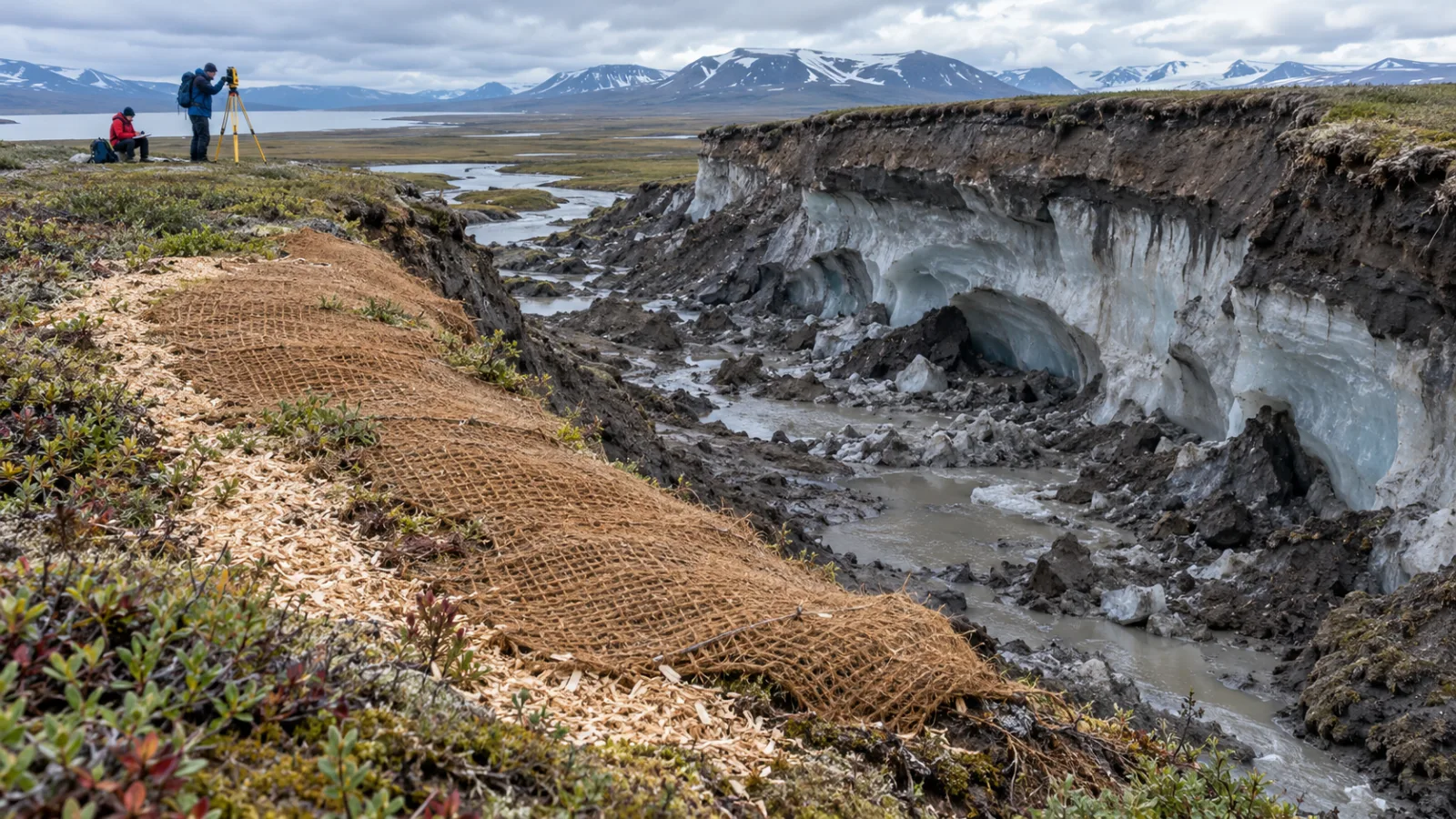
The first field result is encouraging. At a rapidly eroding site in Canada’s Northwest Territories, the untreated edge of a thaw slump retreated by about five metres over the summer, while the section covered by the blanket showed no measurable retreat. That comparison comes from one site and one season, and the company has not yet released a full dataset. Still, it points toward a form of climate adaptation that is concrete, monitorable and modest in its claim.
The useful question is therefore not whether a mat can “save the permafrost.” It cannot. The better question is whether targeted erosion control can protect especially vulnerable patches of carbon-rich ground, infrastructure and habitat while researchers learn which interventions work, where they work and for how long.
Why a thaw slump matters
Permafrost is ground that stays at or below 0°C for at least two consecutive years. It is not simply a layer of ice. It is a mixture of mineral soil, frozen water and organic matter: roots, leaves, peat and the remains of organisms that accumulated over long periods while cold conditions slowed decomposition. Across the Arctic and sub-Arctic, that frozen organic material represents a large carbon store.
When the ground thaws, microbes can begin breaking down material that had been protected from them. Some of the carbon leaves as carbon dioxide. In waterlogged, oxygen-poor conditions, some is converted to methane, a much more powerful greenhouse gas over shorter time periods. The exact balance varies with soil chemistry, drainage, vegetation, temperature and the shape of the landscape. There is no single “permafrost emission rate” that applies everywhere.
Gradual thaw is already difficult to measure. Rapid erosion is harder. A retrogressive thaw slump begins when a thawing section of ice-rich ground loses support and collapses. Meltwater and rain then remove soil from the exposed face. The headwall retreats, exposing another slice of frozen material, which can thaw and collapse in turn. A slump can consume a large area of terrain in a short time, especially after wildfire, vegetation loss, unusually warm weather or changes in drainage.
The climate significance comes from the combination of disturbance and exposure. A slowly thawing surface may release carbon over time. A collapsing slope can expose deeper, older and more carbon-rich layers to warmth, air and flowing water. It can also move organic matter into ponds and streams, where microbial decomposition may continue under different chemical conditions. Researchers still face substantial uncertainty in converting the geometry of a slump into an estimate of carbon dioxide and methane emissions, but the mechanism is not speculative: thaw and erosion make previously frozen material available for decomposition.
That is why a small patch of ground can matter beyond its immediate footprint. The global climate effect of one treated slump would be negligible. A large number of high-emission slumps, however, could add a measurable amount of greenhouse-gas forcing. The reverse is also important: protecting one slump does not offset emissions from fossil fuels, and it does not make continued warming safe.
What the blanket is designed to do
PermaC, the Canadian company behind the trial, is working with a simple sequence of physical controls. A layer of wood shavings and soil is placed over the vulnerable edge. Native seeds are included to encourage plant recovery. A mat made from coconut husks helps keep the material in place while vegetation establishes. The woody layer can also provide insulation, although its thermal effect will depend on thickness, moisture, snow cover and the local ground structure.
The intervention targets the boundary where the slump is advancing. That is strategically important. Covering an entire Arctic landscape would be impossible and would create its own ecological and logistical problems. Stabilizing an active headwall or exposed margin is more like erosion control used in other environments: reduce the movement of soil, protect the surface, and give plants a chance to rebuild a living cover.
Vegetation can help in several ways. Roots bind surface material. Stems and litter reduce the direct force of rain and runoff. Plant cover can alter snow distribution and soil moisture. Over time, a recovering surface may be more resistant to being stripped away than bare, collapsing ground. The same intervention can therefore have mechanical, biological and thermal effects, though the relative importance of each must be measured rather than assumed.
The idea also has a local precedent. Cansu Culha, a co-founder of PermaC and a natural-hazards researcher at the University of British Columbia, has described learning from Indigenous communities in Alaska that plant trees along the edges of degrading permafrost. The company is adapting the broader principle of using vegetation and surface material to hold ground together. That does not turn the commercial trial into an Indigenous technology transfer by itself; any responsible scale-up would need clear relationships with communities, attention to local land governance and respect for knowledge rather than treating it as a decorative origin story.
The use of coconut fibre may seem geographically odd in the Arctic. It is being used as a transportable erosion-control material, not as an Arctic crop. Its usefulness will depend on supply chains, cost, durability and what happens after the mat decomposes. If the material must be shipped long distances, its embodied emissions and field logistics belong in any serious assessment. A biodegradable product is not automatically low-impact in every deployment scenario.
What the first result actually shows
The reported field comparison is straightforward: the unblanketed edge retreated approximately five metres during the Arctic summer, while the treated section showed no measurable retreat. That is a meaningful early observation because it compares exposed and treated sections in the same general landscape and measures a physical outcome that can be checked in the field.
It is not yet proof that the blanket reduced greenhouse-gas emissions. The trial was not reported as a full carbon-accounting experiment, and the company has not released the complete results from the test. A stable-looking edge may still release carbon through soil respiration, drainage or decomposition. Conversely, preventing erosion may protect carbon that would otherwise be exposed, but the size of that avoided release cannot be inferred from the five-metre difference alone.
Christina Schaedel, a permafrost scientist at the Woodwell Climate Research Center who has advised the company, described the observation as promising while emphasizing that it came from one slump over one summer. That qualification is central. Arctic landscapes vary sharply over short distances. Ice content, slope angle, water flow, vegetation, snow depth and soil carbon can all change the result. A blanket that works on a gently sloping, carbon-rich headwall may fail on a wet, unstable cliff or be unnecessary on a site where natural revegetation is already progressing.
The next step is replication. A credible evaluation would compare multiple treated and untreated areas over several seasons, ideally across different permafrost types and climatic conditions. It would track headwall movement, ground temperature, active-layer thickness, soil moisture, vegetation establishment, runoff, carbon dioxide and methane fluxes. It would also document whether the material itself shifts, tears, freezes into the ground, becomes buried by snow or changes drainage.
A useful trial should include failure as a possible result. If the blanket prevents erosion but makes methane emissions worse by creating wetter conditions, that matters. If plants establish but the permafrost continues to warm beneath the cover, that matters too. The intervention should be evaluated as a coupled land-surface experiment, not judged only by whether the visible slope looks greener.
The scale of the claimed opportunity
PermaC has made a preliminary estimate that an average carbon-rich slump might be associated with roughly 2,200 tonnes of carbon-dioxide-equivalent emissions per year that could potentially be avoided by stabilization. The company has discussed an ambitious goal of treating 20,000 slumps across Canada and Alaska over the next decade, which would imply roughly 40 million tonnes of avoided emissions annually if the underlying assumptions proved accurate and the treatment worked at every site.
Those figures are scenarios, not measured outcomes. They combine an estimate of emissions from an “average” slump with an estimate of how many slumps might be treatable. Neither term is simple. Slumps differ in size, age, carbon density, water regime and rate of retreat. Some may be emitting mostly carbon dioxide; others may produce more methane. Some may stabilize naturally. Others may be too remote, steep or active for safe installation.
The number of suitable sites is also not the same as the number of sites that can be treated. Workers and equipment would have to reach locations that may be far from roads, airstrips or ports. Materials would need to be transported, anchored and inspected. In many places, the seasonal window for field work is short. The treatment might require maintenance after extreme rainfall, wildfire or a second collapse. A deployment plan would have to account for community priorities, wildlife disturbance, waste management and the risk of introducing unsuitable seed material.
The estimate is still useful if it is treated as a research hypothesis. It sets a scale for what would need to be true before the approach could become significant: the blankets would have to work repeatedly, remain affordable and deliver verified carbon protection at a large number of high-emission sites. Each of those conditions can be tested. None should be accepted because a single summer looked favorable.
Why site selection may decide the outcome
The most promising locations are unlikely to be chosen simply because they are easy to photograph. They should be selected because they combine rapid retreat, high carbon density, a realistic chance of stabilization and a clear monitoring plan. The intervention might also make sense near infrastructure or community-use areas where erosion creates immediate safety and access problems.
A new preprint on permafrost thaw illustrates why local detail matters. Researchers using a decade of fine-scale satellite imagery and a deep-learning classifier found that ice-wedge degradation did not follow one uniform progression. Thaw developed through multiple, asynchronous and nonlinear pathways shaped by landforms and local ecohydrological feedbacks. In plain language, neighboring areas can respond differently even under the same regional warming trend.
That finding argues against a blanket policy of blanketing. Remote sensing can help identify changing slopes and prioritize field checks, but intervention design still needs ground measurements. A model can locate a rapidly changing patch; it cannot by itself tell engineers whether a layer of wood fibre will drain, insulate, erode or trap water at that exact site. The best workflow would combine satellite observation, local knowledge, field surveys and repeated measurements after installation.
Permafrost is also affected by the vegetation above it. A 2026 study in Nature Climate Change estimated that forest canopies can thermally protect a very large pool of frozen soil carbon in the continuous permafrost zone. That work highlights an important asymmetry: losing vegetation may mobilize much more soil carbon than the carbon stored in the vegetation itself. A local blanket that helps revegetation could therefore have benefits that are not captured by counting only the material placed on the ground. But the same study also shows why disturbance prevention and ecosystem stewardship may be more valuable than trying to engineer every already-damaged site.
This is adaptation, not a substitute for emissions cuts
The direct climate solution remains familiar: reduce greenhouse-gas emissions from energy, industry, transport, buildings and land use. Lowering future warming is the only way to reduce the pressure driving widespread permafrost thaw. Local stabilization can protect a vulnerable site, but it cannot stop the climatic cause of the problem.
That distinction matters because carbon-removal markets may be interested in the idea. PermaC has been developing a methodology that a third party could use to verify avoided emissions, and the company has discussed issuing carbon credits. Credits based on avoided permafrost emissions would face difficult accounting questions. What would have happened without the project? Would the slump have retreated anyway? How long does the protection last? Does carbon move elsewhere in the landscape? Does the treated site displace emissions rather than prevent them?
The permanence issue is especially serious. A blanket that works for three years but is destroyed by a major storm has not delivered the same climate service as a treatment that protects the site for decades. Carbon accounting would need to include monitoring, maintenance, reversal risk and uncertainty. It should also distinguish between avoided carbon dioxide and avoided methane, because the timing and climate effects differ.
There is a broader principle here. Climate adaptation technologies are often judged by whether they can be scaled, but scale is not only a matter of manufacturing. It includes governance, verification, maintenance and local legitimacy. A physically simple intervention can become complicated when it is deployed across thousands of remote landscapes. The more a project claims climate value, the more transparent its baseline, measurements and uncertainty need to be.
What would count as convincing evidence
A stronger evidence base could be built in stages. First, researchers would need independent measurements from several treated and untreated slumps. The study design should be published before results are interpreted, with clear definitions of retreat, stabilization and treatment success.
Second, monitoring would need to continue beyond the first growing season. One summer can bring unusual rain, snow or temperature conditions. Permafrost responds over years, and the treatment may behave differently during spring thaw, autumn freeze-up and winter snow accumulation. At least several years of observations would provide a better test of durability.
Third, carbon measurements should accompany physical measurements. Ground-based chambers, automated sensors, gas sampling, water chemistry and remote observations can each capture part of the picture. No single instrument can reliably estimate the climate effect of a complex thaw slump. The measurement plan should report both carbon dioxide and methane where feasible, along with uncertainty ranges.
Fourth, the evaluation should examine unintended effects. Does the mat divert runoff into a neighboring area? Does it alter snow cover enough to warm the soil? Do the seeds establish a diverse native plant community? Does the coconut fibre degrade as expected? Does imported material bring contaminants or viable non-native organisms? Do animals use, avoid or disturb the treated area?
Finally, a full assessment should compare the intervention with alternatives. In some locations, protecting existing vegetation or redirecting water may be cheaper and more effective. In others, a small amount of surface material may protect a road, airstrip or community access route. The right comparison is not always “blanket versus nothing.” It may be “blanket versus revegetation alone,” “blanket versus drainage control,” or “blanket versus relocating infrastructure.”
The good news is the testability
The encouraging part of the Arctic blanket experiment is not that it promises to engineer the climate back to normal. It is that the proposal makes a narrow claim that can be challenged with measurements. A treatment either slows headwall retreat under defined conditions or it does not. It either helps vegetation establish without creating new problems or it fails that test. Its carbon benefit can be estimated more honestly as evidence accumulates.
That is a healthier model for environmental technology than a grand promise. The intervention is aimed at a particular failure mode: rapid erosion at thawing permafrost slumps. It acknowledges that fossil-fuel emissions remain the root driver. It has a visible early result but also an obvious limitation: one site and one summer. Its larger claims are projections that require independent verification.
If future trials reproduce the result, the blankets could become one tool in a site-specific Arctic adaptation toolkit. They might protect carbon-rich ground, slow damage near communities and create time for native vegetation to return. They might also show that some permafrost interventions are not about preserving every frozen landscape indefinitely, but about reducing the speed and severity of the most destructive local changes.
For now, the right verdict is measured optimism. The Arctic is losing frozen ground because the climate is warming, and no biodegradable mat changes that fact. But a carefully monitored piece of field engineering may still prevent a vulnerable slope from becoming a larger source of emissions. That is not a miracle. It is a small intervention with a real result, a clear uncertainty and a research path that can prove it right or wrong.
Sources and further reading
- Nature: Woody “blankets” are being deployed on Arctic permafrost to reduce carbon emissions — reporting on the PermaC field trial, its early retreat measurements and the company’s preliminary emissions estimates.
- NOAA Arctic Report Card 2025 — peer-reviewed annual assessment of Arctic environmental change, including permafrost-related impacts and the role of sustained observation.
- NASA: Helps find thawing permafrost adds to near-term global warming — satellite-supported context on greenhouse gases from northern permafrost landscapes.
- Braun, May and Andresen, “Permafrost thaw follows spatially organized, nonlinear trajectories in ice-wedge terrain” — open preprint on fine-scale patterns of thaw and the limits of treating permafrost as uniform.
- Stuenzi et al., “Canopy-mediated climate feedbacks in the boreal continuous permafrost zone” — peer-reviewed study of how forest canopy affects ground temperature and frozen soil carbon.
- Monteux et al., “Active layer microbial inocula restore missing functions across thawed permafrost soils” — peer-reviewed research on biological processes that change after permafrost thaw.
Comments
Sign in to comment.
No comments yet.