The Southern Ocean Stored More Ice-Age Carbon Because Sea Ice and Circulation Worked Together
A new Science Advances study explains why Antarctic sea ice alone could not account for ice-age carbon storage. The key was a coupled change in sea ice and ocean circulation that shortened the time carbon-rich water spent exposed to the atmosphere.

The most useful part of a new ice-age climate study is not the familiar claim that cold oceans can hold more carbon. That mechanism is real, but it is not enough to explain the size and character of the carbon dioxide drop recorded during glacial periods.
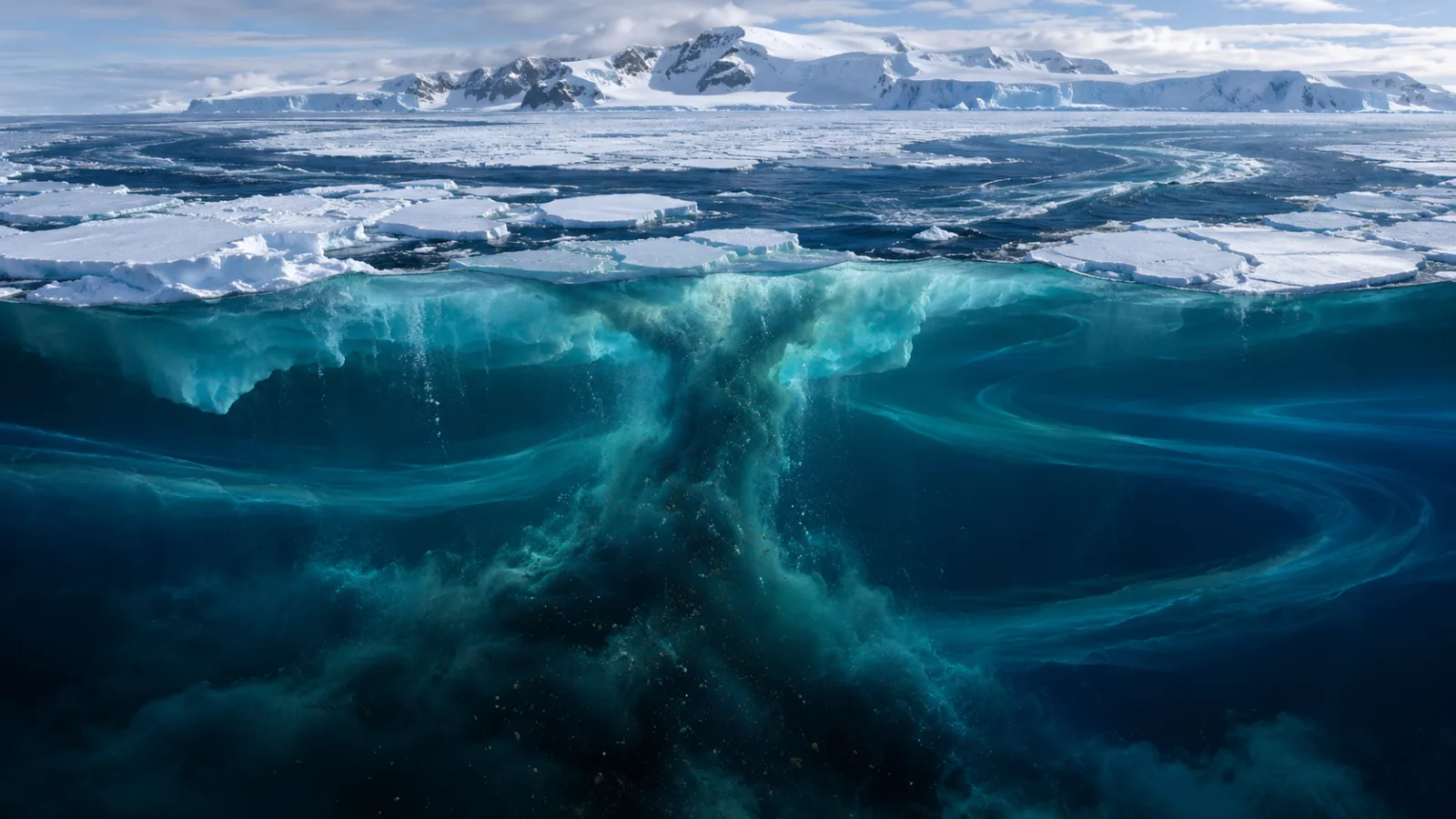
The stronger result is about timing and connection. Researchers from MIT and the Université du Québec à Rimouski find that expanded Antarctic sea ice and a changed Southern Ocean circulation reinforced each other. Acting together, they reduced the time that carbon-rich deep water spent in contact with the atmosphere. Much of that carbon was then returned to the ocean interior instead of escaping into the air.
The study, published in Science Advances, helps resolve a problem that has persisted in paleoclimate research: several plausible mechanisms can store carbon during an ice age, but some of them produce the wrong result when tested on their own. The new model experiments suggest that the answer is less a single “carbon pump” than a change in how the Southern Ocean connects its deep reservoir to the sky.
The missing carbon in an ice age
During the recurring glacial cycles of the past 800,000 years, atmospheric carbon dioxide was substantially lower during cold periods than during the warmer interglacials. At the Last Glacial Maximum, roughly 20,000 years ago, global temperatures were several degrees lower than today and atmospheric CO₂ was around 80–90 parts per million below preindustrial levels, according to MIT’s paleoclimate research overview.
The missing atmospheric carbon did not disappear. Geological and chemical evidence indicates that a large share was stored in the deep ocean. The difficulty is identifying the physical route by which carbon reached that reservoir and remained there for thousands of years.
The ocean has several ways to take up and retain carbon. Cold water can dissolve more CO₂ than warm water, and dense polar water can sink. Phytoplankton remove carbon from surface waters through photosynthesis; some of that organic material sinks and is transformed at depth, a process commonly called the biological pump. Ocean circulation can also move carbon-rich water away from the surface and isolate it from the atmosphere.
Those mechanisms overlap. That is precisely why the ice-age problem is difficult. If all the relevant changes are switched on at once in a large climate model, atmospheric CO₂ can fall. But the result does not automatically show which process did the work. A mechanism can appear important in the full simulation while contributing little, or even pushing in the opposite direction, when isolated.
The new paper focuses on that interaction rather than searching for a solitary explanation.
Why the Southern Ocean matters
The waters around Antarctica are a major gateway between the atmosphere and the deep ocean. Strong winds and the shape of the Southern Ocean bring deep, carbon-rich water toward the surface. Once there, that water can exchange gases with the atmosphere. Some of its carbon is released as CO₂; some is absorbed again by biology or carried back down by circulation.
The length of surface exposure matters. A parcel of water that remains near the air for a long time has more opportunity to approach chemical equilibrium with the atmosphere and release carbon. A parcel that is quickly covered, redirected, or returned below the surface can preserve a carbon deficit relative to the amount it could hold at equilibrium. In the paper and the accompanying MIT explanation, this difference is described as disequilibrium carbon.
That term can sound abstract, but the idea is straightforward. The water contains a history. Its carbon content reflects not only temperature and chemistry, but also how long it was exposed to air, what organisms did in the meantime, and where currents carried it afterward.
The Southern Ocean is therefore not merely a cold container. It is a set of moving interfaces: deep water rising, sea ice opening and closing the atmosphere’s access, surface water being pushed by winds, and water masses crossing boundaries at depth.
What the researchers changed in the model
Sandy Grégorio, Jonathan Lauderdale, Louis-Philippe Nadeau, and Raffaele Ferrari used ocean and climate-model experiments to separate several conditions associated with glacial climates. Their central comparison examined Antarctic sea-ice expansion, glacial changes in ocean circulation, and cooler temperatures both individually and in combination.
The results did not treat the three factors as interchangeable.
When Antarctic sea ice was changed on its own, the simulated atmosphere experienced a slight increase in CO₂ rather than the expected drawdown. A circulation change by itself produced a similar counterintuitive outcome. In the model, each isolated change could alter transport in a way that allowed more carbon to reach the atmosphere somewhere else in the system.
The combined experiment was different. When expanded sea ice and glacial circulation operated together, atmospheric CO₂ declined and ocean carbon storage increased. The important storage signal was not dominated by the extra amount of CO₂ that colder water can dissolve. Instead, much of it appeared in the disequilibrium component associated with limited atmospheric exposure.
That distinction is the paper’s main contribution. Cooling still matters, but the results suggest that cooling alone is not the complete explanation for the observed ice-age carbon reservoir. The route to the deep ocean depends on a coupled physical arrangement.
Sea ice as a lid — but only with the right circulation
It is tempting to describe Antarctic sea ice as a lid over the ocean. That image is useful up to a point, but it is incomplete.
Sea ice can reduce the area and duration over which seawater exchanges gases directly with the atmosphere. It also changes heat and freshwater fluxes, influences the density of surface waters, and affects the formation and movement of water masses. Those effects can reshape circulation rather than simply sealing the surface.
If sea ice expands while the underlying circulation continues to connect carbon-rich deep water efficiently to better-ventilated waters, the carbon is not necessarily secure. Mixing across water-mass boundaries can still provide a route back to the surface and then to the air.
The model experiments indicate that glacial circulation helped close that route. In the accompanying MIT Q&A, Lauderdale describes a changed boundary between deep Southern Ocean waters and North Atlantic-origin waters. With a slower Atlantic overturning circulation in the model, that boundary became shallower, reducing mixing across it. The result was greater isolation of the carbon-rich Southern Ocean reservoir.
This does not mean that every real-world slowdown of the Atlantic Meridional Overturning Circulation would automatically increase carbon storage. The researchers explicitly discuss competing effects. Warming and declining Antarctic sea ice could expose carbon-rich water to the atmosphere for longer, promoting carbon loss. A circulation slowdown could reduce one pathway of leakage while other changes opened another.
The lesson is conditional: the response depends on the coupled state of the climate system, not on the direction of one circulation index.
The biological pump is still part of the story
The study does not make biology irrelevant. Phytoplankton continue to move carbon from surface waters into the ocean interior, and the researchers describe the combined sea-ice and circulation changes as enhancing biological carbon storage.
But the paper does not require an external increase in the biological pump to produce the modeled drawdown. That matters because earlier explanations often emphasized additional iron delivered by glacial dust. Iron can stimulate productivity in parts of the Southern Ocean, where phytoplankton may otherwise lack a key nutrient. More productive surface waters could send more organic carbon downward.
The new work points to another way biology and physics can interact. If circulation and sea ice reduce the time that upwelled, carbon-rich water spends exposed to the atmosphere, carbon processed by biology can be retained more effectively in the ocean interior. The biological pump does not have to become dramatically stronger everywhere for the net storage to increase; the surrounding physical system can change the fraction that returns to the atmosphere.
That is a more restrained claim than saying the researchers have identified a natural carbon-removal technology. They have not. They have shown how a set of past climate conditions could produce a modeled storage pattern consistent with paleoclimate evidence.
What the result does — and does not — tell us about today
The obvious modern implication is that the Southern Ocean’s carbon sink cannot be treated as a fixed service. Its capacity depends on temperature, winds, sea-ice cover, stratification, circulation, seasonal biology, and the time that water spends near the surface.
A warmer ocean generally holds less dissolved CO₂ than a colder one. Changes in winds can alter upwelling. Freshening can change density and mixing. Sea-ice loss can increase the area and duration of air–sea contact in some seasons, while changing heat exchange and stratification in others. These processes can pull in opposite directions.
The paper therefore offers a warning against a common shortcut: using an ice-age mechanism as a simple forecast for a warming world. The glacial system had large Northern Hemisphere ice sheets, different wind patterns, extensive Antarctic sea ice, different temperatures, and a reorganized circulation. Reproducing one part of that state today would not recreate the whole system.
The study is still valuable for future climate modeling because it identifies a specific dependency that models must represent: sea ice and overturning circulation need to be evaluated together. A model that gets the average temperature approximately right but exposes carbon-rich Southern Ocean water for the wrong amount of time can still produce a misleading carbon-cycle response.
Recent research underscores the same sensitivity from another direction. A 2026 Geophysical Research Letters study found that recovery of Southern Ocean carbon uptake after negative emissions is slow and spatially uneven, with ocean memory and seasonal processes controlling how the signal moves through the system. The point is not that the two studies make identical claims. It is that carbon uptake is governed by changing circulation and exposure histories, not by temperature alone.
Why this is useful good news
The good news is methodological rather than technological. A long-standing climate puzzle has become more intelligible because researchers tested interactions directly instead of adding up isolated effects.
That improves the quality of the next questions. Scientists can compare the modeled carbon fingerprint with sediment records, radiocarbon ages, carbon isotopes, water-mass tracers, and reconstructions of past sea-ice extent. They can test whether the predicted reduction in atmospheric exposure appears in independent evidence. They can also examine how sensitive the result is to the model’s resolution, mixing schemes, sea-ice physics, and assumptions about glacial boundary conditions.
It also clarifies what would count as progress. The goal is not merely to produce a simulation in which CO₂ falls during an ice age. A convincing model should explain where the carbon sits, how long it remains there, which pathways are blocked, and whether those pathways match observations.
That standard is useful far beyond paleoclimate. The same discipline applies whenever a complicated system appears to deliver a favorable outcome: identify the mechanism, isolate its limits, and check whether the result survives independent evidence.
The limits that remain
The study is based on model experiments. Models are essential for separating causes that cannot be switched on and off in the real past, but their conclusions depend on how they represent ocean mixing, sea ice, biology, gas exchange, and the geography of glacial climates.
The work also addresses a particular family of ice-age states. It does not directly measure the modern Southern Ocean’s future carbon uptake, and it does not establish that changing sea ice or circulation can be used to engineer carbon storage safely. The authors’ conclusions concern the mechanisms that can explain past carbon sequestration under glacial conditions.
There is also no single observation that records the full exposure history of an ancient water parcel. Researchers reconstruct past circulation and carbon storage from different proxies, each with its own uncertainties. Agreement among several kinds of evidence will be important.
Finally, the phrase “the ocean stored carbon” can hide a timescale. Deep-ocean storage over centuries or millennia is not the same as permanent geological sequestration. Carbon can return to the atmosphere when circulation, stratification, sea ice, or biological export changes. Storage is meaningful only alongside a timescale and a pathway.
The practical takeaway
The new result changes the question from “Which single ice-age mechanism removed CO₂?” to “How did the Southern Ocean reduce the opportunity for carbon to escape?”
That is a modest-sounding shift, but it is scientifically important. Expanded Antarctic sea ice and altered ocean circulation produced little carbon drawdown when considered separately in the experiments. Together, they shortened atmospheric exposure, limited leakage from the deep Southern Ocean, and helped preserve carbon below the surface.
For current climate science, the message is equally precise: the Southern Ocean’s carbon response will be shaped by interactions among sea ice, overturning, mixing, temperature, and biology. Any forecast that treats one of those variables as a standalone switch is missing the mechanism that this ice-age study brings into focus.
Related articles

Caminito del Rey on a budget: book the train around the timed ticket, not the other way round
A practical Málaga day-trip plan for matching the official timed ticket, El Chorro train, shuttle bus, one-way route, heat and real costs.


A Glancing CME Is Due on October 2: How HF Operators Can Test the Path Without Blaming the Antenna
NOAA’s October 2 outlook points to a possible G1 disturbance from the flank of a September 28 CME. Here is a disciplined way to use FT8, WSPR, band reports and your own logs to separate a changing ionosphere from a station problem.

November 10-Meter FT8 Openings: Turn a Short Propagation Window into a Useful Station Test
Recent autumn conditions have made 28 MHz unexpectedly productive, even without extreme solar flux. Here is a disciplined way to test the opening, compare paths, and avoid mistaking a quiet band or a forecasted Kp rise for an antenna fault.
The best tech news this week is quieter than the hype
Climate tools, accessibility debates, and education platforms show technology doing useful work without asking for applause.

Comments
Sign in to comment.
No comments yet.