A Sunlit Trash-Bin Lid Targets the Chemistry of Food-Waste Odor
A research prototype uses a lens, sunlight, and lithium-modified manganese dioxide to break down acetic acid inside a wheeled trash bin. The result is promising engineering, but it is still a small outdoor demonstration—not a ready-made household product.

A food-waste bin does not become unpleasant because it is dirty in some vague sense. As scraps decompose, microbes and chemical reactions release a mixture of volatile compounds. One important contributor is acetic acid, the sharp-smelling molecule associated with vinegar. In warm, damp conditions, that chemistry proceeds quickly, and the ordinary lid on a wheeled bin mostly keeps the smell in until wind, opening, or pressure carries it out.
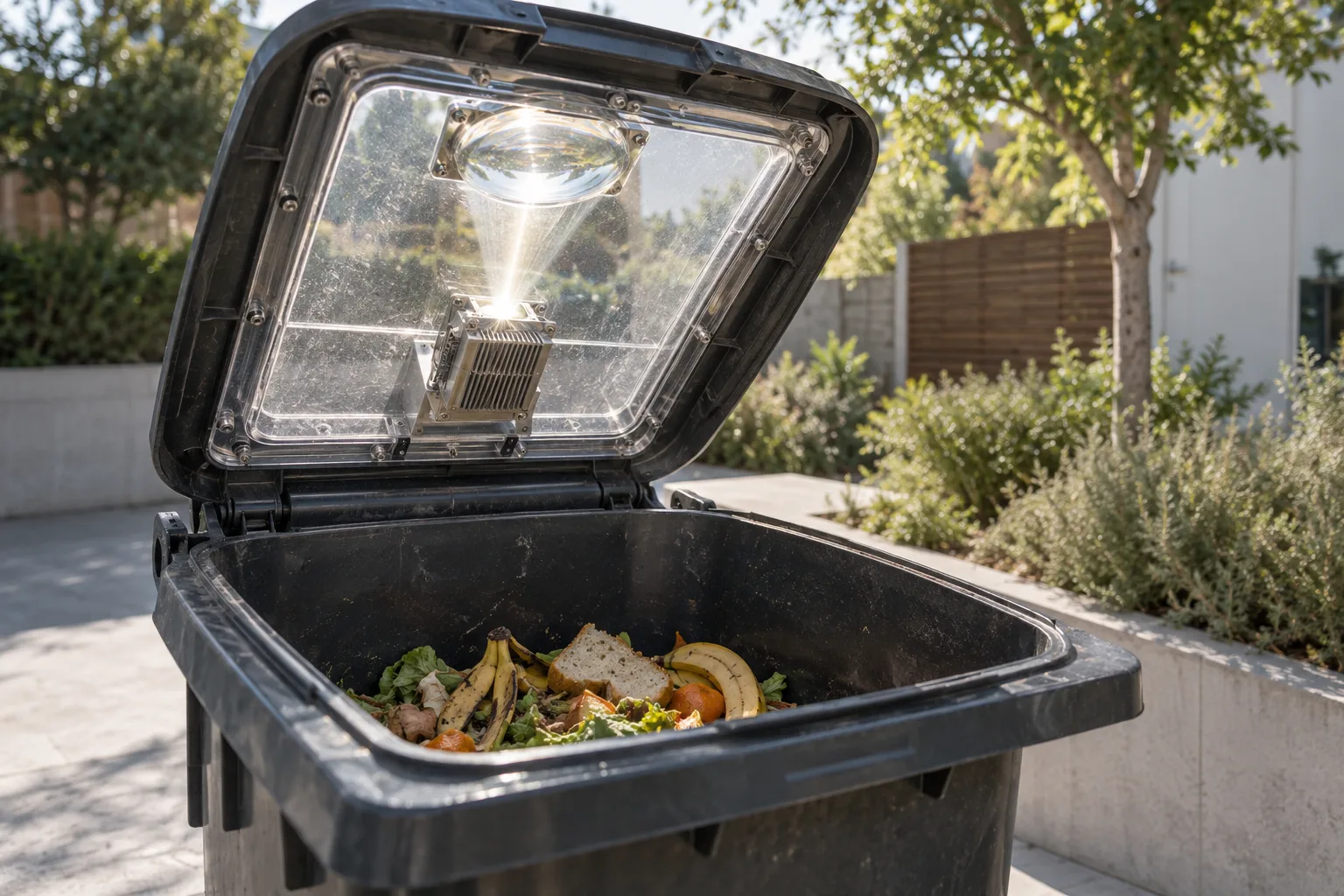
A study published in Environmental Science & Technology tests a more active idea: put a gas-permeable, sunlight-facing module into the lid and use a catalyst to destroy one of the odor compounds before it escapes. The prototype combines a transparent insert, a small lens, and lithium-modified manganese dioxide. In an outdoor test with decaying food, the researchers report continuous acetic-acid removal for more than 40 days. The American Chemical Society describes the result in its research release, while the underlying paper supplies the chemistry and device details (ACS research release; research paper).
That is a modest intervention for a modest problem. It is also a useful example of what practical environmental engineering can look like: identify a nuisance at its chemical source, design around the conditions that make it difficult, and test the device in something close to the setting where it might eventually be used. The important question is not whether sunlight has defeated garbage odor in general. It has not. The question is whether a low-energy surface treatment can keep working in a humid, changing stream of food waste without becoming another disposable filter.
The problem is a mixture, not one magic molecule
Household and municipal organic waste produces volatile fatty acids as food breaks down. Acetic acid is a key member of that group, but it is not the complete odor profile of a bin. Other compounds can contribute sour, sulfurous, rancid, or ammonia-like notes depending on what is present, how wet the material is, how much oxygen reaches it, and how long it sits. A technology that lowers acetic acid should therefore be described as targeted odor control, not as a universal deodorizer.
This distinction matters because odor is easy to oversimplify. A person may notice a single dominant smell, while the bin contains many gases at once. The researchers selected acetic acid partly because it is a chemically identifiable product of food decomposition and partly because it is difficult to manage with simple adsorption in humid conditions. An activated-carbon filter can capture odor molecules, but moisture can reduce its useful capacity and a saturated filter becomes a replacement item rather than a permanent solution.
The study’s approach is different. It aims to convert the target compound rather than merely hold it on a filter. If that conversion is complete, the problem is no longer shifted into a used cartridge. But conversion introduces its own requirements: the catalyst must receive enough light, water and oxygen must participate in the reaction, the material must remain active, and potentially incomplete reactions must be understood rather than hidden behind a lower odor reading.
What the prototype puts in the lid
The central material is manganese dioxide modified with lithium. Manganese oxides are comparatively inexpensive materials that can interact with organic molecules and participate in oxidation chemistry. In this design, the researchers used lithium to change the electronic environment of the manganese-oxygen lattice. The paper describes an ionic lithium-oxygen interaction that localizes electron density and a manganese-oxygen framework that helps move charge through the material.
That description is more technical than a household product label, but it explains why the researchers did not simply spread ordinary manganese dioxide beneath a bin lid. The modification is intended to make the catalyst better at using light and at activating oxygen-containing species at its surface. The paper combines material characterization, calculations, and reaction experiments to connect the changed lattice structure with acetic-acid degradation.
The catalyst is paired with a transparent, gas-permeable module. Air from the bin can reach the active material, while incoming sunlight passes through the transparent section. A lens concentrates the light onto the catalyst layer. This is a small but important piece of engineering: the reaction is not powered by a battery or an electric heater. The lid uses the bin’s exposure to daylight as both its energy source and its most obvious constraint.
Conventional catalytic odor treatment often uses heat or another powered process to make a surface reactive. A solar module avoids an electrical connection, which is useful for a movable outdoor bin. It also means that the device must cope with cloudy weather, changing sun angles, shade, dirt on the transparent surface, and the fact that a bin may be placed beside a building or under a tree.
What the laboratory tests showed
In laboratory experiments, the lithium-modified manganese dioxide performed better than unmodified manganese dioxide and activated carbon under simulated sunlight conditions. The catalyst interacted with acetic acid and promoted reactions that broke down the molecule. The researchers also examined the system under humid conditions, because high humidity is not an edge case for food waste; it is part of the operating environment.
The paper’s mechanistic account proposes that light produces both a photothermal effect and electronic rearrangement at the catalyst surface. Water participates in the surface chemistry, producing reactive groups that can attack bonds in acetic acid. The useful point for readers is not that a single catalyst has solved every detail of photochemistry. It is that the team designed the material around a specific bottleneck: making a light-driven reaction work where the air is wet and the odor compound is continually being generated.
The reported chemistry also makes clear why the word “deodorizing” should be used carefully. Adsorption lowers the concentration of a molecule in the air, while degradation changes the molecule. Those outcomes are not equivalent. A material that only captures acetic acid may require periodic replacement and can release some of its load later. A material that converts it into smaller products may have a longer operating life, but only if the conversion products are acceptable and the reaction remains complete enough under real conditions.
The research team therefore measured more than a simple before-and-after smell comparison. The paper reports acetic-acid degradation and examines the catalyst’s behavior, while the device test moved the experiment outside the controlled laboratory environment. The ACS release summarizes the result as continuous and efficient breakdown of acetic acid generated by food waste.
The outdoor demonstration is the useful part
For the practical test, the researchers fitted the removable insert into the lid of a standard wheeled trash bin. The trial used real food waste, including fruit, bread, and wine. That mixture is more informative than a flask of purified acetic acid because it introduces changing moisture, biological activity, competing gases, and an uneven source of emissions.
Under natural sunlight, the catalyst insert operated for more than 40 days. The researchers report that it continued to remove acetic acid during this period. This is the strongest part of the story: the device was tested in a bin rather than only in a materials laboratory. It also indicates that the catalyst did not immediately lose its activity when exposed to a wet, decomposing mixture.
Still, “more than 40 days” is a durability result for a prototype, not a service-life guarantee. A household might expect a lid insert to work through months or years of rain, frost, dust, ultraviolet exposure, cleaning, impacts, and repeated opening. The study does not establish that lifetime. Nor does a single outdoor configuration answer how the device performs in a shaded alley, a northern winter, or a hot summer with the lid covered by debris.
The test also addresses one important practical concern: the insert is removable. That allows the active component to be inspected or replaced without replacing the entire bin. Modular hardware is often less glamorous than a new material, but it determines whether an environmental intervention can be maintained. A catalyst that works in a paper but cannot be accessed, cleaned, or safely handled is unlikely to survive contact with municipal operations.
What the result does not prove
The study does not show that the prototype eliminates every smell from a trash bin. It targets acetic acid, one important volatile fatty acid. Other odor compounds may remain, and the perceived result will vary with the waste mixture and the bin’s ventilation. A person who puts meat, dairy, grass clippings, diapers, or cleaning chemicals into the same container is not operating the same chemical system as the fruit-and-bread demonstration.
It also does not show that every sunny day supplies enough usable energy. The paper reports complete acetic-acid degradation for a specified light intensity in laboratory conditions, while natural sunlight varies substantially. The outdoor demonstration lasted over 40 days, but a duration test is not the same as a full performance map. It would be useful to know how removal rates change with cloud cover, surface contamination, temperature, bin fill level, and the orientation of the lid.
There is another distinction between reducing odor and improving waste management. A less smelly bin may be easier to live with, but the device does not reduce the amount of food being discarded, prevent methane formation in a landfill, improve composting, or make collection routes more efficient by itself. Odor control can be valuable for comfort and neighborhood acceptance, yet it should not be promoted as a waste-diversion technology.
Safety deserves the same measured treatment. The reported device is designed to keep the catalyst in an insert rather than dispersing it through the waste stream. But a future product would need to address catalyst containment, abrasion, accidental breakage, cleaning, disposal, and exposure during maintenance. The study’s chemistry describes the intended reaction; it is not a complete consumer-safety assessment or a regulatory approval.
The authors also acknowledge funding from the Beijing Academy of Science and Technology, the National Natural Science Foundation of China, Wuhan Municipal Science and Technology Bureau, and Central China Normal University. That disclosure does not invalidate the result, but it is part of reading a prototype responsibly. Independent replication and longer testing would help establish whether the reported performance is robust across devices and environments.
Why source control can beat another filter
The most interesting engineering choice is the decision to treat odor inside the bin, close to where it forms. Many odor-control products work by masking smells, adding fragrance, or placing an adsorbent between the source and the person noticing it. Those approaches can be useful, but they do not necessarily reduce the chemical load in the air.
Source control asks a different question: can the offending compound be captured and transformed before it leaves the container? That logic appears in many areas of environmental engineering. Industrial systems treat exhaust near a process, water-treatment plants remove contaminants before discharge, and indoor-air systems increasingly look for ways to reduce emissions at the source rather than continuously filtering a room.
A bin lid is a small-scale version of the same idea. The source is concentrated, the airflow is limited, and the lid already occupies the position where a module could be mounted. Those conditions make the application more plausible than a claim that the same catalyst could clean a whole street or landfill. Good technology often begins with a narrow operating envelope.
The design also shows why the best next step may be hybrid rather than purely solar. A future system could combine catalytic treatment with a replaceable adsorbent, a simple moisture barrier, or a low-power sensor that reports when the insert is dirty or saturated. The catalyst could handle part of the load while the filter catches compounds it was not designed to degrade. That would be less elegant than a universal odor-eating lid, but more realistic.
What would make the result decision-ready
Before this becomes a product, several measurements would matter more than a striking demonstration photograph. Researchers would need repeated outdoor trials with multiple bins and locations. They would need to compare sunny and shaded conditions, different climates, different waste mixtures, and the effects of rain and surface fouling. A full maintenance schedule should include how often the transparent window must be cleaned and whether the catalyst loses activity.
The performance metric should also expand beyond acetic acid. A useful field study would measure a broader set of volatile fatty acids and other odor compounds, while also recording total gas flow and the products formed during degradation. If the catalyst converts acetic acid but creates another irritating compound under low-light conditions, a narrow odor measurement could give a misleadingly positive result.
Cost and materials accounting would be equally important. Lithium-modified manganese dioxide may be inexpensive at laboratory scale, but a product must include the lens, transparent membrane, housing, seals, mounting hardware, manufacturing energy, shipping, and end-of-life handling. The relevant comparison is not simply the catalyst price. It is the cost and environmental burden of the complete insert versus activated-carbon filters, better bin ventilation, tighter collection schedules, or improved household food-waste separation.
Municipal use would introduce another layer of requirements. Collection crews need lids that open normally, survive impact, and do not create loose parts. The module should not make bins harder to empty or more dangerous to wash. A city might value lower odor complaints, but it would also ask whether the insert remains effective on a route where bins spend much of the day in shade and are frequently moved.
These are not reasons to dismiss the research. They are the ordinary tests that turn a promising material into dependable infrastructure. The study has already crossed one important boundary by leaving the beaker and working in a real bin. The next boundary is repeatability.
The practical lesson is narrower and better
The good news is not that sunlight has made garbage harmless. The good news is that a research team found a way to connect a very ordinary object—a wheeled bin lid—with a specific chemical treatment, and then showed that the connection could remain active for more than a month in natural light. The improvement is concrete: target a major odor molecule, use a catalyst rather than a continuously replaced filter, and design the module for a real container.
That is enough to justify further work. It is not enough to justify a consumer claim that trash bins can now be odor-free. The result still needs larger trials, broader chemical measurements, seasonal testing, safety validation, cost analysis, and evidence that the insert can be maintained without creating a new waste stream.
For now, the prototype belongs in the category of useful early engineering. It addresses a small but persistent problem with a material system that can potentially run on ambient energy. Its limits are visible, which is part of what makes the result credible. If later studies reproduce the field performance and show that the catalyst remains safe, affordable, and effective across different waste conditions, a clear lid insert could become an unobtrusive piece of waste infrastructure. Until then, the right description is simpler: sunlight can help a trash bin break down one important source of food-waste odor, and the experiment has shown why that possibility is worth testing further.
Related articles
Useful technology is having a quiet week, and that is the good news
A grounded look at open-source maintenance, health AI, batteries and assistive tools where progress means fewer everyday failures.


A G3 Storm Has Already Hit: How to Use FT8 and WSPR to Measure the October 11 HF Recovery
NOAA recorded G3 geomagnetic activity on October 10 while CME effects continue into October 11–12. Here is a controlled way to use FT8, WSPR and ordinary band checks to separate ionospheric change from station problems.

Solar flux 101, low Kp: what August 7 space weather means for FT8 and JTDX operators
A practical HF diagnostic workflow for a quiet but not high-margin propagation day: read the NOAA numbers, check spots, then decide whether the antenna or software really needs attention.

The First-Frost Triage: What to Move, Cover, Clean, or Leave in the Garden This October
The first frost is not a single deadline for every plant. Use a short October triage to decide what belongs indoors, what can stay under a breathable cover, what needs greenhouse sanitation, and what is better left in the ground.

Comments
Sign in to comment.
No comments yet.