An extra day before the cyclone: why WeatherNext is a real good-tech story
DeepMind’s open WeatherNext Cyclones model points to about a day more useful warning time, but its value depends on public forecasters, official alerts and careful validation.
Twenty-four hours can be the difference between orderly preparation and a dangerous rush. For a coastal hospital, it can mean moving dialysis patients before roads flood. For a port, it can mean clearing cranes, containers and fuel systems before winds arrive. For families, it can mean finding transport, medicines and a place to stay while official evacuation orders are still actionable. That is why Google DeepMind’s new WeatherNext Cyclones result belongs in Good Tech News: not because it is another AI launch, but because its claimed improvement is measured in warning time for a known public risk.
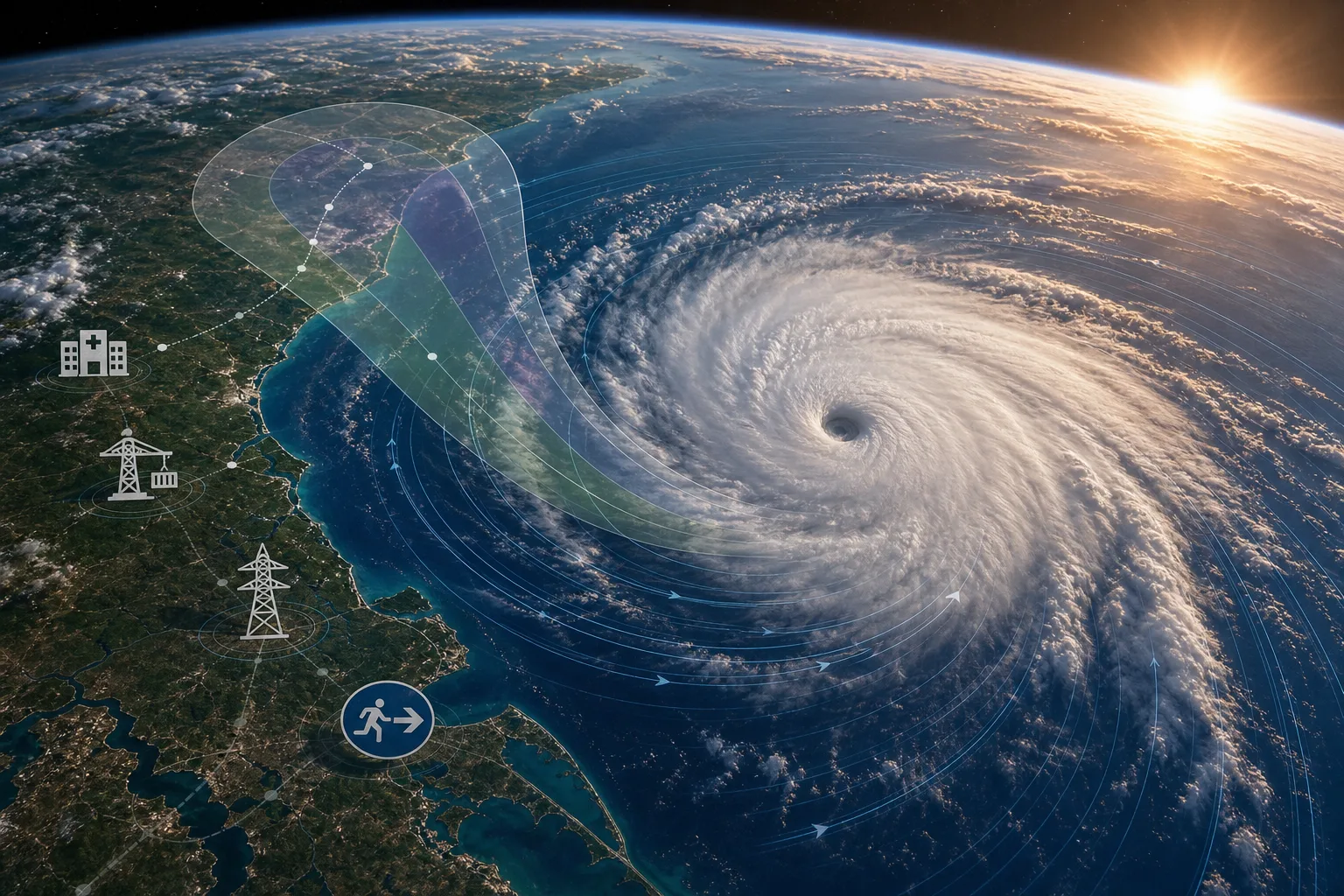 Published in Nature on 6 August 2026 as “Operational Tropical Cyclone Forecasting with AI,” WeatherNext Cyclones is presented as an operational AI weather model for global tropical-cyclone forecasts. DeepMind says the system improves forecasts of track, intensity and wind radii, and that in evaluation against recent storms it achieved an average lead-time advantage of about a day or more over leading operational models. The simplest translation is powerful: a three-day WeatherNext Cyclones forecast can, on average, be as useful as what forecasters previously expected from roughly two days of guidance.
That is not a small claim in hurricane, typhoon and cyclone forecasting. The track of a storm depends on broad atmospheric flows; intensity depends on a harder mixture of ocean heat, eyewall structure, wind shear, moisture and rapid internal changes. Emergency managers need both. A storm that lands 80 kilometres from the expected point changes which towns flood first. A storm that intensifies faster than expected changes whether a shelter, hospital generator or cargo terminal has enough time to act. Better track without useful intensity still leaves people exposed; better intensity without a plausible path is also incomplete. WeatherNext Cyclones is interesting because the Nature paper and DeepMind’s materials frame the advance across track, intensity and wind-field size rather than as a single prettier storm path.
The human stakes are also well documented. The World Meteorological Organization has repeatedly shown that early warnings save lives, while tropical cyclones remain among the costliest and deadliest weather hazards. DeepMind’s own article cites the grim scale of the problem over the last half-century: more than 700,000 deaths and about $1.4 trillion in economic losses associated with tropical cyclones. A model cannot evacuate a neighbourhood or repair a power line, but extra warning time can make those human systems less frantic and more precise.
The best part of the announcement is also the easiest part to overstate. WeatherNext Cyclones does not replace national meteorological services, official advisories or local emergency communication. DeepMind explicitly tells readers to rely on their local meteorological agency or national weather service for official forecasts and alerts. Mike Brennan, director of the US National Hurricane Center, told WIRED that additional time can help with evacuations and preparation, but also stressed that the human element remains critical because forecasts have to be translated into impacts. That sentence matters. People are not killed by a model error in the abstract; they are killed by water, wind, heat, isolation, inaccessible hospitals and decisions made too late.
What changed technically? WeatherNext Cyclones combines global atmospheric data with expert-curated historical tropical-cyclone observations. DeepMind points to nearly 20 terabytes of global atmospheric data and the IBTrACS archive of almost 5,000 historical storms. The model can produce forecasts up to 15 days ahead and generate large ensembles of possible futures. Those ensembles matter because a single best-guess path hides the tails: the lower-probability scenarios in which a storm bends toward a city, expands its wind field or intensifies rapidly. DeepMind says WeatherNext Cyclones can create 1,000-member ensembles, giving forecasters a richer view of uncertainty than one deterministic line.
The speed is part of the usefulness. DeepMind says a single 15-day forecast can be generated in less than a minute on a TPU. Traditional numerical weather prediction models encode physics and remain essential, but large ensembles can be computationally expensive. If an AI model can cheaply generate many plausible storm futures, it can help forecasters interrogate risk earlier and more often. That does not make physical models obsolete; it makes the combined toolbox more useful when time is limited.
One surprising detail should make readers cautious rather than euphoric. WeatherNext Cyclones reportedly uses data at about 28-by-28 kilometre resolution, much coarser than the scales at which a hurricane’s inner core evolves. Yet the model performs strongly on intensity, historically one of the hardest parts of AI weather prediction. Kate Musgrave of CIRA, quoted by WIRED, highlighted intensity as the difficult piece. DeepMind itself notes that the mechanism behind some of this performance is not fully understood. That is not a reason to dismiss the result; it is a reason to validate it carefully, basin by basin and season by season, before letting confidence outrun evidence.
The Hurricane Melissa example explains why forecasters are paying attention. DeepMind has described how WeatherNext guidance helped the National Hurricane Center see the risk of a Category 5 landfall in Jamaica earlier than conventional guidance did. WIRED used that case to give the story a human frame. The careful wording is important: WeatherNext provided experimental guidance that helped experts assess risk; official warnings still came from the responsible public institutions. That distinction is the line between useful AI and irresponsible hype.
Open release is another positive signal. The google-deepmind/weathernext repository is public under the Apache-2.0 licence, and the repository had about 7,459 stars, 959 forks and 77 open issues at the time of verification. DeepMind also released code and model weights for WeatherNext 2 and WeatherNext Cyclones. That matters because weather forecasting is not a closed consumer app. Researchers, meteorological agencies and regional teams need to test whether the model behaves reliably for their basins, their observing networks and their extreme cases. Openness does not solve everything — compute, data access, operational integration and expertise still matter — but it makes scrutiny possible.
The public discussion is healthy precisely because it is not only applause. On Hacker News, many commenters welcomed an AI application that is not about engagement farming or office automation. Others warned that industry models depend on public weather infrastructure: satellites, observing stations, data assimilation, reanalysis archives, NOAA, NHC, the Met Office and their counterparts around the world. If politicians treat an industrial AI result as an excuse to cut public meteorological services, the foundation under the model weakens. The good-news version is not “AI beats government forecasters.” It is “AI can strengthen public-interest forecasting when public institutions remain strong.”
There are practical uses beyond evacuation orders. Shipping companies can reroute vessels earlier. Offshore operators can shut down safely. Utilities can pre-position crews and transformers. Hospitals can move patients who cannot simply wait out a storm. Humanitarian groups can stage supplies in the right region instead of the nearest convenient warehouse. Insurers and city planners can model exposure with more scenarios. Renewable-power operators can adjust to wind and cloud uncertainty around extreme systems. In each case, the value is not the model’s prestige; it is the extra time to make a specific decision.
There are also failure modes. An ensemble can be misunderstood as a promise. A beautiful probability cone can be read as a boundary instead of a range of risk. Regions with weaker meteorological services may gain less if they lack trained forecasters, local communication channels or trusted evacuation procedures. A model trained on past storms may struggle with unprecedented combinations of ocean heat, atmospheric pattern and coastal vulnerability. The more useful WeatherNext becomes, the more important it is to keep “official alert” and “experimental guidance” clearly separated for the public.
So the good news is real, but it is not naive. WeatherNext Cyclones appears to move AI weather prediction from impressive demonstration toward operationally relevant tropical-cyclone guidance. Nature publication, collaboration with forecasting institutions, open code and public warnings about official alerts are all meaningful signs. The public benefit will come if meteorological agencies can test the model, compare it with their existing guidance, integrate it into human decision processes and communicate uncertainty without overselling certainty.
The lesson is broader than storms. The most persuasive AI stories are not the ones that claim to replace experts. They are the ones that give experts more time, more scenarios and better evidence while leaving responsibility with accountable institutions. In cyclone forecasting, a useful model is not magic. It is another day for people who already know what to do when the warning arrives early enough.
Sources
Google DeepMind announcement on WeatherNext Cyclones; Nature, “Operational Tropical Cyclone Forecasting with AI,” published 6 August 2026; Google Keyword article on WeatherNext 2 and Cyclones; WIRED reporting with comments from the US National Hurricane Center and CIRA; Google DeepMind Weather Lab; National Hurricane Center public guidance; google-deepmind/weathernext GitHub repository.
Related articles

Akçay to Lesbos by ferry: budget costs, visa checks and the last-boat risk
A practical cost-and-document checklist for deciding whether the new Akçay–Mytilene crossing is a cheap weekend or an expensive ferry mistake.
West Coast Trail on a budget: price the permit, ferries and Nitinaht water taxi before Vancouver Island
A practical cost-first guide to the West Coast Trail, where the cheapest plan starts with official reservations, boats and weather buffers.


ARRL September VHF 2026: prep bands, grids and logs before contest weekend
A practical one-week station checklist for the September VHF Contest, including the FM Only 902 MHz and 1.2 GHz scoring change.
Cíes Islands from Vigo on a budget: permit first, ferry second, last boat never
A practical Vigo-based plan for checking the Xunta authorization, ferry windows and real costs before paying for a Cíes Islands day trip.

Comments
Sign in to comment.
No comments yet.