Geminid Meteor Scatter QSO Party 2026: Build a Receive-First MSK144 Station Before December
HamSCI’s December Geminid experiment needs both active operators and passive monitors. Here is what to prepare on 6 and 10 meters, which recordings matter, and how to keep a useful station log without treating every decode as a normal FT8 contact.

What the December 2026 experiment is actually asking operators to do
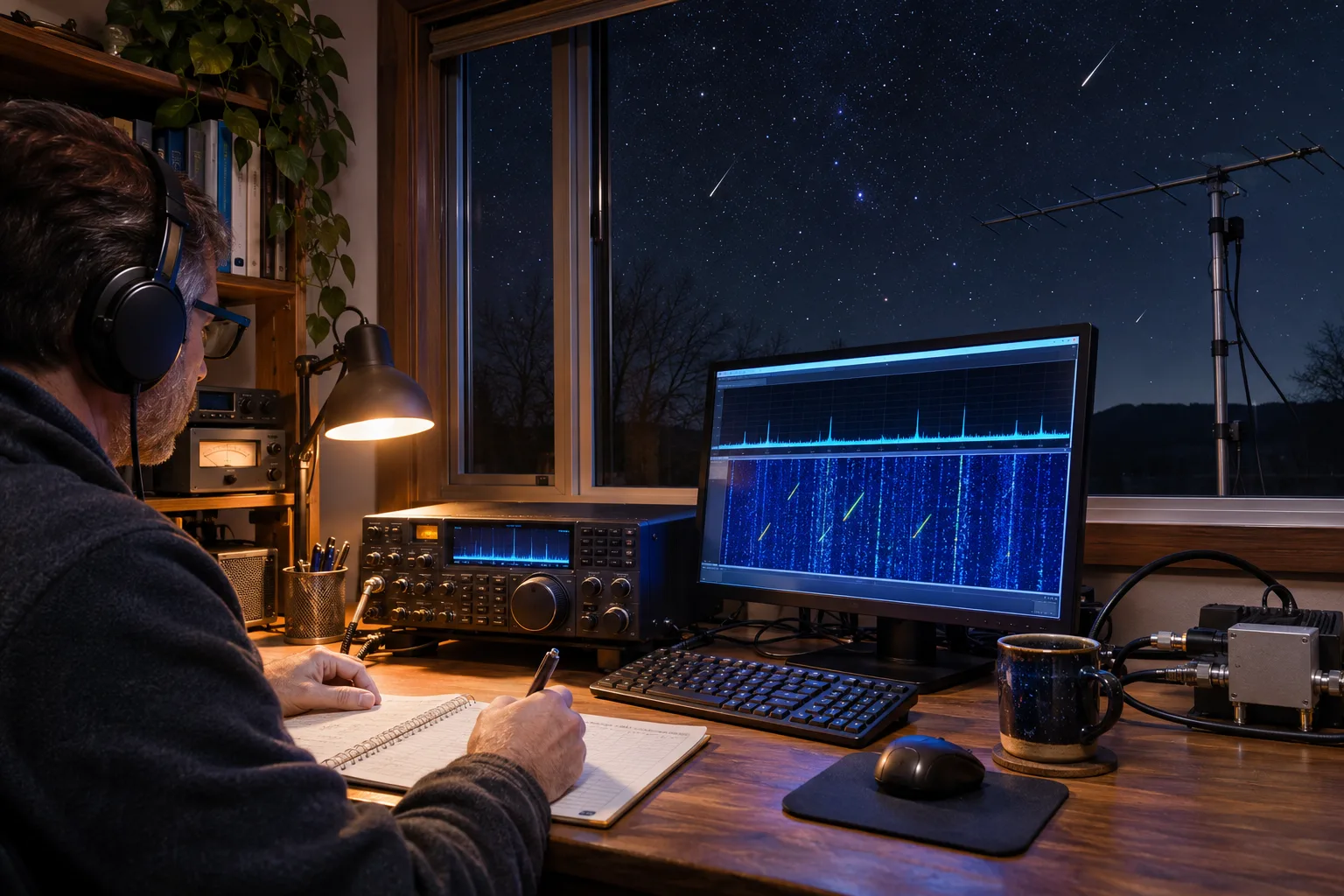
HamSCI’s Geminid Meteor Scatter QSO Party is planned as a three-day observing and operating window, from 0000 UTC on December 13 through 2359 UTC on December 15, 2026. The event is not limited to operators who complete a conventional two-way contact. Its design combines meteor-scatter contacts, receive-only monitoring, PSKReporter spots when available, and archived MSK144 audio files. That wider participation model matters because a quiet station can still document propagation that an active station does not hear at the same moment.
The experiment is best understood as a coordinated measurement opportunity built around amateur-radio equipment. The goal is not simply to produce a list of callsigns. HamSCI’s event material describes a workflow in which contacts, receive-only observations, reporting data, and archived recordings can be considered together. A transmitted exchange is one useful result, but it is only one part of the picture. A receiver that runs reliably, keeps accurate UTC time, and saves relevant audio may provide evidence even when no complete contact is made.
That distinction is important for anyone approaching the event through ordinary digital-mode habits. MSK144 is intended for meteor-scatter work, where brief reflections from meteor trails can create short, intermittent openings. A decode may appear during one burst and then disappear quickly; it should not automatically be treated as equivalent to a routine FT8 contact made under steady propagation. The operating and logging choices need to preserve the circumstances around the signal: when it appeared, what was heard, and whether the station was transmitting or listening only. The value of the event comes partly from that context, not just from the presence of decoded text.
The December party focuses on the 6-meter and 10-meter bands, giving participants two places to listen for the experiment’s activity. HamSCI’s public guidance identifies commonly used frequencies of 50.260 MHz on 6 meters and 28.145 MHz on 10 meters. These are practical starting points for setup and monitoring, but operators should still verify local band plans and the current event guidance before transmitting or recording a session.
For a receive-first participant, the assignment can be kept straightforward: prepare a transceiver and computer capable of receiving the chosen band, run WSJT-X with MSK144 selected, and check that the software’s audio and time information are working. Then monitor the recommended periods, save useful WAV recordings, and maintain a log identifying the UTC time, band, station or grid information when available, and the nature of the observation. The station does not have to force a contact to be useful; consistency and traceability matter more than turning every brief decode into a claimed QSO.
Participation categories should remain separate in the station record. A two-way contact indicates an exchange between stations. A receive-only report indicates that a signal or decode was observed without claiming a completed exchange. A PSKReporter spot supplies another machine-readable indication when that service is available. An archived WAV file preserves the underlying audio so the event’s data can be examined beyond the moment shown in the WSJT-X window. Treating these results as interchangeable would erase information the experiment is designed to collect.
The practical implication is that operators can choose an appropriate level of involvement before December. Someone with a suitable antenna and transmitter may participate actively, while someone who can only receive can still contribute by monitoring, recording, and logging carefully. Both approaches fit the event’s purpose if the records make clear what the station actually did. The HamSCI Meteor Scatter QSO Party guidance and its How to Guide should be checked for the current schedule, operating details, and data workflow as the event approaches.
Starting with that receive-first mindset prevents a common planning mistake: building the station around the expectation that every decode will become a normal digital contact. The better preparation target is a dependable observation chain on 6 and 10 meters—antenna, receiver, computer, timing, software, and storage—followed by an honest record of what happened. The next step is to turn that target into a practical station arrangement that can monitor both bands without implying that specialized equipment is required.
A practical receive-first station for 6 and 10 meters
A useful station for this experiment can be built around familiar amateur-radio equipment: a modern transceiver, a computer running WSJT-X, an audio path between the radio and computer, and an antenna suitable for the band being monitored. HamSCI’s guidance does not make a specialized meteor-scatter array a requirement. The practical goal is a stable, repeatable receive chain that can pass short MSK144 signals to the decoder and preserve the audio for later review.
Treat the radio and computer as one system during setup. Depending on the transceiver, the connection may use a built-in USB audio and control interface or a separate sound-card interface. Either arrangement is suitable if WSJT-X receives clean audio without clipping, excessive gain, hum, or unwanted processing. Confirm that the correct audio device is selected, then watch the waterfall while adjusting the level. A signal that occasionally produces a decode but arrives distorted or overloaded will be much less useful than a quieter, intact recording.
The antenna should be appropriate for the band and location, with sound feed line, connectors, and switching. A directional antenna can help with gain and rejection of unwanted signals, but a dipole or another simple antenna can still provide a worthwhile monitoring station. HamSCI’s guide lists antennas ranging from an attic dipole to a yagi, Hexbeam, quad, or Moxon. The deciding issue is not whether the antenna looks specialized; it is whether the complete installation gives the receiver a dependable path to the band and can remain available during the periods being monitored. If the station has separate antennas for 6 and 10 meters, test both through the same radio–computer chain rather than assuming that success on one band proves the other is ready.
For the two bands emphasized by the party, the commonly cited activity frequencies are 50.260 MHz on 6 meters and 28.145 MHz on 10 meters. Use those frequencies as practical starting points, while checking the current HamSCI instructions, local band plans, and the rules that apply to the station’s location and license. The 10-meter frequency may need to be added to WSJT-X’s frequency list, depending on the software configuration. A receive-only station can listen without transmitting, but anyone planning two-way operation must still confirm that the chosen frequency and operating method are permitted locally.
Select MSK144 in WSJT-X for this work. The mode uses short, repeated transmissions within a 15-second timing window, so accurate computer time is important and the receive and transmit sequence must be understood before the event. HamSCI’s operating guidance also recommends turning the receiver’s AGC off, because rapid changes in signal amplitude can cause AGC action to hide brief pings. A wide USB data filter, around 3000 Hz, is recommended in the how-to guidance. These settings are not decorative preferences: they help the software see the short, changing signals that distinguish meteor-scatter monitoring from simply leaving an ordinary digital-mode setup running.
Frequency accuracy deserves a separate check. HamSCI’s guide notes that MSK144 reception is particularly sensitive to frequency error and identifies a 200 Hz receive tolerance as the widest useful setting in the relevant WSJT-X controls. Before monitoring, verify the transceiver’s displayed frequency against the actual configuration in WSJT-X, make sure the selected mode is MSK144, and confirm that the receiver is listening in the expected part of the passband. Then make a short test recording and reopen it later. That simple test can reveal a wrong input device, an unusable level, a missing frequency entry, or a computer that stops recording when the display is left unattended.
A practical preparation sequence is therefore straightforward. Connect the radio, interface, and computer; confirm a stable audio stream; adjust the level so the waterfall is visible without overload; check each antenna on its intended band; and leave the station running long enough to expose sleep settings, disconnected USB hardware, clock drift, or changing audio gain. If the station can cover both bands, plan for HamSCI’s recommended alternating-band pattern at 20-minute intervals, using the event guidance to decide how to organize the monitoring. Keep the band, antenna, receiver settings, and station grid information in the notes from the beginning. A receive-first station does not need exotic hardware, but it does need a trustworthy path from antenna to decoder and a configuration that can be explained when the recordings are reviewed.
How to configure, record, and label useful evidence
The most useful station for this experiment is not necessarily the one that produces the longest contact list. It is the one that preserves what it heard, when it heard it, and under which conditions. Configure WSJT-X for MSK144, then treat the receive chain as an observing instrument: keep its audio level stable, keep the computer clock accurate, and note any setting changes during a monitoring period. A callsign in a log is a useful starting point, but it does not show what was present in the passband, what failed to decode, or whether a brief signal arrived as a meteor-scatter burst rather than through another propagation mode.
Before monitoring, select MSK144 in WSJT-X and confirm that the program is receiving audio from the intended transceiver or sound-card interface. Check that the waterfall shows activity without the input being driven into saturation. Turn the receiver’s AGC off, as HamSCI’s guidance notes that automatic gain changes can obscure rapidly varying meteor pings and interfere with measurements of their decay. Adjust RF gain so the WSJT-X audio level is around 30–40 dB, leaving enough headroom for stronger bursts. If your station has several possible audio paths, test the one you will use for the event and keep it unchanged while collecting data.
Enable PSKReporter spotting in WSJT-X and save the setting before closing the configuration window. HamSCI specifically asks both transmitting and receive-only stations to send reception reports, because the resulting spots can be compared after the event. A receive-only operator can therefore contribute useful information without completing a two-way QSO. PSKReporter is an additional record, not a replacement for the station’s own log: it helps place a reception report in the wider dataset, while the local log and audio recording preserve the circumstances of that observation.
For the recordings, use WSJT-X’s Save Decoded command. The resulting WAV files are stored on the local drive and can be located through the program’s Open Log Directory path. Create a dedicated directory for the MSQP WAV files immediately before monitoring, and change WSJT-X back to another directory after the event. This simple separation prevents unrelated digital-mode recordings from being mixed with the material intended for analysis. Before leaving the settings window, save the change so that the program actually writes the files to the selected location.
The WAV files matter because they retain more than the decoded text. Researchers can examine the surrounding noise, partial signal fragments, overlapping activity, and the short decay of a meteor echo. Those details may be unavailable in a callsign-only log, especially when a signal appears briefly or produces an incomplete decode. The recording also lets later analysis revisit an uncertain observation rather than treating the software’s first display as final. Preserve the original files as recorded; do not convert them, trim away the surrounding signal, or rename them in a way that removes their connection to the station log.
Use a consistent filename and a companion log that another operator could understand without asking for clarification. Include the UTC timestamp, band or dial frequency, receiving station or callsign, grid locator, and mode in the file name or in a clearly linked record. The exact punctuation is less important than consistency. Record exceptions such as a frequency change, a restarted WSJT-X session, an altered audio level, or a disconnected antenna. Keep the machine’s UTC timestamp, but mark an entry as approximate if the time was copied manually or the clock was not verified.
The log should distinguish reception from transmission. For each observation, note whether it came from a decoded message, a saved WAV file, a PSKReporter spot, or more than one of these. If you transmit, record the two-way exchange separately and follow the event’s operating guidance for identification and sequence. Do not count a receive-only decode as a completed contact merely because WSJT-X displayed a callsign. Conversely, a completed exchange should not replace the recording when the station was configured to save it. Keeping those categories separate makes the archive easier to interpret and prevents passive monitoring from being confused with transmitting activity.
A disciplined workflow also means resisting ordinary FT8 habits. MSK144 signals appear as brief bursts within the operating cycle, so a single display should be treated as an observation to document, not automatic proof that a conventional FT8-style contact is complete. Keep listening through the selected period, preserve the audio around meaningful decodes, and annotate anything that could affect interpretation. At the end of the session, confirm that the WAV files open, that their names match the log, and that the UTC timing remains trustworthy. The aim is a clear chain from signal to file to note: someone should be able to determine when and where the station listened, what it decoded, whether it transmitted, and which original recording supports the entry.
A low-risk preparation checklist and realistic expectations
The most useful preparation is a staged test, not a last-minute attempt to assemble a perfect meteor-scatter station. Start by making the receive path predictable on both 6 and 10 meters. Confirm that the transceiver is connected to the computer correctly, that WSJT-X sees the intended audio input, and that the displayed level is stable rather than driven into clipping. If a sound-card interface is part of the station, check both directions even when the main plan is receive-first: an incorrect input setting can make a strong signal appear absent, while an incorrect output route can create an unexpected transmission when the operator intended only to monitor.
Run the same checks separately for the two bands. A station that decodes on 6 meters is not automatically ready for 10 meters, and an antenna that appears satisfactory on one band does not establish performance on the other. Check the antenna connection, feed line, and any switching or matching equipment before the event. Use the commonly cited MSK144 activity frequencies as a planning reference only, and verify local band plans and the current HamSCI event guidance before monitoring or transmitting. The practical objective is a known, repeatable receive setup—not an assumption that one frequency, one antenna, or one configuration will work everywhere.
Clock discipline deserves its own test. MSK144 decoding depends on accurate timing, so confirm that the computer clock remains synchronized during a monitoring session rather than correcting it only once during setup. Record a short test session with the clock in its normal operating state, then inspect the resulting decodes and timestamps. This also provides an early check that WSJT-X is saving the information you expect. If the station will be unattended for a period, verify that the computer will not enter a sleep state, disconnect the audio device, or stop recording when the display is inactive.
Before the shower, establish a simple file-handling routine. Make sure there is enough storage for the WAV recordings you intend to preserve, and decide where the files will be placed before operating begins. Use filenames that identify the UTC date and time, band, and station or grid information where practical. The exact naming convention matters less than consistency. A recording that can be matched confidently to a UTC interval, a band, and a receiving station is much easier to interpret than an anonymous audio file saved after the fact. Leave the original WAV files unchanged, and make any later notes or analysis in a separate log.
A useful preparation session should also test the evidence trail. Keep the station grid and other relevant station details readily available, note when monitoring starts and stops, and compare local records with WSJT-X decodes. If PSKReporter is available, confirm that the station can use it and understand what it is showing; online spots are useful supporting evidence, but they do not replace the local record. A callsign-only log cannot show what was present in the receiver when a decode was incomplete, marginal, or missed. Preserved audio gives researchers a way to examine the signal itself, including material that did not become a conventional two-way contact.
Separate receive-only work from transmitting at every stage of the test. A monitor can contribute by recording and documenting signals without calling anyone. An operator who chooses to transmit must verify the station’s license privileges, the applicable band rules, and the event’s operating guidance before doing so. Keep the transmit controls unmistakable, especially when switching between a receive test and a two-way session. This is a small procedural detail, but it prevents a receive-first experiment from turning into an unintended transmission.
Expectations should remain realistic. NASA identifies the Geminids as the meteor shower associated with the December observing period, while HamSCI’s event material provides the experiment’s operating context and forecast. Neither point guarantees a continuous stream of decodes at an individual station. Meteor-scatter opportunities are intermittent, and a quiet receiver is not by itself evidence that the station failed or that the experiment produced no useful data. The value of a well-documented quiet period can be different from the value of a successful exchange, provided the timing, configuration, and recording status are clear.
The final checks are operational rather than glamorous: confirm audio levels again, verify the computer clock, inspect available storage, test WSJT-X decoding, review the file names, and check antenna performance on both bands. Then write down the station’s normal configuration before the event begins. Observe power limits, RF-exposure requirements, safe equipment practices, and any jurisdiction-dependent restrictions that apply to the station. With those precautions in place, a modest station can participate in the December experiment in a disciplined way: transmit only when authorized and intended, monitor carefully, and preserve the raw evidence that makes a fleeting meteor-scatter burst useful beyond the moment it was heard.
Related articles

Google Translate’s Gemini Upgrade Is a Context Tool, Not a Replacement for Human Review
Google’s latest Translate work points to a practical shift: better AI translation depends less on word substitution and more on context, audience, tone, and review. Here is how teams can use the upgrade without turning fluent errors into published ones.


Should you pay for Claude after Opus 5?
Opus 5 makes Claude more tempting, but Pro, Max and API credits solve different problems. Buy the workflow, not the launch week excitement.


Gemini Robotics 2 is impressive, but physical AI still has to prove itself outside the demo
DeepMind’s new robotics models point toward more capable robot agents, but public access, safety, hardware and economics still separate the demo from deployment.

Gemini 3.8 Live Makes Voice Agents More Useful—and More Operationally Demanding
Google’s Gemini 3.8 Live brings background tool calls, live visual input and native speech-to-speech interaction to voice agents. The practical question is no longer whether it can talk, but whether a team can control latency, permissions, data retention and failure recovery.

Comments
Sign in to comment.
No comments yet.