JOTA-JOTI 2026: A Practical Radio Station Plan for Welcoming New Operators
JOTA-JOTI runs October 16–18, 2026. A reliable station needs more than an antenna: it needs a safe operating script, licensed supervision, a band plan, simple logging, and activities that let visitors do more than watch.
JOTA-JOTI 2026 runs from October 16 through October 18, bringing Scouts and Guides together through amateur radio and the internet. World Scouting describes it as its largest digital and radio event, with more than two million young people taking part in JOTA-JOTI each year. The weekend is not a contest in which the station with the most contacts wins. Its value is that a visitor can hear a voice from another country, ask a real question, learn how a signal travels, and leave with a reason to come back.
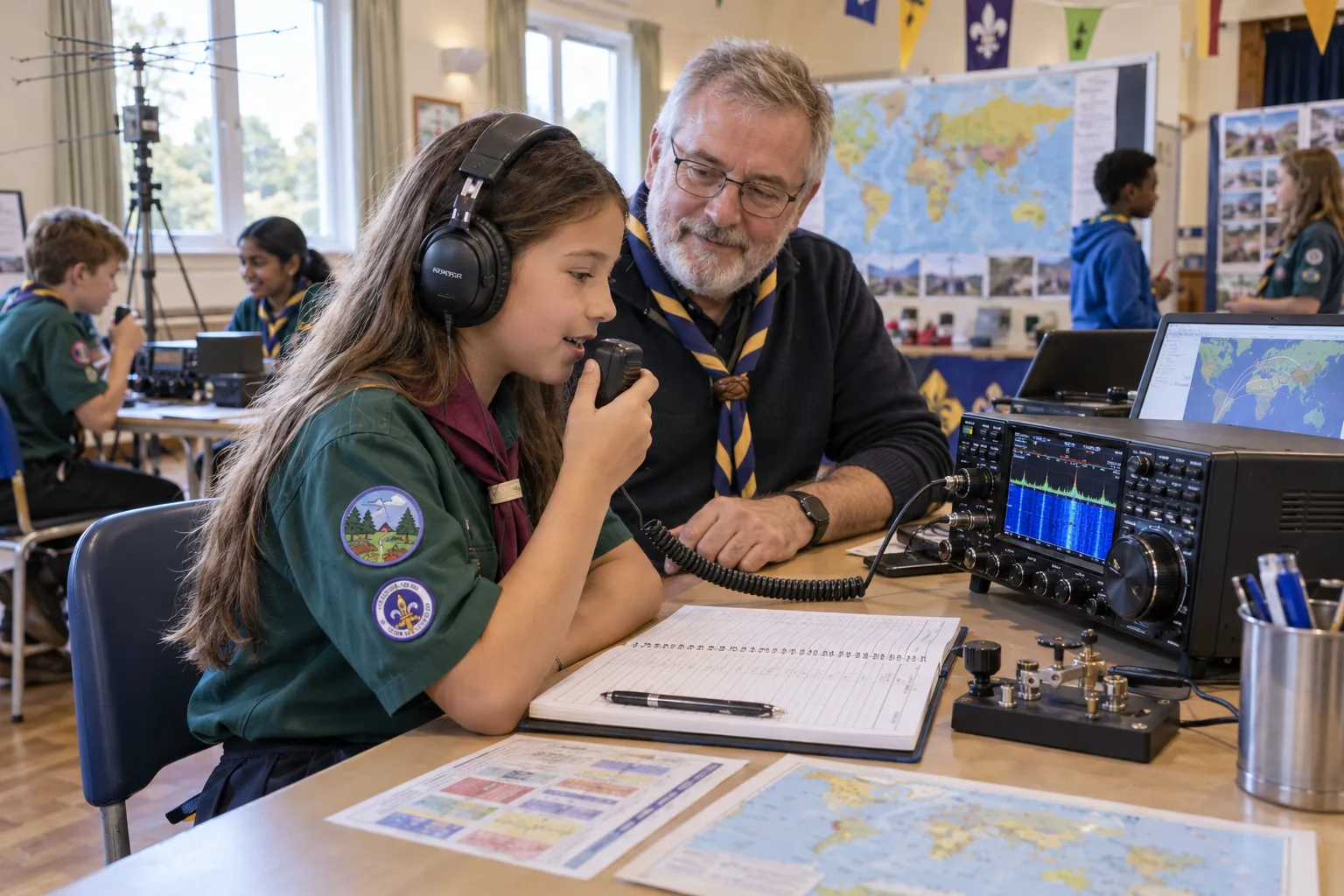
That changes the job for an amateur radio club or licensed operator. A station can be technically impressive and still fail if the microphone is intimidating, the queue is unmanaged, the logging is confusing, or the operator treats every young visitor as an audience member rather than a participant. The most useful preparation is therefore operational: define what visitors may do, make the first contact easy, prepare a fallback when HF conditions are poor, and give every activity a clear adult owner.
This guide is for operators preparing a club station, school visit, Scout gathering, home station demonstration, or a small public event during the 2026 weekend. The event theme announced by World Scouting is “A Peaceful and Inclusive World,” and the station should reflect that in its operating habits: patient exchanges, room for different abilities and confidence levels, and no pressure to speak on air before someone is ready.
What is current for the 2026 weekend
The official World Scouting event page gives the 2026 dates as October 16–18. Its announcement says registration is open through the JOTA-JOTI platform and lists activities such as station hunts, Meet the Pinkies, Mandalas, Dialogue Challenges, and Peace Circles. Those activities belong to the wider JOTA-JOTI programme, not all to amateur radio, so a radio club should decide in advance which parts it can support and which it should leave to the Scout leaders.
The distinction matters. A radio operator is responsible for the station, equipment, frequency discipline, and compliance with the local licence rules. A Scout leader or event organiser is responsible for the wider youth programme, safeguarding procedures, attendance, permissions, and the welfare of participants. The two responsibilities should be coordinated, not silently combined.
JOTA is an international event, but amateur radio regulation remains national or regional. A frequency that is appropriate for one country, licence class, band plan, or mode may not be appropriate in another. The station’s licence holder should check the regulator’s current rules and the applicable IARU regional band plan before the event. A published list of JOTA frequencies is a place to listen and find activity, not a grant of exclusive access.
For a North American station, the 2026 ARRL calendar also lists Pacificon from October 16–18, so some operators and clubs may be away at that convention. That is a practical scheduling detail rather than a problem: appoint a primary operator, a backup, and a contact person early enough that the station does not depend on one volunteer appearing at the last minute.
Start with a visitor experience, then choose the equipment
The common mistake is to begin with the radio. Begin with the visitor’s first five minutes instead. A person who has never used a transceiver needs a short explanation, a chance to hear a contact, and one manageable action. The equipment should serve that sequence.
A useful first-visit path looks like this:
- A greeter explains what the station does and asks whether the visitor wants to listen, ask questions, operate under supervision, or try a hands-on activity.
- A demonstration operator makes or receives a short contact and models the exchange slowly.
- The visitor is shown the call sign, location, band, mode, and signal display without being buried in menu details.
- The supervising operator offers a choice: read a prepared greeting, pass a report, enter a log detail, send Morse, tune a receiver, or build a small circuit.
- The visitor receives a simple record of what happened, such as a station card, a printed contact note, or a group log entry, subject to the organiser’s privacy policy.
That sequence works with a modern HF transceiver, a low-power portable station, a VHF repeater, a digital-mode receive display, or a temporary demonstration receiver. It also exposes a design truth: an expensive radio does not solve a poor queue. If ten visitors are waiting behind one microphone, add another activity rather than asking everyone to wait silently.
A two-station layout is often more effective than one elaborate station. Station A can be the supervised voice position. Station B can be a receive-only waterfall, a Morse key, a simple antenna experiment, an SDR display, a satellite or repeater demonstration, or a small electronics bench. Visitors move between the stations while the operator keeps the on-air exchange short and predictable.
Build a simple operating script
New visitors usually do not need a lecture on every part of amateur radio. They need a script that keeps them safe and gives them confidence. Write that script before the event and let every operator use the same basic wording.
A short introduction might explain that amateur radio uses licensed stations to communicate over radio, that the signal may travel across a city or around the world, and that the visitor will speak only when the licensed operator says it is appropriate. For a newcomer, that is enough context to understand why the radio is interesting without turning the first contact into a training seminar.
The first contact should use a plain-language exchange. The operator can say: “This is [call sign] at a Scout station in [place]. We are taking part in JOTA-JOTI. We have a visitor here who would like to say hello. Please tell us your name, location, and what your group is doing today.” The operator should not promise that every call will be answered, and should not ask a child to disclose a surname, school name, home address, phone number, or other personal information.
If the visitor wants to speak, the licensed control operator remains in charge of the station and should take over immediately if the exchange becomes confusing, inappropriate, or unsafe. The visitor can use a first name, a given group name approved by the organisers, or simply say that they are visiting the station. The exact identification requirements and supervision arrangements depend on the local rules, so the licence holder must confirm them before the event.
Prepare a card beside the microphone with the following prompts:
- Say the station call sign when instructed.
- Give the approved first name or group identifier.
- Give the town, region, or country, not a private address.
- Ask one prepared question.
- End with “thank you” and wait for the operator’s instruction.
A prepared question prevents dead air. Good questions are about the other station’s weather, favourite radio activity, local landscape, Scout tradition, language, or how the station was built. Avoid questions that demand personal information or invite a long speech from a nervous first-time operator.
Choose frequencies as a search plan, not a promise
JOTA activity can appear on different bands, modes, and frequencies according to region, propagation, local band plans, and the stations that actually register. The JOTA-JOTI amateur radio handbook gives examples of commonly used Scout activity frequencies, but that handbook is background material, not a substitute for current national rules or the latest event information. Use it as a starting point, then verify current event resources and regional operating practice.
The practical plan is to assign a scanning order. For example, the operator might begin by checking a local VHF or UHF channel, then listen on an HF voice segment appropriate to the station’s licence and region, then move to another band if the first path is busy or quiet. The station should publish its own planned periods and modes so other operators know when to listen, but it should avoid language suggesting that a frequency belongs to the event.
Before transmitting, listen long enough to identify existing activity. Check that the selected frequency is clear, use the correct mode, and keep the first call brief. If a contact is already in progress, move away rather than calling over it. On crowded bands, a station that repeatedly occupies the same frequency can make the event harder for everyone, especially for small stations trying to reach their first Scout contact.
A frequency board at the operating position should contain:
- Band and mode.
- Region or local band-plan note.
- Planned UTC operating window.
- Primary operator and backup.
- Current antenna and maximum permitted power for the station.
- A note to verify the frequency before every transmission.
- A fallback channel or band if the planned path is busy.
Do not copy a frequency from an old blog post and assume it is legal or suitable. Band allocations, mode segments, licence privileges, and local repeater practices vary. This is particularly important when a club invites participants from several countries or streams the event online.
Make HF propagation part of the lesson
A failed contact is not necessarily a failed station. JOTA is a good opportunity to show that radio is an experiment with variables. The signal may be affected by time of day, band choice, antenna orientation, local noise, skip distance, weather-related noise, or changing ionospheric conditions. The operator can turn that uncertainty into a short lesson instead of hiding it.
Use language that keeps expectations realistic: “We are listening for another station, and the band may change. If we do not find one here, we will try another method.” This prevents visitors from concluding that the equipment is broken when a band is simply quiet.
A basic propagation demonstration can compare the same receiver on two bands at the same time. The operator can note whether signals are strong, weak, fading, or absent, then explain that different frequencies do not follow the same paths. A second demonstration can compare a local VHF contact with a longer HF contact. The point is not to predict the entire ionosphere; it is to show why operators listen, test, and adapt.
Keep a small observation log with UTC time, band, mode, antenna, station heard, signal report, and a short note about the result. Do not turn the log into a performance scoreboard. Its value is that a Scout can see the relationship between a change in band or antenna and a change in what the receiver hears.
If the station already uses FT8, WSPR, or another digital mode, a receive-only display can show how software decodes signals. Do not let a digital-mode screen replace human conversation, and do not ask an unlicensed visitor to transmit. A good demonstration explains that computers can help detect weak structured signals, while a voice contact shows the social side of the hobby.
Prepare three levels of fallback
Every outdoor or club station should have a plan for conditions that are merely inconvenient, and a plan for conditions that make transmitting unsafe. Build the fallbacks before the event.
The first fallback is operational: change band, mode, antenna, or time window. A second operator can listen while the primary operator explains the change. The visitor remains involved because they are helping compare results rather than waiting for a miracle contact.
The second fallback is local: move to a nearby repeater, simplex channel, or club station that is known to be available under the local rules. Confirm the repeater’s access requirements and expected usage before the weekend. A local contact can teach the same basic skills—identification, listening, concise exchanges, and logging—even when long-distance propagation is poor.
The third fallback is receive-only or hands-on. Use an SDR waterfall, a recorded station identification, a Morse practice oscillator, a battery-and-load experiment, or a simple electronic kit. The activity should be designed so that the participant can make a decision, observe a result, and ask why it happened.
Weather and site conditions need their own stop criteria. Do not keep an antenna mast, temporary wire, power supply, or outdoor station in service during lightning, unsafe wind, flooding, or other conditions identified by the site manager. Do not invite children to handle exposed conductors, damaged batteries, mains wiring, soldering irons without close supervision, or equipment that may carry RF energy. The event is optional; safety is not.
Use logging to teach accuracy, not bureaucracy
A clean log is part of the educational experience. It shows that radio contacts are observations that can be recorded and checked. It also prevents the same visitor from repeating an exchange while another visitor is waiting.
Use a paper sheet or logging application with only the fields needed for the event: UTC time, call sign, band, mode, operator initials, station location if voluntarily given, and a short note. The control operator should enter or verify the call sign. Visitors can help read back letters, identify the band, or mark whether the contact was voice, Morse, digital, local, or remote.
Avoid collecting unnecessary personal data. The station does not need a child’s home address, school record, photograph, or contact information to demonstrate amateur radio. If the organisers want photographs or a public online log, they should handle permission and safeguarding through their own procedures. The radio log should contain only what the licence rules, event purpose, and station records actually require.
If you use an electronic logger, test it in offline mode before the event. Confirm the computer clock is correct, the time zone display is understood, the call-sign lookup is not being treated as proof of identity, and the network is not essential for the basic station to function. A printed backup prevents a software update or failed Wi-Fi connection from stopping the activity.
Give beginners jobs that matter
A visitor does not have to make a long-distance contact to participate meaningfully. Assign roles that are small but real. One person can hold the prompt card, another can watch the signal meter, another can write the UTC time, and another can compare two antenna configurations. A quiet visitor can choose which band to try next or ask the prepared question through the operator.
For a group of children, rotate jobs every few minutes. Keep the rotation visible on a whiteboard so the queue feels organised. If one participant is already licensed, give them an age-appropriate operating role that complies with the local rules and the supervising operator’s judgement. Do not assume that a confident child understands the legal limits of the station; explain the boundaries before the microphone is handed over.
Hands-on activities can connect radio to electronics without requiring a transmission. Useful examples include identifying resistors, measuring battery voltage with a correctly rated meter, comparing the effect of a ferrite core on a cable, building a low-voltage Morse oscillator, or using a receiver to compare an indoor and outdoor antenna. Keep every circuit low voltage, current-limited where practical, mechanically stable, and checked by an adult before use.
The best activity is usually the one with a visible result. A blinking indicator, a tone, a changing waterfall, a moving signal meter, or a contact line added to a log gives the participant something to interpret. Avoid a demonstration in which the visitor only watches an expert click through menus.
Coordinate with Scout leaders and venue staff
The station team should meet the Scout leaders before the weekend and agree on arrival times, supervision, accessibility, photography, emergency procedures, food breaks, and the maximum number of participants at the equipment table. The radio operator should know who is the responsible adult for each group. The Scout leaders should know who is the control operator and which equipment must not be touched without permission.
Mark a clear boundary around the antenna, mast, feed line, power distribution, and operating desk. Cable covers or a different routing path may be needed to prevent trips. Keep drinks away from radios and power supplies. Place the microphone where a visitor can reach it without leaning across a soldering iron, a battery terminal, or a tangle of patch leads.
Accessibility should be considered in the physical layout and the operating script. A participant may prefer to type a question, use a larger prompt card, listen through headphones, operate a switch, or participate away from the crowded microphone. Do not equate speaking loudly or quickly with technical ability. The station can be adapted without lowering the technical content.
If the site is connected to a livestream or social media feed, decide what audio and video will be public. A radio contact can contain a person’s voice, call sign, location, and other details. Obtain the permissions required by the organisers, and avoid showing name badges, sign-in sheets, or computer screens containing private information.
The final preparation checklist
One week before the event, confirm the licence, site permission, operator roster, event registration details, local band plan, planned modes, antenna inspection, power arrangements, weather policy, and safeguarding contact. Test every microphone, headset, foot switch, battery, feed line, computer, logging form, and backup cable. Prepare printed copies of the operating script and a simple explanation of what the visitor is seeing.
The day before, check the clock, charge batteries, label cables, save a local copy of any needed reference material, and confirm who can cancel the outdoor station if conditions deteriorate. Do not wait until the first visitor arrives to discover that the only operator cannot use the selected mode or that the logger requires an account nobody can access.
At the start of each operating period, make a short station briefing. Cover the current band, mode, call sign, visitor limit, logging method, emergency stop instruction, and the fallback activity. At the end, write down what worked and what failed while the details are fresh. That record will make the next JOTA-JOTI station better than the last one.
What success should look like
A successful JOTA-JOTI station is not defined by a particular number of contacts or by how many minutes a transmitter stays on the air. It is defined by whether visitors understand that radio is both a technical system and a human activity. They should see that an antenna can be tested, a band can be compared, a signal can fade, a log can be checked, and a conversation can cross a border without becoming a performance.
For some visitors, the memorable moment will be a voice from another continent. For others, it will be discovering that a short wire can receive a signal, that Morse can be learned one character at a time, or that a failed contact can lead to a better question about propagation. The station earns its place in the weekend when it makes those discoveries easy, safe, and repeatable.
Use the official World Scouting JOTA-JOTI information for the event schedule and programme updates. Use current national regulations and regional band-plan guidance for operating decisions. The technical plan should support the educational purpose: welcome people, let them participate, and leave them with a clear next step into amateur radio or electronics.
Comments
Sign in to comment.
No comments yet.