What OPS-SAT PRETTY’s Voice-Controlled Doom Experiment Reveals About SDR Satellite Links
A Norwegian amateur-radio group helped an ESA experiment make a satellite act on a spoken command over 1296 MHz. The useful lesson is not the game: it is how channel width, Doppler, SDR processing and tiny onboard models determine whether an orbital voice link works.

The experiment was a voice-link and onboard-processing test, not just a novelty
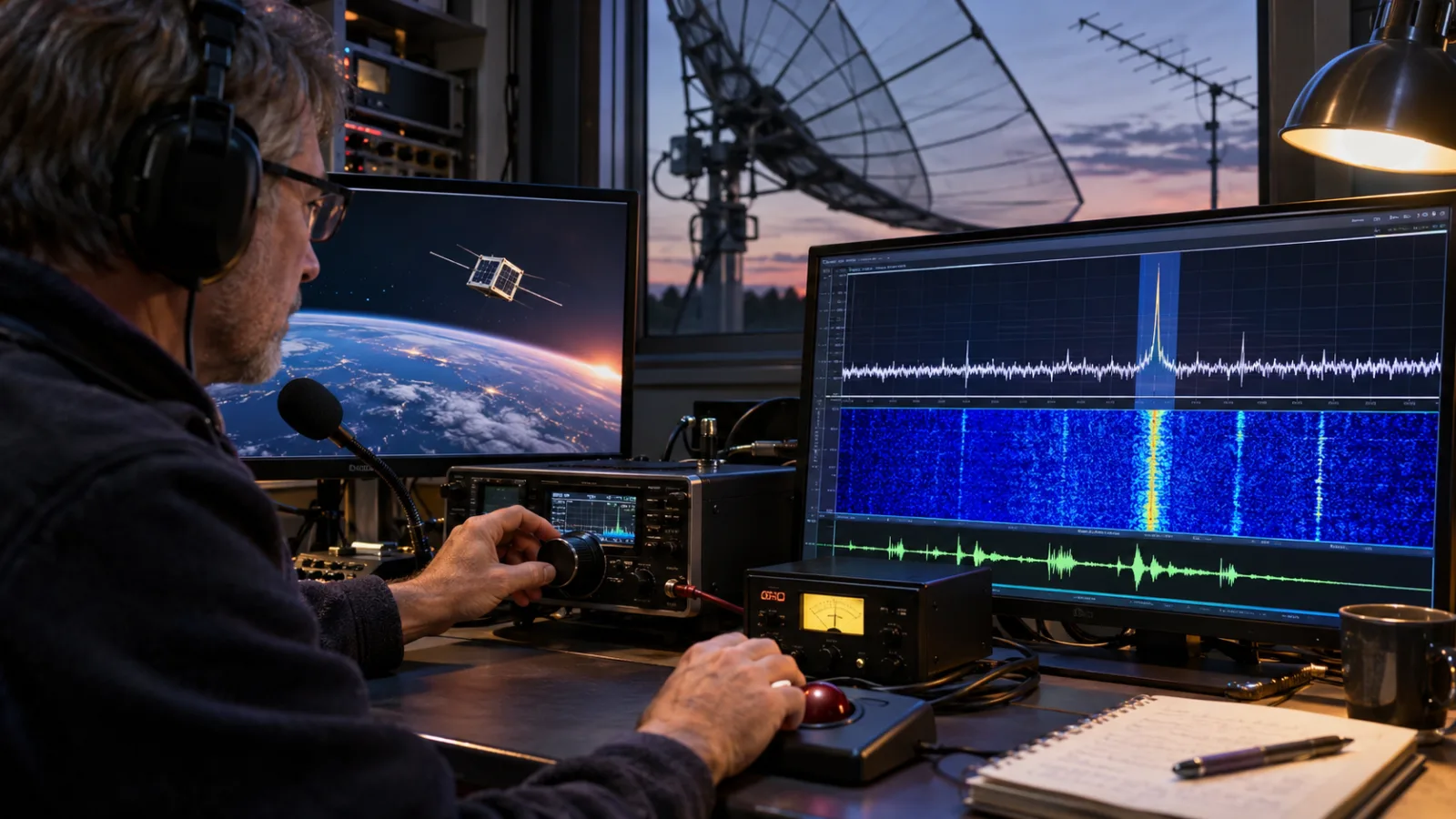
On 27 July 2026, the Norwegian amateur-radio group LA4O transmitted a spoken command to the OPS-SAT PRETTY spacecraft: “PRETTY play Doom.” The signal was sent from Oslo on 1296.000 MHz using narrowband FM. PRETTY received the transmission, processed the speech onboard, converted the spoken request into text, and then launched the 1993 game Doom. The memorable part was the game, but the technically important event was the complete chain between a human voice on the ground and an action performed by a spacecraft in orbit.
That distinction matters because a satellite reacting to speech is not the same thing as a satellite carrying a conventional voice conversation. The ground station had to put a usable radio signal through a space link, the spacecraft had to recover audio from that signal, and an onboard model had to recognize enough of the command to select the intended action. Each stage could fail independently. A command might be transmitted at the wrong frequency, arrive with unsuitable audio, be affected by the changing signal conditions of a low-Earth-orbit pass, or be received clearly enough for a person but not clearly enough for a small speech-recognition system.
PRETTY is an OPS-SAT experiment using the platform’s reconfigurable software-defined-radio capabilities. That made it a suitable environment for testing the boundary between radio reception and onboard computing. The demonstration therefore belongs to two technical categories at once: it was an amateur-radio transmission and it was a spacecraft-processing experiment. Treating it only as a stunt hides the more useful lesson. The result depended on coordinating modulation, frequency control, signal filtering, demodulation and recognition, rather than on voice control as an isolated feature.
The wording of the command was deliberately compact. “PRETTY play Doom” provides a spacecraft identifier, an action and the name of the program to start. A short, constrained phrase gives an onboard recognizer a much narrower problem than unrestricted conversation. It also makes the outcome easier to verify: either the system identifies the intended command and starts the game, or it does not. In that sense, the demonstration showed how a small model can be used as an interface to a predefined spacecraft function, not that a satellite can generally understand arbitrary spoken instructions.
The verified achievement should also be kept separate from later discussion about possible rescue or emergency applications. A successful command in an experiment demonstrates that the signal path and processing concept can work under the tested conditions. It does not by itself establish a hardened emergency communications service, guarantee operation under every pass geometry, or remove the need for authorization, frequency coordination and disciplined radio operation. Those are separate engineering and operational questions.
This is why the event is relevant to operators working with software-defined radios. The payload’s visible response came at the end of a chain that began with a narrow 23-centimeter signal. The experiment exposed how small choices in reception and processing can determine whether a spoken command reaches the software that is supposed to act on it. The next question is not whether Doom can run in orbit, but what the demonstration says about making a low-bandwidth satellite link sufficiently stable, selective and intelligible for a machine to use.
Why a narrow 23-centimeter signal became the decisive engineering problem
The most revealing part of the experiment was not the choice of game but the amount of signal handling required before a spoken command could become a reliable machine instruction. The ground station used an Icom IC-9700, an approximately 80 W indicated transmission level, a 15.1 dBi helix antenna and manual pointing toward OPS-SAT PRETTY. That arrangement put the operator in charge of more than simply selecting a frequency and pressing transmit. The station had to keep the antenna aligned, account for the characteristics of the 1296 MHz link and provide the spacecraft’s onboard software with audio clean enough for its small speech-recognition model to identify the intended command.
That distinction matters because a voice link is only as useful as the least reliable stage in its chain. The radio produces an RF signal; the receiving SDR captures a slice of spectrum; filtering and frequency conversion prepare a baseband signal; the FM discriminator turns that signal into audio; and the onboard model evaluates the resulting speech. A weakness at any stage can turn a clear sentence at the microphone into an ambiguous or unusable input in orbit. In this case, the documented problem was not that the command concept was impossible. The receiver was passing too wide a slice into the FM discriminator, so the demodulator was being asked to process more spectrum than was appropriate for the narrow signal. The result was a processing path that could undermine the audio before recognition even began.
The correction was consequently a signal-processing correction rather than a change to the spoken phrase. The team used a peak search to locate the useful part of the captured spectrum, shifted that signal into the baseband position expected by the next processing stage, applied low-pass filtering and then decimated the data. Each operation reduced a different source of uncertainty. Peak searching helped identify where the signal actually sat in the received slice. Baseband shifting made the desired signal easier to handle consistently. Low-pass filtering limited the material presented to the FM discriminator, while decimation reduced the sample stream after the relevant information had been isolated. Taken together, the steps made the receiver’s view of the signal better match the narrowband-FM link instead of treating the entire SDR capture as if every part of it carried useful speech.
This is a familiar lesson for operators who work with software-defined radios: a large capture bandwidth is not the same thing as a suitable demodulator input. An SDR may record a broad window so that a signal can be found, but the later stages still need deliberate channel selection. If the discriminator receives an unnecessarily wide or poorly centred slice, the resulting audio can contain distortion, noise or other spectral content that complicates recognition. Conversely, filtering too aggressively or shifting the wrong portion of the spectrum can remove useful speech. The practical task is therefore to separate discovery from demodulation: first find the signal in the waterfall, then place and shape the channel that the FM stage will actually use.
The experiment also shows why the hardware list should not be treated as a universal station recipe. The IC-9700, helix antenna, indicated power and manual pointing describe the reported setup, not a guarantee that another station will obtain the same result. Satellite geometry, receive conditions, antenna tracking, frequency offset and the implementation of the SDR pipeline all affect the signal presented to the recognizer. Even the onboard model changes the engineering target: the goal is not merely to make speech audible to a human listener, but to deliver a sufficiently clean and consistently framed command for a constrained recognition system. The useful takeaway is narrower and more transferable. On a 23-centimeter satellite link, disciplined bandwidth selection and baseband processing can matter as much as transmitter power or antenna gain, because the spacecraft cannot act on the RF signal directly; it acts on the audio and command interpretation produced after the signal has been carefully reduced to its intended channel.
What Doppler, modulation and recognition errors teach an operator
The PRETTY experiment is a useful reminder that a low-Earth-orbit voice link is never a stationary terrestrial radio path. The apparent carrier frequency changes as the spacecraft moves, and the received signal can therefore drift across an SDR waterfall during a pass. In this case, the onboard processing tracked an excursion of about 34 kHz even though the ground station applied no transmit-side Doppler correction. That does not make Doppler the only problem, but it shows why a receiver can be correctly configured at one instant and poorly aligned later.
For narrowband FM, frequency tracking and channel width have to be considered together. A demodulator must remain close enough to the carrier to recover the voice, while its input filter must pass the intended modulation without admitting an unnecessarily large slice of noise and adjacent energy. The first LA4O attempt exposed the cost of getting that balance wrong: roughly 170 kHz was presented to the FM discriminator for a signal occupying about ±5 kHz. The returned capture contained enough information for analysis, but the discriminator was operating with a severe bandwidth mismatch and the spacecraft did not obtain usable command audio.
The correction was an SDR processing change, not a change to the basic idea of voice control. The revised chain searched for the signal peak within ±100 kHz, shifted the selected signal to baseband, then applied low-pass filtering and decimation before demodulation. That sequence is familiar to anyone who has debugged an SDR receiver: find where the energy actually is, reduce the amount of irrelevant spectrum, and only then ask the demodulator to produce audio. The lesson is not that every station should copy one set of values. It is that “strong signal” and “good input to the next stage” are different measurements.
There was another stage after the radio. PRETTY had to transcribe the recovered audio and decide whether it contained the command needed to launch DOOM. The onboard model was small and quantised, and the successful command was deliberately constrained. The reported transcripts were rough, yet the system still detected the relevant phrase. That result should not be read as evidence that the spacecraft understood unrestricted speech. It demonstrated that a limited recogniser could find a short, repeated control pattern in imperfect audio.
This distinction matters for operators because keyword detection and language understanding fail differently. A detector can be designed around a known word or a small collection of expected phrases. It may tolerate an imperfect transcript if repetition preserves enough of the decisive vocabulary for the command logic to match it. Understanding a complete, open-ended sentence requires the system to resolve more words, syntax and intent, so the same radio quality may no longer be adequate. A recogniser that reliably answers “is this the trigger?” is not automatically capable of answering “what does this speaker want me to do?”
The flight record also shows why a demonstration should be assessed attempt by attempt. Three of six onboard captures detected the command and launched DOOM. The LA4O analysis attributed two unsuccessful captures to loss of the uplink near culmination and one to recognition margin, rather than to the corrected flight signal processing. In the highest-scoring capture, no exact command token was recognised; the decision depended on lexical repetition and a one-character fuzzy matcher. That is a successful control path, but it is also a precise description of its limits. A result can be operationally correct while the intermediate transcript remains imperfect.
The later live-voice attempt reinforces the same point. A human operator replaced the synthetic voice, and one capture launched DOOM while recognising the command word twice. The outcome was encouraging, but it was not a license to treat every spoken message as equally robust. Human speech varies in timing, pronunciation and emphasis; Doppler, noise and antenna pointing add further variation before recognition begins. Repeating a short phrase gives the system more opportunities to see a usable version, but it can also conceal whether the underlying method works consistently or succeeded near the edge of its recognition margin.
A disciplined operator should therefore diagnose the chain in layers. First inspect the waterfall and determine whether the receiver followed the moving carrier. Then check whether the selected bandwidth and FM settings produced clean, intelligible audio. Only after that should a missed command be classified as a speech-recognition problem. A recording, timestamp and per-attempt log can distinguish frequency error, excessive filtering, noise, audio clipping and weak lexical evidence; without them, all of these failures look like the same vague symptom: “the satellite did not understand.”
That is the transferable SDR lesson from PRETTY. Doppler handling protects carrier alignment, modulation-aware filtering protects the audio, and constrained recognition turns that audio into a narrowly defined action. Each stage passes evidence to the next, and a failure early in the chain cannot be repaired simply by using a more sophisticated model. The experiment’s value lies in making that complete path visible: a voice command is not magic at the edge of space, but a carefully bounded radio, signal-processing and pattern-detection problem.
A safe way to reproduce the lesson on the ground
The most useful follow-up to the PRETTY demonstration is not to copy its transmit setup. It is to recreate the signal-processing problem at receive level, where the experiment becomes measurable and repeatable without putting an unfamiliar signal on the air. Start with a known narrowband FM recording or a signal you are authorized to receive. Watch the waterfall before touching the demodulator: identify the carrier, note how it moves during the pass, and estimate the occupied bandwidth rather than selecting a wide filter simply because the signal is easy to see. The basic question is whether the receiver is isolating the intended channel or feeding adjacent energy and noise into the FM discriminator.
That distinction matters because the documented problem was not that voice control was inherently mysterious. The ground station had to turn a moving, imperfect radio signal into clean enough audio for a small onboard speech-recognition model. On the ground, the same chain can be examined one stage at a time. Record the raw or suitably sampled SDR data, mark the signal’s frequency offset at several timestamps, and compare a centered capture with one that is deliberately left off-frequency. Then apply the narrowband-FM demodulator and listen to the difference. A waterfall can show that a carrier exists; it cannot by itself show whether the recovered audio has the timing, filtering and intelligibility needed by the next stage.
A practical receive-first worksheet can be short but disciplined:
| Check | What to record | Why it matters |
|---|---|---|
| Signal location | Centre frequency and observed offset | A pass is not a static-frequency test; the receiver must follow the carrier closely enough for the chosen channel. |
| Channel selection | NFM bandwidth and filter setting | A filter that is too wide admits unnecessary energy; one that is too narrow can remove useful speech components. |
| Demodulator output | Audio level, noise, distortion and dropouts | Speech recognition sees the recovered audio, not the waterfall display. |
| Processing changes | Baseband shift, low-pass filtering and decimation used | Each change should have a visible or audible reason, not be treated as a magic preset. |
| Time and geometry | Timestamp and pass information | The same signal can behave differently as the spacecraft moves and the link changes. |
The sequence is deliberately conservative. First capture a known signal. Next inspect its spectrum and frequency movement. Then test small changes in centre frequency and occupied bandwidth while keeping the recording and gain conditions fixed. Only after that should you compare demodulated audio. If a filter change improves intelligibility, retain the before-and-after files and write down the setting; if it only makes the signal louder, do not confuse loudness with a better input to recognition. This approach also makes failures useful: a rough transcript or a missed command can be traced back to a recording, an offset, a bandwidth choice or an audio-processing step instead of being dismissed as an unexplained software error.
The PRETTY case also supports a simple logging habit. For every trial, record the timestamp, the pass geometry available to you, the receiver frequency, the observed offset, the NFM settings, and a brief assessment of audio quality. Note whether the command was repeated and whether the result was a clear recognition, a rough transcript or no useful transcript. The point is not to manufacture a statistically strong test from one demonstration; it is to separate radio-link variables from language variables. If several recordings have clean, stable audio but recognition remains inconsistent, the issue may be the wording or the limits of the small model. If recognition improves whenever the carrier is better centred and the channel is better filtered, the lesson is in the SDR chain.
That distinction is especially important for operators tempted to read the experiment as a general-purpose voice interface. A simple, repeated trigger is a narrow test of whether an onboard model can recognize enough speech to select an action. It is not evidence that an orbital system can safely interpret arbitrary instructions, resolve ambiguity or provide dependable command-and-control under emergency conditions. The experiment’s value is precisely that it exposes the boundary between detecting a phrase and understanding a message. A ground exercise should preserve that boundary rather than hide it behind a successful playback or a polished transcript.
Any move from receiving to transmitting changes the responsibility. Amateur satellite transmissions require the operator to work within the applicable authorization, band plan and operating rules; power, antenna pointing and RF-exposure discipline also matter. A receive-side workflow can teach how Doppler, modulation, filtering and audio quality interact, but it does not grant permission to transmit on 1296 MHz or establish that a particular station configuration is suitable for every satellite pass. Nor does the demonstration turn an amateur-radio experiment into an emergency-service capability. Those are separate claims requiring separate engineering, regulatory and operational evidence.
The safe conclusion is therefore modest and useful. Reproduce the lesson first as a recorded NFM signal moving through an SDR: observe the offset, choose the channel deliberately, compare filtering and decimation, and log what the recovered audio actually sounds like. Treat the speech model as another receiver in the chain, with its own failure modes, rather than as a layer of magic. That method captures what the PRETTY experiment teaches best: successful orbital voice control depends on the whole link, from a correctly selected slice of spectrum to an onboard decision that is simple enough to verify. It is a lesson in disciplined signal handling, not a shortcut around authorization, validation or safety.
Related articles
Off Frequency Daily: Satellite Plays DOOM on Voice Command, CubeSat Hunters, and Browser SDRs
Hams tell an ESA satellite to play DOOM over 23 cm, Android CubeSat hunting apps land, and offline browser receivers keep getting weirder. A slightly ironic tour of the last 48 hours in amateur and free radio.
Doom in Orbit, Caroline on 648, and ESP32 TV on 6 cm
Norwegian hams voice-commanded a satellite to play Doom, Radio Caroline is still rocking medium wave into Estonia, and someone built DATV with two ESP32 boards.

Cloudflare OS is the AI workspace question enterprises cannot avoid
Cloudflare’s new agent workspace is less interesting as a product launch than as a blueprint for governed AI work: permissions, sandboxes, Gatekeepers, audit logs and app sprawl.

When multi-agent AI is worth it — and when it burns tokens
Anthropic’s latest multiagent research is a practical warning: agent teams can buy more parallel attention, but only when orchestration, evaluation and review are stricter than the demo.
Comments
Sign in to comment.
No comments yet.