When a vendor says turn it off: the ShareFile shutdown lesson
Progress told some ShareFile customers to keep Storage Zone Controllers offline. The incident is a runbook test for file-sharing, hybrid cloud and security teams.

Progress did not tell some ShareFile customers to install a patch. It told them to turn off servers.
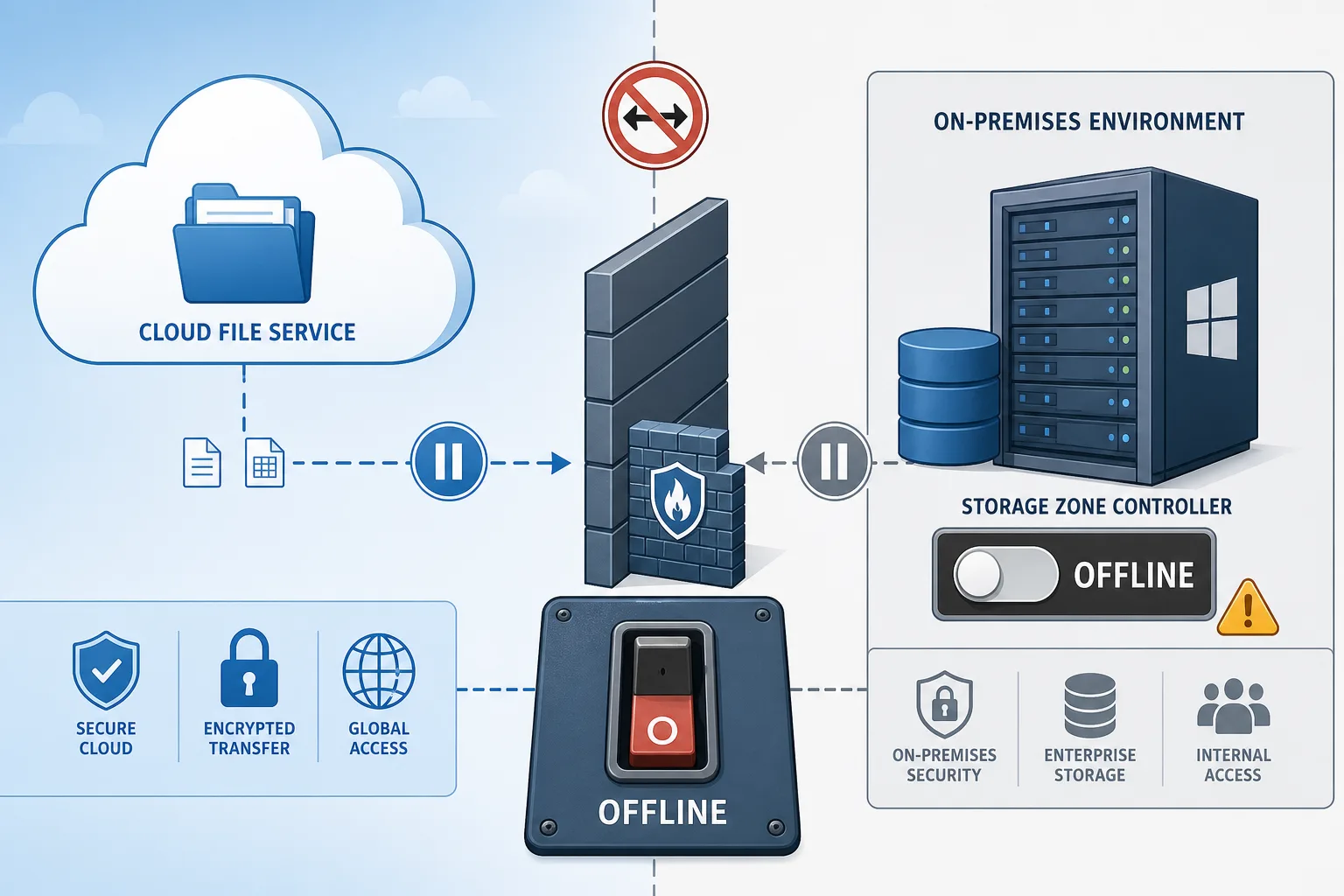
That is the detail that matters for IT teams. On July 10, Progress Software told customers running ShareFile Storage Zone Controllers to manually shut down the Windows servers hosting those controllers. The company described the reason as a "credible external security threat" targeting the on-premises component of ShareFile's hybrid file-sharing architecture.
The public status page still showed, at the time checked, an open incident: "ShareFile customers with Storage Zone Controllers are not operational at this time," posted July 10 at 12:12 EDT and marked Investigating. Progress later told media that cloud access for affected customers had been restored by 5 p.m. ET on Sunday, July 12. The same statement said Storage Zone Controllers must remain turned off while the investigation continues.
Progress also said it had no evidence of unauthorized access to any ShareFile customer account or data, and no active threat had been identified in that statement. That is important. It is also not the same as a clean all-clear for the customer-run controllers.
For IT operations, this is a rare kind of vendor instruction: no public CVE for the current issue, no public patch, no published indicators of compromise, no restart criteria, and a direct order to take a production-adjacent server offline.
What Storage Zone Controllers do
ShareFile can run as a cloud file-sharing service, but some organizations use Storage Zone Controllers to keep files in their own storage. The controller sits on a customer-managed Windows server. ShareFile cloud handles authentication, user management, sharing and collaboration, while the controller moves uploads and downloads between users and the organization's storage.
That hybrid model exists for sensible reasons. Legal teams, healthcare providers, financial firms and companies with strict data-residency rules often want more control over where files sit. The tradeoff is that the controller becomes a high-trust edge component. It is close to sensitive documents, it talks to the cloud, and it is often reachable from the internet because users need to move files through it.
A file-sharing edge server is never "just middleware." It is a data path.
Why a shutdown order is unusual
The normal enterprise security rhythm is familiar: vendor advisory, affected versions, CVE, patch, workaround, detection notes, monitoring. Sometimes the workaround is ugly. Sometimes the patch window is painful. But the instruction still fits the patch-management machine.
This case does not fit that machine. Progress told customers, according to BleepingComputer and other reports quoting the customer email, that disabling access through ShareFile cloud was not enough. Customers had to manually shut down the server hosting Storage Zone Controllers as a "critical additional step" to protect data.
That does not prove a zero-day. It does not prove exploitation in the wild. It does not prove compromise. Progress has not publicly said those things.
It does tell IT teams that the vendor saw enough risk to prefer downtime over continued exposure. In a production environment, that is a serious signal.
What is known
The strongest facts are narrow.
Progress described a credible external security threat targeting ShareFile Storage Zone Controllers. The impacted component is the customer-run controller, not standard cloud-only ShareFile accounts. ShareFile's status page confirms the operational impact for Storage Zone Controller customers. Media outlets including BleepingComputer, The Hacker News, SecurityWeek and The Register reviewed or confirmed the substance of the customer communication.
Progress said it had no evidence of unauthorized access to ShareFile customer accounts or data. SecurityWeek and The Register both reported an updated Progress statement saying cloud service access had been restored for customers with Storage Zone Controllers by Sunday evening, but controllers must remain off while the investigation continues.
The r/sysadmin thread that first surfaced the email was also visible through Reddit's RSS feed. The original post said the user had received a Progress email telling customers to shut down ShareFile Storage Zone Controllers because of a credible external security threat. Comments in the RSS feed showed administrators discussing confirmation calls and the status-page update. Reddit is a signal, not the factual base; the status page and vendor/media confirmations carry the story.
What is still unknown
Progress has not publicly disclosed the nature of the threat, whether any customer controller was compromised, whether the issue is a vulnerability, which versions are affected, or when administrators can safely bring controllers back online.
There was no new July 2026 NVD entry for "ShareFile Storage Zone Controller" in the check performed for this article. That does not mean there is no issue. It means public vulnerability metadata had not caught up, or the incident may not be a normal CVE-shaped disclosure.
There are older and recent historical facts around this product family. CVE-2023-24489 affected Citrix ShareFile Storage Zones Controller and could allow unauthenticated remote compromise; it was added to CISA's Known Exploited Vulnerabilities catalog in 2023. In April 2026, NVD entries for CVE-2026-2699 and CVE-2026-2701 described critical flaws in Progress ShareFile Storage Zones Controller, including configuration-page access and file-upload paths that could lead to remote code execution. SecurityWeek reported speculation that the July event might relate to those March-patched flaws.
That remains context, not attribution. The current incident should not be presented as MOVEit 2.0, a confirmed zero-day, or a confirmed breach unless Progress, CISA or credible technical evidence says so.
The business problem is real even without a breach
For affected customers, this is not only a security headline. ShareFile is used for document exchange. Turning off Storage Zone Controllers can interrupt client portals, legal document flows, healthcare file transfers, finance workflows, vendor onboarding, HR paperwork and any process that assumes secure file sharing will be available.
That is why this kind of instruction tests more than the security team. It tests the business-continuity plan. Who tells the legal department that document exchange is paused? Who approves a temporary file-transfer path? Who decides whether a fallback is allowed for regulated data? Who communicates to clients without saying too much or too little?
If the answer is "the ShareFile admin will figure it out," the organization has already learned the wrong lesson.
What affected teams should do now
First, follow the vendor instruction. If Progress tells affected Storage Zone Controller customers to keep controllers offline, do not treat a current version number as permission to restart.
Second, preserve evidence before the response gets messy. That may mean snapshots, relevant Windows and IIS logs, application logs, reverse-proxy logs, EDR telemetry and firewall records, depending on the environment and on legal or incident-response guidance. If a server is already off, coordinate with incident response before powering it back on just to collect data.
Third, check versions and exposure. Know exactly which controllers exist, which versions they run, what ports are exposed, whether they sit behind a reverse proxy or WAF, and whether administrative access is reachable from places it should not be.
Fourth, separate official guidance from community speculation. The Hacker News suggested checking for unfamiliar .aspx files in web folders and storage paths and confirming that versions are current, such as 5.12.4 or later on the 5.x line or a 6.x release. That is useful industry guidance, but it is not a substitute for Progress's restart approval or for your own forensic process.
Fifth, talk to the business. Identify which workflows are down, which alternatives are approved, which customers need communication, and which data types cannot move through ad hoc tools.
Questions to ask Progress or your MSP
Ask whether your tenant and controllers are in the affected group. Ask which versions are affected, whether any specific logs or indicators should be collected, and whether Progress has seen exploitation against customer-managed controllers.
Ask what "no evidence of unauthorized access" covers: cloud accounts, customer data, controller hosts, or all of those. The scope of that sentence matters.
Ask when controllers may be restarted and what conditions must be met first. If the answer is "not yet," document it and keep leadership informed.
Ask whether temporary cloud-only access changes data-location commitments, customer contracts or compliance controls. In some organizations, the difference between cloud access and customer-managed storage is not merely technical.
The wider lesson for file-transfer systems
Attackers like enterprise file-transfer and file-sharing systems because the reward is obvious. These systems handle sensitive files, they serve external users, and they often sit at the edge between internal storage and the internet.
Progress knows this history better than most. MOVEit Transfer was mass-exploited in 2023 by the Clop operation. ShareFile's older Citrix-era Storage Zones Controller had a known exploited unauthenticated compromise issue in 2023. The current ShareFile event has not been linked publicly to those incidents, but it sits in the same risk category: trusted file-moving infrastructure at the boundary of an organization.
That category needs its own runbook. Asset inventory should identify file-transfer gateways, storage connectors, MFT servers, reverse proxies, service accounts and the data stores behind them. Logging should be good enough to reconstruct file movement. Isolation procedures should be rehearsed before a vendor email arrives on a Friday.
What to change after this incident
Treat hybrid SaaS connectors as production security assets, not helper boxes. If a server bridges your data and a cloud service, it belongs in vulnerability management, EDR coverage, backup planning, firewall review, certificate management and incident-response exercises.
Write a shutdown runbook. It should say who can isolate a file-sharing edge server, how to preserve evidence, who approves fallback channels, who talks to business owners, and when legal or compliance teams join the call.
Keep a communications template ready. A calm, accurate note beats a scramble. Say what is unavailable, what alternatives are approved, what data handling rules still apply, and when the next update is expected.
Review vendor dependency. Hybrid cloud can be the right architecture, especially when data residency matters. But it does not remove risk. It moves part of the risk onto a customer-managed component that must be monitored like an internet-facing application.
The takeaway is not "never use ShareFile" or "never use hybrid file sharing." The takeaway is simpler and less comforting: when a vendor says "turn it off," your organization should already know what that means operationally, legally and technically.
Related articles
Cloudflare CASB automatic remediation turns SaaS posture findings into production change
Cloudflare CASB can now revoke risky Microsoft 365 and Google Workspace sharing and send webhooks automatically. The useful question is not whether to turn it on, but how to keep the automation from becoming an unreviewed write path into SaaS data.

Grok Build shows why AI coding agents need data boundaries
The Grok Build backlash is less about one vendor than a new rule for development teams: AI coding agents need sandboxing, egress controls and repository-aware governance.

What Grok Build changed about trusting AI coding agents
The xAI backlash is not only about one CLI. It shows why teams need to verify what AI coding agents read, upload, store and leave behind.

Copilot for Word makes document trust an IT security problem
A new disclosure shows how hidden instructions in office files can cross from source material into AI-generated documents. Microsoft 365 rollouts now need a document trust model.
Comments
Sign in to comment.
No comments yet.