NVIDIA OpenShell puts agent permissions under policy control — what is ready to test
NVIDIA OpenShell is an Apache-licensed runtime for placing coding and autonomous agents inside policy-controlled sandboxes. Its useful idea is not another agent framework, but a boundary around files, processes, networks, credentials, and policy changes.

NVIDIA OpenShell is the open-source part of NVIDIA’s new effort to make autonomous agents easier to contain. The project wraps agents such as Codex, Claude Code, OpenCode, and GitHub Copilot CLI in sandboxes, then applies rules to the files they can touch, the programs they can run, the network destinations they can reach, and the credentials they may use.
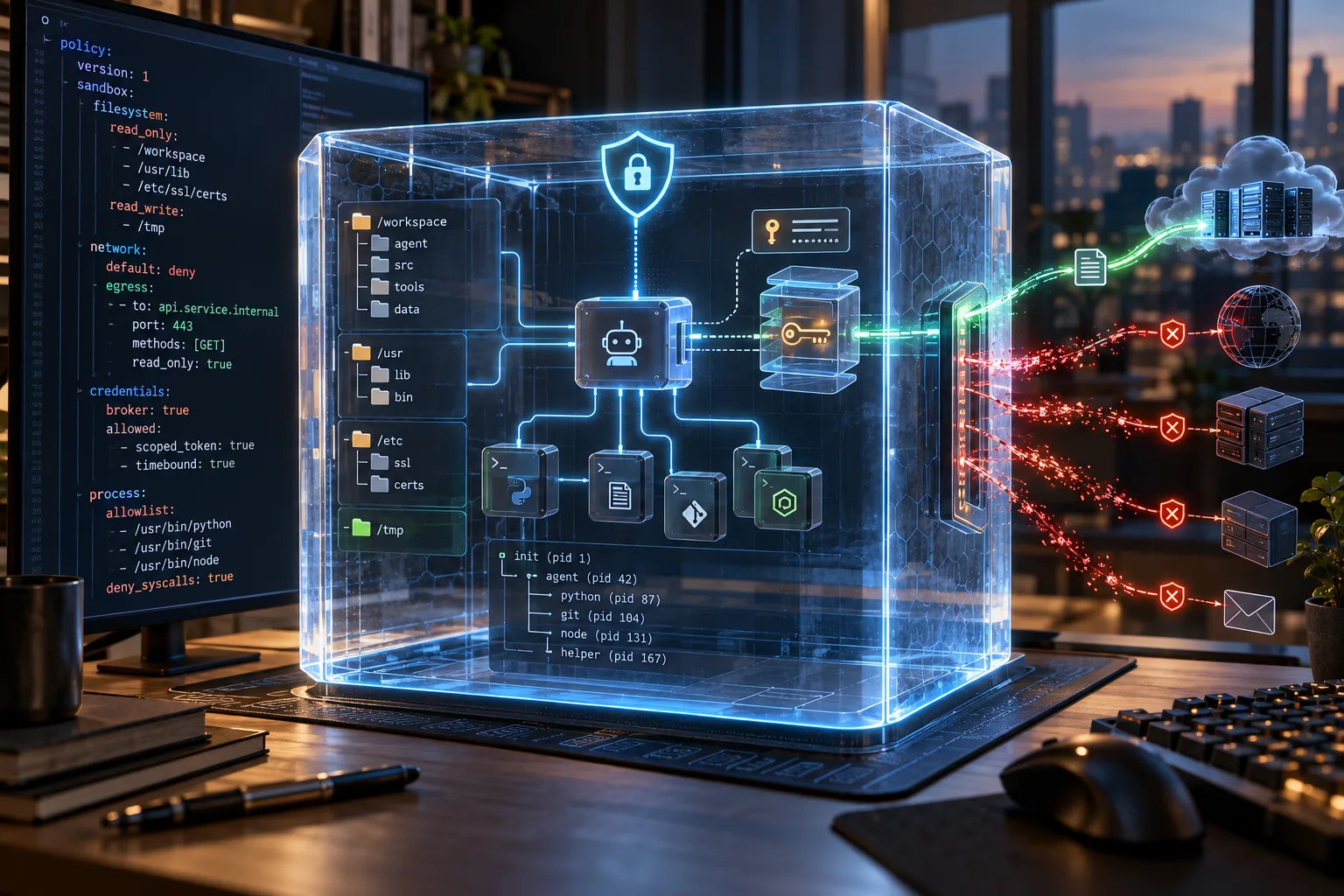
That framing matters because many agent security discussions still start with the model. OpenShell starts one layer lower. It assumes that a model can misunderstand a request, follow hostile instructions in a repository, execute a risky shell command, or delegate work to a child process. The question becomes what the resulting workload is technically allowed to do.
NVIDIA announced its wider Open Agent Safety Platform on September 28, 2026. The platform also includes Sentry, a separate monitoring and containment design tied to NVIDIA hardware. OpenShell is the part developers can inspect and run across several infrastructure choices. It is licensed under Apache 2.0, but it is still an emerging project with operational complexity, host requirements, and a policy model that needs careful testing.
The practical advice is straightforward: OpenShell is worth trying for security experiments, local agent evaluation, and controlled development workflows. It is too early to treat a successful quickstart as proof that an agent is safe for production.
The current angle: the agent boundary is the product
OpenShell’s repository describes it as a runtime for fleets of autonomous agents. That is a different proposition from an agent framework. It does not decide how an agent plans a task, which model should generate the next step, or how a developer should structure an orchestration graph. It sits underneath an existing harness and attempts to keep the harness inside a declared operating boundary.
That distinction is easy to miss because the project arrives during a rush of agent launches. A typical coding agent can read a checkout, edit source files, install dependencies, call package registries, use Git, access cloud APIs, and start subprocesses. A prompt can tell it to be careful, but a prompt is not an enforcement mechanism. An agent that receives a malicious instruction from a README or an issue can still have the authority granted by its surrounding shell.
OpenShell changes the place where that authority is expressed. The operator writes policy as YAML. The runtime turns that policy into controls applied by the kernel, the sandbox supervisor, and a network proxy. The model can still make a bad decision, but the decision has to pass through the permissions granted to its workload.
This is a more useful open-source angle than another list of supported models. The project is testing whether agent permissions can become portable, reviewable configuration. If that works, the same policy can travel with a sandbox image or be reviewed in a pull request. If it does not, the project becomes another layer of configuration that developers bypass whenever it interrupts a task.
What OpenShell actually controls
The core policy has several domains, and they do not all behave in the same way. That timing is one of the first things an evaluator should understand.
filesystem_policy defines which paths are readable and which are writable. The project uses Landlock-based controls for filesystem access. Filesystem and Landlock settings are applied when the sandbox starts, so changing them is not the same as changing a network rule on a running workload. A policy might allow an agent to write to a project directory and a temporary directory while keeping credentials, SSH keys, browser profiles, and unrelated home-directory data outside its view.
The process section controls the identity and process conditions used when the sandbox is created. The aim is to prevent a workload from simply turning an ordinary coding task into a privilege-escalation exercise. This is still dependent on the selected runtime and host configuration; a policy file does not erase the security assumptions of Docker, Podman, Kubernetes, a virtual machine, or the operating system underneath them.
network_policies control outbound access. OpenShell uses a deny-by-default model for sandbox connections, then allows named destinations and, where configured, particular binaries. A rule can distinguish a package manager from a shell command, or a Git client from a generic HTTP client. That makes it possible to permit a narrow workflow without handing every process the same egress.
The network layer can also inspect requests at a higher level. NVIDIA’s example allows curl to read from the GitHub REST API while rejecting a write request. The important detail is that allowing a host is not necessarily the same as allowing every operation on that host. A policy can describe an endpoint, port, protocol, permitted binary, and read-only or write access.
network_middlewares provide another place for inspection, transformation, or blocking. In practice, that is where a policy can become more specific than a conventional firewall rule. The project documentation describes controls for HTTP, GraphQL, and Model Context Protocol traffic. That does not mean every application protocol is equally mature or equally easy to express; it means the runtime is designed to reason about requests rather than only IP addresses and ports.
Finally, provider profiles handle credentials and approved service access. The intended model is that an agent does not receive a raw secret and then get to use it everywhere. OpenShell keeps the real credential outside the workload, checks the destination and policy, and substitutes the credential only for an authorized request. A GitHub token that can be used for a read-only API path should not automatically become a general-purpose secret available to every command in the sandbox.
That last boundary is especially important for coding agents. A tool can be prevented from reading a local token, while still being granted narrowly scoped access to a remote service. The arrangement is not a replacement for the service’s own permissions. It is an additional control around how the agent can use them.
A small policy is more informative than the marketing claim
The most useful way to evaluate OpenShell is to start with a deliberately boring task. Create a sandbox with no outbound network access. Run a harmless request such as a call to the public GitHub API. Confirm that the request is blocked and inspect the log. Then apply a policy that permits a read-only GitHub endpoint and repeat the request. Finally, attempt a write operation and confirm that the read-only rule rejects it.
A simplified policy shape looks like this:
version: 1
filesystem_policy:
  include_workdir: true
  read_only:
    - /usr
    - /lib
    - /etc
  read_write:
    - /tmp
landlock:
  compatibility: best_effort
network_policies:
  github_api:
    name: github-api-readonly
    endpoints:
      - host: api.github.com
        port: 443
        protocol: rest
        enforcement: enforce
        access: read-only
    binaries:
      - path: /usr/bin/curl
This example is not a production policy. It is a way to make the control visible. It also shows why the project should be evaluated with tests rather than screenshots. The question is not whether YAML exists. The question is whether a request that should be denied is denied under the exact runtime, image, binary path, credential setup, and host configuration that a team intends to deploy.
OpenShell’s documentation says static controls are locked at sandbox creation while network controls can be changed while the sandbox runs. That is useful for incremental approval: an agent can begin with no network, ask for a specific service, and receive a reviewed update without being restarted. It also creates a governance problem. A dynamic policy change can expand access during a long-running session, so the approval path, audit trail, and rollback behavior matter as much as the initial policy.
The project includes a policy advisor and policy prover for reviewing proposed access. The promise is that a change can be checked for new authority before it is applied. That is a valuable direction, but formal verification of a policy is not the same as verification that the policy expresses the business intention. A formally valid rule can still allow the wrong repository, the wrong API method, or a credential with more power than the task needs.
Who should try it now
OpenShell is a good fit for people who already run agents with meaningful local authority and want to measure the difference between prompt-level caution and runtime enforcement. Security engineers can use it to build reproducible agent escape and exfiltration tests. Platform teams can investigate how policies might travel from a developer laptop to a Kubernetes gateway. Maintainers of agent tools can test how their process trees, network calls, and provider integrations behave inside a restricted environment.
It is also relevant to developers working with repositories they did not create. An unfamiliar codebase may contain installation scripts, generated files, dependency hooks, or instructions aimed at automated tools. A sandbox with a narrow work directory and no default egress gives the developer a safer place to inspect such material. The protection is not absolute, but it can reduce the consequences of an accidental command.
Researchers evaluating local models should find the separation useful as well. OpenShell can run an agent against local or cloud-based inference while placing the workload’s files and outbound requests behind policy. That allows an experiment to compare models without changing the entire host environment for every run.
Teams should be more cautious if they are looking for a turnkey enterprise control plane. The repository includes a gateway, SDKs, provider handling, audit behavior, and a Kubernetes deployment path, but using those parts together is a systems project. It involves image management, runtime privileges, network enforcement, identity, secrets, logging, incident response, and policy ownership. Installing the CLI is not equivalent to completing that work.
The host and runtime still matter
The quickstart currently targets Linux, macOS on Apple Silicon, and Windows through WSL 2 on an experimental basis. The project expects a container or virtualization substrate such as Docker, Podman, or host virtualization. Kubernetes is supported through a Helm deployment, with the project noting that the cluster network layer must enforce the relevant network policy.
These requirements are not administrative footnotes. A sandbox is only as strong as the boundary that actually enforces it. A team should document which kernel features are available, what happens when Landlock is unavailable, whether the container engine is rootless, which capabilities remain in the workload, how images are built, and how updates are authenticated. The same YAML can produce different practical results when the host assumptions change.
The project’s policy documentation includes a compatibility setting for Landlock. That is a useful accommodation for different environments, but a permissive compatibility choice should not be mistaken for a guarantee that every intended filesystem restriction is active. A production deployment needs a startup check that fails closed or clearly reports a reduced security posture.
The network proxy is another dependency to test. If the agent needs a package registry, Git provider, model endpoint, issue tracker, or MCP server, each service adds policy surface. A rule that permits a broad domain may be convenient while undermining the reason for having per-endpoint controls. A rule that is too narrow may encourage a developer to add a catch-all exception. The operational design should make the narrow path easier than the bypass.
Credential brokering is promising, but not magic
OpenShell’s provider model addresses a common failure mode: giving an agent an environment containing every token available to the user. By keeping credentials outside the sandbox and binding them to approved destinations, the runtime can prevent a token intended for one service from being sent to another. It can also apply a read-only request rule even if the underlying token technically permits writes.
That does not eliminate credential risk. The service still has to issue sensible tokens. A provider profile still has to be configured correctly. The proxy still has to recognize the traffic it is supposed to inspect. A credential that is authorized to delete repositories remains dangerous if the policy allows the relevant API method. And a model can still produce damaging output inside the scope it was granted.
The best test is therefore a matrix, not a single success case. Test a permitted read, a denied write, an unapproved host, a request made by the wrong binary, an expired credential, a malformed request, a subprocess, and a child agent. Test the same actions through the SDK or integration path that the real workload will use. Then examine the audit output to determine whether an operator could reconstruct what happened.
OpenShell says it records policy decisions in an Open Cybersecurity Schema Framework audit trail. That is useful for incident response, but logs only help if they are collected, retained, protected from the workload, and connected to the identity of the person or automation that approved a change. A local demo log is not yet an enterprise audit system.
What the project does not solve
OpenShell is containment, not alignment. It cannot make an unreliable model reliable, distinguish a subtle business mistake from a valid action, or guarantee that a task specification is safe. If an agent is allowed to modify a production deployment, the runtime may successfully enforce that permission while the model makes a disastrous but technically authorized change.
It also does not replace identity providers, secret managers, endpoint security, vulnerability management, software supply-chain controls, observability, or human approval. NVIDIA’s own product material describes OpenShell as an agent runtime boundary that integrates with those surrounding systems. That is the right mental model. The project adds a layer; it does not make the rest of the stack optional.
There is a more basic limitation: policy quality determines useful access. A developer agent that cannot read the right files or reach the right package registry will fail in confusing ways. A developer agent with broad filesystem and network permissions may work smoothly while receiving little meaningful protection. The engineering challenge is to define the smallest authority that still lets the task complete, then make exceptions explicit and reviewable.
The public discussion has raised the same concern from another direction. Coverage of the announcement noted that restrictive controls could block useful work, and that case studies are needed to understand the balance. That is not a reason to dismiss the project. It is a reason to test real workflows instead of repeating the claim that an agent can be quarantined in milliseconds.
The separate Sentry component also needs to be kept conceptually separate. NVIDIA presents it as a hardware-level monitoring and containment layer, while OpenShell is the open runtime and policy boundary. OpenShell can be useful on rival compute platforms, including Arm and Intel, according to NVIDIA and reporting on the launch. A team evaluating the open-source project should not assume that it automatically receives every property of the wider NVIDIA platform.
Licensing and project maturity
The OpenShell repository identifies Apache License 2.0 as its license. That is a permissive license familiar to infrastructure and developer-tool projects. It makes the code easier to inspect, modify, and integrate, subject to the license and the separate terms attached to retrieved materials, container images, models, providers, and third-party components.
The repository also contains a security policy and third-party notices. Those documents should be part of an adoption review. The project’s own disclaimer says that materials retrieved or accessed by the software are governed by their separate terms and that users are responsible for checking their security, integrity, and suitability. In practical terms, an open runtime does not make every image, skill, plugin, model, or script run inside it trustworthy.
Maturity should be judged from the release and issue history, not only from the presence of a major company behind the repository. OpenShell has a broad surface area: a CLI, a local gateway, sandbox drivers, policy schema, proxy behavior, provider credentials, SDKs, Helm deployment, inference routing, and agent skills. Each component creates compatibility and security questions. Early adopters should pin versions, keep a disposable test environment, review changes between releases, and preserve a rollback path.
Telemetry deserves a specific check. The repository says OpenShell collects anonymous operational categories and counts by default, while excluding names, hostnames, file paths, prompts, credentials, provider names, model names, and user content. It also documents ways to disable telemetry or compile it out. That is a more useful disclosure than silence, but organizations with strict privacy requirements should verify the implementation and their build configuration rather than relying on a summary.
Alternatives and complements
OpenShell is not the only way to reduce agent authority. A minimal container with no host mounts can be enough for a narrow build step. A rootless container, a microVM, a dedicated virtual machine, a remote development worker, or a CI job can provide different isolation trade-offs. Linux primitives such as Landlock and seccomp can also be used directly when a team wants a smaller control surface.
Those approaches solve different parts of the problem. Containers and pods provide runtime substrates. MicroVMs may provide a stronger isolation boundary at the cost of startup time and image management. CI runners are useful for repeatable jobs but can be awkward for interactive development. Direct kernel policy can be lightweight but leaves teams to build their own credential brokering, network mediation, lifecycle management, and audit conventions.
OpenShell’s argument is that agent workloads need these pieces to be coordinated. A policy should describe not only what the process can read, but which executable can call which endpoint, which credential is bound to that endpoint, how a running policy changes, and how the result is logged. That coordination is the project’s main reason to exist.
The right comparison is therefore not OpenShell versus Docker. It is OpenShell plus a runtime versus a runtime alone, with the extra policy and gateway components measured against the complexity they introduce. For a simple untrusted build command, OpenShell may be unnecessary. For an agent that can browse a repository, install tools, call APIs, and launch subprocesses over a long session, the additional layer may be justified.
A sensible evaluation plan
Start with a disposable host and a small repository. Record the host operating system, kernel features, container engine, OpenShell version, sandbox image, agent version, and provider configuration. Do not begin with production credentials or a project containing unrelated secrets.
Create a baseline sandbox. Confirm which files are visible, which paths are writable, which user owns the processes, and what happens when a command attempts to use the network. Run the same checks from the agent, from a shell launched by the agent, and from a child process.
Add one service at a time. A read-only package or Git service is a better starting point than unrestricted web access. Test the positive path and several negative paths. Keep the policy in version control, review it like code, and write down why each allowed endpoint and binary is necessary.
Then test policy changes during a session. Confirm which sections require a new sandbox and which are hot-reloadable. Verify that a denied request remains denied until the approved change is actually applied. Test rollback and failure handling. An access-control system should be evaluated when the gateway is unavailable, a policy is malformed, a provider is missing, and a network request times out.
Finally, simulate an incident. Feed the agent a repository instruction that asks it to search for secrets, call an unapproved endpoint, or modify a file outside the worktree. The aim is not to trick the model for entertainment. The aim is to determine whether the boundary blocks the action, whether the error is understandable, whether the event is logged, and whether an operator can tighten the policy without destroying the session.
The verdict
NVIDIA OpenShell is interesting because it treats agent authority as infrastructure rather than as a promise embedded in a system prompt. Its Apache-licensed code, declarative policies, kernel-backed filesystem controls, network mediation, provider credentials, and gateway model give developers something concrete to test. The project also connects naturally to the open-source ecosystem: it supports multiple agent harnesses, exposes SDKs, documents a Kubernetes route, and can run on more than NVIDIA hardware.
The caution is equally concrete. The project is not a universal safety system, its policies can be difficult to design, its host assumptions need verification, and its broad feature set raises the cost of a careful deployment. A default-deny network rule is useful only if the exceptions remain narrow. A sandbox is useful only if the host and image are understood. A credential broker is useful only if provider permissions and request inspection are tested.
For the Open Source Radar audience, the sensible next step is a lab trial, not a production migration. Use OpenShell to build a repeatable test harness for the agent workflows that currently have too much authority. Measure blocked actions, false positives, startup behavior, policy review, logs, and recovery. If the controls survive that process without turning every task into an approval queue, OpenShell could become a practical foundation for safer agent development. If they do not, the experiment still reveals exactly where the workflow depends on ambient authority—and that is information most agent projects need.
Related articles

Nvidia’s Open Agent Safety Platform Makes Runtime Containment the Next AI Buying Question
Nvidia’s new agent-safety stack is less a magic brake than a sign of where enterprise AI due diligence is heading: explicit permissions, monitored execution and evidence that autonomous tools can be stopped.
Nvidia’s reported Hugging Face talks turn model hubs into platform risk
The reported talks are not a confirmed acquisition, but they show why AI teams should treat model hubs as strategic dependencies, not neutral folders of weights.
Открытая платформа Nvidia для безопасности агентов делает контроль выполнения главным вопросом при покупке ИИ
Новый стек Nvidia для безопасности агентов — не волшебный тормоз, а признак смены подхода: компаниям нужны явные разрешения, контролируемое выполнение и доказательства того, что автономный инструмент можно остановить.
英伟达开放式智能体安全平台:运行时遏制为何成为企业采购 AI 的下一个问题
英伟达的新智能体安全栈并不是让自主 AI 突然变安全的万能刹车,而是在提醒企业:权限、执行监控,以及能够证明自主工具可被及时停止的证据,正成为 AI 尽调的核心。
Comments
Sign in to comment.
No comments yet.