ABB’s AI Robot Trainer Moves Factory Vision from Specialist Project to Managed Workflow
ABB’s new AI Robot Trainer targets a quiet bottleneck in industrial robotics: keeping vision systems accurate after the factory, products and lighting change. The promise is easier retraining, not hands-off autonomy.

ABB’s latest robotics announcement is less about giving a robot a larger vocabulary than about changing who is allowed to improve it. On October 15, ABB introduced an end-to-end physical-AI workflow for fashion and apparel logistics by adding its AI Robot Trainer to the Fashion Inductor module. The company says the system can cut engineering and commissioning effort by up to 75 percent.
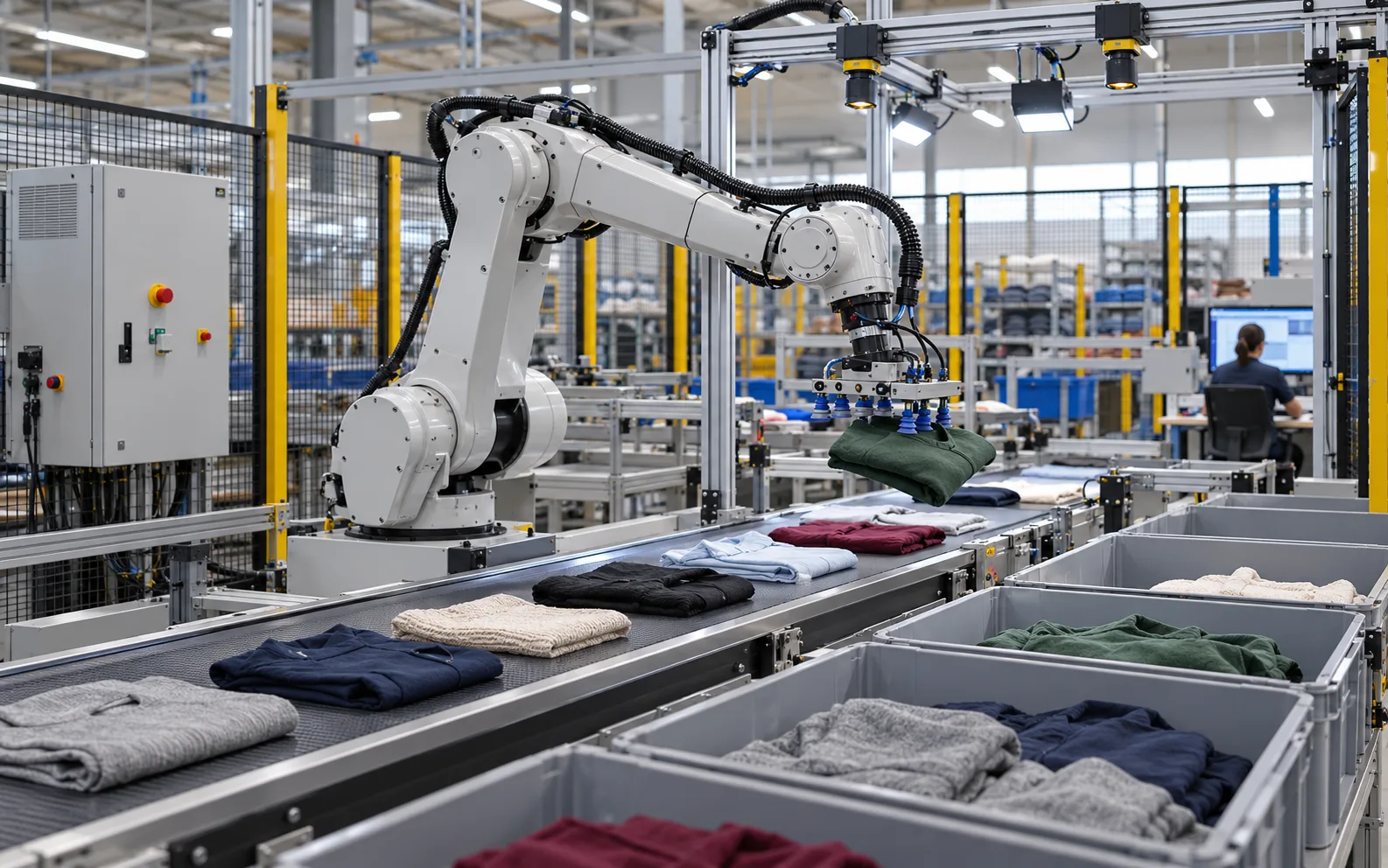
That number deserves careful reading. It is not a claim that a robot can be dropped into an unknown warehouse and safely teach itself every task. The more specific proposition is more interesting: an industrial vision application can be trained, deployed, monitored and retrained inside a controlled software and hardware stack, with less dependence on a specialist who must rebuild the model whenever operating conditions drift.
This is a different problem from the one usually associated with humanoid robots or general-purpose physical AI. A factory robot does not need to understand the whole world. It needs to distinguish a black shirt from a dark bin under changing illumination, identify a garment that is partly folded, select a reachable grasp, avoid collisions and keep doing so when the product mix changes. The commercial test is whether the complete cell becomes easier to operate without making its safety case weaker.
The announcement is about the maintenance loop
ABB describes AI Robot Trainer as part of OmniCore EyeMotion and the Fashion Inductor functional module. The system is designed to connect image acquisition, model training, deployment and continuous improvement. ABB’s stated workflow monitors performance, looks for anomalies, generates new training data and sends an improved model back to the physical robot.
That sequence matters because the first model is rarely the hard part of a vision project. A system may work during acceptance testing and then degrade when a supplier changes packaging, a product arrives in a different color, a conveyor is adjusted, dust accumulates on a lens or warehouse lighting changes with the season. In a conventional project, the customer may have to call an integrator, collect examples, label them, retrain the model, validate the update and schedule a controlled redeployment. The delay can be measured in hours or weeks depending on the cell and the organization.
A lifecycle workflow tries to turn that interruption into an operating procedure. The important unit is not the model but the closed loop around the model. It has to answer five practical questions: what changed, how certain is the system, which examples should be added, who approves the update and how can the previous version be restored if performance falls?
ABB’s public announcement establishes the intended architecture, but it does not publish a complete independent benchmark covering every one of those questions. The company reports up to 75 percent lower engineering and commissioning effort for the application. That is a useful commercial signal, but it should not be mistaken for a universal productivity result or a guarantee that every factory will see the same reduction.
Why fashion logistics is a revealing test
Fashion logistics sits in an awkward middle ground for automation. It has enough repetition to justify a robot, but not enough uniformity to make simple fixed tooling ideal. Garments differ in shape, texture, color, size and how they arrive in a tote. Fabric can collapse, overlap and obscure the feature that a gripper needs to find. The same stock keeping unit may look different after folding, unpacking or handling.
ABB says the Fashion Inductor can sort up to 1,300 items per hour per cell and has picking-accuracy targets above 99.5 percent. Those are ABB’s stated figures for the module, not an independently audited result in every customer environment. Still, they show why a vision system has to be judged on more than recognition accuracy. A missed pick is one problem. A correct identification followed by an unreachable grasp, a collision, a dropped item or a jam is another.
The robot therefore sits inside a chain that includes cameras, lighting, conveyors, grippers, motion planning, exception handling and software that coordinates the cell. A model can be excellent at classifying images and still be a poor production component if its confidence estimates are badly calibrated or if its errors cluster around the most expensive items.
The apparel case also exposes the difference between visual variability and true open-world autonomy. The system may encounter many appearances, but the task boundary remains defined: items arrive in a known area, they must be sorted into known destinations and the robot operates at a known speed with known reach and payload limits. That is a demanding engineering environment, yet it is not the same as a robot freely reasoning through an unstructured warehouse.
EyeMotion supplies perception; the cell supplies the limits
ABB launched OmniCore EyeMotion in 2025 as a hardware-agnostic vision system for OmniCore-powered robots. The company says it can use third-party cameras or sensors, integrate with RobotStudio and provide a web interface for setting up vision applications. ABB also claimed commissioning reductions of up to 90 percent compared with custom solutions for the earlier EyeMotion launch.
The newer AI Robot Trainer announcement builds on that perception layer. EyeMotion can provide the sensing and visual interpretation; the trainer is meant to make the learned part easier to improve over time. RobotStudio and a digital twin provide the virtual design and simulation environment, while the OmniCore controller remains the execution layer on the production robot.
This division is important. A vision model does not replace the robot controller, the safety circuits or the mechanical design of the cell. It can influence what the robot believes it is looking at and which motion is appropriate, but the system still needs constraints around speed, reach, collision avoidance, stop behavior and access to hazardous areas.
ABB says the upgraded Fashion Inductor includes a digital twin described as an exact replica of the module software, connecting the Application Controller Platform, Automatic Path Planning, AI Robot Trainer and RobotStudio. In practice, the value of such a twin depends on how faithfully it represents the production environment. A simulation can test many combinations cheaply, but it cannot automatically prove that the real camera will see every fabric texture, that the gripper will hold every item or that an unexpected human intervention is harmless.
The strongest reading of the announcement is therefore not that the robot becomes independent. It is that the software stack gives a factory a more disciplined way to manage a robot that remains bounded by a designed application.
The hidden bottleneck is data ownership
When machine vision is sold as a one-time installation, the integrator often holds much of the practical knowledge. The integrator knows which images were collected, why certain examples were rejected, what threshold was selected and which mechanical changes can invalidate the model. That arrangement can work, but it becomes expensive when the customer operates several sites or changes products frequently.
A trainer integrated into the application shifts some of that knowledge toward the operator and the manufacturer. The customer can potentially see the cases that trigger an exception, add representative examples and manage updates without opening a completely new project. The benefit is not simply that more people can click a training button. The benefit is that the organization can develop an institutional memory of failure cases.
That shift creates responsibilities. Someone has to decide which examples are safe to use. A pile of images from a rare lighting condition may improve one metric while damaging another. A model that performs better on average may become worse at detecting a high-value or fragile item. A data pipeline can also preserve sensitive information about workers, visitors or supplier labels even when the original application was intended only to sort products.
For that reason, an industrial AI trainer should be evaluated like a production change-management system. Useful questions include:
- Does the platform retain a version history for models and datasets?
- Can an operator compare the new model with the current production model on a fixed validation set?
- Are confidence thresholds and reject behavior visible to the people responsible for the line?
- Can the customer roll back quickly?
- Does the system log why a sample was selected for retraining?
- Can the model be tested against known difficult cases rather than only fresh examples?
ABB’s announcement emphasizes continuous improvement, but it does not provide all of these implementation details. They are the details that will determine whether the feature reduces operational friction or merely moves complexity into a new interface.
What the 75 percent claim can and cannot mean
The phrase up to 75 percent lower engineering and commissioning effort is easy to repeat and easy to misunderstand. It may refer to a defined comparison between the updated ABB workflow and a previous process for a particular application. It does not mean that a full robotic installation costs 75 percent less, that labor disappears or that a customer can operate a cell without integration expertise.
Engineering effort includes many layers. A customer still has to select and mount cameras, design lighting, specify a gripper, integrate conveyors, define the robot workspace, connect the cell to upstream and downstream equipment, test failure modes and train workers. The physical layout may be the largest cost in a deployment, and a software trainer cannot remove the need to build and validate that layout.
Commissioning effort is also not identical to time spent creating a model. It includes bringing components together, tuning motion, checking cycle time, validating communications, documenting the installation and making sure the cell behaves correctly when an item is missing or the line stops. A reduction in one portion of that work can still be valuable, but the headline should be treated as a directional promise until customer data shows how it holds across different plants.
The commercial question is total cost of ownership. A customer should compare the cost of the software and support contract with the cost of specialist visits, downtime, spare parts, retraining and lost throughput. If the trainer lets an internal team resolve routine drift while an integrator handles only difficult changes, the economics could be attractive even when the original installation remains complex.
The timing of improvement matters too. A short intervention that prevents a long stoppage may be more important than a large reduction in initial commissioning. Conversely, a model that is fast to retrain but slow to validate can create a new bottleneck. Factory buyers should ask for evidence at the level of the workflow, not just the model.
Safety remains a system property
The arrival of a learning loop does not change the basic safety obligation around an industrial robot. ISO 10218-1:2025 covers safety requirements for industrial robots as partly completed machinery, while ISO 10218-2:2025 addresses the integration, commissioning, operation, maintenance and decommissioning of robot applications and cells. The distinction is directly relevant here: the robot manufacturer can provide a safe robot and controller, but the complete cell still has application-specific hazards.
The International Organization for Standardization explicitly separates the robot from the integrated application. A camera model may influence task behavior, but it does not by itself provide safeguarding for a person entering the work envelope. A vision system that fails to recognize a garment is a production fault. A system that fails to recognize a person or an open access point can become a safety event, and those cases need to be handled by the appropriate safety-rated architecture rather than by ordinary model confidence.
OSHA notes that the United States does not have a single robotics-specific OSHA standard, while pointing employers toward consensus standards and existing requirements such as machine guarding and lockout/tagout. That context reinforces a practical rule: AI can change the robot’s perception and planning, but it does not waive the employer’s responsibility to assess hazards, install safeguards and train people.
The distinction is especially important when a marketing phrase such as physical AI is attached to an established industrial cell. The system may adapt to new visual conditions while remaining tightly constrained in motion. That is usually a strength. Predictable boundaries are easier to test, document and maintain than a vague promise of general autonomy.
A responsible deployment should keep safety-critical functions separated from the learned perception path wherever the risk assessment requires it. It should also define what happens when the model is uncertain, the camera is occluded, the robot sees an object outside the training distribution or the network connection to a supporting service fails. The safe response may be a controlled stop, a reject lane or a request for human intervention. None of those outcomes is a model failure if the cell was designed to handle them.
The real customer may be the integrator
ABB presents AI Robot Trainer as a way for system integrators to deploy, scale and continuously optimize AI-powered fashion logistics applications. That positioning is telling. The first market is not necessarily a small factory that wants to buy a robot and configure it alone. It is the network of integrators that repeatedly builds similar cells and needs to reduce the effort required to adapt them to different customers.
An integrator that can reuse a validated workflow has a reason to standardize around a platform. It can maintain a library of camera configurations, grippers, validation scenes and recovery procedures. It can offer a customer a more manageable support model because routine retraining may happen at the site while the integrator retains control over major changes.
For ABB, the advantage is equally strategic. The more of the workflow that runs through RobotStudio, OmniCore, EyeMotion and the application module, the more difficult it is for a competing component to replace the stack one piece at a time. A customer is not only buying an arm; it is adopting a set of tools for designing, deploying and maintaining a cell.
That can be good for reliability if the integration is coherent. It can also increase platform dependence. Buyers should ask which data can be exported, whether the vision model can be evaluated outside the vendor’s tools, how long a software version will be supported and what happens when the factory wants to change cameras or grippers. The easier a system is to deploy, the more important it becomes to understand the boundaries of that ease.
Where this approach should work first
The best early applications have a few characteristics. They have a stable physical layout, a clearly defined set of objects, a meaningful but manageable amount of visual variation and a fallback path for uncertain cases. They also have enough throughput or downtime cost to justify building a data and validation process.
Fashion sorting fits because the product mix is variable but the task can be bounded. Other likely candidates include packaging inspection, bin picking for known parts, quality checks with repeatable lighting and machine tending where the robot must distinguish a limited range of part states. These are not trivial environments, but their failure modes can be catalogued.
The approach is less convincing when the object set is unbounded, the consequences of a bad grasp are severe or the physical environment changes faster than the organization can validate models. A warehouse aisle open to people, a construction site or a public-facing service robot presents a broader risk surface. The software may still be useful there, but the evidence required for deployment is higher and the operating assumptions are less forgiving.
The same logic applies to food, pharmaceuticals and other regulated or hygiene-sensitive settings. A vision model can recognize an item without satisfying the requirements for contamination control, traceability or process validation. The robot’s ability to adapt is only one part of the approval problem.
What buyers should measure during a pilot
A serious pilot should begin with a baseline rather than a demo. Record current throughput, first-pass success, reject rate, manual interventions, downtime, mean time to recover and the time required to update the vision system. Then introduce representative changes: new colors, new packaging, altered lighting, partial occlusion and deliberately difficult arrangements.
The important comparison is not only whether the new model achieves a higher average accuracy. Buyers should measure the cost of errors. A false positive that sends the wrong item to a destination may be more expensive than a false negative that places an item in a reject bin. A dropped garment may be a minor nuisance in one operation and a serious quality issue in another.
The pilot should also test the human workflow. Can a trained operator understand why the robot rejected an item? Can the operator collect useful examples without contaminating the dataset? Can a supervisor approve a model update? Can the plant return to the previous version without waiting for a vendor engineer? How long does it take to prove that a change is ready for production?
Finally, test the boring cases. Disconnect a camera. Cover the lens. Present an item that was not in the training set. Change the light. Stop the conveyor. Interrupt the network. Open a guarded area through the correct procedure. The goal is not to make the robot look clever. It is to learn whether the system fails in a visible, bounded and recoverable way.
The broader significance for physical AI
The robotics industry often describes progress through bigger models, richer sensors or more general behaviors. ABB’s announcement points to another axis of progress: the industrialization of the improvement process. A robot becomes more useful when a customer can keep it accurate after the initial installation, and when the organization can explain how a change was made.
That is a less glamorous story than a robot learning a new task from a spoken instruction, but it may be closer to how physical AI becomes ordinary infrastructure. Industrial customers buy uptime, repeatability and recoverable failure. They do not buy a model in isolation. They buy a cell that can be maintained by real people under real production pressure.
The timing also fits a wider movement toward software-defined robot operations. The U.S. Department of Energy has described robotics programs that combine reusable robot skills, digital twins, benchmark tasks, datasets, trained models, safety practices and provenance records for autonomous scientific discovery. The details differ from apparel logistics, but the shared lesson is clear: the useful system includes evidence, versioning and operational context, not just inference.
ABB’s approach is narrower and more industrially legible. It begins with a known robot platform, known sensors, a defined application and a customer that can decide when a model is ready. That narrowness is not a weakness. It is what makes the performance claim testable.
The unresolved question is whether the workflow can preserve that discipline as it expands to more applications. Retraining is not automatically improvement. A model update is not automatically safe. A digital twin is not automatically a faithful copy of the plant. The value of AI Robot Trainer will be established by how well it handles those distinctions over months of production, not by the first successful demonstration.
For factories considering the technology, the practical advice is straightforward: treat it as a managed vision and maintenance system, not as a shortcut to general autonomy. Start with a bounded task, keep a measurable baseline, separate safety functions from learned perception, require rollback and auditability, and price the ongoing operating model. If the software can make ordinary changes faster while keeping failures visible and controlled, ABB will have addressed one of the least celebrated but most expensive problems in industrial robotics.
Sources: ABB’s announcement of AI Robot Trainer for fashion logistics; ABB’s OmniCore EyeMotion launch; ABB Robotics product and platform information; ISO 10218-1:2025 safety requirements for industrial robots; ISO 10218-2:2025 safety requirements for robot applications and cells; OSHA guidance on robotics standards; U.S. Department of Energy robotics and automation selections
Comments
Sign in to comment.
No comments yet.