Agility’s Digit 5 Battery Bet Turns Charging Time into a Warehouse Scheduling Problem
Agility says Digit 5 can work for 90 minutes and recharge in nine. The important test is not the headline ratio but whether fast charging, fleet software, safety controls, and battery life produce dependable warehouse throughput.

A warehouse humanoid robot is only as useful as the minutes it can spend doing work. Agility Robotics’ latest Digit 5 announcement makes that operational fact unusually visible: the company says a new battery system supplied by Nyobolt can run for 90 minutes and recharge in nine, moving the robot from a roughly two-to-one work-to-charge ratio on Digit 4 to a claimed ten-to-one ratio on Digit 5.
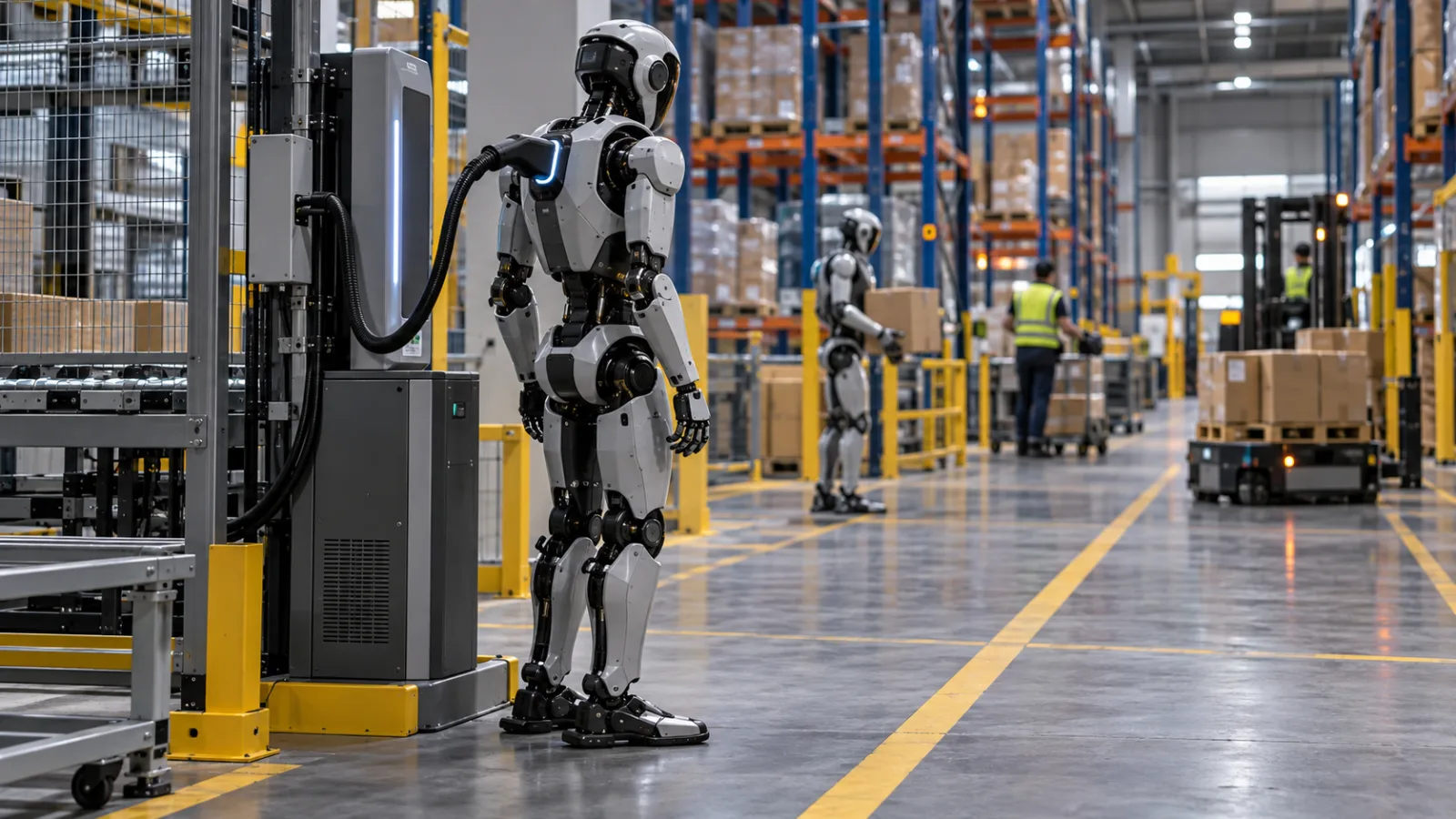
That is not a promise that a humanoid can replace a warehouse worker for a full shift without supervision. It is a more specific proposition. Agility is trying to make battery downtime fit inside the rhythm of a facility, where a robot can leave a task, top up, and return before the interruption becomes a line-level problem. The important question is therefore not whether nine minutes sounds fast. It is whether the complete charging workflow, fleet scheduler, battery thermal controls, and maintenance plan can turn that number into dependable throughput.
The announcement is about time in the workflow
Nyobolt and Agility announced the partnership on October 15, 2026. Their release says Digit 5 will use a fast-recharge battery system with 90 minutes of runtime and a nine-minute charge, allowing more than 20 hours of work in a 24-hour day under the company’s stated operating assumptions. The same release gives the earlier Digit 4 ratio as two hours of operation for one hour of charging.
Those figures should be read as operating claims, not as a universal endurance rating. Runtime depends on the task, payload, walking distance, floor surface, temperature, battery state, and how much time the robot spends standing or manipulating. A robot carrying totes through a predictable aisle will draw power differently from one repeatedly lifting, reaching, balancing, and recovering from interruptions. The release does not publish a full duty-cycle test protocol, a battery capacity in kilowatt-hours, charger power, or a fleet-level availability result.
Still, the change in ratio matters. A two-to-one ratio means a robot that works for two hours and then needs an hour of charging loses a substantial share of a long operating window unless the customer buys spare robots or batteries. A ten-to-one ratio makes short opportunity charges more plausible. A nine-minute stop can be placed between assignments, during a shift handoff, or while a work area is waiting for inbound material. The gain is not simply more energy. It is more scheduling options.
Agility says Digit 5 is intended for manufacturing, warehousing, and logistics. The company’s separate product announcement describes the robot as the next generation of a platform with more than 65,000 hours of operation and commercial deployments, and says it has received more than $300 million in multi-year orders and a growing customer pipeline. Those are company-reported figures. They indicate commercial interest, but they do not by themselves establish that the new battery system has achieved the same maturity in customer operations.
Why charging is a robotics problem, not just a battery problem
A warehouse does not measure a robot only by how long its battery lasts. It measures completed tasks, blocked aisles, missed handoffs, exceptions, recovery time, and the number of people needed to keep the system moving. Charging sits inside that larger loop.
The normal sequence is more complicated than robot goes to charger. A fleet system must decide when to interrupt a job, reserve a charging point, route the robot around people and other machines, align it correctly, manage the electrical connection, verify that charging has started, and release it when the battery is ready. If several robots reach their minimum level together, a nine-minute charge can still become a queue. If a robot fails to dock, the nominal charging time becomes irrelevant until an operator intervenes.
SAP’s warehouse-robotics documentation describes this logic in practical terms: robots can be sent to charging points when their battery falls below an autonomous-charging threshold, charging points can be reserved, and operators can monitor robot states and exceptions. Zebra describes smart charging for autonomous mobile-robot fleets as a scheduling problem that accounts for robot availability, schedules, battery status, and health. Those systems are built around wheeled robots, but the operational lesson transfers to humanoids. The energy subsystem has to be managed as part of the fleet, not treated as a private concern of each machine.
Humanoids add complications. A tall biped has to approach a dock with more moving joints, a less forgiving balance problem, and a body that may block access to connectors or pads. Its peak power demand can change sharply during lifting and walking. A battery-management system therefore has to watch temperature, voltage, current, cell balance, and controlled shutdown behavior while the robot is still expected to remain stable and safe around people.
Renesas’ technical material on humanoid battery management lists cell monitoring and balancing, charge and discharge protection, pack-voltage and current sensing, communications, auxiliary power, and active cooling as parts of the system. These are not decorative specifications. They are the mechanisms that determine whether a fast charge is repeatable, whether a battery can be used without excessive degradation, and whether the robot can handle a fault without losing control.
The ten-to-one ratio changes the business case, but does not solve it
Suppose the published numbers hold in a defined warehouse duty cycle. A single Digit 5 could theoretically spend 90 minutes working, nine minutes charging, and then return to work. Over a 24-hour period, that makes more than 20 hours of productive availability possible in Agility’s formulation.
That is materially different from a system that needs an hour of charging after every two hours of work. With the older ratio, a customer has to cover charging gaps with spare units, a human operator, or an acceptance that the robot will not be available for large portions of the day. With the newer ratio, a facility may be able to keep fewer robots assigned to a task while using short planned stops.
The arithmetic is not the same as uptime. Productive availability includes navigation to the charger, docking, software handshakes, safety checks, task reassignment, and the time required to recover from failed attempts. It also includes planned maintenance and the possibility that the robot must stop before the battery reaches the theoretical minimum. A fleet manager may reserve a larger safety margin because a robot that reaches zero at the far end of a facility is harder to recover than a mobile robot that simply rolls to a dock.
Battery life is another unresolved cost. Fast charging can reduce downtime while increasing the demands placed on cells, cooling, connectors, and power electronics. Nyobolt presents its technology as designed for high-power, ultra-fast charging, but the public announcement does not provide a full cycle-life curve for Digit 5 in the exact workload Agility describes. A buyer needs to know how the battery behaves after hundreds or thousands of cycles, how much capacity remains at the end of its warranty period, and whether a replacement pack is a routine service item or a major repair.
The cost model also has to include infrastructure. A site deploying several humanoids may need dedicated charging positions, electrical upgrades, fire and thermal monitoring, spare packs, service access, and a control layer that connects the robots to warehouse-management and fleet systems. A faster charge can reduce the number of robots required, but a high-power charger can raise the cost and complexity of the facility. The right comparison is not battery price against labor price. It is total cost of ownership against the value of the tasks completed reliably.
A useful distinction: energy availability versus task capability
The new battery story can be attractive because it addresses a clear bottleneck, but it should not be mistaken for a capability breakthrough in manipulation. More available energy does not make a robot better at picking an unfamiliar object, recovering from a dropped tote, understanding a changing workstation, or working safely beside a person.
Agility’s Digit 5 announcement says the robot was built for cooperatively safe work at scale and close proximity to people. Its product material also describes upgrades based on three years of Digit 4 work on production floors. Those claims point to a system-engineering effort around the robot, not just a new pack. But a buyer still needs task-level evidence: success rate by task, intervention rate, average recovery time, payload under repeated operation, performance across shifts, and the conditions under which the robot must be teleoperated.
Charging can improve the economics of a robot that already performs a narrow task well. It cannot rescue a workflow whose perception, grasping, navigation, or exception handling is unreliable. In some facilities, the energy constraint may not be the binding constraint at all. If workers have to clear the route, reset the robot, or correct a failed placement every few minutes, a faster charger will leave the dominant cost untouched.
That is why the most useful customer trial would report two separate sets of numbers. The first would describe energy and equipment: work minutes, charge minutes, charger occupancy, battery temperature, energy per task, battery degradation, and failures to dock. The second would describe operations: completed units, human interventions, mean time to recovery, safety stops, task success, and throughput at the handoff point. Combining these numbers into a single uptime percentage would hide the trade-offs a buyer needs to see.
Opportunity charging is the real target
The strongest interpretation of the Nyobolt partnership is that Agility wants Digit 5 to use opportunity charging rather than wait for a long battery break. Industrial mobile robots already use this idea. A robot can take energy during a natural pause, at a staging point, or between assignments, then return to the workflow before its state of charge becomes a constraint.
For a humanoid, opportunity charging has to be designed around the shape and behavior of the machine. The robot needs a safe place to stand, a repeatable docking motion, enough clearance for people and other vehicles, and a way to abandon the approach if the path is blocked. The station needs to withstand repeated connections and disconnects. The software needs to understand that a robot with a partially charged battery may be more valuable on a nearby job than on a distant one.
Charging placement therefore becomes a layout decision. A single charger at the edge of a large warehouse may deliver excellent laboratory numbers and poor operational results because the robot spends too much time walking to it. Several smaller charging opportunities may reduce travel and queues, but increase infrastructure cost and maintenance. A good deployment will measure charger utilization and robot travel to the charger just as carefully as it measures charge speed.
The scheduling problem becomes more interesting when the fleet grows. If one robot can work for 90 minutes and recharge for nine, then a group of robots can create synchronized demand every 99 minutes unless the scheduler deliberately staggers their cycles. A smart system will assign jobs with different energy profiles, reserve capacity for urgent tasks, and avoid sending multiple robots to the same station at once. The facility’s order system and robot fleet manager have to share enough state to make those decisions.
Research on battery-aware scheduling for autonomous mobile robots has reached the same conclusion from another direction: task assignment and charging decisions should be optimized together, while considering charger access and battery degradation. The mathematics is different for each site, but the operational principle is simple. A robot should not be assigned a job merely because it is physically closest. Its remaining energy, the charger queue, the next task, and the cost of a forced stop all matter.
What the announcement does and does not prove
The public information supports several measured conclusions.
First, Agility has identified battery downtime as an important product issue for an industrial humanoid, and it has selected a named technology partner to address it. Second, the claimed 90-minute runtime and nine-minute charge would represent a large improvement over the ratio Agility reports for Digit 4. Third, the improvement is aimed at deployment economics: a robot that spends less time parked can be assigned to a larger share of a facility’s operating window.
The announcement does not establish that every Digit 5 will work for 20 hours in every warehouse. It does not disclose the exact workload behind the 90-minute figure, the charging power, the battery pack’s mass and capacity, the number of simultaneous chargers a customer needs, or the expected cycle life. It does not provide independent validation of throughput, safety, or total cost. It also does not say that a customer can purchase Digit 5 today on the same terms as a conventional warehouse robot.
This distinction is important because robotics launches often mix product specifications, demonstrations, customer commitments, and future plans. A specification can be real while still being unsuitable for a particular facility. A customer order can show demand without proving that the system has met production-level service targets. A robot can complete a task in a video while still requiring frequent human intervention in a live operation.
For readers evaluating the announcement, the missing evidence is more valuable than a more dramatic endurance slogan. Ask for the duty-cycle definition. Ask whether the 90 minutes includes walking, manipulation, and safety stops. Ask how many consecutive fast-charge cycles were tested. Ask for battery state at the end of a normal shift and after a full service interval. Ask what happens when the robot reaches the station with a person, pallet, or another robot in the way. Ask who handles the failed dock and how long that recovery takes.
Who benefits first
The clearest early customers are facilities with predictable indoor routes, repeatable material-handling tasks, and enough operating volume to justify fleet infrastructure. A warehouse or factory that already has digital work orders, mapped travel paths, controlled access, and a team responsible for automation is better positioned to use opportunity charging than a small site with irregular work.
Companies running extended hours may benefit most from a high work-to-charge ratio. They can spread energy demand across the day and use the robot during periods when a human-shaped body provides access to existing workstations. A factory that needs a machine to handle bins, move materials, or perform a repeated loading task may value reduced charging interruptions even if the robot remains specialized.
The least obvious first customer is a home user. A home has more variable objects, less controlled traffic, fewer reasons to install a high-power charging station, and a much higher tolerance problem for a robot that needs assistance. The battery improvement could eventually help household robots, but the current announcement is framed around industrial deployment, where the operator can manage space, schedules, and exceptions.
Small businesses may also struggle to capture the benefit. A fast charge is useful only if there is enough work to keep the robot busy and enough operational discipline to integrate it. Buying a humanoid to perform a few tasks per day could leave the customer paying for a sophisticated battery and charging system without using the capacity that makes the economics attractive.
The practical test is a shift, not a charging demo
Digit 5’s battery partnership is a meaningful product decision because it targets a constraint that appears in every physical deployment: energy has to be available when the work is scheduled. A ten-to-one work-to-charge ratio, if demonstrated under a transparent and repeatable duty cycle, could make a humanoid easier to place in an existing production rhythm.
The harder test is whether the robot can turn that energy into completed work without a person standing beside it. That requires evidence from full shifts and full workflows. The decisive metrics will be task success, interventions, recovery time, charger utilization, battery health, and the cost of keeping the system available—not just the time shown on a charge screen.
For now, the announcement is best understood as an infrastructure bet. Agility is trying to make a humanoid’s battery behave more like a scheduling resource and less like a daily shutdown event. If the charging system, fleet software, safety controls, and task performance mature together, the improvement could matter more than another impressive demo. If they do not, a nine-minute charge will simply make an unreliable robot return to the floor faster.
Related articles
Atlas’s New Hand Makes Humanoid Robotics a Factory Product Problem
Boston Dynamics’ four-finger Atlas hand is less about looking human and more about surviving tools, shifts, repairs and safety audits. That makes it a useful signal for where humanoid robots are actually headed.
Agility’s October Pivot: Why Humanoid Robots Now Need a Safety Architecture Around the Machine
Agility’s new defense-policy role and its expanded safety partnership with FORT Robotics point to the same practical lesson: humanoid deployment will depend as much on external controls, operating procedures, and accountability as on the robot’s learned skills.
IROS 2026’s Digit Demo Shows the Next Humanoid Test Is Measurable Reliability
A first-try mobile-manipulation run on Agility’s Digit v4 is a meaningful research signal, but not proof of general warehouse autonomy. The real test is repeatability, recovery, safety and cost in a working facility.
Hyundai’s Atlas strike is really about who writes the rules for humanoid robots
The Ulsan walkouts are formally about wages, but Atlas turns them into an early test of how factories should negotiate humanoid automation before it is fully mature.

Comments
Sign in to comment.
No comments yet.