Atlas’s New Hand Makes Humanoid Robotics a Factory Product Problem
Boston Dynamics’ four-finger Atlas hand is less about looking human and more about surviving tools, shifts, repairs and safety audits. That makes it a useful signal for where humanoid robots are actually headed.
Boston Dynamics did not need another video proving that Atlas can move in a way that makes people stop scrolling. It already owns that lane. The more useful news on October 1, 2026 was smaller, stranger and more industrial: Atlas got a new hand. Four fingers. Thirteen degrees of freedom. Direct actuation. Dense pressure sensing across the fingertips and palm. No pinky. No attempt to win a cosmetic contest against the human body.
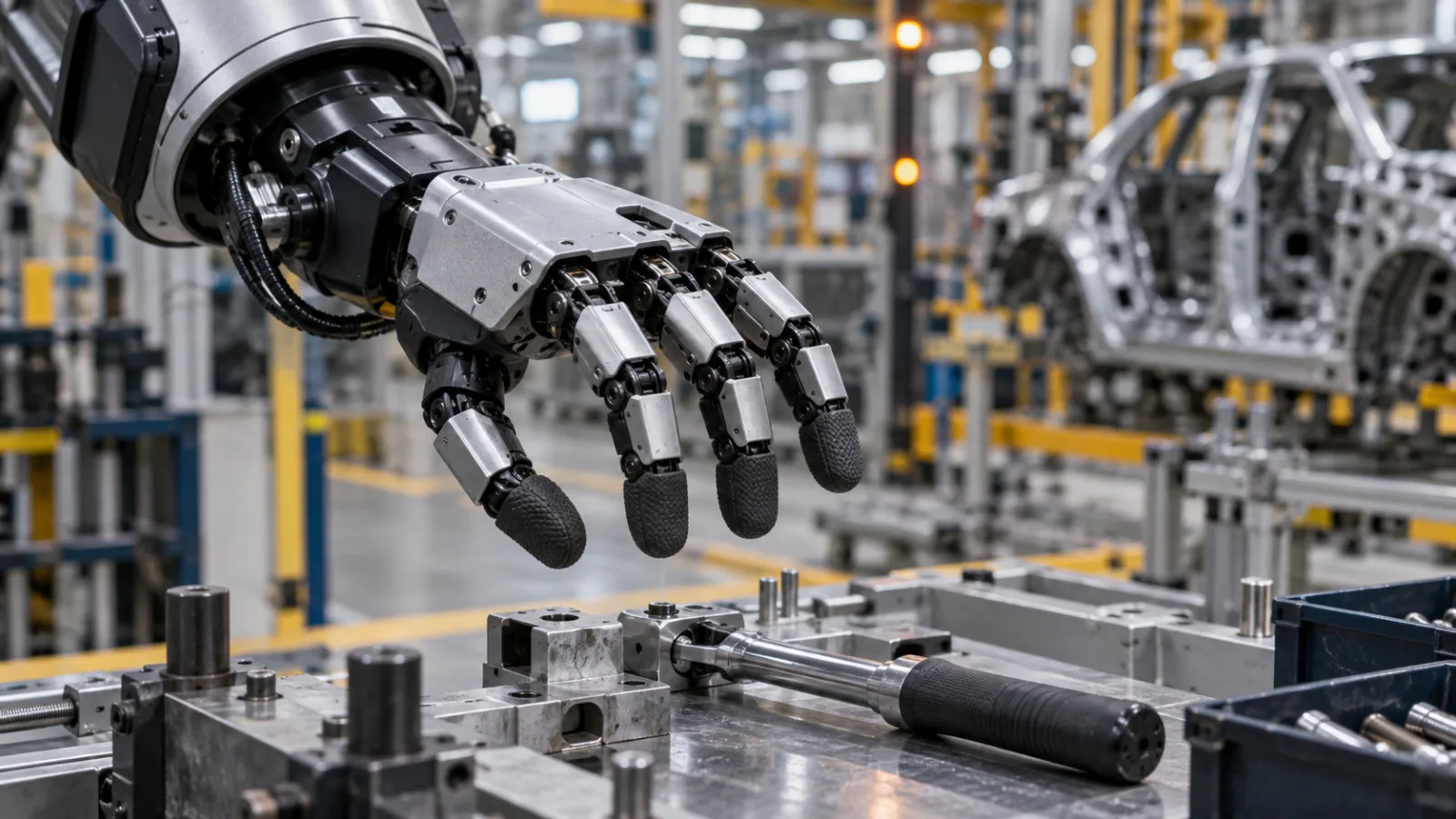
That detail matters because the hard question for humanoid robots is shifting. For years, public attention has gone to whole-body feats: walking, jumping, recovering balance, carrying bins, dancing around a lab or completing a carefully staged factory routine. Those clips tell us something, but not enough. The robot that works a shift has to do duller things with less drama. It has to find the part, hold it without crushing it, reorient it when it slips, fit it into a human-designed tool or fixture, use enough force but not too much, avoid breaking itself, stop safely near people, and be repairable when the hand inevitably takes abuse.
The new Atlas hand is a marker for that stage of the industry. Boston Dynamics is making an explicit bet that humanoid deployment will not be won by the most human-looking hand. It will be won by the hand that can use real tools, generate useful training data, survive contact-rich work, and be manufactured and serviced in volume. In other words: less theater, more product engineering.
That does not mean Atlas is ready to replace factory labor at scale. Boston Dynamics has published design claims and demonstration footage, not public fleet reliability data from thousands of production hours. The company is also still building the operational setting around Atlas through Hyundai’s Robotics Metaplant Application Center in Georgia. But the hand announcement is useful because it reveals what an experienced robotics company thinks the bottleneck now is: not simply making a humanoid walk, and not simply adding a bigger AI model, but making manipulation hardware that can live inside an industrial system.
What Boston Dynamics Actually Changed
Boston Dynamics says the previous Atlas hand had seven degrees of freedom and was built primarily to grasp many kinds of objects. The new generation moves to four fingers, including a more capable thumb, and raises the count to 13 degrees of freedom. The company describes the architecture as directly actuated, with encapsulated actuators and no fragile cables crossing the joints. The hand is roughly in the range of a large human hand because Atlas is meant to use spaces, tools and objects designed around people.
The difference between grasping and manipulating is the center of the story. A simple gripper can pick up a bin, clamp a part, or move a predictable object from one known position to another. A dexterous hand has a different job. It may need to roll an object between fingers, recover from a slipping grip, press a trigger while holding a tool, or change the object’s orientation without putting it down. Those are not parlor tricks if the target is factory work. They are often the difference between an impressive demo and a robot that can handle a workstation without rebuilding the workstation around the robot.
Boston Dynamics lists several target behaviors for the new hand: pinch grasps, tripodal grasps, in-hand reorientation, recovery from slip, and triggered tool grasps for equipment such as drills, drivers, grinders, nail guns or welding torches. The company is careful to frame the hand as a trade-off, not as a universal solution. Softer fingers are better for some materials. Harder fingers are better for force. More joints can increase dexterity but also add volume, cost, power draw and failure points.
The missing pinky is not a joke detail. It is a product detail. A fifth finger would move the hand closer to a human silhouette, but it would also mean more actuators and more parts to build, power, control and repair. Boston Dynamics says the team decided the additional function was not worth the complexity for the work it is targeting. IEEE Spectrum’s reporting adds the commercial subtext: the previous research hand was not designed for mass production in the tens or hundreds of thousands, while this new design is being evaluated against questions of manufacturability, reliability and service.
That is the more sober version of the humanoid race. It is not enough for a hand to be clever once. It has to be boringly available. It has to be produced in repeatable units. It has to tolerate impacts, awkward loads, dust, misalignment, operator mistakes, and the normal indignities of industrial work. If it breaks, a technician has to replace a module rather than perform delicate surgery on a bundle of tendons and cables.
Why the Hand Is Also a Data Strategy
Robot hands are hardware, but they also decide what kind of learning is practical. Boston Dynamics is explicit that the new Atlas hand was designed for high-fidelity simulation and sim-to-real reinforcement learning. The company says it wants the geometry, dynamics and contact behavior of the hand to be clean enough in simulation that control policies can be trained there, randomized across conditions, and then rolled out on the robot.
That point deserves attention because manipulation is one of the places where AI language tends to get slippery. A robot does not manipulate a part because a model has seen enough pictures of parts. It needs closed-loop control at high rate. It needs to feel, infer or measure contact. It needs to respond when friction is different than expected. It needs to know whether a part is rotating inside the grasp, whether a fingertip is about to lose purchase, and whether a tool trigger has actually moved.
Boston Dynamics describes two feedback paths. One is proprioception: the robot’s sense of where its joints are, how they are moving, and what forces are acting through them. The other is tactile sensing, with dense pressure sensors on the fingertips and palm. The company’s argument is that human demonstrations are useful for the visual and semantic side of a task, but they do not directly capture the high-rate action signals needed to control a robot hand under force. A glove or other wearable can show roughly how a person moved, yet the robot still has its own body, inertia, friction, motors and control limits.
This is where direct actuation and backdrivability become more than mechanical preferences. A hand that can transmit contact forces cleanly back through its joints is easier to sense and potentially easier to simulate. A hand with too much hidden friction, backlash or cable compliance may look elegant, but it can be harder to model accurately. For learning systems, that gap is expensive. The simulated robot becomes less like the real robot, and policies trained in simulation may fail when the hardware touches the world.
The hand therefore sits at the junction of three constraints: it must be strong enough for work, transparent enough for control, and simple enough to produce. That is a narrow target. It also explains why Boston Dynamics is not chasing maximum human likeness. A robotic hand only needs to resemble a human hand to the degree that this helps with tools, fixtures and training data. Past that point, extra anatomy can become baggage.
The Factory Context Behind the Announcement
The timing is not accidental. On September 21, 2026, Boston Dynamics announced the Robotics Metaplant Application Center, or RMAC, inside Hyundai Motor Group Metaplant America near Savannah, Georgia. The center is intended as a testbed and training site for integrating Atlas robots into Hyundai’s automotive manufacturing operations. Hyundai has also described RMAC as a validation hub that uses real manufacturing data to prepare robots for safe deployment.
That changes how the hand announcement should be read. This is not a lab hand looking for a future robot. It is an end effector being presented as part of an industrial product path. Atlas is being aimed at work such as parts logistics, sequencing and manufacturing support, not domestic chores or open-ended general labor. That focus is sensible. Automotive plants have structured workflows, defined parts, repeatable processes, safety engineering teams, existing automation expertise and a business case for reducing ergonomic strain in specific tasks.
Boston Dynamics’ own Atlas sales material, published earlier in 2026, describes the robot as 1.9 meters tall and 90 kilograms, with 56 degrees of freedom, tactile fingers and palm sensing, a 360-degree camera view, modular components, field-replaceable service features and multiple operating modes including autonomous operation, VR teleoperation and tablet control. The same sheet lists four hours of battery life, two hours under heavy lifting, autonomous battery swapping, and weight capacities of 50 kilograms instant, 30 kilograms sustained and 20 kilograms one-handed.
Those numbers are useful, but they should not be overread. A spec sheet says what the product is designed to support, not what an operator will get at high utilization across many plants. The real test will be measured in cycle times, intervention rates, near-miss reporting, repair frequency, software update stability, uptime, training time per task and how often the robot is useful without turning a simple workstation into a bespoke robotics project.
This is why the hand is such a revealing component. If a humanoid is supposed to enter human-built workspaces, the hand carries much of the cost of that promise. A mobile base can bring the robot to the task. Legs can help it move through spaces that were not designed for wheeled automation. But the hand determines whether the robot can actually complete the work once it arrives.
The Industry Is Learning That Safety Is a System, Not a Checkbox
The same week brought another telling development. On October 1, 2026, Agility Robotics and FORT Robotics announced a memorandum of understanding to expand safety infrastructure around Agility’s Digit 5 humanoid. Their planned architecture includes a safety pendant, on-robot communications, and off-robot interfaces that connect the robot to external safety systems. The new offboard interface is meant to extend the safety approach beyond the robot body itself.
That is a different product, but the lesson applies to Atlas too. Industrial humanoids cannot be treated as standalone gadgets that become safe because the vendor says the model is cautious. A walking, reaching, lifting robot needs to cooperate with facility infrastructure: emergency stops, access controls, zone controls, workflow software, human detection, lockout practices and incident reporting. A safety case has to cover the robot, the application, the environment and the people around it.
Traditional industrial robots gained trust by being constrained. They were installed in cells, guarded by fences or light curtains, programmed for known tasks, and assessed under mature safety practices. Autonomous mobile robots created a different challenge because they move through shared space. Humanoids add another layer: they are mobile, tall, dynamically stable rather than fixed, and equipped with arms that can exert force in many directions. A stop command, a trip, a dropped object, a tool in the hand, a blind corner and a human stepping into the workspace all become part of the deployment problem.
The standards landscape is catching up. ISO 10218-1:2025 covers safety requirements for industrial robots, while ISO 10218-2:2025 addresses integration and applications. Agility has also pointed to work on ANSI/A3 TR R15.108 for dynamically stable industrial mobile robots, including humanoids in the United States and Canada, and ISO 25785-1 for humanoid safety. Those efforts matter because humanoids do not fit neatly into older categories of fixed arm, collaborative arm or warehouse mobile base.
This is where overclaiming becomes risky. A robot can be impressive and still not be ready for unfenced shared work at scale. A robot can have tactile sensors and still mishandle a rare object. A robot can stop when a person enters a zone and still create a bottleneck that ruins the economic case. A robot can be teleoperated some of the time and autonomous some of the time, which may be acceptable for deployment, but only if customers understand the labor and supervision model they are buying.
Why Human-Like Is Not the Same as Useful
The most common mistake in humanoid coverage is to treat resemblance as progress. A human-shaped machine looks as if it should inherit human capability. It does not. A five-fingered hand looks familiar, but that familiarity hides engineering debt: small joints, compact actuators, routing for tendons or cables, heat, impact tolerance, contamination, repair and calibration.
Boston Dynamics’ four-finger decision is useful because it punctures that assumption. The point of a humanoid hand is not to recreate a person. It is to interact with a world that people built. Those are related goals, but not identical. A tool handle may need a thumb and opposing fingers; it may not need a pinky. A fixture may require enough reach and wrist orientation; it may not care whether the hand looks natural. A training pipeline may benefit from human demonstration data; it may not require one-to-one anatomical imitation.
There is a parallel in warehouse automation. Many successful robots do not look like workers; they look like shelves, carts, arms, shuttles or mobile platforms because the environment can be adapted around them. Humanoids are attractive when adaptation is expensive or when workflows are too varied for fixed automation. But that advantage only holds if the humanoid can use the existing environment without becoming a fragile premium tool.
A hand built around tool use is a more credible argument than a hand built around spectacle. Tools multiply capability. A robot that can reliably hold a driver, press its trigger, maintain contact, absorb reaction torque and set the tool down safely does not need a different hand for every fastener. A robot that can handle parts in crates, shelves, slots and piles may reduce the need for elaborate presentation fixtures. But each of those verbs has to be proven under production conditions, not just narrated in a product video.
The Cost Problem Is Hidden in the Fingers
Humanoid economics are often discussed at the level of the whole robot: unit price, lease rate, cost per hour, battery life, duty cycle. The hand announcement is a reminder that the bill of materials is made of stubborn details. Each actuator is a cost. Each sensor is a cost. Each joint is a failure mode. Each extra finger adds parts, assembly steps, calibration and service inventory.
If a humanoid is deployed in tens of units, some complexity can be tolerated. If a company imagines thousands or tens of thousands of units, complexity becomes a tax. IEEE Spectrum reported Boston Dynamics’ interest in what would have to change if it wanted to make 100,000 hands a year. That is the right scale of question for a humanoid product, even if the industry is not yet there in real deployments.
Repairability may turn out to be as important as dexterity. A robot hand will hit fixtures, scrape surfaces, misgrip objects, catch edges and carry loads while the whole robot is moving. In a real plant, the question is not whether every component avoids damage forever. The question is whether damage is rare, diagnosable, quick to fix and cheap enough that the fleet still makes sense.
This is also where tactile sensing has a practical business role. Sensors are not only for clever manipulation. They can help detect degraded grasps, unexpected contacts, object presence, pressure distribution and fault conditions. But tactile systems themselves must be robust. A fingertip sensor that performs beautifully in a lab and fails under oil, dust, repeated impacts or replacement cycles will not carry an industrial deployment.
What Buyers Should Ask Before Treating Humanoids as Labor
For a manufacturer or warehouse operator watching the Atlas hand news, the practical question is not “Can the robot use tools?” It is more specific: Which tools, in which workflows, at what cycle time, with what autonomy rate, under what safety constraints, and with what maintenance load?
A credible humanoid deployment should be evaluated task by task. Start with the process map. Identify where workers spend time on ergonomically awkward, repetitive or hard-to-staff work. Measure the current cycle, quality rate, injury risk and downtime. Then ask whether a humanoid adds value compared with a conventional arm, AMR, conveyor, fixture redesign, lift assist, cobot or software change. The answer will not always favor the humanoid, and that is fine. Generality is only valuable where the alternatives become too rigid or too expensive.
The hand should be part of that audit. Can it grasp the actual parts, including the dirty, worn, slightly misaligned ones? Can it recover from a slip without dropping the part or stopping the line? Does it need special trays? Can it use the existing tool, or does the tool need to be modified? How often do fingertips wear out? What happens when a sensor fails? Can an on-site technician replace modules, or does the unit go back to the vendor?
The autonomy claim also needs careful language. A robot may be autonomous for navigation but supervised for manipulation. It may complete routine cycles alone but require teleoperation for exceptions. It may learn from demonstrations but still need task-specific validation. None of that makes it useless. Early industrial robotics has always involved boundaries, fixtures, supervision and staged rollout. The problem is when the sales language compresses those boundaries into a vague promise of general-purpose work.
What This Means for the Humanoid Race
The Atlas hand announcement is not a declaration that Boston Dynamics has solved humanoid manipulation. It is a sign that the competition is becoming more serious. The winners will not be the companies with the smoothest demo reel. They will be the companies that connect manipulation, mobility, simulation, safety, service and manufacturing into one usable product loop.
That loop is already visible. Boston Dynamics has the RMAC training environment with Hyundai. It has a hand designed around tool use and sim-to-real reinforcement learning. It has an Atlas platform presented for industrial work, with modular serviceability and factory integration as part of the sales story. Agility, meanwhile, is pushing the safety-infrastructure side with Digit 5 and FORT. The International Federation of Robotics says five million industrial robots were operating in factories worldwide in 2025, which means customers already know what mature automation looks like. Humanoids will be judged against that baseline, not against science-fiction expectations.
The near-term market is likely to be narrow and practical. Parts sequencing, tote handling, machine tending support, tool-assisted operations, inspection-adjacent tasks and awkward material movement are more plausible than open-ended replacement of human workers. The best early use cases will have repetitive structure, high enough labor pain, manageable safety zones, measurable quality requirements and a path to expand once the robot proves uptime.
There is still plenty that can go wrong. The hand may not be durable enough. Sim-to-real learning may work for selected tasks but struggle with messy variation. Safety systems may slow operations. The economics may depend on assumptions about supervision and maintenance that customers do not accept. Standards may evolve more slowly than product roadmaps. Public reaction may harden if companies frame humanoids as worker replacement rather than hazardous-task relief and productivity support.
Still, the direction is clearer than it was during the era of pure acrobatics. The industry is moving from “Can the robot do something amazing once?” toward “Can the robot do something useful every day, in a plant, with a repair plan and a safety case?” Boston Dynamics’ new Atlas hand is interesting because it answers the first question less loudly and the second question more directly.
That is the right kind of progress to watch. Not because a four-fingered hand makes Atlas human-like, but because it makes the humanoid promise more testable. If robots are going to leave the demo floor, the proof will be in the parts they handle, the tools they use, the stops they respect, the failures they recover from, and the maintenance logs nobody puts in a launch video.
Related articles
Isaac 1 shows the uncomfortable middle stage of home robots
Weave’s $7,999 home robot is compelling because it targets laundry and tidying, but its remote-assistance model makes privacy, trust and service economics the real test.
Hyundai’s Atlas strike is really about who writes the rules for humanoid robots
The Ulsan walkouts are formally about wages, but Atlas turns them into an early test of how factories should negotiate humanoid automation before it is fully mature.

AlphaGenome Atlas turns nine billion possible DNA changes into a research map
Google DeepMind’s new AlphaGenome Atlas precomputes predicted molecular effects for every possible single-letter change in the human genome. Its value is practical: it helps researchers decide what to test next, while leaving diagnosis and clinical interpretation to experiments and genetics professionals.


AI browsers create a new trust boundary. Treat them that way
New research on agentic browsers, same-origin policy and BioShocking does not mean panic. It means AI browser agents need isolation, limits and explicit confirmation before they touch sensitive sessions.
Comments
Sign in to comment.
No comments yet.