When a Thermal Camera Becomes “Military-Grade”: The FCC’s DJI Drone Fight Is Really About Working Robots
A proposed FCC restriction on previously authorized foreign-produced drones puts LiDAR, thermal imaging and autonomous docks at the center of a broader argument about dual-use robotics.

The fight over DJI drones in the United States has moved from a familiar national-security argument into a more uncomfortable robotics question: when does an ordinary sensor turn a civilian robot into a “military-grade” system? The Federal Communications Commission’s Public Notice DA 26-758, released on July 21 and published in the Federal Register on August 3, asks for comment in PS Docket 26-189 on whether importation and marketing should be prohibited for certain foreign-produced uncrewed aircraft systems and critical components from covered entities, including equipment that had already received authorization. Comments are due thirty days after Federal Register publication, which puts the near-term deadline at September 2, 2026.
What the FCC is actually weighing
The proposal is not a rule grounding every existing DJI aircraft tomorrow. The notice repeatedly frames the action around future importation, marketing, sale and related equipment authorization for selected categories of foreign-produced UAS and UAS critical components. It also says the Commission does not propose to prohibit the use or operation of devices that consumers already possess. That distinction matters: the immediate question is not whether a fire department must stop flying a drone it already owns, but whether it can buy the same model again, replace parts, expand a fleet, support docking workflows or keep a standardized training program alive after a final rule.
The FCC’s stated national-security concern is direct. The notice proposes to treat several capability classes as “military-grade” when the equipment is foreign-produced and tied to entities on the Covered List. The list includes large UAS weighing 55 pounds or more, systems with swarming capability, aerosol-dispensing platforms, UAS with thermal imaging, UAS with LiDAR, docking stations, aircraft designed to incorporate defense articles, and critical components such as flight controllers, radios, data links, cameras, gimbals, ground-control stations, operating software and related command-and-control pieces. The agency’s reasoning is that those features can help surveillance, targeting, reconnaissance, payload delivery, autonomous navigation in GPS-denied environments and persistent operations.
That is a serious security case, not a mere labeling dispute. Drones are dual-use machines by design. The same stabilization, mapping, communications and autonomy that make them useful to emergency responders can also make them useful to military or intelligence organizations. The United States has spent several years trying to reduce dependence on Chinese communications and surveillance equipment, and DJI is already on the FCC Covered List. From the regulator’s side, the concern is not only one brand’s consumer quadcopter; it is a supply chain of airframes, sensors, radios and software that can become infrastructure.
Why operators see a reversal
DJI and many U.S. operators read the proposal differently. DJI’s ViewPoints post says the approach could cut off future access to popular models that the FCC previously allowed and calls it a reversal of the Commission’s earlier position. DroneXL, PetaPixel and DroneLife all picked up the same tension in early August: the proposed action reaches beyond new models that cannot receive authorizations and asks whether previously authorized equipment should also be removed from future import and marketing channels.
For a small inspection company, the word “marketing” is not abstract. It can mean whether a broken gimbal can be replaced, whether a second aircraft can be bought for redundancy, whether a client contract can be served with the same thermal workflow, or whether an operator must retrain on a more expensive platform. For a public-safety drone unit, it can mean whether a fleet built around one set of batteries, docks, controllers and flight procedures can be maintained. The aircraft in the storeroom may remain legal to fly, but the operational system around it can still be squeezed.
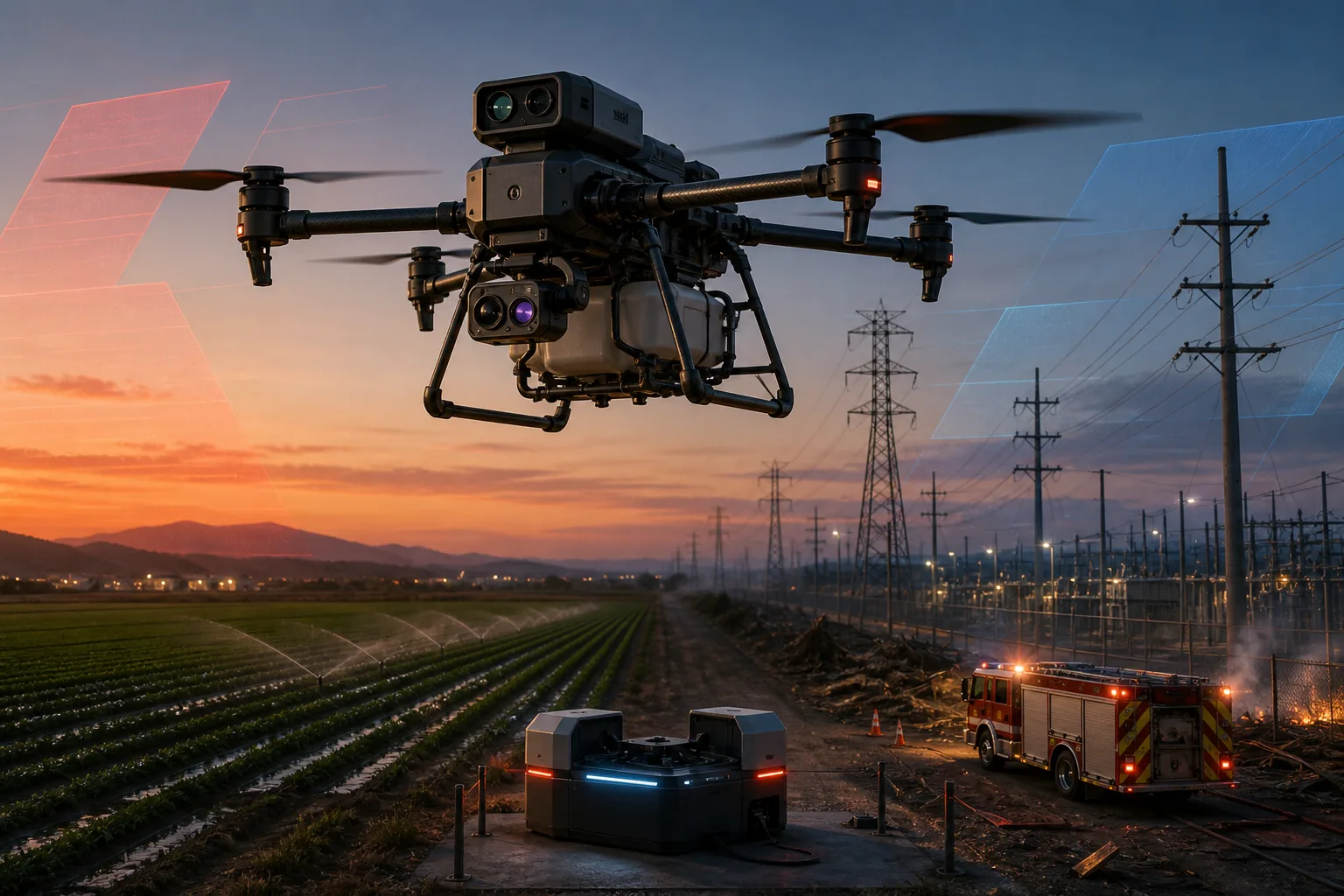
This is why the backlash is unusually practical. A photographer may focus on camera drones, but the more consequential cases are less glamorous: thermal search at night, roof and bridge inspections, power-line patrols, crop spraying, disaster mapping, construction progress surveys, wildfire overwatch and “drone as first responder” deployments that rely on a docked aircraft launching quickly from a fixed site. These are robots doing work, not toys flying for novelty.
Thermal cameras and LiDAR sit on both sides of the line
The hardest part of the proposal is not swarming. Most readers understand why a regulator worries about coordinated drone groups. The harder cases are thermal imaging and LiDAR, because those are now normal tools in civilian autonomy. A thermal sensor lets a search-and-rescue team look for a missing person after sunset, lets firefighters see hotspots, lets inspectors identify heat loss or overheating equipment, and lets police or emergency managers survey dangerous spaces without sending people in first.
LiDAR has the same dual character. The FCC notice describes it as a remote-sensing technology for measuring distance with laser light and analyzing reflections, then connects it to three-dimensional terrain mapping, foliage penetration, autonomous navigation in GPS-denied environments and reconnaissance. Those are indeed valuable military capabilities. They are also precisely why civil engineers, utilities, mining companies, forestry teams and robotics researchers use LiDAR. In robotics, richer perception is not an exotic weapon feature; it is how machines understand their surroundings safely enough to operate without constant human steering.
The same contradiction appears with docking stations. The notice says docking stations enable UAS to land, take off, recharge or replace batteries, and transfer data and payload; it also says they can support persistent 24/7 operations and coordinated launch and recovery. In military language that sounds like a network of autonomous surveillance nodes. In city or industrial language it sounds like a first-responder drone box on a roof, a scheduled power-substation inspection, a mining perimeter patrol, or a port-security workflow that reduces the need for workers to enter risky places.
That is the robotics story. The regulatory boundary is moving from “who made this product?” toward “what capabilities does this robot have?” Once the trigger is capability, not simply brand, the same logic can spread. A ground robot with thermal perception, a warehouse machine with autonomous navigation, a teleoperated inspection rover, or a mapping robot with a dock could face a similar policy conversation if its sensors, radios or controllers come from a sensitive supply chain.
The market cannot switch overnight
A clean policy answer would be easier if buyers had abundant substitutes at the same price, scale, battery ecosystem, software maturity and repair availability. They do not. U.S. and allied drone makers have improved, and public agencies have procurement paths such as Blue UAS or other approved lists. But many commercial operators choose DJI because the aircraft, payloads, controllers, software, batteries, spares and training ecosystem are available now and priced for small businesses as well as larger fleets.
The FCC notice anticipates economic and supply-chain consequences. It proposes a 180-day timeline after Federal Register publication of a final rule before parties must cease importation and marketing activities for the previously authorized military-grade UAS and critical components. The notice says that window is intended to balance national-security concerns with economic and supply-chain impacts, and it acknowledges the broader scope compared with earlier covered-equipment restrictions.
A 180-day wind-down can be meaningful for distributors, but it is short for robotics operations. Fleet replacement is not just a purchase order. A public-safety agency has to budget, choose a platform, test radios and payloads, train pilots, update standard operating procedures, integrate evidence or dispatch systems, confirm privacy rules and secure maintenance. A farm service provider has to match tanks, spray patterns, batteries, route-planning software and seasonal schedules. An inspection company has to prove that deliverables remain consistent for clients. If the rule is finalized broadly, the practical adjustment period may extend far beyond the legal wind-down.
The docket is already becoming the real battleground
The most useful signal is not a social-media argument. It is the FCC docket itself. ECFS filings in PS Docket 26-189 began appearing from individual operators, drone-service companies and public-safety users, while DJI urged American operators to submit comments. Specialist drone media amplified the call, and broader technology publications followed on August 10. That sequence matters because the outcome will depend partly on whether the record contains concrete evidence about costs, affected missions, substitutes and transition time rather than only slogans about China or innovation.
The strongest comments will likely separate three questions. First, which categories are genuinely necessary for national-security restrictions? Second, which civilian uses deserve exemptions, grandfathering or a slower transition? Third, what evidence should count when the government decides that a sensor, dock or component class crosses from useful automation into unacceptable risk? If the docket receives only brand-defense arguments, the agency may discount them. If it receives operational data from fire departments, utilities, farmers, surveyors, construction firms and emergency managers, it can test the security benefit against real public costs.
Drone Advocacy Alliance campaigns should also be read with disclosure. DJI has supported advocacy around these issues, and a manufacturer has a direct commercial interest in shaping the record. That does not make every operator concern invalid; it simply means the article, the docket and policymakers should distinguish between company lobbying and independent evidence from users who rely on the equipment.
What drone teams should do now
Operators do not need to panic, but they should treat the comment window as an operational audit. Inventory every aircraft, payload, controller, dock, battery type, radio, software dependency and spare part that could be affected. Map which workflows depend on thermal imaging, LiDAR, spraying, heavy-lift payloads or docked autonomous launch. Identify whether the work is public safety, critical infrastructure, agriculture, construction, media production or research, because the public-interest argument differs by mission.
The next step is replacement realism. Get quotes for comparable alternatives, but include the boring costs: batteries, payload adapters, docks, software subscriptions, training, insurance, maintenance, data export, client acceptance, compliance documentation and downtime. If a U.S. or allied alternative works, say so. If it fails on payload, endurance, price, delivery time or integration, document that specifically. Regulators are more likely to understand a gap when it is described as a mission and cost problem rather than as nostalgia for one brand.
Public agencies should also review grant conditions and procurement rules. A city may already face restrictions on covered equipment for federal funding even before a new FCC rule. A utility or contractor may have client-imposed supply-chain rules. A rescue group may depend on donations and used equipment. Each case changes the transition plan. The proposal is a reminder that a robot fleet is now critical infrastructure in miniature: sensors, radios, docks, software, parts and policy all have to be managed together.
Why this matters beyond DJI
The DJI dispute is only the visible front edge. Robotics is leaving the lab and becoming infrastructure. Drones launch from docks, robots map power corridors, autonomous machines watch crops, inspection systems collect data for maintenance decisions, and public-safety teams rely on aerial sensors in minutes when humans would need hours. As those systems become useful, governments will regulate them not only as aircraft or gadgets but as platforms with perception, autonomy, communications and supply-chain risk.
That means robotics companies should design for policy resilience. Modular payloads, auditable data flows, documented component provenance, local processing options, exportable logs, replaceable radios and clear security models may become market features, not procurement paperwork. Operators should expect buyers to ask where data goes, who can update firmware, which components are covered, how docks authenticate aircraft and whether a fleet can keep working if one vendor is restricted.
The bottom line is not that the FCC is wrong to worry, and not that DJI users can ignore the risk. The point is that the tools which make drones valuable in everyday life are the same tools that make them politically sensitive. Thermal cameras, LiDAR and autonomous docks are not merely accessories; they are the bridge between a flying camera and a working robot. The September 2 comment deadline is therefore more than a procurement fight. It is an early test of how democracies will classify and govern useful dual-use robots once they are already embedded in public safety, agriculture and infrastructure work.
Related articles
Unitree AS2-W and the case for wheel-legged robots
Unitree’s new AS2-W is not just another robot dog clip. It shows why robotics companies are mixing wheels and legs, and why buyers should ask harder questions about autonomy, safety and developer access.

Phone thermal cameras from marketplaces: what a $300 plug-in imager can actually diagnose
USB-C thermal cameras are becoming a tempting marketplace buy for electronics, HVAC and home checks. Here is what the category can reveal, where temperature readings mislead, and which buyers should skip the gadget.


Sandia’s ETCRAM points to a quieter way to cut energy in sensor computing
Sandia researchers have demonstrated an analog memory that stores far more precise states across a wider range than earlier devices. The useful idea is not a faster server, but less raw sensor data moving between chips.

Faraday Future’s 919 Robot Launch Tests Whether a Portfolio Can Become a Deployment Business
Faraday Future is using its September 19 launch to present humanoids, quadrupeds, mobile manipulators, and industry packages as one robotics platform. The important question is not how many forms it shows, but whether customers can operate and measure them beyond a demonstration.

Comments
Sign in to comment.
No comments yet.