Smart home by subscription: why SmartThings users are worried about Home Assistant integrations
Samsung says ordinary SmartThings app users are not the target. The worry is what happens to Home Assistant, dashboards, scripts, PATs and Samsung-appliance data when API access becomes paid.
Samsung has not said that ordinary SmartThings app users will suddenly have to pay a monthly fee. That distinction matters. But it has said enough to make Home Assistant users, dashboard builders and Samsung-appliance owners nervous.
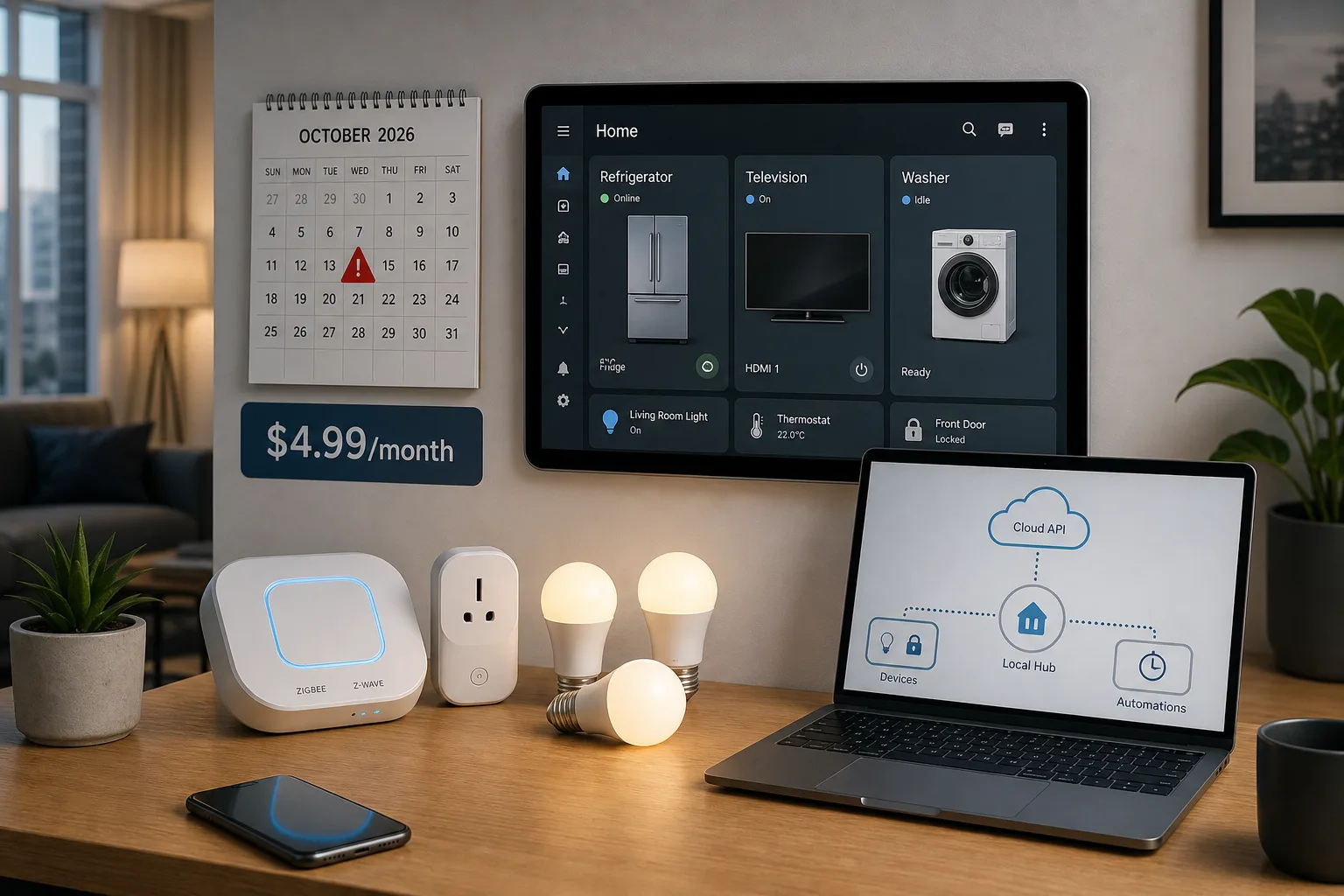
In a June 2026 SmartThings community announcement titled “A New Enhanced SmartThings API Experience,” Samsung said it plans to introduce paid commercial API tiers and a $4.99-per-month plan for non-commercial individual developers. The target date is October 2026. Free access remains available through Q3 2026, and Samsung says it will not start applying new usage limits or phasing out free access until October 2026.
The official reassurance is clear too: this change “does not affect the millions of SmartThings users who use the SmartThings App with thousands of WWST partner devices.” If you only open the Samsung SmartThings app, run Samsung’s own routines and control devices in the official ecosystem, the announcement is not aimed at you.
The anxiety starts one layer lower, where many smart homes actually live.
Why Home Assistant users noticed immediately
Home Assistant’s SmartThings integration is not just a decorative add-on. For many homes it is the bridge between Samsung’s cloud and a local dashboard: refrigerators, washers, dryers, TVs, air conditioners, thermostats, sensors, switches, locks and other devices can appear as Home Assistant entities. The official Home Assistant integration page now warns of an upcoming breaking API change in October 2026 and says SmartThings API access will require the paid Personal Plan after that date.
That is why the community reaction was fast. The fear is not that the SmartThings mobile app disappears. The fear is that the useful second life of SmartThings devices, the part where they feed a local dashboard, trigger scripts, appear in automations, or send appliance state to another system, becomes a subscription dependency.
A SmartThings fridge that still works in the SmartThings app is one thing. A fridge whose temperature, door state or energy data no longer reaches Home Assistant is another. To the owner, both feel like the same product. To the API, they are different worlds.
What Samsung actually announced
Samsung framed the move as an infrastructure change. SmartThings says the platform has hundreds of millions of registered users and many Works with SmartThings partner brands. The API connects third party apps and platforms to the ecosystem, from commercial property platforms to custom dashboards and personal smart homes.
The company says a structured paid model will fund platform stability, scalable integrations, expanded access to Samsung devices such as TVs and refrigerators, and a new Developer Center with an API usage dashboard. That dashboard is supposed to show call volume and help developers choose a pricing tier.
For commercial partners, the logic is easy to understand. If a short-term rental platform, energy-management service or API aggregator uses SmartThings at scale, Samsung wants a commercial relationship. The controversy is the personal plan. The $4.99/month price lands exactly on the hobbyist and power-user layer: people using Home Assistant, Rules API experiments, personal scripts, personal access tokens, custom dashboards and small tools that were built because SmartThings exposed an API.
What is still unclear
The announcement answers the business direction, not every practical edge case. Community members immediately asked about Personal Access Tokens, the Rules API, CLI tooling, Edge-driver development, SharpTools, ConstantGraph, smartwatch controllers and other third party tools. Others asked what happens to Home Assistant users who no longer own a SmartThings hub but still buy Samsung appliances and push their appliance data into Home Assistant through SmartThings.
Those are not fringe questions. They describe exactly how many advanced smart homes are assembled: one vendor app for initial setup, one automation platform for daily logic, and a handful of scripts to glue the gaps.
Samsung said current API usage is not interrupted today and that more transition guidelines are coming. That buys time, but it does not remove the planning problem. If a home depends on cloud API access, October 2026 is close enough to start auditing.
Why this feels like “smart home by subscription”
The smart-home industry has trained buyers to think the hardware purchase is the main cost. Buy a fridge, washer, hub or sensor, and the digital integration is part of the experience. SmartThings made that feel even more natural because the platform was free for a long time after the hub or appliance purchase.
Paid API access changes the mental contract. Samsung can correctly say the app remains free for ordinary users. But the people who made the home more useful through Home Assistant or custom dashboards hear something different: the data path they relied on may become a paid feature.
That matters because smart-home value often comes from cross-platform behavior. A washer finishing a cycle can flash a Zigbee light. A TV state can dim a room. A refrigerator alert can appear on a wall dashboard. A leak sensor can shut a valve through another system. None of that feels like “developer infrastructure” to the person living in the house. It feels like the smart home working.
Home Assistant is the pressure point
Home Assistant users are more sensitive to this than ordinary app users because they already think in terms of ownership, local control and failure modes. Many moved to Home Assistant specifically to avoid every device becoming a cloud subscription.
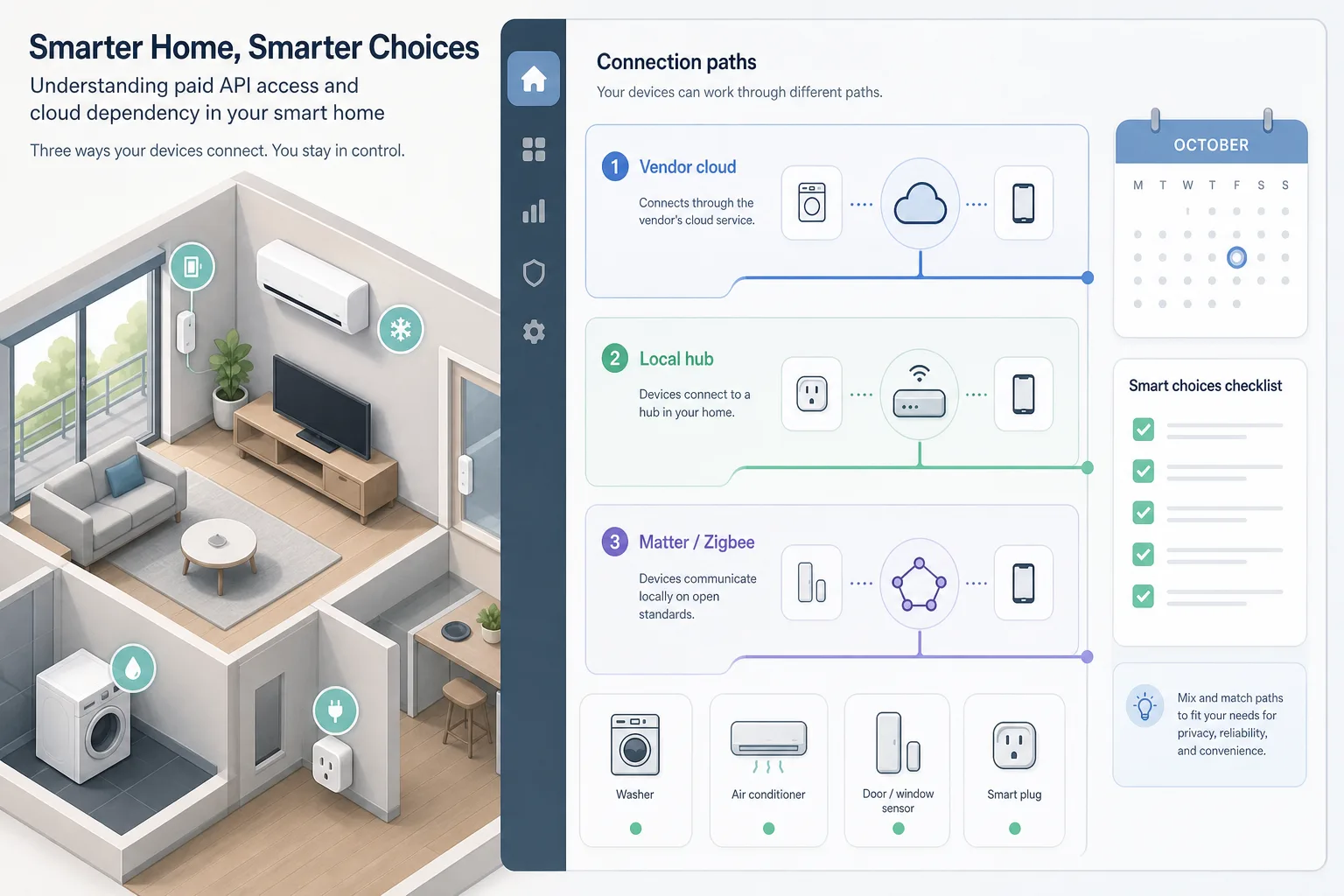
The SmartThings integration also sits in an awkward place. Some devices connected through SmartThings hubs, such as Zigbee or Z-Wave sensors, may be replaceable with local radios and direct pairing. A user can migrate those to Home Assistant hardware over time. Samsung appliances are harder. A washer, dryer, refrigerator, air conditioner or TV may expose its useful state only through Samsung’s cloud. There may be no clean local alternative.
That is why the best advice is split. If SmartThings is only your Zigbee hub, plan a migration. If SmartThings is your bridge to Samsung appliances, watch the API plan closely and assume you may need either a subscription or a reduced integration.
SharpTools, dashboards and scripts are in the same bucket
The announcement is not only a Home Assistant story. Community replies immediately named SharpTools and other dashboard or graphing services. Users also asked about Rules API access, Personal Access Tokens, Macrodroid-style calls, the CLI and development tools.
These tools differ technically, but the user concern is the same: a private smart-home setup that used to be a free API use may now be classified as individual developer access. A script that checks one device twice a day is obviously not a commercial platform. But if Samsung prices all non-commercial API access at $4.99/month, the small script and the elaborate dashboard may end up in the same personal tier.
That is not necessarily unfair from Samsung’s infrastructure perspective. It is, however, a change in expectations. A monthly fee makes owners ask whether each integration is important enough to keep.
What owners should do before October 2026
The first step is boring: list what actually depends on SmartThings API access. In Home Assistant, check which entities come from the SmartThings integration. Mark which ones are Samsung appliances, which are hub-connected Zigbee or Z-Wave devices, and which are automations or scripts that could be moved.
Second, separate critical from convenient. A washer-status notification is nice. A water-leak automation may be critical. A dashboard tile may be cosmetic. If an integration breaks or becomes paid, not every feature deserves the same response.
Third, migrate what can be local. Zigbee and Z-Wave devices are often better paired directly with Home Assistant using local radios. Matter devices may also reduce dependence on a vendor cloud, depending on the device and feature set. Samsung cloud-only appliances are the harder category, so do not pretend everything has an easy local replacement.
Fourth, reduce unnecessary API noise. If Samsung’s new dashboard exposes call volume, heavy pollers and chatty scripts may matter. Event-based integrations and sensible update intervals are safer than a script that hammers the cloud every few seconds.
The realistic verdict
This is not the end of SmartThings. It is not even proof that every Home Assistant user will lose access. Samsung has a year-plus runway and says more details are coming. Home Assistant already documents the coming change, which means the issue is visible rather than hidden.
But the worry is rational. The smart-home community has seen enough cloud changes, app shutdowns and feature migrations to understand the pattern. When a free API becomes paid, the damage is not only the price. It is the reminder that a smart home built on someone else’s cloud can change terms after the hardware is already in your kitchen.
If your SmartThings setup is simple, you may only need to wait. If your home depends on SmartThings data inside Home Assistant, start mapping the dependency now. October 2026 is not tomorrow, but it is no longer abstract.
Related articles
SmartThings API is becoming paid. Check your smart home before October
Samsung says ordinary SmartThings app users are not affected, but Home Assistant and custom automation users should audit cloud-dependent devices now.
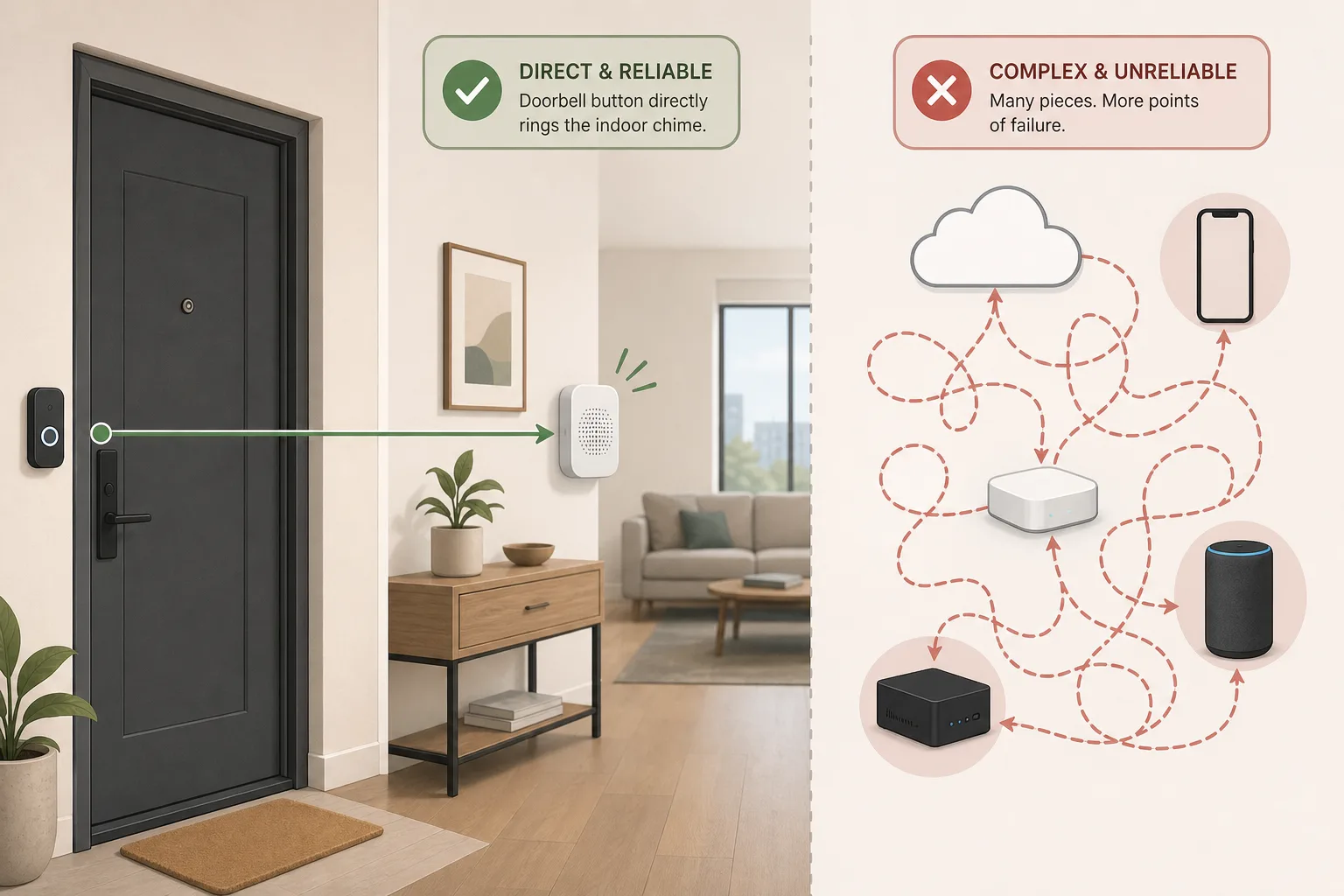
A smart doorbell should not need five clouds to ring indoors
A viral doorbell workaround is a practical buying guide in disguise: make the basic chime local, then add video, apps and automation only where they improve reliability.
IKEA Matter-over-Thread is cheap smart home, but not yet effortless
IKEA’s new Matter devices could make smart homes cheaper, but early pairing issues show why buyers still need to understand hubs, Thread routers and setup risk.
Shelly Wall Display as a Matter Controller: Useful Upgrade, Not a Hub Replacement for Every Home
Shelly's Wall Display firmware 2.8.0 makes some panels Matter controllers and Matter devices. The useful part is local room control; the catch is Thread, wiring, and platform expectations.
Comments
Sign in to comment.
No comments yet.