AI agents in the Taiwan attack: what defenders should learn without panic
A reported multi-agent intrusion shows how AI-assisted tooling accelerates familiar security failures: weak APIs, exposed secrets, credential attacks and fragmented logs.

The frightening version of the story is easy to write: “AI agents attacked a nuclear safety agency.” The useful version is more precise. According to reporting by The Register and Taiwanese media around research from Dream, a suspected Chinese-language operator used an open-source multi-agent framework during a July campaign against Taiwanese government-linked systems, then expanded scanning toward supply-chain vendors, a nuclear-safety agency and energy-sector companies. The lesson is not that artificial intelligence suddenly became an independent hacker. It is that agentic automation can chain ordinary weaknesses faster than a slow, fragmented defense can react.
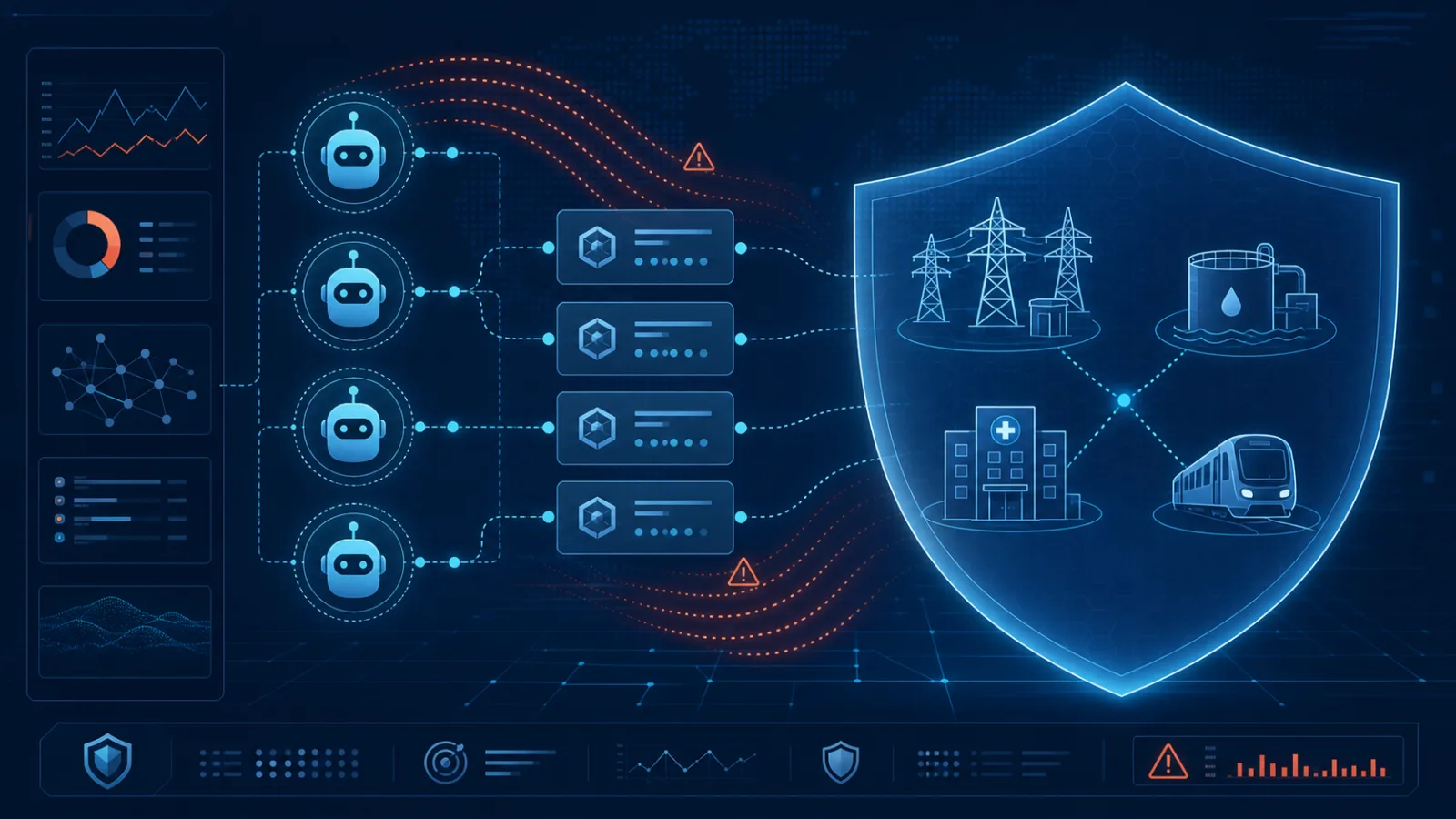 The details matter because this is a cybersecurity story, not a science-fiction story. The Register reported that Dream found an online archive of about 160 MB with 1,395 files describing the operation. The reported campaign ran across the first four days of July, used as many as eight sub-agents across 12 attack waves, and began with a government portal before moving through connected systems, accounts, API endpoints and credentials. The same reporting says 85 government user accounts were compromised and more than 2,500 personnel records were extracted. Dream did not publicly name Taiwan in the research, while The Register, Financial Times-linked reporting and Taiwanese outlets identified Taiwan or reported official Taiwanese confirmation of AI-assisted attacks on government websites.
That distinction should shape the response. A nuclear-safety agency appearing in later targeting or scanning is serious, but it is not the same as evidence of operational technology compromise, reactor control impact or physical safety disruption. Publicly available reporting points to web portals, accounts, APIs, SSO objects, personnel data, supply-chain vendors and energy-linked organizations. That is enough to matter without adding unsupported drama.
What appears to have happened
The reported attack chain began with reconnaissance of a government-facing ecosystem. Agents mapped a portal, extracted embedded URLs, identified API endpoints, discovered OAuth client IDs and Keycloak configuration objects, and connected those findings to 21 related government systems. That is not exotic tradecraft by itself. Good testers and attackers have enumerated portals this way for years. What changes is the packaging: several agent tasks can be assigned in parallel, results can be summarized for the operator, and the next wave can start before one human has manually read every page.
The reported weaknesses were familiar. The coverage describes unauthenticated API endpoints, hidden endpoints returning authenticated sessions, exposed user databases, predictable password patterns, CAPTCHA-solving claims, SSO client secrets and internal database credentials for systems using MSSQL, Oracle and Sybase. None of those requires a magical model. They are the kind of gaps defenders already know how to reduce: inventory endpoints, require authentication, rotate secrets, lock down admin surfaces, segment systems and make password spraying unprofitable.
The alarming part is the speed and breadth. The campaign reportedly moved from the initial government environment to supply-chain vendors, a government email system, a nuclear-safety agency and more than seven energy-sector companies for parallel scanning. Even if some of that activity was probing rather than confirmed compromise, the operational pattern is important. Once an agent workflow learns the shape of one organization, it can reuse that shape against nearby portals, vendors and connected services.
What “near-autonomous” should and should not mean
The phrase “near-autonomous” attracts attention, but defenders should translate it into operational terms. It does not mean humans disappeared. Operators still choose objectives, prepare infrastructure, select tools, review results, decide whether to continue, and benefit from the intrusion. A Hacker News comment on the story made that point bluntly: there are still people directing the work.
A better definition is this: the attacker can delegate many low-level decisions to software. One sub-agent can enumerate endpoints. Another can look up known vulnerabilities and GitHub references. Another can test authentication behavior. Another can collect promising credentials or session artifacts. Another can document what worked and feed it into the next wave. The operator becomes an orchestrator rather than the only reader and typist.
That matters because many defenses are designed around human-paced investigation. A small security team may expect unusual API enumeration, password spraying and vendor probing to appear as separate events across several queues. An agentic campaign makes those events more concurrent and more repetitive. It also lowers the cost of trying many small hypotheses: “Does this endpoint require auth?” “Does this Keycloak object reveal a client?” “Does this predictable password pattern work for a subset of accounts?” “Does this vendor portal share the same naming convention?”
The old failures become more expensive
The most useful lesson is that AI-assisted attacks punish the boring gaps first. If an unauthenticated API leaks a user table, an agent does not need genius. If a portal embeds OAuth client IDs, a model can help classify them, but the exposure is already there. If internal database credentials sit in an accessible export, the main failure is secrets management. If service accounts use predictable passwords, automation only makes the spray wider and faster.
This is why buying an “anti-AI attack” product should not be the first reaction. The first reaction should be a controls review. Do all public and semi-public APIs require the authentication intended by the owner? Can teams list every endpoint exposed by each portal? Are SSO client secrets rotated and scoped? Are Keycloak, OAuth and identity-provider objects treated as sensitive configuration rather than harmless metadata? Can a SOC reconstruct four days of API exploration across web, WAF, identity and database logs?
Organizations often lose time because ownership is split. The portal belongs to one team, SSO to another, API gateway to another, vendor access to procurement, and detection engineering to the SOC. Agentic attacks exploit those seams. They do not have to be brilliant if the organization cannot quickly answer which systems are connected and which credentials can be revoked.
What defenders should look for
Detection should focus on behavior, not on the word “AI.” Look for rapid endpoint discovery, repeated 404 and 403 patterns followed by successful authenticated requests, unusual access to OAuth or Keycloak configuration routes, password-spray waves across many accounts, CAPTCHA anomalies, large JSON exports, and tool clusters that hit related vendors after the first environment is mapped. Correlate web logs with identity-provider events, WAF decisions, API gateway telemetry and database access.
The important signals may be weak alone. A single scan is common internet noise. A few failed logins may be ordinary. A metadata route may be legitimate admin work. The pattern becomes serious when enumeration, credential attempts, session discovery and data export appear together, especially across connected systems. Agentic workflows can produce exactly that cluster because each sub-task feeds the next.
Do not wait for a named indicator of compromise if none has been published or if it would be unsafe to rely on it. Vendor-specific IOCs expire. Behavior-based detections last longer. For this case class, useful questions are practical: which accounts failed across many targets, which endpoints returned unusually large data, which clients requested SSO objects, which vendor IPs or hosting providers appeared across phases, which newly discovered paths were hit in sequence, and which scans overlapped with data export.
A calm checklist
First, inventory exposed APIs. Every internet-facing portal should have a current list of routes, owners, authentication requirements and expected data classes. Hidden endpoints are not protected because they are undocumented. If an endpoint can return sessions, user databases, client secrets or internal configuration, it needs explicit access control and logging.
Second, tighten identity and secrets. Rotate SSO client secrets when exposure is suspected. Scope OAuth clients narrowly. Treat Keycloak and identity-provider configuration as sensitive. Remove database credentials from web-accessible exports and build a path to revoke them quickly. Enforce MFA and password policies that make predictable patterns and password spraying less useful.
Third, rate-limit and segment. Public portals should not allow unlimited API enumeration. Admin routes, staging tools and vendor integrations should not share the same trust zone as ordinary public content. Energy and critical-infrastructure-linked organizations should be especially careful to separate IT compromise from operational technology access; clear segmentation is what keeps a web incident from becoming a safety incident.
Fourth, test incident reconstruction. A tabletop exercise should ask whether the team can replay four days of activity across portal logs, WAF logs, identity logs, database logs and vendor access. If the answer is no, an AI-assisted campaign will look like unrelated noise until the story is already old.
Fifth, set expectations with leadership. The message is not “AI can hack anything.” The message is “automation now makes cheap reconnaissance and chaining faster.” That is a solvable risk if organizations fix the same foundations they already knew were important.
Why the wording matters
Cybersecurity reporting often swings between dismissal and panic. Dismissing the case as “just automation” misses the operational change. A tool that can coordinate reconnaissance, query vulnerability references, test assumptions and produce the next target list is more than a shell script. It can compress the time between discovery and exploitation.
Panic is also wrong. The public facts do not justify claims of AI independently controlling critical infrastructure. The strongest confirmed lesson is about web-facing government and vendor systems, identity hygiene, API governance, logs and segmentation. Those are mundane controls, but they decide whether an attacker with better automation finds a chain or hits a wall.
The organizations that should worry most are not only national agencies. Universities, hospitals, municipalities, SaaS vendors and local utilities often have the same mixture of public portals, old APIs, SSO integrations, vendor access and incomplete logs. They may not be geopolitical targets every week, but the playbook scales down easily.
The practical takeaway
AI-assisted offensive tooling changes the tempo of attacks more than the laws of defense. It helps an operator search, sort, test and pivot faster. It does not make unauthenticated APIs safe, weak passwords strong, exposed secrets harmless or flat networks acceptable.
For defenders, the answer is deliberately unglamorous: know your exposed endpoints, lock down identity objects, rotate secrets, slow password spraying, segment critical systems, monitor vendor paths and make logs joinable. If those controls are weak, agentic automation makes the weakness easier to exploit. If they are strong, the same automation produces more failed attempts, better alerts and less impact.
Sources
Dream research on a multi-agent AI framework used against government entities in Asia; The Register reporting from 12 August 2026; Taipei Times, Focus Taiwan and Guardian reporting on Taiwanese government statements; Hacker News item 49281266; reporting references to Financial Times identification of Taiwan; public defensive guidance around API authentication, SSO secret management, WAF/API gateway logging and MITRE ATT&CK techniques for reconnaissance, credential access, valid accounts and data collection.
Related articles
AI mind viruses without panic: agent memory is now a security boundary
Recent Anthropic, EPFL and industry reports do not show a runaway AI outbreak. They do show a practical risk: writable agent memory, shared workspaces and persistent prompt files must be treated like privileged configuration.
AI coding agents are becoming infrastructure. Treat them that way.
Claude Code, Bun, Codex and OpenCode show why development teams now need platform controls for the agents that read, edit and run their code.

AI agents need trust boundaries before they get a shell
Friendly Fire shows why companies should treat autonomous coding agents as privileged automation, not just smarter chat tools.
Claude Code's hidden check is a trust test for AI coding agents
A hidden Claude Code detection experiment shows why terminal AI agents need the controls of software supply chain tools, not the trust model of chatbots.
Comments
Sign in to comment.
No comments yet.