Last year’s gasoline in a lawn mower: myths, risks and the safe spring test
Old petrol is not automatically a death sentence for a mower, but it is not harmless either. Here is how to judge it without ruining a carburetor.

Every spring the same argument starts in sheds and garages: can last year’s petrol go back into the mower, or is it a quick way to gum up the carburetor? The honest answer is less dramatic than the folklore. Old fuel is sometimes usable, sometimes a nuisance, and sometimes exactly the thing that turns a simple first mow into an afternoon with a socket set.
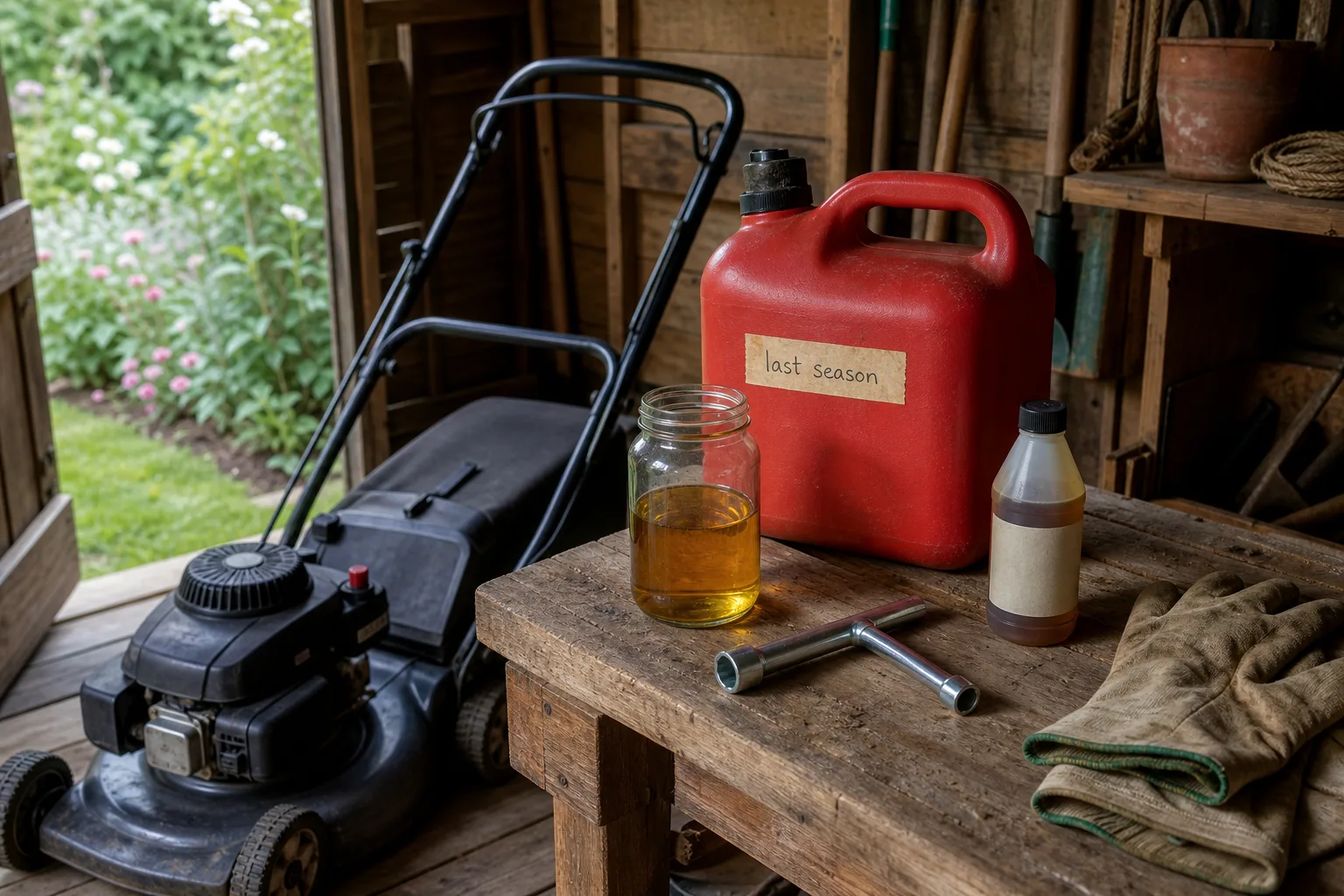
Small engines are less forgiving than cars. A mower has a tiny carburetor jet, a vented tank, a hot shed, long pauses between uses and, in many countries, petrol that contains ethanol. That combination explains why people on lawn-care forums tell two completely different stories. One person pours last season’s fuel into a mower and cuts grass for another month. Another person does the same and spends the weekend cleaning varnish from a carburetor bowl. Both can be telling the truth.
Myth 1: if the mower starts, the fuel is fine
Starting is useful information, but it is not proof. A mower can start on borderline fuel and still surge, hunt, stall under load or leave deposits as it warms up. The first few seconds use what is already in the carburetor and fuel line. The real test is whether the engine runs cleanly under mowing load for ten or fifteen minutes.
Old fuel changes in two ways. The lighter, more volatile parts evaporate first, so cold starting becomes harder. Oxidation then leaves heavier gums and varnish-like deposits. In a car these problems are diluted by a larger tank, fuel injection and frequent use. In a mower, a tiny passage in the carburetor can be enough to turn “almost fine” into “will only run on choke.”
So do not use “it fired once” as the verdict. Use “it starts, warms up, accelerates, mows under load, restarts hot and does not smell wrong” as the practical test.
Myth 2: all year-old petrol is bad
Age alone is not the whole story. Fuel stored in a sealed approved container, kept cool, bought ethanol-free or treated with stabilizer, and used within one season may be perfectly serviceable when diluted with fresh petrol. Fuel left in a half-empty mower tank in a hot shed is a different case.
The same calendar age can mean very different chemistry. A full sealed can has less air exchange and less moisture exposure. A vented mower tank breathes with temperature changes. Ethanol-blended petrol can absorb moisture from the air; when enough water is present, the mixture can separate into layers. That lower layer is bad news for a carburetor.
This is why the forum answer is usually “it depends,” even when people sound certain. It depends on ethanol content, container, temperature, how full the tank was, whether stabilizer was added before storage, and how sensitive the engine is.
Myth 3: fuel stabilizer fixes old petrol
Fuel stabilizer is preventive, not magic. It works best when added to fresh petrol before storage, then run through the engine so treated fuel reaches the carburetor. Adding stabilizer in spring to fuel that already smells sour, looks dark or has water at the bottom does not reverse oxidation or clean a clogged jet.
That does not make stabilizer useless. It is useful for people who buy fuel once, store equipment for months, or live where mowing seasons are short. The mistake is treating the bottle like a reset button. If the fuel was neglected all winter, stabilizer is no substitute for draining it and starting with fresh petrol.
For future storage, the better habit is simple: buy less fuel, label the can with the date, add stabilizer immediately if the can will sit, and run the mower for a few minutes after filling with treated fuel.
Myth 4: mixing old fuel with fresh always makes it safe
Dilution can help when the old fuel is only mildly aged and clean. A small amount of last season’s petrol mixed into a larger amount of fresh fuel may run fine in a tolerant engine. But dilution does not remove water, dirt or gum. If there is phase separation, sediment, rust flakes or a sour varnish smell, mixing only spreads the problem.
Use a clear jar test before deciding. Pour a small sample into a clean glass jar and let it sit. Good fuel should look clean and uniform. Warning signs are a separate layer at the bottom, cloudiness, dark color, particles, or a sharp stale odor. If you see water or debris, do not pour it into the mower.
If the fuel looks acceptable but old, the cautious approach is to use it in a small ratio with fresh petrol, not as the whole tank. For a small push mower, many owners simply choose not to risk it because the cost of fresh fuel is less than the time needed to clean a carburetor.
Ethanol is the part people argue about
Ethanol is not automatically evil. Millions of engines run on E10 without drama when the fuel is fresh and the equipment is used regularly. The problem is storage. Ethanol attracts water, and small engines often sit for months. That makes ethanol-blended fuel less forgiving in seasonal tools.
Avoid fuels above the manufacturer’s limit. Many small-engine makers specify ordinary unleaded petrol up to E10 and warn against E15 or E85. The exact rule is in the mower manual, not on a forum. If your area sells ethanol-free petrol and the price is reasonable, it can be a good choice for equipment that sits. If not, buy E10 in small quantities and do not keep it around forever.
The practical point is not to panic about ethanol. It is to match the fuel to the storage pattern. Fresh E10 used every week is usually less risky than premium petrol that sat open for a year.
What mechanics and forum regulars keep repeating
Across lawn-care forums, small-engine groups and repair discussions, the same pattern appears: old fuel is blamed for many no-start problems because it often is involved, but it is not the only cause. Dirty air filters, old spark plugs, stuck floats, clogged fuel caps and neglected oil also show up every spring.
The useful folk wisdom is this: if a mower ran well last autumn and will not run in spring, start with fuel before replacing parts. Drain the tank, refill with fresh petrol, check the air filter and plug, and see whether the engine improves. If it only runs on choke or dies under load, the carburetor may already need cleaning.
The less useful advice is the absolutist kind: “I use three-year-old gas and it is fine” or “anything older than a month destroys engines.” Those claims ignore storage conditions. A better rule is: inspect, smell, sample, dilute only if clean, and do not risk questionable fuel in a small carburetor.
The safe spring test
Before the first mow, look at the mower instead of just yanking the cord. If the tank contains old fuel, check how much is there and how it smells. Sour, varnish-like or paint-thinner odors are bad signs. If the tank is nearly empty, it is usually easiest to drain it, add fresh petrol and move on.
If there is a lot of fuel and you want to judge it, take a sample into a clear jar. Look for layers, water beads, cloudiness or debris. If the sample is clean and the fuel was stored with stabilizer, you can choose to dilute it with fresh petrol. If it looks wrong, dispose of it properly according to local rules.
Then start the mower outside. Let it warm up. Engage the blade or actually cut a small patch. Listen for surging. Stop and restart it hot. If it behaves badly after fresh fuel, do not keep pulling the starter until you flood it. Move to normal maintenance: air filter, spark plug, fuel line and carburetor.
What to do with old fuel you should not use
Do not pour petrol onto the ground, into a drain, or into compost. Old fuel is still hazardous. Many areas accept it at household hazardous waste sites, recycling centers or municipal collection days. Some repair shops can advise where to take small quantities.
If the fuel is only slightly old and clean, some people use tiny amounts diluted into a car tank. That advice depends on local fuel rules, vehicle type and how old the petrol really is, so it is not a universal recommendation. When in doubt, dispose of it through the proper waste route.
For the mower itself, draining is only half the job. If bad fuel sat in the carburetor, the bowl may contain gum or water even after the tank is empty. That is why running the engine dry at the end of the season, or storing it with treated fuel that has reached the carburetor, prevents more trouble than spring rescue attempts.
Better habits for next season
The easiest fix is to buy less petrol. A small lawn does not need a huge can. Buy what you will use in a month or two. Keep it in an approved container, closed tightly, away from heat and direct sun. Label the date. If the fuel may sit, add stabilizer when it is fresh, not after it has aged.
At the end of the mowing season, follow the mower manual. Some owners prefer to run the tank and carburetor dry. Others store with stabilized fuel and a full tank to reduce air space. Both methods can work when done deliberately. The worst method is accidental storage: half a tank, no stabilizer, hot shed, six months of temperature swings.
If the mower has a fuel shutoff valve, use it. If not, consider adding one if you are comfortable with small-engine maintenance. A shutoff makes it easier to run the carburetor dry while leaving treated fuel in the tank.
Verdict
Last year’s petrol is not automatically poison, but it is not something to pour blindly into a mower. Clean, stabilized fuel stored well can often be used carefully, preferably diluted with fresh petrol. Fuel that smells sour, looks cloudy, has water, sat in a vented tank, or came from an unknown can should not go into a small engine.
The cheapest repair is fresh fuel and a ten-minute inspection. The expensive mistake is believing a myth in either direction. Old petrol is not always fatal. It is also not always fine. Treat it as a condition to check, not a gamble to win.
Related articles
When a zucchini wilts overnight: how to spot squash vine borer before the stem is gone
A practical late-summer guide to diagnosing squash vine borer, deciding whether to rescue a plant, and planning prevention without harming pollinators.


Pixel 11 trade-in reports show the hidden risk in phone upgrades
Pixel 10 owners report rejected Google Store trade-ins after ordering Pixel 11. The lesson: a trade-in is not a discount until the credit lands.


Should You Buy the Samsung Galaxy S26 FE? Only at the Right Price
The Galaxy S26 FE offers a big 120Hz display, telephoto camera, wireless charging, IP68 protection, and long software support. Its familiar hardware and $699.99 starting price make the discount, storage choice, and alternatives more important than the new model number.

Snapdragon 8 Elite Gen 6 brings 30-billion-parameter AI to phones. Here is what buyers should actually wait for
Qualcomm’s new flagship chips promise faster phones and much larger on-device AI models, but the useful question is not how many parameters fit in a demo. It is whether a finished phone can sustain the gains without excess heat, battery drain, or cloud dependence.

Comments
Sign in to comment.
No comments yet.