Caltech’s ASTRA Robot Builds a Truss in Orbit — and Shows What Space Construction Still Lacks
Caltech’s ASTRA experiment autonomously assembled a new truss section in orbit, a first for robotic space construction. The useful result is smaller than the headline: it proves a building method, not yet a working antenna or a self-sufficient orbital factory.

A small robot has taken a practical step toward building large structures in space. During a six-month orbital demonstration, Caltech’s ASTRA system picked up composite tubes and aluminium joints, connected them, and built a new section of a truss without astronauts assembling the parts by hand. Caltech and DARPA describe the result as the first autonomous construction of a structure in space.
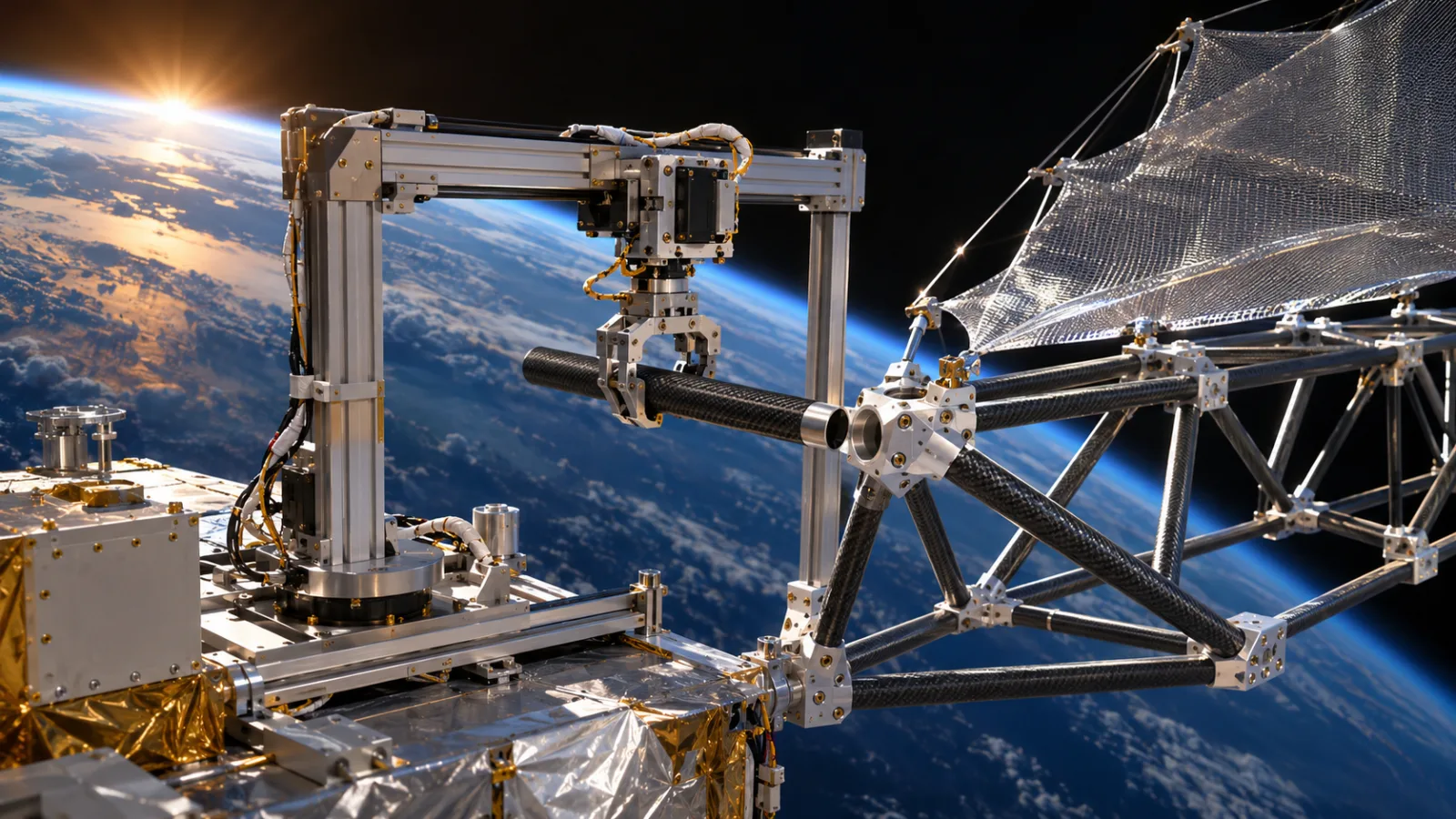
The achievement is worth attention precisely because it is limited. ASTRA did not build a finished space telescope, a functioning communications antenna, or a space station module. It constructed part of a 1.4-metre reflector structure, and the full planned antenna was not completed. What the experiment established is more specific: a robot can perform a repeated assembly sequence in orbit, using components carried separately and joining them where the structure is meant to operate.
That distinction matters. Space hardware is still largely designed around the dimensions of a rocket fairing. If an antenna, mirror, solar array, or habitat is too large to fit inside the launch vehicle, engineers generally have to fold it, unfold it, or send up multiple pieces for astronauts or specialised spacecraft to connect. ASTRA tests a third option: launch a compact box of parts and let a machine build the structure after reaching orbit.
What ASTRA actually did
ASTRA stands for Autonomous In-Space Tensioned Reflector Assembly. The Caltech payload was developed through DARPA’s Novel Orbital and Moon Manufacturing, Materials, and Mass-efficient Design programme, known as NOM4D. Momentus hosted the payload on its Vigoride orbital vehicle after launch on SpaceX’s Transporter-16 mission at the end of March 2026.
The machine is not a free-flying humanoid robot. It is a relatively simple gantry-style manipulator that moves along three linear axes, with a rotational degree of freedom in the research design. Its job is tightly defined. It retrieves structural members and joints from dispensers, positions them on an assembly plate, connects them into a truss bay, and helps deploy a thin reflective mesh as the section is released.
The flight payload began with two bays already built. It carried additional composite-fibre tubes, aluminium joints, reflective material, cameras, dispensers, supports, and the mechanisms needed to move the partially assembled structure through the builder. The machine then constructed a third bay in orbit. Caltech’s official account says the team encountered time limitations and completed only the initial section of the intended antenna.
That outcome is not a failure of the experiment’s core purpose. The demonstration was designed to test whether the assembly concept could survive launch, deployment, and operation in the space environment. The result shows that at least one repeated construction process can be executed on orbit. It does not show that a larger structure can be assembled at the same reliability, speed, or dimensional accuracy.
Why building after launch changes the design problem
A rocket fairing imposes a hard geometric limit. Engineers can make a large structure fold smaller, but folding introduces hinges, latches, release mechanisms, flexible members, and deployment sequences. Every added mechanism creates another possible failure mode. A structure can also be too delicate or too stiff to unfold reliably after spending months exposed to vibration, vacuum, temperature swings, and radiation.
Assembly in orbit moves some of that complexity from deployment into construction. Instead of making one very large object behave like a compact object during launch, designers can launch standardised parts and join them gradually. The approach is especially attractive for structures that are light but wide: mesh reflectors, radio antennas, solar arrays, sunshades, and perhaps the structural frames of large telescopes.
The physics also changes once the structure is no longer supported by Earth’s gravity. A truss that would sag under its own weight on the ground may be practical in orbit if its main loads come from tension, rotation, sunlight pressure, or attached equipment. That does not make the engineering easy. It changes which constraints dominate.
The most useful way to understand NOM4D is therefore not as a plan to send construction robots into space next year. It is a programme testing whether structures can be designed specifically for orbital assembly rather than designed on Earth and forced through a launch vehicle’s dimensions.
The robot’s simplicity is part of the result
The ASTRA demonstration does not depend on a general-purpose artificial intelligence system making open-ended decisions. DARPA describes the device as a relatively simple gantry robot and emphasises the combination of mechanisms, materials, and operations. That is important because reliability in space often comes from reducing the number of things a machine has to understand.
A carefully constrained robot can repeat a known motion, use fixed dispensers, and be observed by cameras. The trade-off is flexibility. If a component is badly positioned, a joint does not engage, or the partially assembled structure shifts outside its expected envelope, the machine may not know how to improvise. A more capable autonomous system could potentially recover from more situations, but it would also need more sensors, more software, more validation, and more ways to fail.
The experiment’s architecture reflects that compromise. ASTRA’s parts and sequence were prepared on Earth. The robot was not asked to design the truss, select a new construction method, or diagnose every fault without assistance. Its value lies in demonstrating that a repeatable, pre-engineered sequence can be carried out in orbit with limited human intervention.
This is a useful pattern for space robotics. The first operational machines are likely to be narrow tools with strong mechanical constraints, not all-purpose builders. Their autonomy can grow as engineers collect data about real failures and improve the hardware around those failure modes.
Why the orbital test was harder than a laboratory demonstration
Caltech had already developed the assembly concept and tested it on Earth during earlier phases of the project. Ground tests are necessary, but they cannot reproduce every condition that affects an orbital mechanism.
On Earth, gravity loads parts against supports and helps engineers observe them directly. In orbit, parts can float, contact surfaces can behave differently, and a small unplanned movement may persist rather than being damped by weight. The machine must also operate through a spacecraft platform with restricted power, communications, thermal control, and pointing conditions. Engineers cannot simply reach into the mechanism, replace a jammed component, or adjust a fixture between attempts.
DARPA says the payload had communications, power, imaging, and other support from the Momentus platform. Caltech’s payload used 11 cameras to monitor the assembly. Those cameras are not decorative documentation; they are part of the experiment’s operational feedback loop. When a mechanism behaves unexpectedly, the team needs images and telemetry before deciding what command to send next.
The distance to low Earth orbit is not the main communication challenge here. The difficulty is access and timing. An orbital experiment may offer only limited opportunities to send commands and inspect the result. A fault can consume an entire operating window, and a cautious recovery sequence may take much longer than the same repair would take in a laboratory.
That is why the incomplete antenna is informative. It shows where the gap between a successful ground prototype and a useful orbital system appears: not necessarily in the basic motion, but in time, fault recovery, component handling, and the ability to continue construction when conditions are imperfect.
What was proved — and what was not
The strongest verified claim is narrow: ASTRA demonstrated automated assembly of a truss section in space from individual components. Caltech says the robot built a third bay after launching with two pre-built bays. DARPA describes the flight hardware as a proof of concept for future space-based antennas.
Several larger claims remain prospective.
The experiment did not produce a complete, operational radio-frequency antenna. The reflective mesh was a surrogate material for the demonstration, not a complete antenna system with the electronics, feed, calibration, pointing control, and signal performance required for communications or astronomy. A structurally assembled reflector is only one part of a working instrument.
The experiment also did not demonstrate a structure hundreds of metres or kilometres across. DARPA’s programme goal is to make very large orbital construction feasible, but the demonstrated structure was 1.4 metres in diameter and only part of the planned design was assembled. Scaling is not a matter of multiplying the number of bays and assuming the result will behave the same way.
A larger structure would bring new problems: accumulated alignment errors, longer construction time, more opportunities for parts to jam or drift, structural dynamics during assembly, thermal distortion, debris exposure, and the need to transfer loads safely as the growing structure extends away from the builder. It may also require multiple robots, replenishable materials, inspection systems, and mechanisms for handling a finished structure without damaging it.
Finally, ASTRA was not an autonomous orbital factory. The payload launched with its components and a purpose-built assembly machine. It did not mine material, manufacture arbitrary parts from raw feedstock, weld a pressure vessel, or make independent decisions about a changing construction site. Those capabilities may matter for future space manufacturing, but they were outside this demonstration.
The best near-term applications are large and low-mass
The most plausible early applications are structures that are hard to launch as a single object but do not need to support heavy equipment across a rigid surface.
Large mesh reflectors are one example. Radio astronomy and communications systems can benefit from a wide aperture, while a mesh reflector can be much lighter than a solid mirror. A robotically assembled frame could be packaged as a set of relatively small parts and expanded after launch.
Solar power systems are another possible direction. Large collectors need area, and launch vehicles impose a severe packaging constraint. Orbital assembly could permit arrays designed for their working scale rather than arrays limited by the folded volume that can survive launch. That does not solve the separate problems of power transmission, maintenance, orbital debris, and economics, but it could remove one physical bottleneck.
Large sunshades, sensor booms, and depots might also benefit from construction methods that distribute parts over a wider area. Space telescopes are a more demanding case. A telescope mirror needs not only size but also precise optical shape, alignment, stability, contamination control, and instruments capable of turning reflected light into reliable data. A truss-builder demonstration is relevant to that future, but it does not validate the complete telescope architecture.
The common feature is not simply “space technology.” It is a design in which area matters more than mass, and in which a modular structure can tolerate being built section by section. The more a future system depends on tight tolerances, sealed pressure boundaries, or complex electrical integration, the more difficult the transition from truss assembly to useful hardware becomes.
What engineers should measure next
The next phase of progress should be judged with engineering metrics rather than concept art. A larger orbital assembly programme would need to report at least five kinds of evidence.
First is reliability. How often does the robot complete a bay without intervention? Which components fail to feed, align, connect, or release? Can the system detect a bad connection before it becomes part of the growing structure?
Second is recovery. If the robot encounters a jam or a misaligned member, can it back away, retry, or use a different sequence? A system that succeeds only when every part arrives in exactly the expected position may be useful for a carefully controlled demonstration but fragile in routine operations.
Third is geometry. How accurately do the assembled bays match the intended dimensions? How much error accumulates as sections are added? For an antenna or telescope, a structure that looks complete may still be unusable if its shape is outside the required tolerance.
Fourth is throughput. How much time, power, communication, and operator attention are required per bay? A process that works once but takes weeks for each section may not compete with a folded deployable or a sequence of crewed assembly missions.
Fifth is structural performance. The completed truss needs to carry its own loads, hold its shape through temperature changes, withstand launch of later components if construction continues, and support whatever reflective, electrical, or scientific equipment is added later. Construction is not finished when the last joint clicks into place.
These measurements would turn ASTRA’s qualitative proof into a technology path. The question is no longer whether a robot can assemble one section in orbit. It is whether the process can be repeated, inspected, repaired, and scaled while maintaining the performance of the final system.
Why the result is good technology news
ASTRA is a useful example of what evidence-based optimism looks like in space engineering. The headline is dramatic—an autonomous robot built a structure in orbit—but the durable result is more modest and more valuable. A team moved a construction concept from laboratory testing into the environment where it would actually have to work.
That transition exposed time limits and prevented completion of the full reflector. Those limitations do not cancel the demonstration; they define the next engineering work. The team now has orbital observations of its mechanisms, its material handling, its camera views, and the practical difficulty of operating a construction sequence without physical access.
DARPA describes the demonstration as a beginning, not an endpoint. That is the right reading. The experiment does not make giant orbital telescopes, space habitats, or kilometre-scale solar arrays ready for deployment. It does something more concrete: it reduces uncertainty around one way of building large, lightweight structures after launch.
The long-term value will depend on whether future teams publish the failures as carefully as the success. If ASTRA leads to more reliable feeders, better fault recovery, tighter dimensional control, and longer demonstrations, then the experiment will have opened a credible route to space construction. If it remains a one-off assembly of a small partial truss, it will still be an important proof of possibility—but not yet a new way of building in space.
For now, the lesson is straightforward. The size of a space structure may no longer be determined only by what fits inside a rocket. But before that becomes a practical design freedom, robots will have to prove that they can build repeatedly, accurately, and recoverably in the place where repairs are hardest: orbit.
Related articles
Stanford’s quantum-acoustics experiment catches a single sound quantum making its jump
A chip-scale resonator and superconducting qubit let physicists watch a phonon change energy state in real time. The result is a measurement advance, not a finished quantum computer, but it gives sound-based systems a new way to expose errors and sense tiny signals.
L’expérience quantique de Stanford capture en temps réel le saut d’un quantum sonore
Un résonateur à l’échelle d’une puce et un qubit supraconducteur ont permis de suivre le passage d’un phonon d’un état d’énergie à un autre. Cette avancée concerne la mesure, pas encore un ordinateur quantique complet.
Stanfordzki eksperyment z akustyką kwantową rejestruje pojedynczy kwant dźwięku podczas skoku
Rezonator w skali układu scalonego i nadprzewodzący kubit pozwoliły fizykom obserwować w czasie rzeczywistym zmianę stanu energetycznego fononu. To postęp pomiarowy, nie gotowy komputer kwantowy, ale otwiera nowe możliwości wykrywania błędów i niezwykle słabych sygnałów.
Comments
Sign in to comment.
No comments yet.