A Chip-Scale Optical Frequency Comb Brings Precision Timing Closer to the Field
A NIST-led team has demonstrated a self-aligned optical frequency comb that performs several precision-measurement tasks on a chip. The advance does not replace GPS or atomic clocks yet, but it removes a major obstacle to making optical timing hardware smaller and more deployable.

A ruler works because its marks are regular. An optical frequency comb applies the same idea to light: it produces a large set of sharply defined frequencies, evenly spaced like the teeth of a comb. By comparing an unknown laser with those reference lines, scientists can measure optical frequency with extraordinary precision. The difficulty has been practical. The best comb systems have traditionally occupied optical tables, require careful alignment, and depend on supporting equipment that is difficult to move into a vehicle, field station, or compact navigation instrument.
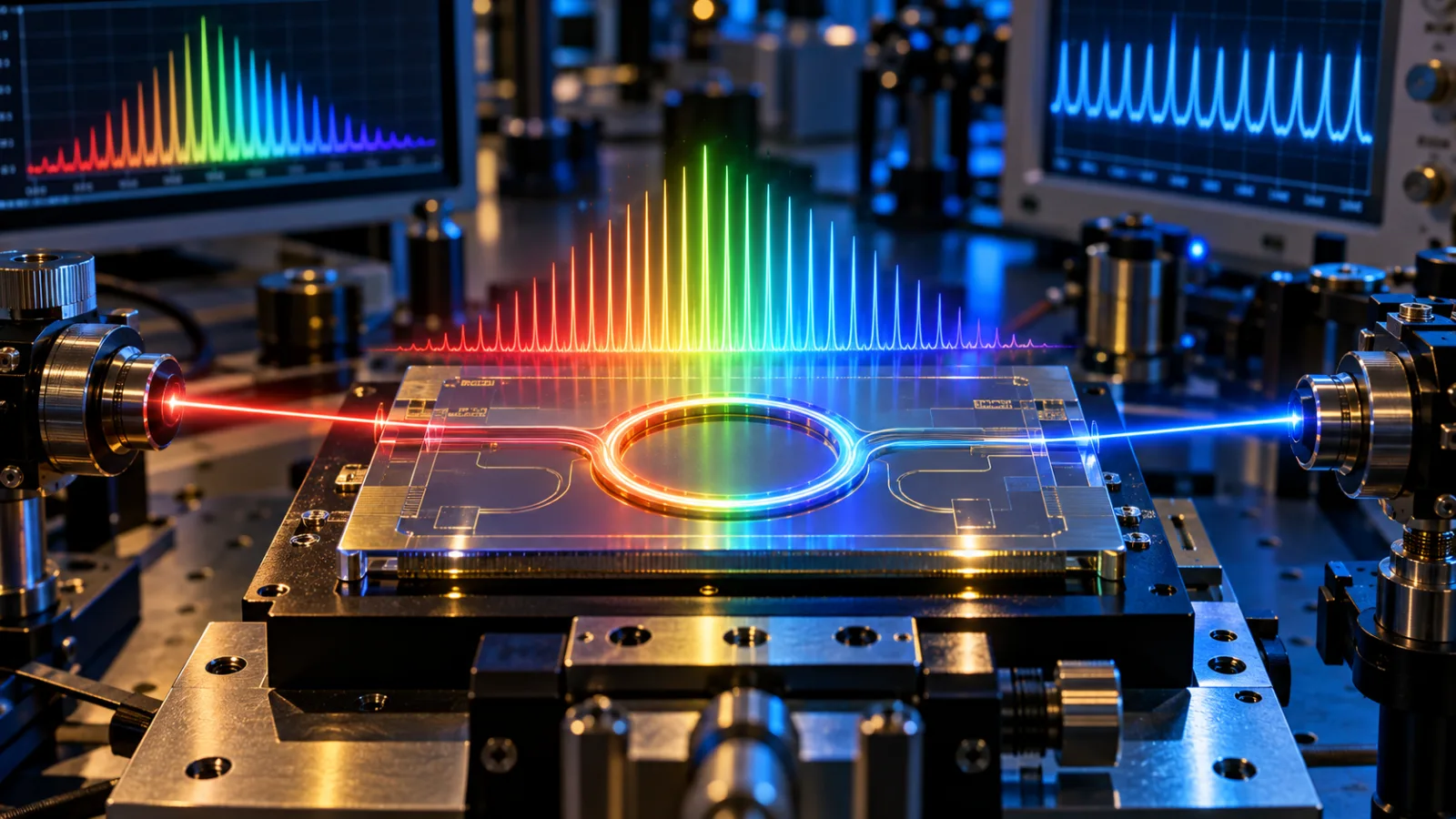
A new experiment from researchers at the National Institute of Standards and Technology, the Joint Quantum Institute, the University of Maryland, and collaborating institutions addresses one of the hardest parts of shrinking that technology. The team demonstrated a chip-integrated microcomb that can be self-aligned to two lasers and can be used for three different metrology tasks: linking microwave and optical frequencies, generating low-noise millimetre waves, and reading out an optical clock. The peer-reviewed work appeared in Nature in September 2026, and NIST highlighted the result on October 16.
The important point is not that a laboratory optical clock has suddenly become a phone component. It has not. The result is a credible engineering route toward portable optical timing and precision navigation because it tackles the part of the system that has kept many chip-scale combs tied to laboratory infrastructure: making a broad, stable optical ruler whose frequency offset can be measured and controlled without a large self-referencing setup.
Why an optical frequency comb matters
Light oscillates extremely quickly. Visible and near-infrared optical waves cycle hundreds of trillions of times per second, far beyond the direct reach of ordinary electronic counters. Yet optical frequencies are useful precisely because they are so high. An atomic transition can provide an exceptionally stable reference, and a laser locked to that transition can preserve that stability. The problem is transferring information between the optical domain and electronics.
An optical frequency comb provides the bridge. Its spectrum contains many narrow lines separated by a known repetition frequency. In simplified form, the frequency of each comb tooth can be described as:
f_n = f_0 + n f_rep
Here, f_rep is the spacing between adjacent teeth, n is an integer, and f_0 is the carrier-envelope offset frequency. If both quantities are known or stabilized, every comb tooth becomes a precisely labelled reference. A laser whose frequency lies between two teeth can then be compared with the comb, and an optical signal can be connected to a microwave or radio-frequency reference.
This is useful in optical atomic clocks, frequency synthesis, precision spectroscopy, astronomical instruments, telecommunications, lidar, radar, and tests of fundamental physics. The same architecture can translate a very stable optical signal into a low-noise microwave signal, or use a microwave reference to establish an optical one.
The comb therefore acts less like a clock by itself than like a gearbox between kinds of clocks and measurements. Making that gearbox portable could matter in places where the reference signal from a satellite is weak, obstructed, spoofed, or deliberately jammed. It could also make precision instruments easier to install in observatories, aircraft, ships, autonomous vehicles, and industrial sites.
The problem with shrinking a tabletop comb
The new work builds on a long effort to place optical frequency combs on photonic chips. A microcomb uses a tiny optical resonator, often a ring made from a nonlinear material. Light circulating in the ring interacts with the material and with itself, generating new frequencies. Under the right conditions, those frequencies form a regular comb.
At first glance, miniaturization seems straightforward: replace a large resonator and associated optics with a ring on a chip. In practice, the comb must satisfy several demanding conditions at once. Its lines need to be sufficiently strong, evenly spaced, low in noise, and broad enough to span a large range of frequencies. The system must also identify and stabilize the offset frequency f_0. Without that control, the comb’s teeth are not fully anchored to an absolute reference.
Many earlier chip-scale designs followed the logic of tabletop systems. A single pump laser was injected into a resonator, and nonlinear processes generated additional frequencies outward from the pump. This approach can work, but producing strong and clean signals across a full octave—the range in which the highest frequency is twice the lowest—can be difficult on an integrated platform. The weak or noisy parts at the edges make self-referencing harder.
The researchers changed the architecture rather than simply making the old design smaller. They used two pump lasers separated by an octave and arranged for the microcomb to fill the spectrum between them. In the paper, the resulting state is described as a parametrically driven cavity soliton in an integrated third-order nonlinear resonator. The terminology is specialized, but the design choice is simple to state: instead of asking one pump to broaden outward across the entire useful spectrum, the two pumps define the outer regions and the comb develops between them.
That inversion gives the system a useful relationship between its endpoints. When the two pump frequencies are harmonically related, their relationship helps define the carrier-envelope offset. The offset is no longer an independent quantity that must be discovered and stabilized using a separate, bulky self-referencing chain. The chip still needs lasers, control electronics, thermal management, and optical interfaces, but one of the most troublesome stabilization tasks is built into the way the comb is generated.
What the experiment actually demonstrated
The Nature paper reports a single octave-spanning comb extending from telecommunications wavelengths into the visible. The device was fabricated across multiple foundry-produced chips, and the researchers observed the self-aligned behaviour across more than one device and operating configuration. That matters because a one-off optical effect in a carefully tuned laboratory sample is not the same as a method that survives fabrication variation.
The group then used the same basic microcomb for three kinds of measurement. The hardware was not transformed into three unrelated instruments; the input locks were changed so that the comb could serve different metrology functions.
First, the comb linked microwaves to optical frequencies. This microwave-to-optical connection is a foundation of frequency synthesis. A stable electronic signal can be multiplied or transferred into the optical domain, and an optical signal can be measured against a more accessible microwave reference. Such links are useful when different instruments need to share a frequency standard.
Second, the researchers generated low-noise millimetre-wave signals. Millimetre waves occupy frequencies useful for radar, communications, sensing, and high-resolution ranging. Noise in the source broadens or destabilizes the signal, limiting the precision of the measurement. A comb that transfers the stability of a low-noise optical reference into the microwave region can provide a cleaner electronic output without requiring the entire optical system to remain a room-sized apparatus.
Third, the chip was used for integrated optical clock readout. Optical clocks use atomic transitions as references and can be much more stable than conventional microwave atomic clocks, but their signals are difficult to handle electronically. The comb translates between the optical transition and a measurable microwave signal. In this demonstration, the comb was therefore performing the essential role of optical clockwork: preserving and transferring frequency information between domains.
The team also compared the chip-based system with a conventional tabletop comb. That comparison is important for interpreting the result. The claim is not simply that the chip emits many colours of light. A useful comb must perform the measurement tasks for which combs are valued, and it must do so with enough stability and control to be compared against established equipment. The experiment shows that the new architecture can operate in that direction.
Why this could improve navigation
Most people encounter precision timing indirectly through satellite navigation. A navigation receiver estimates position from the arrival times of signals from several satellites. Those signals are synchronized to atomic clocks, and the receiver’s calculations depend on knowing timing differences accurately. The navigation system itself is much more than a clock, but the clock is part of the foundation.
Satellite signals can be blocked by buildings, terrain, water, or indoor environments. They can also be interfered with or jammed. A local system with a very stable clock can continue to provide timing and navigation information for a period without relying entirely on an external satellite reference. If the local clock is small enough, it could be integrated into aircraft, autonomous vehicles, ships, defence systems, scientific instruments, or infrastructure that needs an independent timing source.
This is where the new comb may eventually matter. The microcomb is not itself a complete navigation system, and the experiment does not demonstrate a finished GPS replacement. A fieldable instrument would need a compact and stable optical reference, lasers that tolerate vibration and temperature changes, packaging, power electronics, control software, photodetectors, and a navigation architecture that combines the clock with inertial or environmental measurements.
The comb addresses one of those pieces: converting and stabilizing frequency information in a compact photonic package. If other parts of the system can be reduced in size and hardened for operation outside a laboratory, a portable optical clock could become practical in applications where satellite timing is not dependable.
The benefit may be broader than navigation. A portable optical frequency reference could calibrate instruments in remote locations, improve synchronization across distributed sensors, support precision ranging, and help compare clocks without transporting large laboratory systems. In astronomy, frequency stability can improve the performance of spectrographs used to detect small shifts in starlight. In telecommunications, better frequency references can support coherent links and high-capacity data systems. In spectroscopy, a compact comb could make high-precision measurements easier to conduct outside specialized laboratories.
The engineering advance is in control, not just size
It is tempting to describe the result as “an atomic clock on a chip,” but that wording hides the real achievement and overstates the current stage. The chip contains the microcomb, not every component needed for a robust optical clock. The system still relies on external lasers and supporting instruments. What has been demonstrated is a key subsystem that can make the overall package smaller, less dependent on bulky equipment, and more versatile.
That distinction is useful because precision instruments often fail to become practical for reasons that are not visible in a headline specification. A resonator can be tiny while the laser stabilization hardware remains large. A sensor can be sensitive while its calibration procedure is slow. A promising material can work in a clean laboratory but drift under temperature changes, vibration, radiation, or manufacturing variation. The new paper is valuable because it focuses on an architectural bottleneck: generating a broad, self-referenced comb on an integrated platform and using it for real metrology tasks.
The foundry-fabricated aspect also points toward repeatability. Photonic chips are manufactured in batches, and a design that can be reproduced across multiple devices has a better chance of becoming an engineered platform. That does not guarantee commercial production. Yield, packaging, optical coupling, thermal control, reliability, and cost still have to be demonstrated at scale. But repeatability is a more meaningful step than a single spectacular measurement from one custom-built resonator.
The system’s flexibility is another practical feature. The researchers used the same comb for several tasks by changing which sources were locked to it. In a deployed instrument, that could reduce the number of specialized frequency-conversion modules required. One stable chip-based component might serve as a common optical-to-microwave interface for different measurement modes. The final product would still need switching, calibration, and control logic, but the underlying photonics would be shared.
What remains uncertain
The paper establishes a technical demonstration, not a product roadmap. Several questions determine whether the result can move beyond a research instrument.
How small can the complete system become? The resonator and comb-generation elements are chip-scale, but the pumps, detectors, thermal actuators, optical isolators, packaging, and electronics also occupy space. A useful comparison must include the whole instrument, not only the photonic chip.
How much power will a field version require? The new architecture avoids some power-hungry equipment associated with earlier self-referencing approaches, according to NIST. That is encouraging, but a deployable clock or navigation unit must include the power used by lasers, temperature control, feedback electronics, signal processing, and environmental protection. Battery life and heat dissipation could be as important as optical performance.
How stable is it outside the laboratory? Optical resonators respond to temperature, mechanical stress, fabrication differences, and changes in coupling. The demonstrations included multiple foundry-fabricated devices, but field systems face a harsher combination of vibration, shock, thermal cycling, contamination, and long unattended operation.
What is the long-term noise and drift? Precision timing applications care about performance across different averaging times. A device may look excellent over a short interval but accumulate drift over hours or days. Real navigation systems also need predictable failure modes and clear estimates of how uncertainty grows when an external reference disappears.
Can manufacturing deliver enough usable chips? A wafer can contain hundreds of chips, and the NIST description notes that individual chips can include hundreds of ring resonators. That supports a path toward scale, but production economics depend on yield and on whether the entire optical assembly can be packaged with comparable consistency.
What is protected by intellectual property? The authors disclose a provisional patent application covering aspects of the work. That is normal for a technology with possible applications, but it means future availability will depend on licensing, partnerships, and further engineering as well as on scientific performance.
These are not arguments against the result. They define the distance between a strong laboratory demonstration and a device that can be installed in a vehicle or operated at a remote site without expert attention.
Why the timing of the announcement matters
The NIST announcement arrived in a period when dependence on satellite navigation is receiving more practical scrutiny. Navigation systems are highly capable, but their signals are weak by the time they reach Earth and can be disrupted more easily than many users realize. Independent timing does not solve every navigation problem, yet it can make a system more resilient when paired with inertial sensors, terrestrial signals, visual odometry, maps, or other sources of position information.
The same trend appears in science and infrastructure. More instruments are being distributed across large distances, and more of them need to agree on time and frequency. A portable standard can reduce the cost and difficulty of bringing precision measurement to the instrument instead of bringing the instrument to a national laboratory.
That is why the most useful interpretation of the work is not “GPS is about to disappear.” It is that the boundary between laboratory metrology and field instrumentation may be moving. A chip-based comb can become one of the enabling components for systems that retain high timing quality while operating in places where a full optical table is impossible.
The good news, stated precisely
The good news is a reduction in a specific kind of fragility. Earlier chip-comb designs could generate useful optical lines, but robust self-referencing and stabilization often required additional equipment. The new two-pump architecture creates a self-aligned octave-spanning comb whose offset is tied to the relationship between the pumps. The researchers showed that the same integrated platform can support optical frequency synthesis, low-noise millimetre-wave generation, and optical-clock readout.
That is a real improvement in the architecture of precision timing. It is also a limited one. The result does not yet provide a complete portable atomic clock, an independent navigation network, or a consumer device. It provides a compact, repeatable photonic building block that makes those larger systems easier to imagine and potentially easier to engineer.
The next milestones will be less dramatic but more decisive: package the system, reduce the number of external components, test it under vibration and temperature changes, quantify long-duration drift, improve manufacturing yield, and integrate it with a complete clock or navigation demonstrator. If those steps succeed, optical timing could become less confined to national laboratories and more available to the machines and instruments that need it in the field.
For now, the result belongs in the category of good technology news that deserves careful wording. The advance is not a miracle and it is not a finished product. It is a well-defined bottleneck removed from the path toward smaller, more resilient precision measurement.
Related articles
Stanford’s quantum-acoustics experiment catches a single sound quantum making its jump
A chip-scale resonator and superconducting qubit let physicists watch a phonon change energy state in real time. The result is a measurement advance, not a finished quantum computer, but it gives sound-based systems a new way to expose errors and sense tiny signals.
Sandia’s ETCRAM points to a quieter way to cut energy in sensor computing
Sandia researchers have demonstrated an analog memory that stores far more precise states across a wider range than earlier devices. The useful idea is not a faster server, but less raw sensor data moving between chips.
Inclusive Color Space is good tech because it makes better avatar defaults easier
A small MIT-licensed color picker turns a messy representation problem into practical design infrastructure for games, avatars and creative tools — while openly admitting what it cannot solve.

Hafnia’s Hidden Switch: What Intrinsic Antiferroelectricity Could Change in Electronics
A Science study argues that hafnium oxide is intrinsically antiferroelectric down to a 0.6-nanometer film. The result does not make a new memory chip overnight, but it gives engineers a familiar, silicon-compatible material with a clearer electrical identity to work from.
Comments
Sign in to comment.
No comments yet.