A Contact Lens Can Measure Serotonin in Tears. The Real Advance Is Molecular Sampling
A soft contact-lens sensor detected tiny amounts of serotonin in human tears and worked in a pig-eye test. It is promising wearable-biosensing research, not yet a stress meter or a clinical diagnostic.
A contact lens that measures serotonin sounds like a device for reading a person’s mood. That is not what researchers have demonstrated. The more useful achievement is narrower and more practical: a soft lens can sample a difficult body fluid and detect a molecule present at extremely low concentrations without requiring a blood draw.
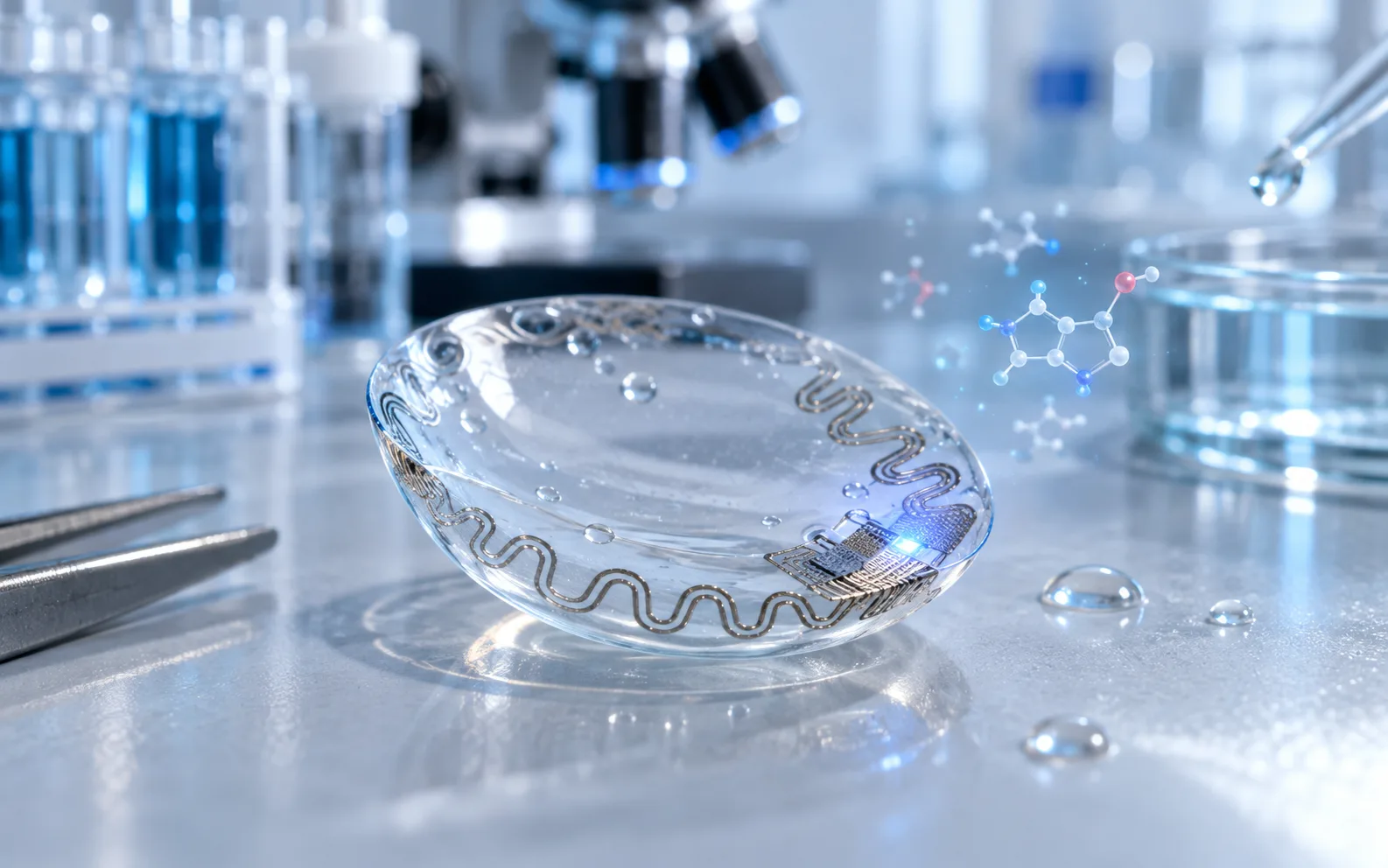
The device, described in Science Translational Medicine, combines a flexible electrochemical sensor with a conventional hydrogel contact lens. In laboratory experiments, it detected serotonin in artificial tears and in tear samples from volunteers. The group also tested a lens on the eye of an anesthetized pig. The results show that tear chemistry can be measured through a wearable platform, but they do not establish that a consumer could put on the lens and receive a reliable stress score.
That distinction matters. Serotonin is involved in many biological processes, and its concentration in tears may vary with the eye’s surface, time of day, illness, medication, and the way tears are produced. A sensor can be technically sensitive while the meaning of its reading remains uncertain.
What the researchers built
The research team, led by Yangzhi Zhu at the Terasaki Institute for Biomedical Innovation, developed what it calls a lab-on-a-contact-lens platform. The lens is soft and reusable. Flexible graphene and silver electrodes are embedded in a serpentine pattern so that the electrical conductors can tolerate bending and stretching. A chemical mediator, ferrocene, is attached to the graphene to help convert the interaction with serotonin into an electrical signal.
The engineering problem is not simply to make an electrode smaller. Serotonin is present in tears at very low levels, while tears contain many other substances that can interfere with a chemical measurement. The sensor therefore needs both sensitivity and selectivity. In the reported design, serotonin participates in an electrochemical reaction involving the ferrocene-modified electrode. The resulting current can be related to the amount of serotonin present.
The lens has to meet another set of requirements that an ordinary laboratory sensor does not. It must remain transparent enough to see through, flexible enough to sit on the eye, and compatible with repeated movement. A rigid chip placed on the cornea would be a poor contact lens even if its chemistry were excellent. The study is therefore as much about packaging and mechanical durability as it is about serotonin detection.
The paper’s primary scientific record is the study “Serotonin measurement by lab-on-a-contact lens in porcine and human tears”, published in Science Translational Medicine on September 16, 2026. The Terasaki Institute’s research announcement provides additional technical and institutional context.
The sensitivity result is impressive, but it is not the same as clinical accuracy
In tests with artificial tears, the sensor detected serotonin down to about 72 picomolar. A picomolar is one trillionth of a mole per liter. The reported detection limit was roughly 200 times lower than the typical serotonin concentration the researchers expected in human tears. That margin is useful because a sensor needs headroom if it is to distinguish small changes from background noise.
The team also examined whether the lens could keep working after mechanical stress. According to the study’s coverage by IEEE Spectrum, the prototypes remained functional after more than 28 days of repeated flipping, folding, stretching, and twisting. That is an encouraging durability test for a proof-of-concept device. It is not yet equivalent to a long-term wear study. Repeated laboratory deformation does not reproduce every combination of blinking, tear evaporation, protein buildup, cleaning solution, temperature change, and microbial exposure that a real lens would encounter.
Sensitivity answers one question: can the sensor respond when a molecule is present at a low concentration? Clinical usefulness requires many more answers. Does the reading remain stable across different people? Does it track a meaningful physiological change? Is the result reproducible when the lens is worn on different days? Can the device tell serotonin apart from chemically similar substances in natural tears? Can the reading be calibrated without collecting a separate sample?
The current work begins to address the first group of questions, not the whole chain. That is why the most defensible description is a sensitive tear-biosensing platform, rather than a finished stress monitor.
What happened in the human-tear experiments
The researchers collected tears from 10 volunteers at several points around stressful tasks. The participants completed public-speaking and arithmetic challenges, and samples were collected before, immediately after, and approximately 30 minutes after the tasks. The sensor detected serotonin in those samples. The reported pattern was a decline in tear serotonin after the stressful activities.
This is an important demonstration because natural human tears are more complicated than a prepared solution. Yet the experiment remains small and controlled. Ten participants cannot establish normal ranges for a diverse population, and a laboratory stress task is not the same as chronic stress, depression, anxiety, sleep loss, pain, or the ordinary fluctuations of a working day. The direction of a change in one experiment also does not tell us whether a specific reading can classify an individual’s mental state.
Stress is not a single chemical variable. It involves the nervous system, endocrine responses, immune signals, behavior, sleep, environment, and personal interpretation. Serotonin itself is not a simple “happiness” meter. It acts in multiple tissues and pathways, and a concentration measured in tears cannot automatically be treated as a direct measurement of serotonin activity in the brain.
That point is especially important for public communication. A wearable that reports a number may invite users to assign a meaning that the biology does not support. If a future application displays a stress trend, the trend would need to be validated against clinical assessments and other physiological measures. It should not be presented as a diagnosis of depression, anxiety, burnout, or any other condition.
The pig-eye test shows feasibility, not readiness for people
The team also placed a prototype on the eye of an anesthetized pig for about five minutes. The lens detected serotonin when the eye was exposed to artificial tears containing 50 and 100 nanomolar concentrations. The researchers reported no visible infection or irritation during that short test.
An in vivo demonstration is valuable because a device can behave differently on an eye than in a dish. Blinking, tear flow, curvature, and the position of the sensor all affect the measurement. The pig experiment indicates that the lens can make contact with an ocular surface and produce a signal under controlled conditions.
It does not establish comfort during ordinary wear, safe use over hours or days, or reliable readings in people with dry eye, allergies, contact-lens intolerance, eye disease, or altered tear production. It also does not answer whether the sensor’s electrical materials, encapsulation, wiring, or cleaning process are suitable for repeated human use. Those questions require dedicated safety and usability studies.
The researchers used flexible nickel wires to connect the lens to readout equipment in the laboratory and animal experiments. They have also developed a proof-of-concept wireless version with a miniaturized near-field communication chip and a stretchable antenna. The wireless design points toward smartphone-based readout without a battery in the lens, but it remains an engineering prototype that needs further optimization and validation.
Why tears are attractive—and why they are difficult
Blood is the standard reference fluid for many biomarker measurements, but drawing blood is inconvenient for frequent monitoring. Sweat and interstitial fluid can also be sampled with wearable devices, yet each fluid has its own chemistry and its own relationship to what happens elsewhere in the body. Tears are appealing because they are accessible, produced continuously, and already in contact with the lens.
A tear sensor could eventually make repeated measurements easier for researchers studying eye disease, pain, inflammation, medication response, or systemic physiology. It might also help answer basic questions that are difficult to investigate with occasional blood samples. A time series can reveal patterns that a single measurement misses.
But tears are not a transparent window into every organ. Their composition depends on the ocular surface and on the process that produces them. Reflex tears caused by irritation may not be chemically equivalent to basal tears. Blinking and evaporation can change concentrations. Cosmetics, contact-lens materials, eye drops, allergies, infection, and dry-eye disease can all influence the sample. Even the act of collecting tears can alter the fluid being measured.
For serotonin in particular, the central validation question is how tear measurements relate to other measures that researchers and clinicians care about. The study’s animal observations suggested that blood and tear serotonin changed in a similar direction during a controlled stress paradigm. That is a reason to investigate the relationship, not proof that the two compartments can be substituted for each other.
The researchers themselves emphasized the need to study variation between individuals, changes across the day, different stress conditions, ocular-surface states, and disease conditions. They also need to compare tear readings with blood biomarkers and clinical assessments. That list is not a formality; it defines the work required before the device could support a medical decision.
A second signal could be more informative than serotonin alone
The group also measured cortisol in tear experiments. Cortisol is often associated with a more immediate stress response, while serotonin may reflect a different aspect of physiology. Measuring both could eventually provide more context than either molecule alone.
Even then, two biomarkers would not turn a contact lens into a mind reader. A useful system would need a validated model of what the signals mean in a particular setting, a clear account of uncertainty, and safeguards against overinterpretation. The more molecules a platform measures, the more difficult calibration and interpretation may become. More data is not automatically better data.
There is also a practical issue: a sensor that works in a laboratory may not be able to measure multiple molecules at once without cross-reactions, drift, or a larger electrode area. Each added analyte can require its own chemistry and reference conditions. The platform’s future value will depend on whether multiplexing can be achieved while preserving transparency, softness, comfort, and manufacturability.
The privacy problem arrives before the product
A contact lens that records molecular information would create a different category of wearable data. Heart rate and step counts already raise questions about ownership and access. A biochemical trace associated with stress, medication response, eye disease, or fatigue could be even more sensitive.
That does not make the technology undesirable. It means the design should include data governance from the beginning. Users would need to know what is measured, how often it is recorded, where the data goes, who can see it, and whether a company can use it for advertising, employment screening, insurance, or automated mental-health judgments. A research prototype does not settle those policy questions, but a future product would have to.
The safest early applications may be supervised research and clinical studies in which the measurement is paired with a defined question and a human expert. That setting can reveal how tear serotonin varies and whether it adds information beyond questionnaires, blood tests, cortisol, eye examinations, or other established tools. It also gives researchers a chance to measure failure modes rather than hiding them behind a polished app.
What would count as real progress next
The next milestones are straightforward to describe, even if they will be difficult to achieve. Researchers need larger and more diverse human studies, repeated measurements over longer periods, and comparisons with validated laboratory assays. They need to test the lens across age groups, sex, skin and eye conditions, contact-lens prescriptions, medications, and different environmental conditions.
They also need independent replication. A single laboratory can show that a design works; independent groups can test whether its calibration and interpretation survive changes in equipment, sample handling, and participant population. For a sensor intended to measure tiny concentrations, reproducibility is as important as the headline detection limit.
Human safety studies will need to examine irritation, oxygen transmission, infection risk, material stability, and the effect of repeated wear and cleaning. A wireless version will need a dependable readout system, and a practical product will need a safe way to manage power, communications, and data storage. Corrective-lens versions may broaden the potential user base, but they will also add optical and manufacturing constraints.
Finally, the field needs a clinically meaningful endpoint. “The device detected serotonin” is a device result. “The device improves the monitoring or treatment of a defined condition” is a clinical result. The distance between those statements is where most wearable-biosensing projects either become useful medical tools or remain interesting demonstrations.
The good news, stated precisely
This study is good technology news because it advances a difficult measurement problem without requiring a dramatic claim. The researchers made a soft lens that can detect very small amounts of serotonin, preserved the form factor needed for an ocular wearable, tested human tear samples, and demonstrated short-duration operation on a pig eye. Those are meaningful engineering and biomedical steps.
The limitation is equally clear. The work does not show that people can use the lens to diagnose stress, depression, anxiety, or any other disorder. It does not establish a universal normal range for tear serotonin, prove that tear readings directly represent brain chemistry, or demonstrate long-term human safety.
The most useful way to think about the device is as a new sampling interface. If future studies show that tear molecules can be measured reliably and connected to outcomes that matter, a contact lens could make repeated biochemical monitoring less disruptive. For now, the advance is the sensor and the evidence that the approach can work—not a finished health verdict delivered through the eye.
Related articles

Phone thermal cameras from marketplaces: what a $300 plug-in imager can actually diagnose
USB-C thermal cameras are becoming a tempting marketplace buy for electronics, HVAC and home checks. Here is what the category can reveal, where temperature readings mislead, and which buyers should skip the gadget.

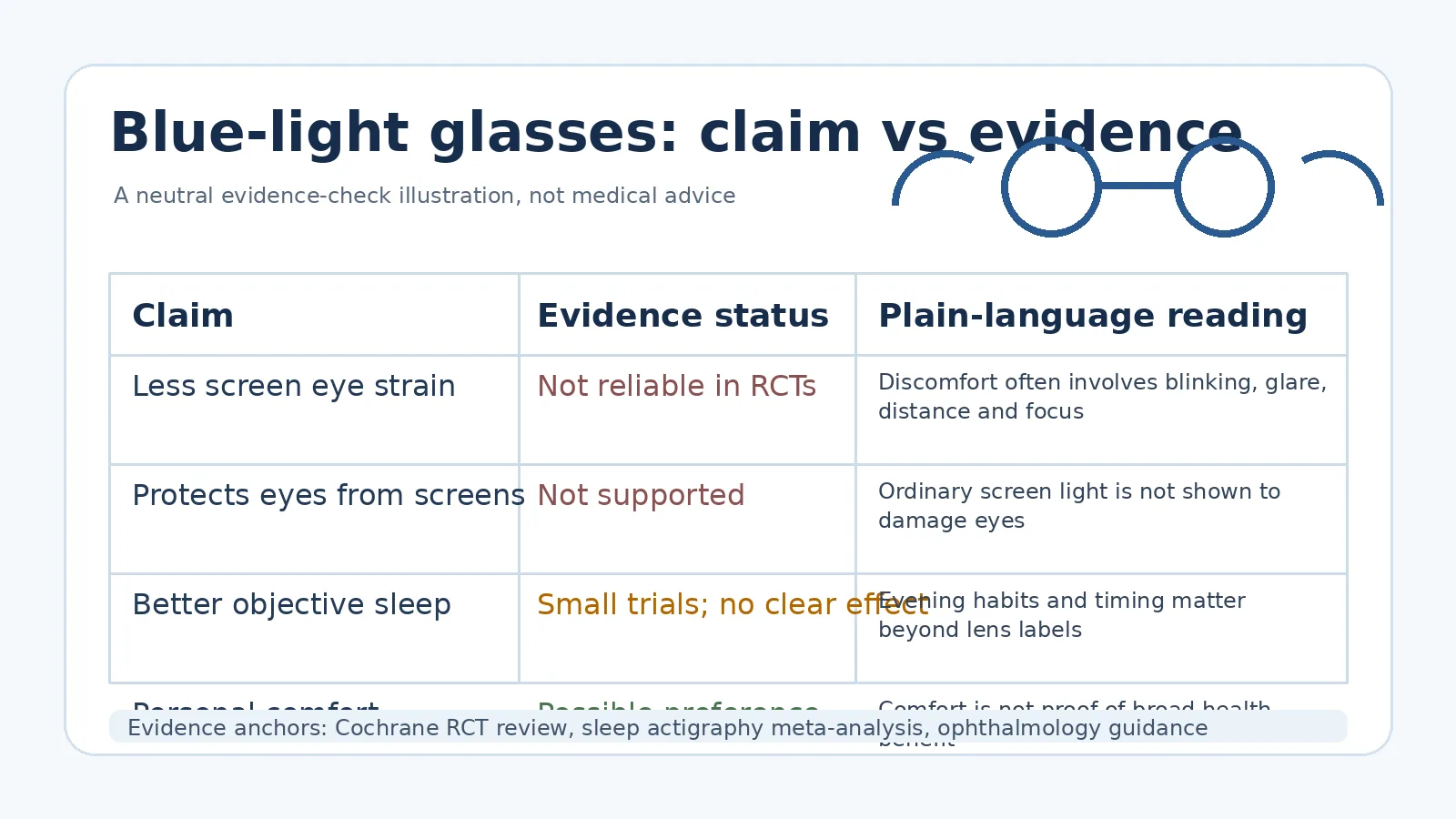
Do blue-light glasses really help eye strain and sleep? What trials show
A plain-language evidence check separates screen-comfort preferences from stronger claims about eye strain, screen damage and sleep.

The cat scratches the sofa: choose the right post, place it well and know when to worry
A practical owner guide to normal feline scratching, furniture protection, humane redirection and the red flags that belong with a veterinarian rather than another gadget.

A reliable smart home is built in the boring parts
Before buying another sensor or hub, check the parts that decide whether automations keep working when the internet, power or cloud is awkward.
Comments
Sign in to comment.
No comments yet.