Solar Cycle 25 after the peak: how FT8 and JTDX operators should read SWPC data before blaming the antenna
A practical HF guide for August 2026: separate solar-cycle trend, daily space weather and station evidence before retuning hardware.
A strong solar cycle is useful information, but it is not a promise that the FT8 waterfall will be full every evening. Many HF operators now see two apparently conflicting facts: Solar Cycle 25 has produced high sunspot numbers by recent-cycle standards, while an ordinary log on 10, 12, 15 or 20 meters can still swing from excellent to thin in one session. The right response is not to blame the antenna first and not to treat a forum screenshot as a forecast. The useful response is to separate the cycle background, the daily space-weather weather map, and the evidence from your own station.
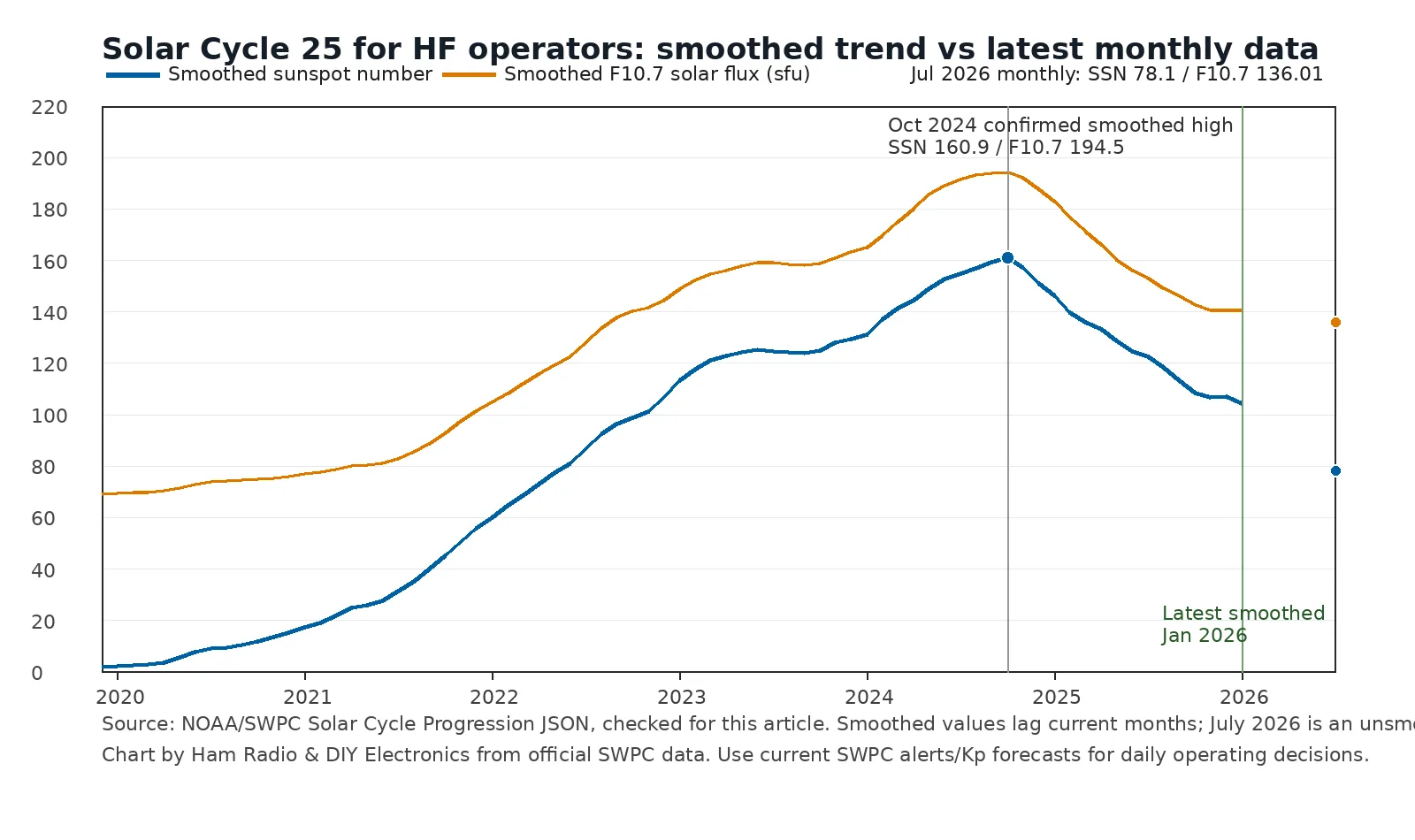
NOAA SWPC Solar Cycle Progression data checked for this article show Cycle 25's highest confirmed smoothed sunspot number so far in October 2024: smoothed SSN 160.9 and smoothed F10.7 194.5. The newest monthly observed row at the check was July 2026, with SSN 78.1, observed SWPC SSN 80.84 and F10.7 136.01. The latest usable smoothed row was January 2026, with smoothed SSN 104.2 and smoothed F10.7 140.9; later months are intentionally not smoothed yet.
That distinction matters because smoothed solar-cycle values are deliberately delayed. They answer the question 'where is the cycle trend?' rather than 'what will my path do tonight?' Monthly unsmoothed numbers are fresher but noisier. Daily Kp, A-index, geomagnetic storm watches and radio-blackout alerts answer a different question: whether the ionosphere is likely to disturb a path that would otherwise be reasonable. Your JTDX or WSJT-X log answers a third question: what your receiver, noise floor, timing, antenna and local activity actually saw.
For a digital operator the practical reading is simple. Cycle 25 has not made HF magic, but it has kept the higher bands worth checking. When geometry, season and local daylight cooperate, 10, 12 and 15 meters deserve real operating time instead of being dismissed out of habit. At the same time, a falling or delayed smoothed line does not mean HF is over. A cycle can be past a confirmed smoothed high and still support good openings, especially when daily geomagnetic conditions are quiet and the path is in season.
The chart in this article is based on the official SWPC JSON data rather than a decorative radio illustration. It shows why operators should not mix time scales. October 2024 stands out as the confirmed smoothed high currently visible in the data. July 2026 is present as a monthly point, but it is not a final verdict on the cycle because smoothing has not caught up. If a headline says high sunspots and your waterfall is empty, these two statements can both be true.
Start with SWPC as you would start with a weather map. Look at the Solar Cycle Progression for background, then look at the three-day forecast, alerts and geophysical report for current conditions. High F10.7 generally helps the higher HF bands by raising the ionization background, but geomagnetic disturbance can damage polar and high-latitude paths, increase absorption, move openings, and make receive conditions look worse even when the solar-cycle headline is positive. Radio blackouts are another separate event class and should not be confused with ordinary evening fade-out.
Then compare your own log with outside receiving evidence. PSK Reporter, Reverse Beacon Network, WSPR-style maps and local club reports can tell you whether the band is quiet everywhere, whether your signal is being heard only nearby, or whether other stations in your region are making the path that you are missing. Those tools are biased by who is transmitting and who is reporting, but they are still better than judging a station by one unrepeatable evening.
Before changing hardware, confirm the boring station variables. FT8 and JTDX are intolerant of bad time synchronization; a clock error can look like weak propagation. Wrong audio levels, too much AGC action, narrow filters, a muted input device, an accidental split setting, or a software update that changed a decoder option can all create a false propagation problem. Write down the software build, band, UTC, grid or target path, antenna used, approximate power, SFI/F10.7, Kp or A-index, and whether the change was transmit, receive or both.
Band choice should follow opportunity, not mythology. Around a strong part of the cycle, 10 meters is worth trying during daylight and around seasonal openings, but it still has dead hours and regional gaps. Fifteen and twelve meters often bridge the gap between reliable 20-meter work and the more dramatic high-band openings. Twenty meters remains the workhorse for many operators, but its late-afternoon and evening behavior changes with season and latitude. Forty and eighty meters remain night and regional tools where local noise, antenna efficiency and receiving discipline often dominate more than the cycle number.
A useful station test changes one variable at a time. If you retune the antenna, change power, change software, move bands and adjust filters all in one evening, the log will not tell you which change mattered. A cleaner experiment is to keep the station fixed, note the SWPC conditions, watch reports for a target path, and repeat the test on another day. If the external maps show your neighbors being heard and you are invisible, look at station issues. If everyone in the region is quiet on the same path, do not punish the feed line for an ionospheric problem.
Be careful with social proof. Amateur-radio forums and Reddit threads are valuable because they reveal what operators are actually struggling with: 'Why is 10 meters dead?', 'Is PSK Reporter proving my antenna is bad?', 'Should I move from 20 to 15 meters when solar flux rises?' They are not a replacement for SWPC data, allocation tables or a controlled station log. Treat anecdotes as questions to investigate, not as forecasts.
Regulatory context also matters. Band allocations, digital segments and power limits are jurisdiction-dependent. A propagation article can say that higher solar flux often makes the upper HF bands more attractive, but it cannot tell every reader to transmit on the same frequency or with the same power. Check your local allocation, your IARU-region band plan and the rules that apply to your licence before turning a receive-only observation into a transmission plan.
A practical checklist for a thin FT8/JTDX log is: confirm UTC time sync; verify the radio and computer audio path; check the correct band segment for your jurisdiction; read SWPC Kp, A-index and radio-blackout context; compare your reception and reports with PSK Reporter or similar maps; note whether the missing activity is local, regional, polar, trans-equatorial or long-path; and only then change antenna or feed-line variables. This order saves time because it tests the cheap explanations first.
The same logic helps when the band is excellent. Do not just enjoy the contact and forget the conditions. Good openings are evidence too. Save the UTC window, path, band, mode, software version and solar numbers. Over a month, those notes become more valuable than one screenshot because they show which openings repeat for your station. That is where a cycle-level story becomes operator practice.
The August 2026 conclusion is not that the good years are gone and not that every waterfall should be busy. It is that Cycle 25 has already provided a strong enough background to keep higher-band habits alive, while the daily weather and station variables still decide the log. Use SWPC for the map, ARRL/K7RA-style amateur interpretation for context, spotting networks for outside ears, and your own disciplined notes for the final diagnosis.
Sources used: NOAA/SWPC Solar Cycle Progression, SWPC three-day forecast and geophysical report pages, ARRL/K7RA solar-update context, and current amateur-radio discussion signals from r/amateurradio-style searches. Forum and social posts are treated as evidence of operator questions, not as numerical authority.
A symptom table is often better than a single rule. If the waterfall is empty but PSK Reporter shows many nearby stations hearing the band, look first at audio routing, time sync, receive filters and antenna switching. If you decode many stations but receive no reports, compare power, ALC, transmit audio, antenna match and whether you are calling into a crowded period with an unfavorable path. If only local reports appear, the band may be open only short, your antenna may have the wrong pattern for the intended path, or the high band may be closing with sunset. If a normally reliable polar path collapses while mid-latitude paths survive, check Kp and geomagnetic warnings before touching hardware.
For station notes, use enough detail that tomorrow you can repeat the test: date in UTC, local time, band, mode, software version, radio, antenna, approximate power, target region or grid, F10.7, Kp/A-index, major SWPC alert if present, and the one thing changed. A month of such notes will show whether Cycle 25 is giving your station repeatable high-band windows, whether local noise is the true limiter, or whether the pattern is simply seasonal.
Sources and operator notes
Related articles
Solar flux 101, low Kp: what August 7 space weather means for FT8 and JTDX operators
A practical HF diagnostic workflow for a quiet but not high-margin propagation day: read the NOAA numbers, check spots, then decide whether the antenna or software really needs attention.
Should you buy a portable power station in 2026?
A practical verdict on portable power stations: when they help, when they disappoint, and what to check before spending money.
Germany’s wind and solar milestone is good news because the hard part is now engineering
Wind and solar overtook fossil electricity in Germany for a year. The achievement is real, but the next gains depend on storage, grids, flexibility and smarter demand.

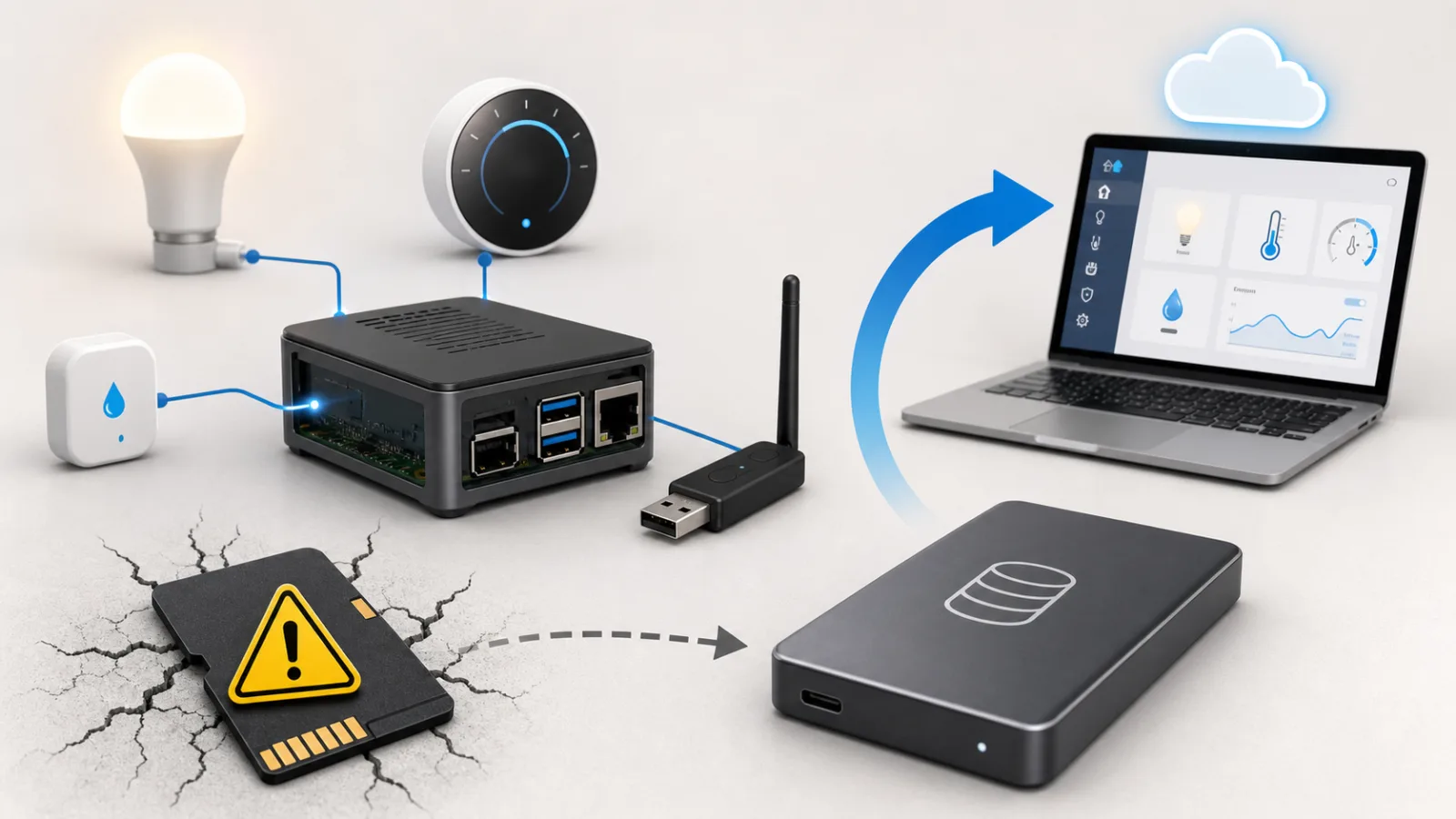
Home Assistant keeps failing? Start with the storage, not the dashboard
Raspberry Pi and Orange Pi smart-home setups often fail at the least glamorous layer: microSD cards, USB sticks, power supplies and missing backups. Here is how to move toward SSD, Data Disk or a mini PC without losing the house.
Comments
Sign in to comment.
No comments yet.