Citrix NetScaler CVE-2026-107406: the SAML configuration check and patch plan for IT teams
Citrix has disclosed a critical NetScaler memory-overflow vulnerability affecting SAML service-provider and identity-provider deployments. The useful response is configuration-led: identify exposed appliances, confirm the affected build range, patch, and review authentication telemetry.

Citrix has disclosed CVE-2026-107406, a critical memory-overflow vulnerability in NetScaler ADC and NetScaler Gateway. The issue can lead to denial of service and potentially remote code execution, but it is not a blanket vulnerability affecting every NetScaler deployment. The decisive condition is how the appliance handles SAML: affected systems are configured as a SAML service provider, an identity provider, or both, with version-specific exposure depending on the release line.

Citrix published its bulletin on 8 October 2026 and recommends upgrading customer-managed appliances to fixed builds. The bulletin gives the vulnerability a CVSS v4 base score of 9.5, while also rating attack complexity as high. That combination matters. It describes a serious possible impact, but it does not mean that every internet-facing NetScaler can be exploited in the same way or that exploitation has been confirmed. Teams should treat the advisory as an urgent exposure-management task, not as a reason to make assumptions from the score alone.
The practical question for an IT department is narrower and more useful: do we operate a customer-managed NetScaler instance that is both within the affected version range and configured for the SAML roles named by Citrix? If the answer is yes, the appliance belongs in the emergency patch queue.
What Citrix disclosed
CVE-2026-107406 is described by Citrix as a memory-overflow vulnerability, mapped to CWE-119, improper restriction of operations within the bounds of a memory buffer. Citrix says the flaw can result in remote code execution or denial of service under the stated preconditions. Its CVSS v4 vector is AV:N/AC:H/AT:N/PR:N/UI:N/VC:H/VI:H/VA:H/SC:H/SI:H/SA:L. In plain language, the vulnerable service is reachable over a network, exploitation does not require a user to click something, and a successful attack could affect confidentiality, integrity, and availability.
The high attack-complexity component should not be read as a reason to defer remediation. It means that exploitation is not represented as a simple, low-effort request against every installation. It does not remove the operational risk of an identity and remote-access appliance exposed to the internet. NetScaler frequently sits at the edge of an organization, in front of virtual applications, remote desktop services, VPN access, web applications, or identity flows. A flaw there can create consequences beyond the appliance itself.
Citrix identifies the issue as affecting NetScaler ADC and NetScaler Gateway. The bulletin is specifically for customer-managed deployments. Citrix says that Citrix-managed cloud services and Citrix-managed Adaptive Authentication are upgraded by the provider. That distinction is important for inventories: a cloud service subscription and a self-managed ADC or Gateway appliance may be related in an architecture diagram but have different owners and remediation paths.
The SAML condition is the first triage filter
SAML is an identity federation protocol. In a common enterprise arrangement, a service provider consumes assertions from an identity provider. The identity provider authenticates a user and issues an assertion; the service provider validates that assertion and uses it to establish a session or authorize access. NetScaler can participate in these flows in different roles, and Citrix’s advisory uses that configuration detail to define exposure.
For the older and current version ranges listed in the bulletin, the appliance is affected when it is configured as a SAML service provider or SAML identity provider. For some builds in the 14.1 and 13.1 lines, Citrix narrows the condition to the SAML identity-provider role. The exact interpretation depends on the version and build, so a generic statement such as the appliance uses SAML is not enough for final triage.
Citrix gives administrators two configuration indicators to help determine whether the relevant roles exist. A SAML service-provider configuration contains an authentication SAML action, represented in the advisory by add authentication samlAction. A SAML identity-provider configuration contains an identity-provider profile, represented by add authentication samlIdPProfile. These strings are configuration markers, not exploit instructions. They can help an administrator map the advisory to an approved configuration review.
A team should not infer exposure from the presence of a SAML-capable feature alone. Feature availability, a dormant object, a currently bound policy, and an active authentication flow are different states. The safe workflow is to establish the appliance build, inspect the relevant configuration through normal administrative controls, and compare both facts with the affected-version table in the official bulletin.
Which versions need attention
Citrix’s affected-version table is precise enough that patch decisions should be based on build numbers rather than marketing labels. The advisory identifies these conditions:
- NetScaler ADC and NetScaler Gateway 14.1-73.37 through 14.1-73.41 are affected when configured as a SAML identity provider.
- NetScaler ADC and NetScaler Gateway 13.1-64.23 through 13.1-64.28 are affected when configured as a SAML identity provider.
- Older 14.1 releases before 14.1-73.37 are affected when configured as a SAML service provider or SAML identity provider.
- Older 13.1 releases before 13.1-64.23 are affected when configured as a SAML service provider or SAML identity provider.
- The corresponding FIPS and 13.1-NDcPP branches have their own build identifiers and must be checked against the bulletin rather than treated as ordinary 13.1 installations.
The fixed versions named by Citrix are NetScaler ADC and NetScaler Gateway 14.1-73.46 and later, and 13.1-64.29 and later for the 13.1 line. Citrix also lists 14.1-73.46 FIPS and later for the 14.1 FIPS branch, plus 13.1.37.283 and later for the 13.1 FIPS and 13.1-NDcPP branches. Administrators should verify the exact supported upgrade path for their appliance and licensing or maintenance state before scheduling the change.
The gap between the affected builds and the fixed builds is a useful warning against relying on a recent-looking version string. An appliance updated to a build in the 14.1-73.37 through 14.1-73.41 range may still be affected if the SAML condition applies. Likewise, an appliance on an older branch may remain exposed even if it has received other security updates. Patch management needs the full build number and configuration context.
Why this is an edge and identity problem
NetScaler is often treated as a network appliance, but its security role is broader. It can terminate sessions, mediate authentication, proxy application traffic, publish remote-access services, and enforce policy before a request reaches an internal workload. A vulnerability at this boundary can affect the organization’s access path even when the protected applications themselves are fully patched.
SAML adds a second layer of importance. Federated authentication creates trust relationships between organizations, applications, and identity systems. A NetScaler instance acting as a SAML provider may be part of that trust chain. If the appliance is compromised, the immediate impact is not necessarily limited to a single web endpoint. The attacker’s opportunities would depend on the vulnerability’s real exploitability, the appliance’s privileges, network segmentation, session handling, and the surrounding identity architecture. Those details are not established by the advisory and should not be invented.
The confirmed facts are enough to justify action: the vendor describes a critical memory-overflow flaw, identifies SAML-related preconditions, publishes fixed builds, and urges affected customers to upgrade. The unconfirmed question is whether attackers are exploiting this specific CVE in the wild. Public discussion about a vulnerability, scanning, or a proof of concept is not the same as a confirmed intrusion campaign. Security teams should watch trusted advisories and their own telemetry without turning unverified claims into incident facts.
A patch plan that starts with inventory
The first step is to create a short, defensible inventory of every customer-managed NetScaler ADC and Gateway instance. Include production, disaster-recovery, test, staging, and appliances managed by a separate infrastructure team. Record the hostname or management identifier, software version and build, deployment role, internet exposure, SAML role, owner, maintenance window, and current backup status. A partial inventory is a common source of false confidence: the main production pair may be known while a standby, lab, or regional appliance is not.
Next, separate customer-managed appliances from Citrix-managed services. The remediation authority is different. For a customer-managed appliance, the local team must plan and execute the update. For a provider-managed service, the team should confirm the provider’s maintenance status and preserve the relevant support or advisory record. Do not assume that a cloud control plane has the same patch state as an appliance with a similar product name.
Then compare the build with Citrix’s table. Use the exact installed build, not only a major release such as 13.1 or 14.1. If the build falls in an affected range and the appliance has the relevant SAML configuration, treat it as vulnerable. If the team cannot determine whether SAML is active, the uncertainty itself should raise the priority of an owner-led configuration review.
Before changing a production pair, validate the recovery path. Confirm that configuration backups are recent, restorable, and stored separately from the appliance. Check whether the deployment uses high availability, clustering, traffic management, custom authentication policies, or integrations that require an orderly sequence. Identify the person who can test user authentication after the upgrade, not only the person who can install the firmware.
The change window should include functional tests for the paths that matter. Test a normal SAML login, a rejected login, logout, session expiry, access to a representative published application, and the failover behavior of the pair. If the appliance fronts VPN or remote-access services, test those separately. A successful software upgrade is not the same as a successful identity upgrade.
What to review after patching
Patching closes the known software defect; it does not answer whether the appliance was previously targeted. After updating, security teams should review the telemetry that the organization already collects. Useful sources may include NetScaler audit and authentication logs, web access logs, SAML transaction records, identity-provider logs, remote-access logs, network-flow data, endpoint detections, and centralized security analytics. The review should be scoped and time-bounded according to the organization’s logging retention and the date the vulnerable configuration was exposed.
Look for anomalous authentication behavior, unexpected administrative changes, new or modified SAML objects, unexplained configuration exports, unusual management access, unexpected process or service behavior, and connections from sources that do not fit the appliance’s normal role. These are investigation leads, not proof of compromise. A security analyst should correlate them with identity-provider events, change records, maintenance windows, and known administrative activity before escalating.
Do not erase logs during cleanup, and do not make an unplanned configuration change solely to make an alert disappear. If the appliance shows signs of compromise, preserve evidence and follow the organization’s incident-response process. The next actions may include isolating a node, moving traffic to a known-good peer, rotating credentials or signing material where justified, checking sessions and tokens, and involving Citrix support. Those actions are environment-dependent and should be approved by the incident commander or system owner.
The SAML relationship deserves special attention during an incident review. If an appliance participates in federation, examine whether assertions, signing certificates, trust metadata, or relying-party configurations were altered. The appropriate response depends on what evidence exists. Rotating every certificate immediately can disrupt authentication and may destroy useful evidence; delaying a required rotation can extend risk. Make that decision from observed facts and the identity team’s response procedure.
What not to conclude from the advisory
A high CVSS score is not a finding that an organization has been breached. It is a severity measure for the described vulnerability and its potential impact. Conversely, the absence of a public exploit report is not evidence that an unpatched, internet-facing appliance is safe. The responsible conclusion is narrower: affected configurations should be patched promptly, and exposure should be verified from authoritative technical details.
The advisory also does not establish that every SAML deployment is vulnerable in the same manner. The version-specific conditions matter. An appliance configured as a SAML service provider may fall under a different condition from one configured as a SAML identity provider. A fixed build may still need to be checked against the supported branch and deployment type. Precision is part of the response, not bureaucratic overhead.
There is no basis in the cited material to claim that CVE-2026-107406 is being actively exploited, that a particular threat actor is responsible, or that a specific organization has been compromised. Security coverage should say so plainly. Confirmed vendor facts, official government guidance, community observations, and local investigation results have different evidentiary status. Keeping those categories separate helps decision-makers act quickly without creating an avoidable incident narrative.
A short decision tree for administrators
If the appliance is Citrix-managed, record the service and confirm the provider’s remediation status. If it is customer-managed, continue the review.
If the installed version is outside the affected ranges and the vendor’s fixed-release guidance does not require an update, document the result and continue normal patch governance. If the build is within an affected range, inspect the SAML role and the exact branch conditions.
If the appliance is configured as a SAML service provider or identity provider under the affected conditions, schedule the upgrade to the fixed build with the highest operational priority available. If the SAML state is unknown, assign an owner to establish it rather than closing the ticket as not applicable.
If the appliance is vulnerable and internet-facing, coordinate network, identity, application, and security owners for the change. If it is not internet-facing but protects internal access, patch it as well; internal reachability and trusted network placement do not eliminate the impact of a gateway or identity flaw.
After the upgrade, test authentication and application access, review relevant logs, update the asset record, and retain the advisory and change evidence. This turns a one-time emergency patch into a reusable control for future NetScaler advisories.
The broader lesson for edge-platform owners
The immediate issue is CVE-2026-107406, but the operational lesson is about how teams manage edge platforms. Security tools often classify an appliance by product and version. The real exposure is usually a combination of product, build, role, policy, reachability, and identity integration. A version-only inventory cannot answer whether a SAML-specific condition applies. A configuration-only inventory cannot answer whether the installed build contains the fix.
Organizations that maintain this relationship as structured asset data can respond faster. For each gateway or ADC, they should know which applications it publishes, which identity protocols it uses, whether it is customer-managed, how it fails over, where its logs go, and who owns the patch decision. That information is useful for ordinary change management as well as emergency response.
The same approach applies to other security-sensitive platforms: reverse proxies, VPN concentrators, mail gateways, API gateways, identity brokers, and cloud edge controls. The system that protects access is part of the application’s attack surface. Its patch status and configuration should be visible to the teams responsible for the applications and identities behind it.
For CVE-2026-107406, the next action is concrete. Find every customer-managed NetScaler ADC and Gateway instance, record the exact build, determine whether the SAML preconditions apply, and upgrade affected systems to the Citrix-recommended fixed release. Then test the authentication path and review the evidence. That is the part of the response that can be established and completed today.
Related articles
When a vendor says turn it off: the ShareFile shutdown lesson
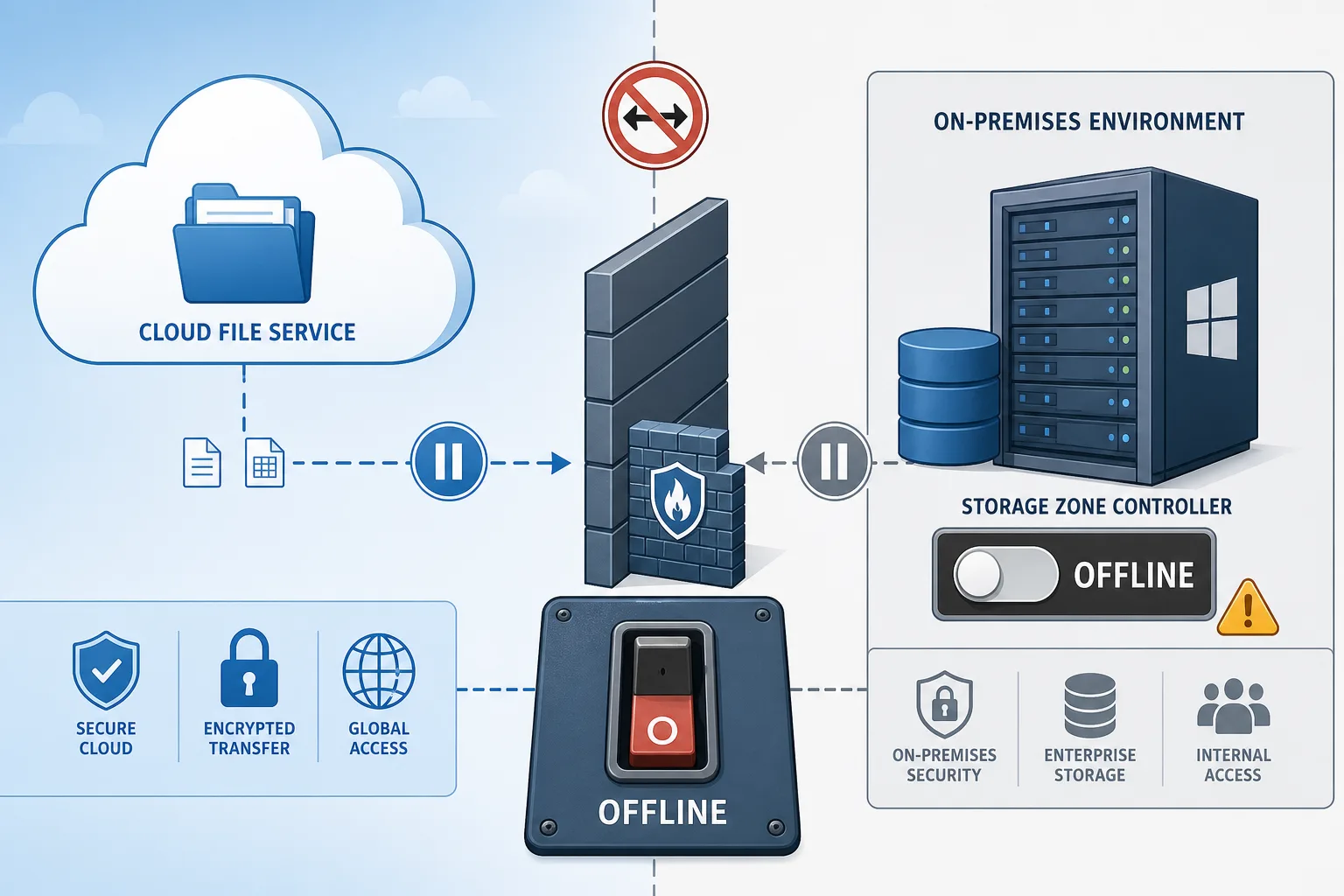
Progress told some ShareFile customers to keep Storage Zone Controllers offline. The incident is a runbook test for file-sharing, hybrid cloud and security teams.
Gdy vendor mówi wyłącz: lekcja ShareFile dla zespołów IT
Progress kazał części klientów ShareFile trzymać Storage Zone Controllers wyłączone. To test runbooków dla file sharing, hybrid cloud i security.
Когда vendor говорит выключить сервер: урок ShareFile для IT-команд
Progress велел части клиентов ShareFile держать Storage Zone Controllers выключенными. Это проверка runbook для file sharing, hybrid cloud and security teams.
Cuando un proveedor dice apágalo: la lección de ShareFile para TI
Progress pidió a algunos clientes de ShareFile mantener apagados sus Storage Zone Controllers. Es una prueba real para continuidad, cloud híbrido y seguridad.
Comments
Sign in to comment.
No comments yet.