Robotaxis are now a fight over city rules, not just AI
Uber, Waymo, Tesla and regulators are turning autonomous taxis into a policy battle over sensors, labor, emergency response and who controls the ride market.

Robotaxis are no longer only a robotics problem. They are becoming a city-law problem.
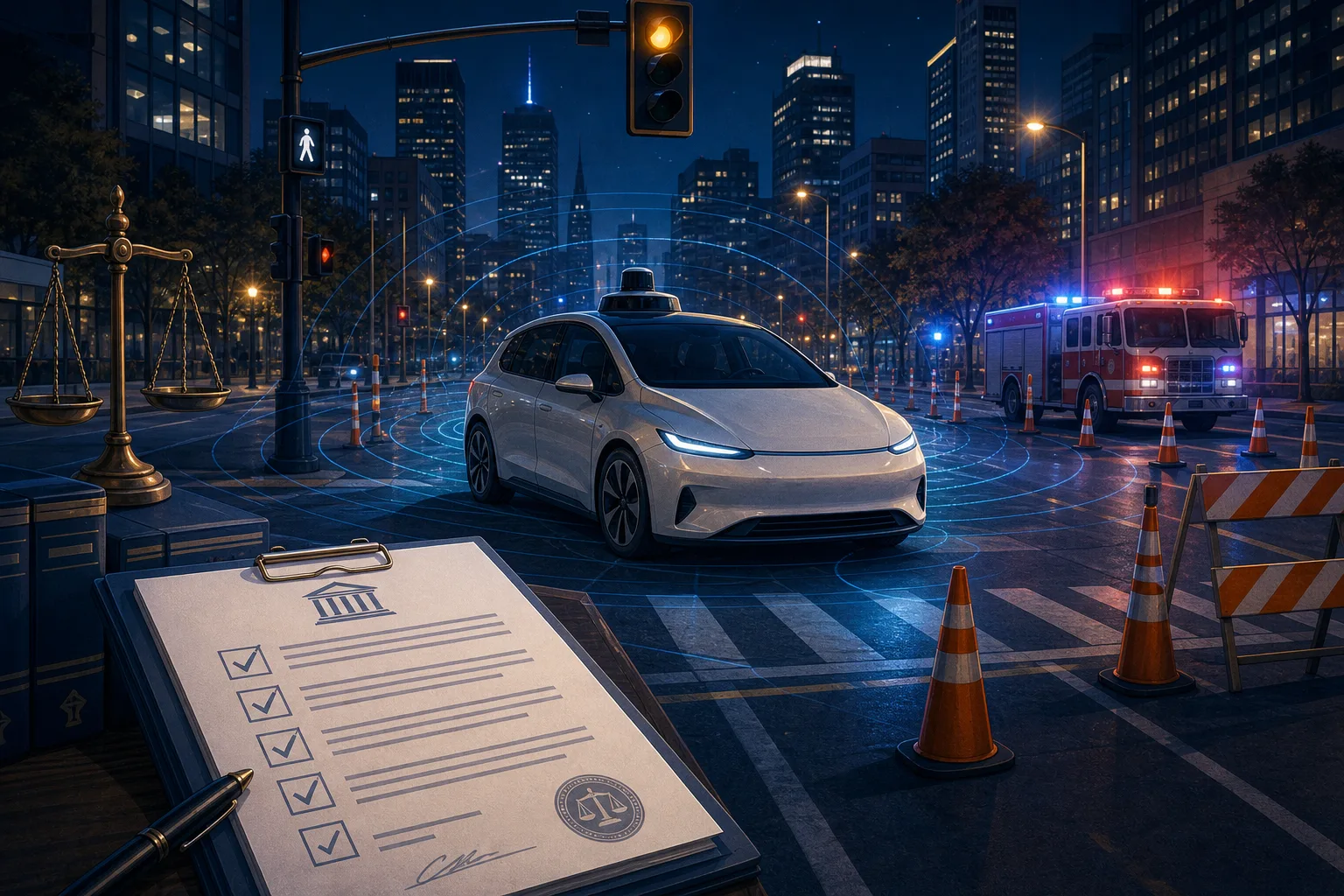
In one week, the fight around autonomous taxis moved from engineering arguments into hearings, taxes, sensor mandates, labor rules and emergency-response requirements. Washington, D.C. is considering a bill that would let driverless commercial services operate in the district. New Jersey is weighing a pilot program that could require fully autonomous vehicles to use cameras plus two other sensing technologies, usually lidar and radar. Uber has been pushing a "hybrid network" model in which robotaxis would operate alongside human drivers on ride-hailing platforms. And the U.S. National Highway Traffic Safety Administration has told driverless-vehicle developers that blocking ambulances, firefighters or police is not a rare edge case. It is a functional insufficiency.
That combination matters more than another demo video. It shows the next phase of autonomous transport: the hard part is not just whether the vehicle can drive. It is who gets to decide when it is safe enough, what hardware counts as adequate, who pays for the street space, what happens to human drivers, and how a robot behaves when a city is messy.
Washington asks who gets to run the market
TechCrunch reported on July 13 that a proposed D.C. bill has become a test case for the robotaxi market. The bill would update the district's 2012 autonomous-vehicle law and allow driverless testing and commercial driverless operations. Today, companies can test with a human safety operator, but driverless deployment needs a new framework.
The proposed requirements are not light. TechCrunch described a minimum of $5 million in liability insurance, crash reporting within eight or 72 hours depending on the vehicle type, a $0.15 per-mile vehicle-miles-traveled tax, a $1 million application fee and a $5 million non-refundable permit fee after approval. The VMT tax revenue would be split between public transit and education or workforce development for ride-hail and taxi drivers who may lose work to robot cars.
That is not only safety regulation. It is market design.
Uber opposes the D.C. bill as written. Its argument is that a first-party robotaxi model could displace human drivers and give a company such as Waymo too much control. Uber wants a hybrid model: riders should be able to access robot rides and human-driven rides inside ride-hailing networks, rather than letting autonomous operators build stand-alone robotaxi businesses that bypass existing platforms.
Waymo takes the opposite view. It backs the D.C. bill and argues that autonomous operators should be able to deploy safely without being forced into one kind of network. The disagreement is awkward because Uber and Waymo are also partners in some cities. That is the robotaxi market now: partnership in one city, regulatory combat in another.
Uber is trying to keep the platform layer
WIRED reported on July 12 that Uber's lobbying goes beyond D.C. In New Jersey, an Uber representative circulated language that would require driverless ride-hailing platforms to have human drivers serve 85 percent of rides for three years. The proposal is not part of the New Jersey bill, according to WIRED, but it reveals the strategy.
Uber is no longer trying to build the autonomous stack itself. Its stronger position is to become the commercial layer where riders find every kind of ride: human, Waymo, Nuro, Baidu, Volkswagen's MOIA or another operator. The company says this is a practical transition that protects riders, cities and drivers. Critics see something else: a platform trying to write its gatekeeper role into law before robotaxi companies can sell directly to passengers.
Both readings can be partly true. Cities do need to think about labor and accessibility. A service with only driverless cars may struggle to help older or disabled passengers who need physical assistance, and it may push transition costs onto drivers. But a rule that forces autonomous operators through incumbent ride-hailing networks can also reduce competition and slow deployment for reasons that have little to do with safety.
That is why robotaxi regulation is already political. The question is not "robots or people." It is who controls the dispatch layer when the driver disappears.
New Jersey turns sensors into law
The New Jersey fight is more technical and more explosive. The Verge reported on July 8 that state bill S1677 would establish a three-year pilot program for fully autonomous vehicles and require companies to use cameras plus two additional sensing technologies. In practice, that usually means lidar and radar.
If passed in that form, it would be the first state law to encode this kind of hardware mandate for fully autonomous vehicles. It would also make New Jersey difficult or impossible for Tesla's current camera-only Robotaxi approach unless Tesla changed the hardware.
State senator Andrew Zwicker, the bill's sponsor, told The Verge that the proposal is not anti-Tesla but pro-New Jersey safety. His argument is straightforward: in the densest U.S. state, a single-sensor approach has not yet proven enough for driverless public operation. The bill also reportedly requires supervised miles before removing a safety driver and would set authorization and reporting requirements.
Tesla supporters see a different risk. If lawmakers mandate lidar and radar, they may freeze one engineering philosophy into statute and effectively block a competitor before performance data has had a chance to decide the argument. That is a real concern. Technology law can age badly when it specifies components instead of outcomes.
But the opposite risk is real too. Performance-based rules sound elegant until a city has to decide whether a camera-only car can handle glare, smoke, flares, traffic cones, night construction, emergency vehicles and unusual human behavior. Lawmakers are not choosing between innovation and bureaucracy in the abstract. They are choosing how much proof they want before removing the human driver.
The political mobilization is already visible. The Verge reported that Zwicker's office received about 4,000 emails in one day after Tesla contacted owners. The article had more than 200 comments. This is not a niche engineering debate anymore.
NHTSA says emergency scenes are not edge cases
The federal piece is the most important safety signal. On July 8, NHTSA Administrator Jonathan Morrison sent a letter to automated-driving-system developers saying the agency had identified a clear pattern of driverless AVs interfering with law enforcement and first responders. TechCrunch reported that the letter cited vehicles entering active emergency scenes, blocking ambulances or firefighters, and failing to respond properly to flashing lights, flares, smoke, fire and traffic cones.
The line that changes the tone is this: emergency scenes are not rare or extreme edge cases.
That is exactly right. A city is not a controlled test track. It has fire trucks, police gestures, temporary cones, broken traffic lights, road workers, flooded streets, construction crews, parades, collisions and confused human drivers. If a robotaxi cannot safely handle the emergency layer of a city, it is not merely missing a corner case. It is failing at part of the operating environment.
NHTSA did not name companies in the letter, but the context points at robotaxi operators. TechCrunch had previously documented repeated run-ins between Waymo vehicles and first responders. Waymo declined to comment to TechCrunch on the July 8 story.
The agency asked developers and operators to present solutions by the end of the month. It did not spell out penalties or a single approved fix. That leaves room for engineering approaches: better detection, remote assistance procedures, emergency-service communication channels, updated operational design domains, geofencing around active scenes, or new training data. But the message is blunt. The city will not rewrite emergency response around robotaxi limitations.
Sensors are only one part of the argument
It is tempting to reduce the story to Tesla versus Waymo, cameras versus lidar. That misses the larger point.
Sensors matter. Lidar and radar can provide redundancy, especially at night, in glare, in poor visibility or around unusual road scenes. Camera-only systems may eventually prove good enough in some domains, but regulators are asking whether "eventually" is enough for public deployment now.
Platform rules matter too. A robotaxi app that bypasses human-driver platforms may speed competition and lower costs. It may also accelerate job loss and make accessibility harder if the service is not designed for riders who need assistance.
Taxes and fees matter. D.C.'s proposed per-mile tax is not a side detail. Robotaxis can cruise empty, add vehicle miles, compete with transit and use curb space. Cities will want revenue, data and leverage before fleets scale.
Emergency behavior matters most. No city can accept a mobility product that turns emergency scenes into negotiation points between software and firefighters.
Who wins under different rulebooks
A law that requires multiple sensors helps companies that already build around sensor fusion, such as Waymo and Zoox. It hurts Tesla's current camera-first strategy. A law that requires human-driver ride-hailing networks helps Uber and Lyft. It may hurt autonomous operators that want direct customer relationships. A law with high fees favors the biggest companies and can keep smaller robotics firms out.
Labor rules help human drivers, at least in the short term, but they can also be written in ways that protect platforms more than workers. Accessibility rules may require more than an app button: some passengers need help with doors, wheelchairs, luggage, service animals, pickup points or safe drop-offs.
Public-transit funding can make robotaxi growth less damaging to cities, but only if the fees are calibrated well. Too low, and cities subsidize congestion. Too high, and only the richest operators can enter.
The public gets the result of all these choices. A passenger may see only a car arriving with no driver. Behind that ride is a stack of political decisions about insurance, sensors, emergency response, labor, accessibility and data reporting.
The robotics lesson
Robotics does not become real when a machine works in a lab. It becomes real when the machine has to live inside a society that already has rules, unions, budgets, emergencies and lawsuits.
Robotaxis are hitting that point now. Waymo has moved from demonstration to commercial service. Tesla wants to prove a different autonomy stack. Uber wants to own the marketplace. Cities want safety, revenue and labor protections. Federal regulators want autonomous vehicles to stop confusing emergency scenes for rare exceptions.
That is why the next robotaxi breakthrough may not look like a new neural network or a better sensor. It may look like a city law that says exactly what a robot must prove before it can pick up passengers at scale.
The companies that win will not simply be the ones with the best driving software. They will be the ones that can show cities how their robots fit into traffic, public safety, disability access, labor transition and everyday street chaos without asking everyone else to adapt around them.
Related articles
Robotaxis are now a fight over who writes the rules of the street
Uber, Waymo, Tesla, New Jersey and NHTSA are turning autonomous taxis from a technology rollout into a public-policy test for cities.
A robotaxi map is not a service
Tesla’s Miami geofence and Waymo’s standing-water recall show that the real robotaxi race is no longer about drawing bigger maps. It is about proving the operating domain.
San Mateo’s humanoid robot permit push tests the rules for physical AI
A Silicon Valley county is not banning humanoid robots; it is asking what permits, fire rules, supervision and labor disclosures must exist before commercial deployment.
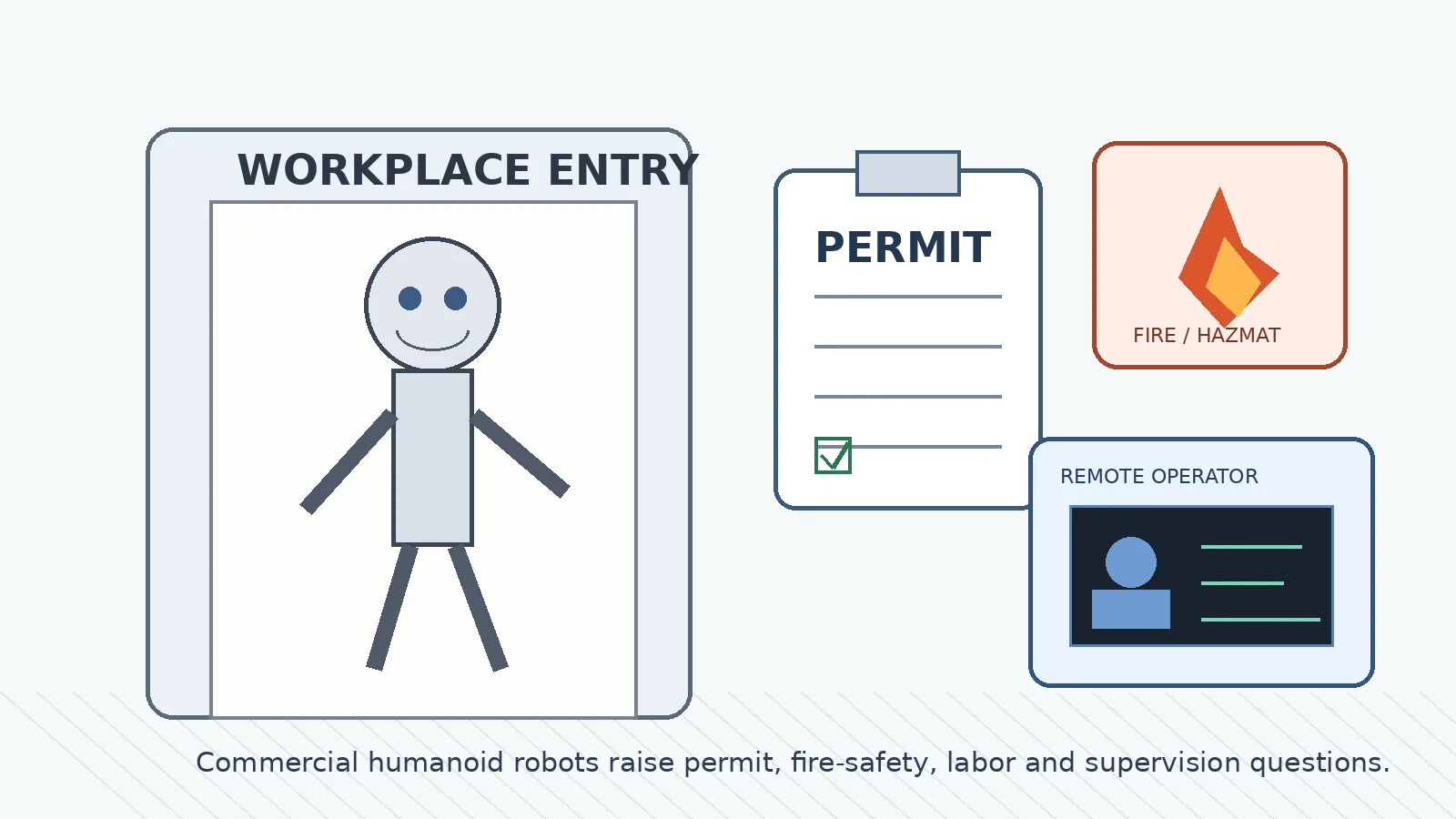
Robotaxis at the school gate: what the Waymo probe really tests
NHTSA’s redacted Waymo file turns a low-speed Santa Monica collision into a bigger question about robotaxi caution and public evidence.
Comments
Sign in to comment.
No comments yet.