Wi-Fi smart plugs for heaters, boilers and electric blankets: convenience with electrical limits
A smart plug can be useful for lamps and fans, but heaters, boilers and electric blankets turn convenience into a power-electrics decision.
A Wi-Fi smart plug looks like the quickest way to give a heater, boiler, or electric blanket a schedule. The safer starting point is less glamorous: before the app, automation, or energy graph, the adapter has to be a mechanically sound mains device that can tolerate the load for the whole time it is expected to run.
What the Silentnight recall changes
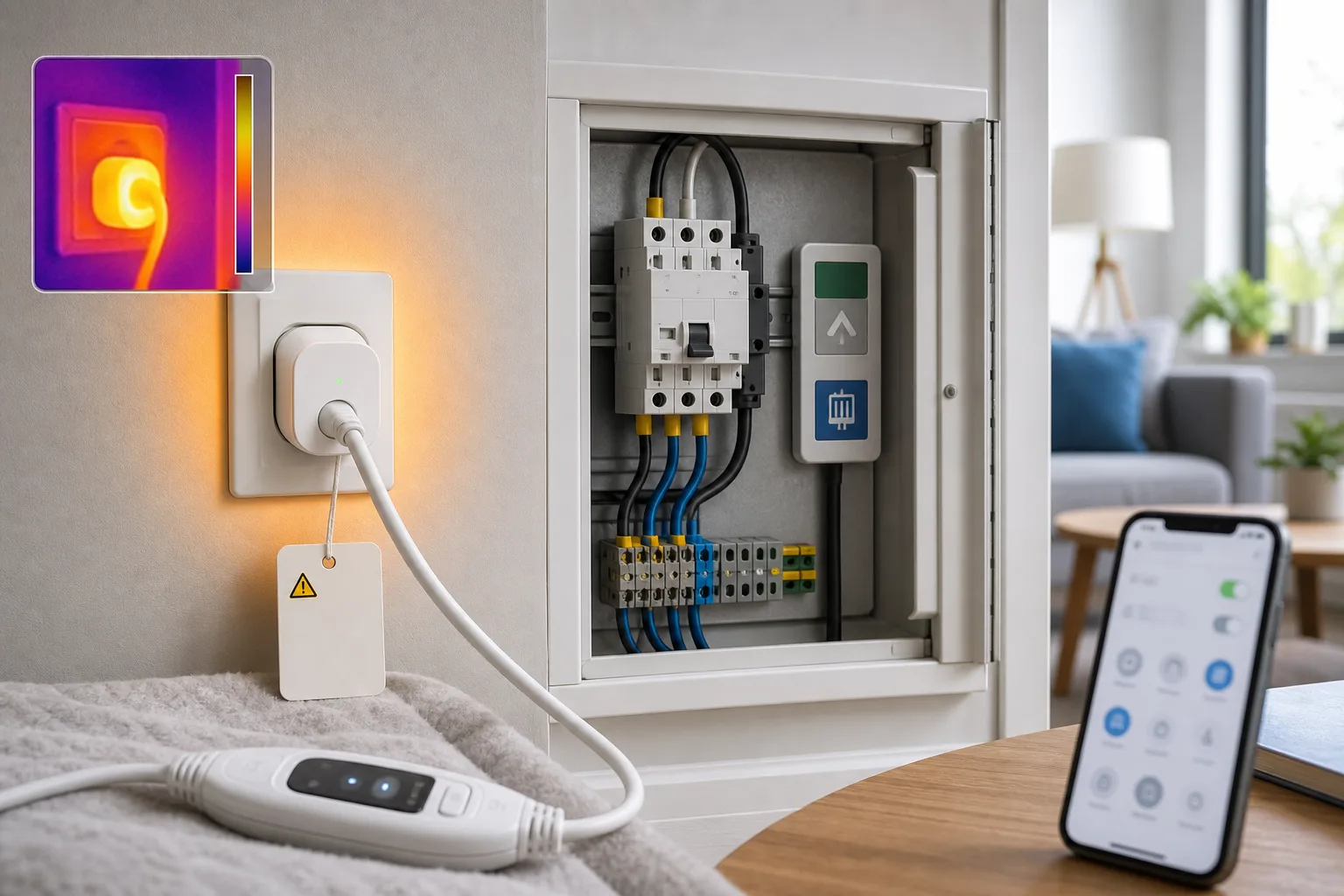
On 27 March 2026, GOV.UK published a product recall for the Silentnight Smart Wi-Fi Plug, model A6, under PSD notification 2602-0174. The notice described a serious electric-shock risk because the mains plug did not meet the dimensional requirements of BS 1363 and might not make a secure connection in a socket. It also mentioned socket shutters that could become stuck open and insufficient separation between mains-voltage circuits and low-voltage output circuits.
The important lesson is not that one brand had a problem. It is that a smart plug is still a plug, a relay, an enclosure, a set of clearances, and a heat-management problem. When it is sold in a bundle with an electric blanket, the convenience story can hide the electrical story: the user sees a timer, while the wall socket sees sustained current, contact pressure, plastic temperature, and any weakness in the adapter body.
A recall also changes how people should think about old smart-home drawers. Many Wi-Fi plugs remain in homes for years after their apps stop being fashionable. They may be moved from lamps to heaters because they are available, not because they were chosen for that duty. If a plug is recalled, cracked, discolored, loose in the socket, unusually warm, buzzing, or sold by a vendor that cannot provide credible compliance information, it should not be treated as a spare automation part.
Heating loads are not ordinary smart-home loads
A lamp, router, fan, phone charger, or aquarium light usually gives a smart plug an easy job. The current is modest, the heat inside the plug is limited, and a failure is more likely to be annoying than dangerous. A portable heater, immersion-style boiler, towel rail, oil-filled radiator, or electric blanket changes the duty. It can sit close to the maximum rating for long periods, often in the evening or overnight, sometimes behind furniture or under bedding.
Continuous high-load heating is where marginal design shows up. A 2,000 W heater on a 230 V supply draws roughly 8.7 A; a 2,600 W boiler draws roughly 11.3 A; a 1,500 W space heater on a 120 V circuit draws 12.5 A. Those numbers are not short pulses. They are heat being produced in the appliance and a smaller but important amount of heat being produced at every imperfect connection in the plug, socket, relay, fuse holder, and wiring path.
The risk is cumulative. A relay contact with a little extra resistance may survive a kettle cycle but run hot during a two-hour heating schedule. A socket that grips a normal plug weakly may feel acceptable with a charger but become a heating point with a boiler. A plastic enclosure that passes a basic expectation in open air may run hotter when it is behind a sofa, inside a cupboard, or covered by a curtain.
This is why the same smart plug can be fine for a lamp and unsuitable for a heater. The question is not simply whether the appliance switches on. It is whether the whole connection remains cool, stable, and mechanically secure while the load is near its maximum, while dust accumulates, while the socket ages, and while nobody is standing beside it.
Why printed amperage is not enough
A number printed on the case is a starting clue, not a complete safety argument. A 13 A, 15 A, 16 A, or 20 A marking does not automatically mean the device is appropriate for hours of resistive heating at that current. Ratings depend on local standards, test conditions, duty cycle, ambient temperature, relay type, terminal design, enclosure material, certification, and the manufacturer’s quality control.
The local voltage matters as much as the wattage. A 2,600 W load is around 10.8 A at 240 V but about 21.7 A at 120 V. A phrase such as “20 A smart plug” can therefore mean very different things in different markets, and imported devices can create a false sense of headroom. The plug shape, fuse arrangement, socket shutter design, and earth path also belong to the local electrical system; they are not decorative details.
Load type matters too. Resistive heaters are simpler than motors, but they are still hard on contacts because they run near full current for a long time. Some appliances also have thermostats that cycle on and off, causing repeated relay operations under load. Others include fans, pumps, control boards, or inrush behavior that the smart plug’s marketing page may not discuss.
A responsible check asks for more than the largest number on the label. Is the device certified for the market where it is used? Does the manual permit heaters or explicitly forbid them? Is the rating continuous or only maximum? Does it mention derating for high loads? Does the plug include overtemperature protection? Is the vendor traceable if something goes wrong? Does the appliance manufacturer allow third-party switching at the wall?
Energy-monitoring smart plugs add another trap. A live watt reading can make a setup feel measured and controlled, but the graph cannot inspect contact pressure, relay wear, insulation distance, shutter behavior, discoloration, or heat trapped behind furniture. Some low-cost plugs are also poor at very low loads, sometimes showing zero below a few watts, so the graph is useful for consumption estimates but should not be mistaken for a safety instrument.
Wi-Fi and cloud failure modes
Automation changes the human part of the risk. If a person turns on a heater by hand, they normally see where it is, notice whether clothes are nearby, smell dust burning off, hear an odd buzz, and feel whether the socket is hot. Remote activation removes those checks. The app can be correct and the room can still be wrong.
Wi-Fi failure is not a single failure. The router may reboot, the plug may reconnect late, the vendor cloud may be unavailable, a hub may miss a command, or a phone app may display stale state. Some plugs can resume their previous state after a power outage; others default off; some offer a configurable power-on state that users forget to set. For a lamp this is a convenience detail. For a heater it defines what happens after a blackout at 3 a.m.
Cloud automations can also duplicate intent. A schedule in the plug, a routine in a voice assistant, a scene in a smart-home hub, and a manual override in the app may all coexist. After daylight-saving changes, firmware updates, or account migrations, the user may not remember which rule is authoritative. The result can be unexpected starts, missed shutoffs, or a device cycling more often than intended.
Sensor-based automations deserve extra skepticism. A temperature sensor on a shelf may say the room is cold while a heater is obstructed under a desk. A presence sensor may keep a room marked occupied after someone leaves. A current threshold may confirm that power is flowing while saying nothing about whether the plug body is heating up. The automation can satisfy its logic while the physical installation becomes unsafe.
The safer design principle is to make failure boring. Loss of Wi-Fi, loss of cloud, hub reboot, router replacement, phone battery failure, and power restoration should all leave a heating load off unless a person deliberately restarts it nearby. If the system cannot be made to fail that way, it is the wrong pattern for unattended heat.
Contactors, relays, and safer switching patterns
For fixed or high-power heating loads, a smart plug should often stop being the power switch. A better pattern is for a properly rated contactor, relay, or heating controller to switch the load, with the smart-home device providing only a low-power control signal. The contactor is selected for the circuit, enclosure, duty, terminals, and local rules; the app becomes an input, not the weakest part of the power path.
This is the pattern electricians use because it separates control from load. The heavy current flows through hardware built and installed for that current. The smart module may energize a coil, send a dry-contact signal, or request heat through a controller, but it does not carry the boiler current through tiny relay contacts inside a plastic adapter. It also allows appropriate circuit protection, strain relief, service isolation, and enclosure temperature management.
A boiler is the clearest example. A non-smart electric boiler around 2,600 W may run for a couple of hours each day. Several consumer plugs may appear to work at first and then fail silently: the LED still lights, Wi-Fi still connects, the relay still clicks, but no current reaches the boiler. That failure is inconvenient, but the same stress can also mean hot contacts or damaged plastic before the failure becomes obvious.
A contactor is not a magic word that makes any installation safe. It must be correctly rated, enclosed, protected, wired, and installed according to local electrical rules. The point is that once a load is fixed, high-current, or repeatedly scheduled, the solution belongs closer to electrical distribution practice than to desk-lamp automation.
Electric blankets need special caution
Electric blankets are not just small heaters. They operate in bedding, close to a sleeping person, with fabric that can fold, trap heat, age, or be damaged by pets and washing. Many blankets already include a controller designed for that product, with heat settings, timers, sensors, and safety behavior chosen by the manufacturer. Bypassing that control logic with a wall plug schedule can undermine the way the blanket was intended to be used.
A smart plug may be acceptable only if the blanket manufacturer allows wall switching and the original controller returns to a safe off or low state after power is restored. Many controllers do not behave that way; some remember the last setting, some require a button press, and some may not be designed for repeated hard power cuts. Users should test behavior while present, but a successful test is still not permission for unattended or overnight automation.
The practical rule is conservative: keep the supplied controller, follow the blanket manual, inspect for damage, never use a recalled adapter, and avoid remote starts. If the goal is a warm bed, a short preheat while awake and nearby is very different from an automation that can energize bedding when nobody has checked its condition.
Portable heaters and room heating
Portable heaters create familiar hazards even without smart plugs: blocked airflow, tip-over risk, dust, extension leads, overloaded sockets, and people placing them too close to furniture. A smart plug adds one more layer by allowing the heater to start when the person who last saw the room is no longer there. That is why many safety bodies and manufacturers discourage unattended heater use.
If a heater is used at all, the appliance should have its own thermostat, overheat protection, and tip-over protection where relevant. It should be plugged directly into a sound wall socket, kept visible, and placed away from fabrics and furniture. A smart plug should not be used to defeat a heater’s own controls, restore power to a heater left switched on, or run a high-output heater hidden under a desk.
For people trying to avoid freezing pipes, damp rooms, or a cold home office, the safer route is usually a purpose-built heater with built-in scheduling and safety certification, or a fixed heating control installed as part of the electrical system. Convenience should not depend on a small adapter carrying the full heater current for hours.
Low-power monitoring is a better use case
Smart plugs are often excellent for low-power monitoring and control. A router, lamp, fan, dehumidifier within rating, sewing machine standby, media cabinet, or charger bank can be measured and scheduled with much lower electrical stress. In those cases the main concerns are nuisance outages, privacy, network reliability, and whether the plug fits securely.
Even here, the user should treat monitoring as information rather than proof. A plug that reports 3 W when a television is on standby may help find wasted energy. A plug that reports zero for a trickle charger may simply be below its accurate measurement range. For small loads, that limitation is usually harmless; for heating decisions, it can become false confidence.
Low-power monitoring also helps identify normal behavior before automation is added. If a device draws far more than expected, cycles strangely, or warms the adapter, that is a sign to stop. The best smart-home setup is not the one with the most automations, but the one where each controlled load is boring, visible, and appropriate for the hardware.
Practical safety checklist
- Confirm the appliance wattage and calculate current for the local voltage, not for another country’s mains supply.
- Check the smart plug manual for heater restrictions, continuous-load ratings, certification, and overtemperature protection.
- Use a wall socket that grips firmly, shows no discoloration, and stays cool during supervised operation.
- Keep the adapter visible and ventilated; do not bury it behind bedding, curtains, cushions, or furniture.
- Avoid remote or unattended starts for portable heaters and electric blankets.
- Verify the power-on state after an outage and choose off by default for heating loads.
- Remove duplicate schedules across apps, voice assistants, hubs, and device firmware.
- Treat watt graphs as estimates, not evidence that contacts, shutters, insulation, or plastic are healthy.
- Use electrician-installed contactors, relays, or heating controllers for boilers and fixed high-current loads.
- Stop using recalled, cracked, loose, buzzing, hot, or discolored plugs immediately.
Scenario guide
| Case | Better judgement | Main reason | Safer pattern |
|---|---|---|---|
| Lamp, router, fan, charger | Usually suitable within rating | Low current and visible failure | Certified plug, direct wall socket, simple schedule |
| Energy monitoring | Useful with limits | Readings do not prove electrical safety | Use for estimates and anomaly spotting |
| Electric blanket | High caution | Bedding traps heat and people may sleep | Supplied controller, manual rules, no recalled adapter |
| Portable heater | Avoid unattended smart switching | Sustained current and remote start risk | Heater’s own thermostat and safety cutouts, local supervision |
| Electric boiler or fixed high load | Do not switch directly with a consumer plug | Relay wear and hot connection risk | Rated contactor or controller installed by an electrician |
Bottom line
The point is not that smart plugs are bad. They are useful when the load is modest and the failure mode is tolerable. The point is that heaters, boilers, and electric blankets are power-electrical decisions before they are smart-home conveniences. Sustained current, contact quality, local standards, enclosure heat, power-loss behavior, and human supervision matter more than a tidy app screen.
A good smart-home rule is simple: use ordinary certified smart plugs for ordinary small loads, and move heating loads to appliances and controls designed for heating. If the setup would be worrying with the Wi-Fi turned off, the cloud unavailable, and nobody in the room, the automation is not the part that needs improving; the electrical pattern does.
Related articles
Will your smart home survive when the app disappears?
Wemo’s cloud shutdown is a practical warning for anyone buying smart plugs, bulbs, switches or appliances: the safest smart home is the one whose basic controls do not depend on one vendor server.
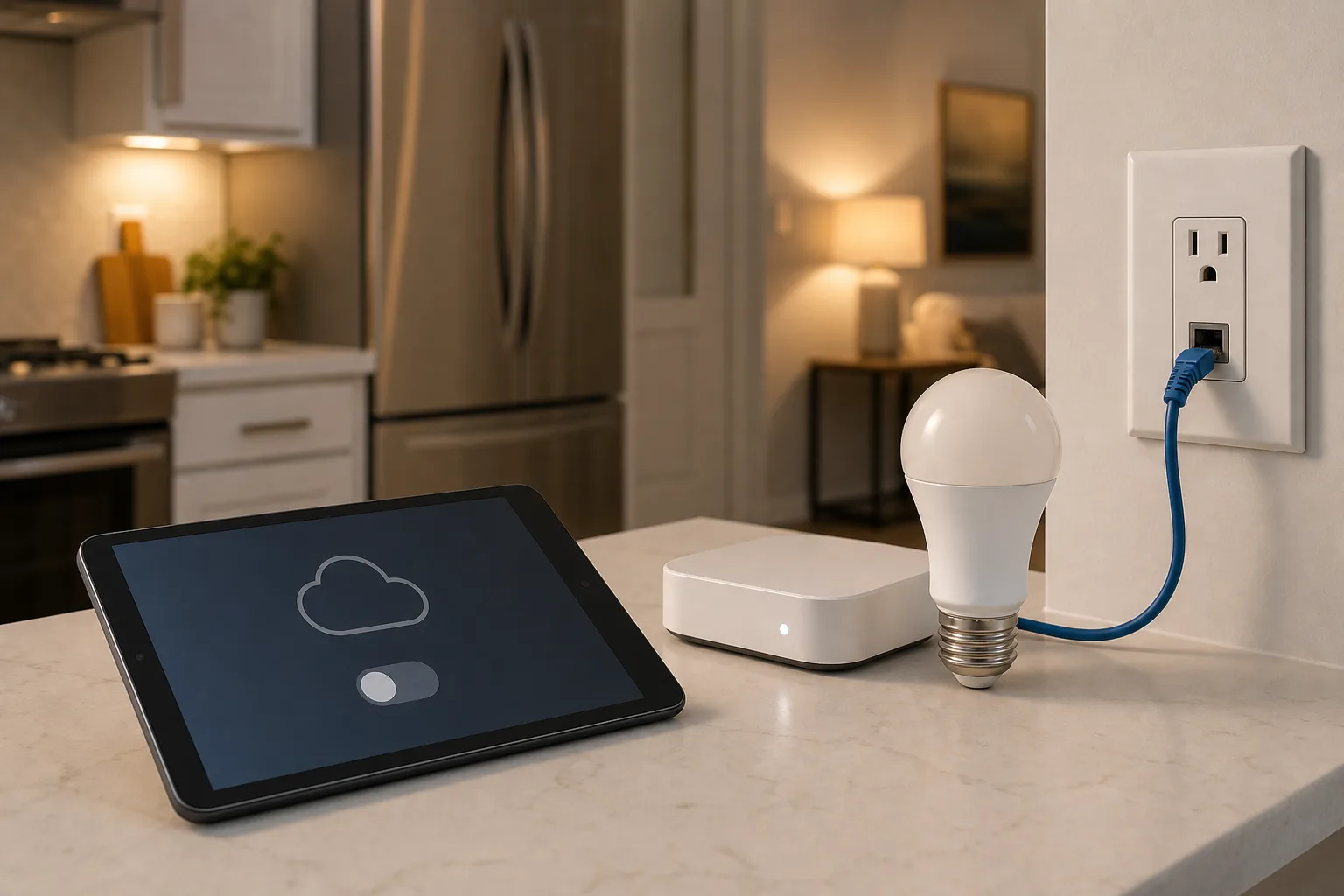
Sub-GHz Thread Is Coming, but Your Smart Home Should Not Wait for It
Thread Group has started work on a Sub-GHz version of Thread. That matters for range, but it is not a buying signal for today’s door sensors, locks or outdoor devices yet.
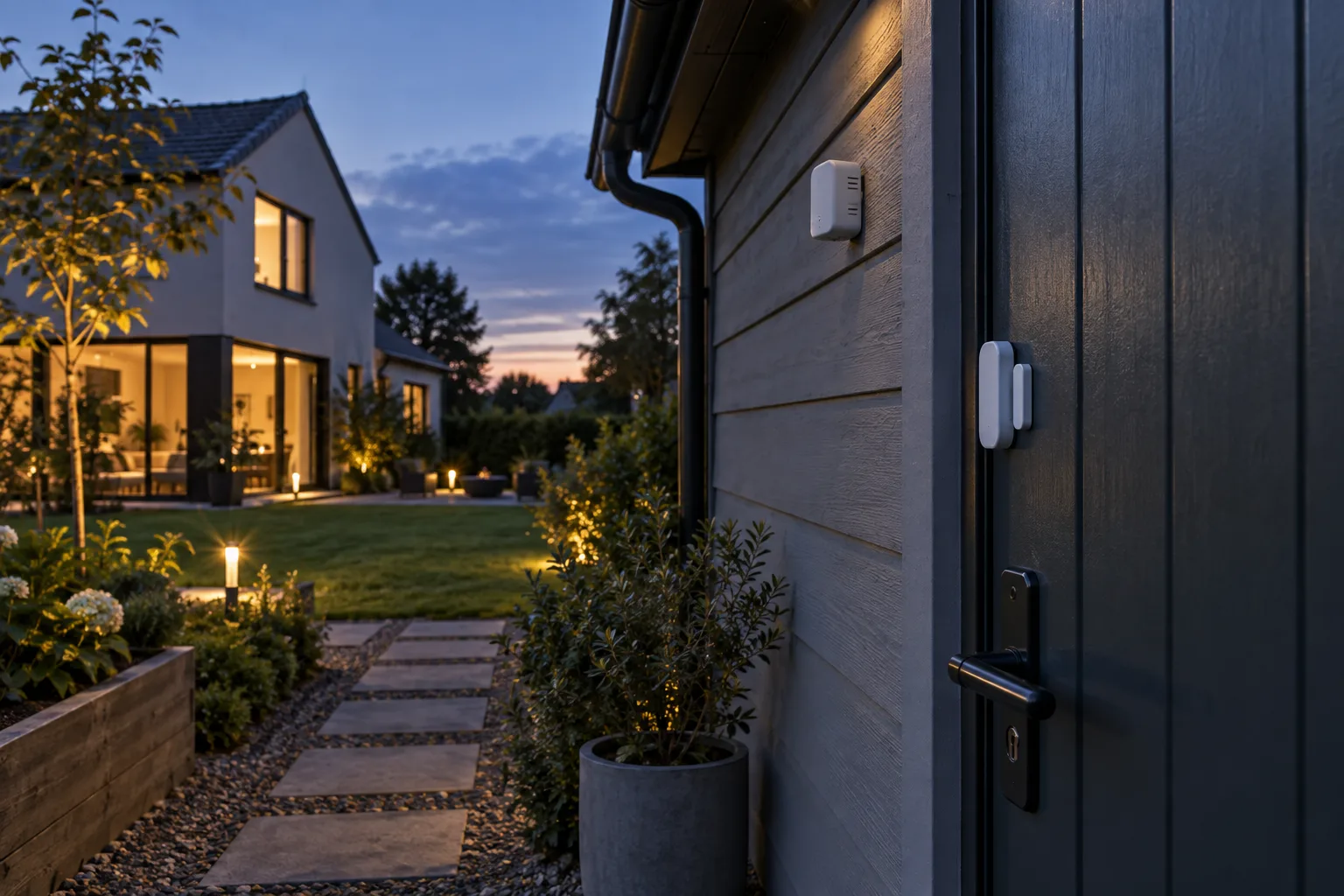
Apple’s Reported October Home Hub Push: What to Buy Now and What to Wait For
Apple is reportedly preparing a home hub, a new HomePod mini, and an Apple TV for October 13. The useful question is not whether the launch sounds exciting, but which parts of an Apple smart home depend on it.
Google Home MCP Is a New Permission Problem, Not Just a Smarter Assistant
Google’s early-access Home MCP can let outside AI agents inspect and control a Google Home setup. Before connecting one, audit its data access, action limits, household consent, and recovery path.
Comments
Sign in to comment.
No comments yet.