NASA’s X-59 Moves Quiet Supersonic Flight From Promise to Public Test
NASA’s X-59 has entered a sustained flight-test phase aimed at answering a practical question: can supersonic travel be made quiet enough for communities and measurable enough for regulators?

A supersonic aircraft has now spent enough time in the air to make the next question more important than the first one. NASA’s X-59 completed six flights in one week at the end of September, after entering supersonic testing earlier in 2026. The aircraft’s headline purpose is familiar: fly faster than sound while replacing the sharp, disruptive sonic boom with a lower, softer pressure signature that NASA calls a “sonic thump.” The useful development is less cinematic. The project is turning a long-running promise about quieter supersonic flight into a testable question about measurements, human responses, and aviation rules.
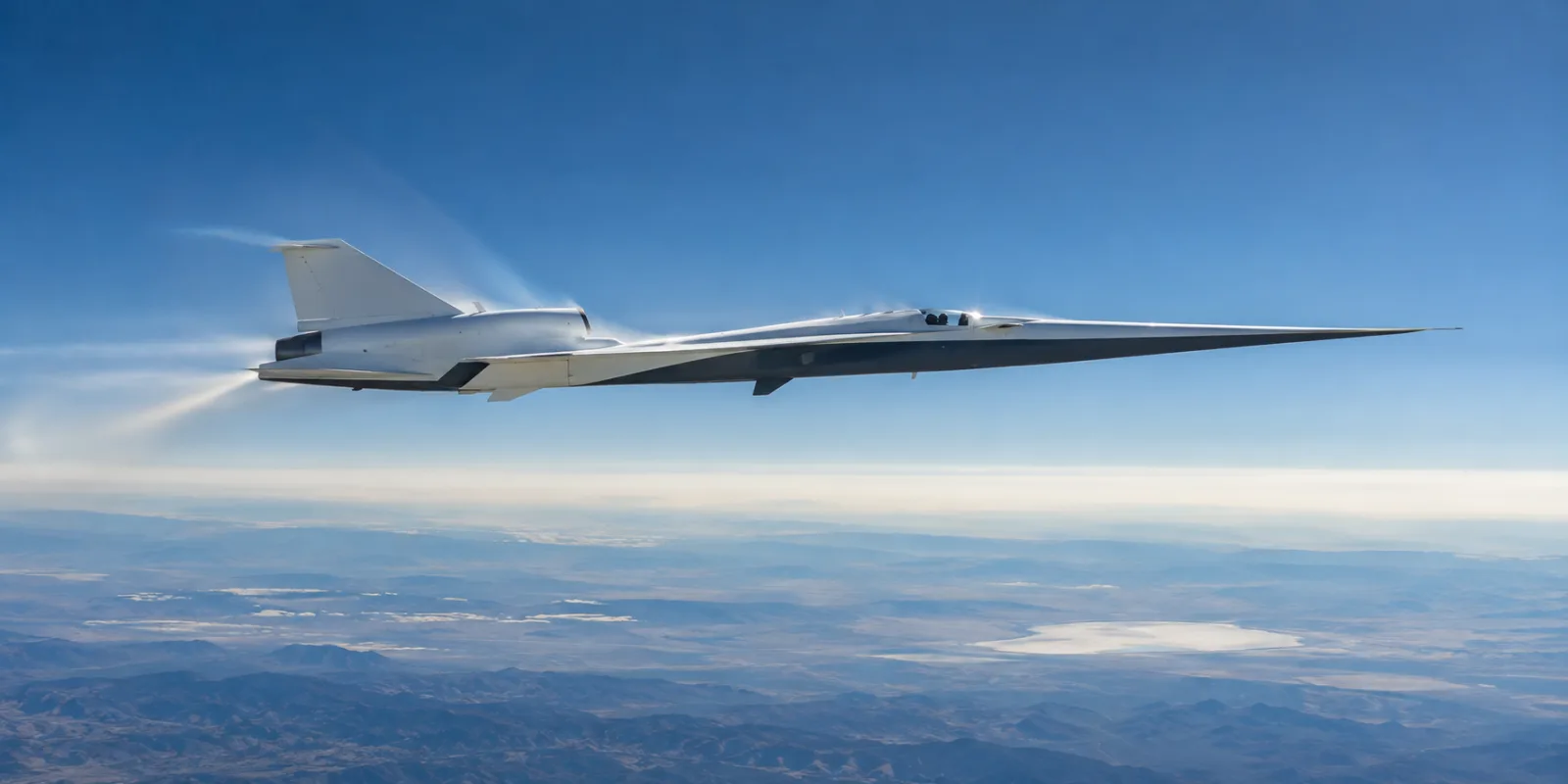
That distinction matters. A successful flight does not mean commercial supersonic service is returning, and it does not show that every proposed aircraft could fly over cities without causing unacceptable noise. It does show that an unusual aircraft has moved into the part of the program where its aerodynamic design, instruments, procedures, and noise predictions can be checked against repeated flight data. NASA’s Quesst mission is intended to supply evidence that regulators can use, not to certify a passenger plane.
The milestone is repeated testing, not a single crossing of Mach 1
The X-59 first flew faster than sound on June 5, 2026. NASA reported an 81-minute flight at Mach 1.1 and an altitude of 43,400 feet, with the aircraft performing as expected. A later flight reached the speed and altitude planned for the more demanding test phase: about Mach 1.4 at 55,000 feet. In early October, NASA said the aircraft had completed six flights in one week, a record for the program.
The sequence is important because flight research is built around repetition. Engineers need the aircraft to operate reliably across different conditions before they can interpret its sound signature with confidence. One unusual measurement can come from instrumentation, weather, an accompanying aircraft, or an unexpected flight condition. A series of flights provides a better chance of separating the aircraft’s behavior from the noise of the experiment itself.
The first supersonic flight was not a clean public demonstration of quietness. A NASA F-15 chase plane flew nearby, and its own sonic booms obscured the X-59’s sound. NASA explicitly described the later sound-focused phase as the point at which the aircraft’s acoustic performance would be assessed. That is a useful limitation to keep in view: “the aircraft went supersonic” and “the aircraft produced an acceptably quiet signature” are different claims, established by different tests.
The aircraft is a research demonstrator, not a prototype airliner waiting for a commercial launch date. It is designed to test a shaped pressure wave and the measurement systems needed to characterize it. The flights therefore answer questions about physics and public acceptability before they answer questions about tickets, routes, fuel use, maintenance, or airline economics.
Why the shape of the airplane changes the sound
A conventional supersonic aircraft creates shock waves as its nose, cockpit, wings, engine inlets, and other surfaces disturb the air. Those waves can combine as they travel toward the ground, producing the familiar abrupt boom. The X-59’s long, narrow nose and carefully arranged surfaces are intended to prevent the strongest disturbances from merging into one sharp pressure jump.
The goal is not silence. Supersonic flight still creates pressure changes, and the aircraft still moves through air faster than sound. The engineering target is a signal spread out enough, and weak enough at the surface, to be perceived as a series of quieter events or a thump rather than the crack associated with earlier supersonic aircraft.
That makes the X-59 an experiment in wave management. The airframe has to preserve the aerodynamic and structural requirements of a fast aircraft while controlling the timing and strength of multiple shock waves. A design that looks extreme from the outside is doing practical work: its length, nose profile, canopy arrangement, and surface geometry are part of the acoustic strategy.
The term “low boom” can be misleading if it is heard as “no noise.” NASA uses it to describe a reduced sonic-boom signature. The remaining sound depends on the aircraft, its speed and altitude, atmospheric conditions, and the location of an observer. Wind and temperature layers can alter how a pressure wave travels. Ground terrain and background noise can also affect what people hear. That is why a model or a single sensor reading cannot settle whether a future operation would be acceptable to communities.
The real experiment includes people on the ground
NASA’s Quesst mission has a second half that is less visually impressive and more consequential: community response testing. The agency plans to fly the X-59 over several U.S. communities and collect responses from people who hear the aircraft. NASA’s research plans describe repeated overflights, with participants reporting their reactions after individual events and at the end of the day.
This design recognizes that a noise standard cannot be based only on the peak pressure recorded by a microphone. A sound may be technically below a chosen threshold yet still be disturbing if it occurs repeatedly, at night, or in a place where people are not expecting it. Conversely, an occasional sound that is noticeable may be judged tolerable by a community. Regulators need a way to connect physical measurements with how people experience them.
NASA’s technical work on cumulative noise metrics makes the same point. The agency has examined how to pair end-of-day survey responses with a metric that represents multiple supersonic overflights. Day-night average sound level is widely used for transportation noise, but it was developed in a regulatory environment where civil overland supersonic flight had effectively been excluded. A low-boom aircraft creates a new measurement problem: the events are unusual, impulsive, and potentially infrequent, so established metrics may not transfer perfectly.
The surveys also matter because acceptability is not identical to audibility. A community might clearly hear a thump without finding it objectionable, or it might respond negatively to a lower-level sound that is repetitive or unexpected. Researchers will have to account for the number of events, their timing, the local soundscape, individual sensitivity, and the difference between a laboratory impression and a real neighborhood.
That is the part of the program that could make the research useful to rule-makers. The point is not for NASA to declare that people will like the sound. The point is to collect structured evidence that can be compared with acoustic measurements and used in a transparent decision about limits.
The regulatory problem is changing from speed to noise
In the United States, civil aircraft have generally been barred from flying faster than Mach 1 over land except under special authorization. The rule was established in 1973, when the policy problem was how to protect people from the sonic booms produced by civil aircraft. A speed limit was a straightforward way to prevent those booms, even though it did not distinguish between a loud conventional boom and a quieter shaped signature.
The Federal Aviation Administration proposed a different framework in July 2026. The proposal would replace the general prohibition with a noise-based operating standard. One condition would require the sonic-boom overpressure at the surface to stay at or below 0.11 pounds per square foot. Operators would also need to demonstrate compliance through methods approved by the FAA, including measurement, modeling, or other accepted approaches. The proposal keeps special authorizations for controlled testing and other circumstances.
That proposal is not the same thing as a finalized rule, and it does not make the X-59 a certified passenger aircraft. It does show why NASA’s data has a practical destination. If the regulatory system is going to judge supersonic operations by their effect at the surface, it needs reliable ways to predict, measure, and verify that effect.
The threshold itself should not be treated as a universal guarantee of comfort. A regulatory limit is a line used for certification and enforcement; public experience is broader. The FAA has said that further work will address noise thresholds for takeoff, landing, and supersonic cruise, with attention to community acceptability, feasibility, and international coordination. Supersonic aircraft must also meet ordinary aviation requirements for safety, airport operations, emissions, and noise during non-supersonic parts of a flight.
The policy transition may be as difficult as the engineering. A rule based on measurable overpressure needs trusted test methods. It must account for atmospheric variation and secondary effects, and it must be enforceable across different aircraft designs. It also has to work internationally because aircraft routes and noise standards do not stop at a national border.
What the latest flights establish
The recent flight cadence strengthens the program in several specific ways.
First, it demonstrates progress in expanding the aircraft’s flight envelope. NASA can operate the X-59 at the speed and altitude needed for later acoustic work, not merely perform a brief, symbolic crossing of the sound barrier.
Second, repeated flights help validate the aircraft as an integrated research platform. The program depends on flight controls, propulsion, instrumentation, communications, chase procedures, and safety systems working together. A low-boom measurement is meaningful only if the aircraft can produce the intended condition consistently and the instruments can capture it.
Third, the milestone narrows the uncertainty around the central aerodynamic idea. The aircraft has not yet proved that its sound will be accepted over populated areas, but it has moved beyond a design rendered on a screen or a low-speed test article. The vehicle is now generating real flight data in the regime for which it was built.
Fourth, the flights create a bridge to a public dataset. NASA’s later community tests will need an aircraft that can fly repeatable profiles. A stable test program makes it more plausible to compare the acoustic signature over different communities and atmospheric conditions.
These are meaningful advances, but they are not commercial readiness. The X-59 carries one pilot and is a purpose-built demonstrator. It does not answer whether a larger aircraft could preserve the same pressure-wave behavior with passengers, baggage, fuel, emergency systems, and an economically useful range. It also does not answer whether the aircraft could meet stringent takeoff and landing noise rules or operate economically under modern fuel and emissions requirements.
The benefits are real, but they are narrower than the slogan
If low-boom supersonic flight becomes practical, the most direct benefit would be shorter travel times on routes that currently cross large land areas. Faster travel could be valuable for some passengers, freight, emergency logistics, and specialized operations. But the benefit would depend on access and price. A faster aircraft that serves only a small number of premium routes would not transform ordinary travel for most people.
There is also an environmental question. Quieter supersonic flight solves one major obstacle—disturbing noise over land—but it does not automatically solve fuel consumption, emissions, contrail effects, or airport impacts. Supersonic aircraft operate under demanding aerodynamic conditions, and their design trade-offs can differ from those of efficient subsonic airliners. A fair assessment therefore needs separate evidence on noise, climate effects, local air quality, safety, and cost.
That is why the Quesst mission is best understood as one enabling experiment inside a larger aviation system. If the sonic signature is acceptable, regulators and manufacturers still need to address the rest. If the signature is not acceptable, the public testing will have identified the problem before a commercial fleet is built around an assumption that communities reject.
This is also where the program’s design offers a useful lesson for technology reporting. A positive result does not have to mean the final product is already available. It can mean that an important uncertainty has been moved from speculation into measurement. In this case, the question is no longer only whether engineers can draw a low-boom aircraft. It is whether they can fly one repeatedly, measure the result in realistic conditions, and connect the measurement to a rule that people can live with.
What to watch next
The next important evidence will come from flights focused on the X-59’s own acoustic signature, followed by mission-condition flights and community response studies. The valuable reports will include more than a statement that the aircraft was “quiet.” They should identify the flight profile, atmospheric conditions, measurement methods, uncertainty, and how the observed signal compares with the proposed regulatory framework.
The public studies will also deserve careful reading. Useful results will say who participated, how often the aircraft passed overhead, what questions people were asked, how responses were analyzed, and whether the results differed between communities. A single favorable demonstration would be less informative than a transparent dataset that includes annoyance, audibility, repetition, and local context.
The FAA’s rule-making process is another checkpoint. The July proposal is a policy direction, not a completed certification regime. Comments, technical revisions, and the eventual noise standards will determine what evidence future aircraft must provide. International bodies will have their own role in coordinating standards for aircraft that cross borders.
Commercial claims should wait for those pieces. The X-59 can make the return of overland supersonic flight more scientifically credible without making it inevitable. That is enough to count as good technology news: an old constraint is being challenged with a carefully designed experiment, and the experiment includes the people who would have to live under the flight path.
The best outcome is not a promise that every city will soon have supersonic jets overhead. It is a rule based on measured sound, repeatable testing, and public evidence rather than on either nostalgia for Concorde or blanket assumptions from 1973. NASA’s recent flights do not finish that process. They make the next stage possible.
Related articles
Arctic Permafrost Gets a Small, Testable Defense: Can Woody Blankets Stop Carbon-Rich Slumps?
A Canadian field trial is testing whether wood shavings, native seeds and coconut-fibre mats can slow the rapid erosion of thawing permafrost. The first result is encouraging, but it is one site, one summer and not yet a verified climate solution.


Home NAS boxes are becoming closed gadgets. Check this before buying one
A fresh NAS debate shows why buyers need to check RAM, networking, drive rules, M.2 support and backup plans before trusting a box with years of data.

Арктическая мерзлота получает небольшую проверяемую защиту: смогут ли древесные «одеяла» остановить оползни, богатые углеродом?
Канадское полевое испытание проверяет, способны ли древесная стружка, семена местных растений и кокосовые маты замедлить эрозию тающей вечной мерзлоты. Первый результат обнадёживает, но это лишь один участок и один сезон.

Условия КВ 6 октября: как превратить спокойный или неустойчивый прогноз NOAA в план проверки станции
Прогноз NOAA на 6 октября указывает на ослабление геомагнитной активности после недавнего интервала уровня G1. Используйте изменение прогноза Kp, чтобы сравнить диапазоны, направления и уровень шумов по журналу, пригодному для повторных измерений.
Comments
Sign in to comment.
No comments yet.