Mistral Large 4 Is Open Weight. The Real Test Is Whether You Can Run It
Mistral has released the weights for its trillion-parameter multimodal model. That changes the conversation from API access to hardware, serving software, licensing, and whether local deployment is useful for your team.

Mistral Large 4 is now available as downloadable weights, three weeks after the company opened a public preview through its API. The release is significant, but not for the simple reason that “open” models keep getting larger. The more useful question is narrower: what does the release let a developer, security team, or research group do that an API-only model could not—and what does it still fail to make practical?
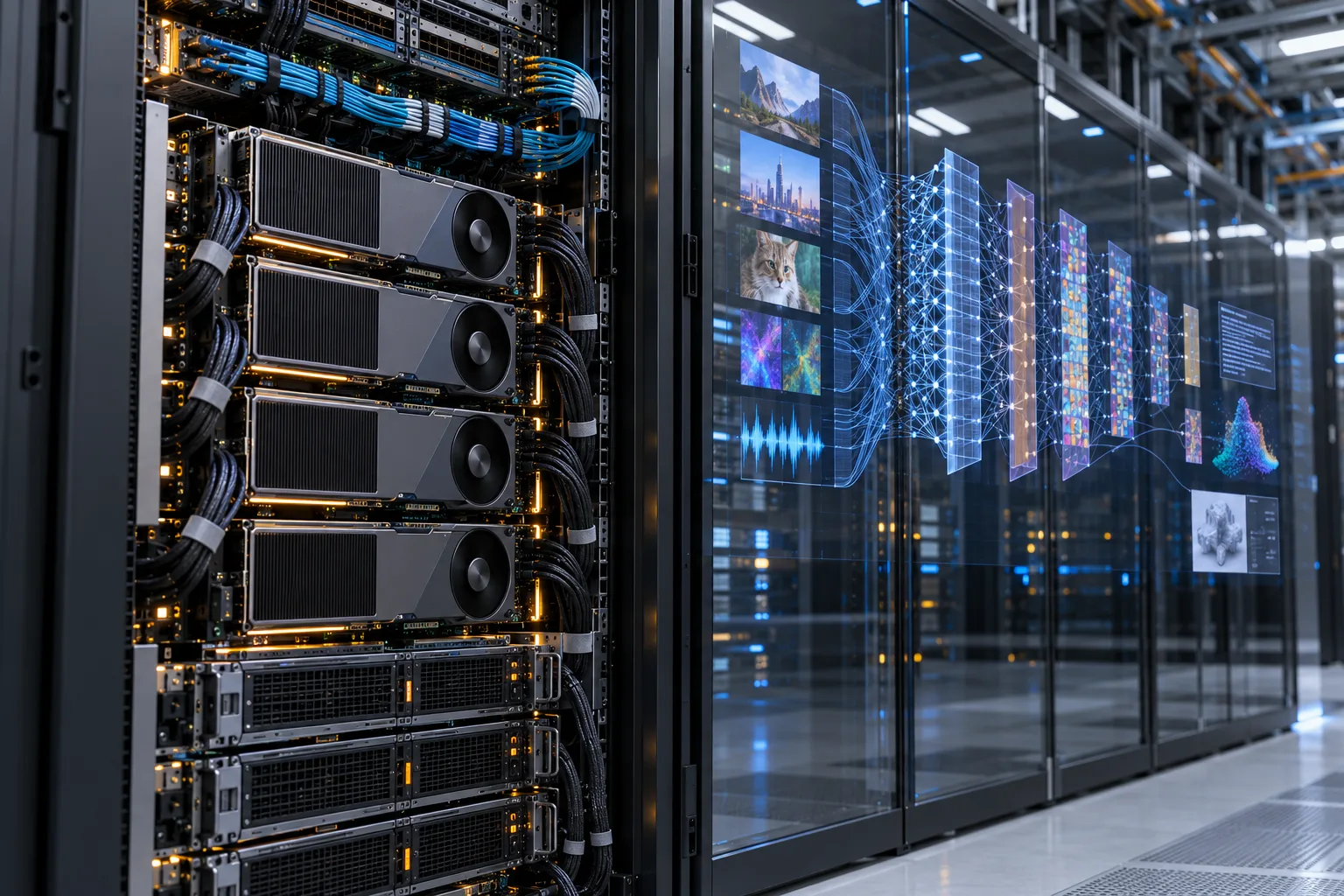
The answer is mixed. Mistral Large 4, also called Le Chonk, is a one-trillion-parameter multimodal Mixture-of-Experts model with a one-million-token context window. The model has roughly 52 billion active parameters per token, while the full checkpoint remains vastly larger than what most developers can store or serve locally. Mistral has published an FP8 checkpoint and an NVFP4 variant designed to reduce the memory burden on newer NVIDIA hardware.
That makes this a meaningful open-weight release, but not a desktop download. For most readers, the immediate value is not “run the model on a laptop.” It is the ability to inspect the model card, deploy it under a controlled infrastructure policy, evaluate it without depending on a remote endpoint, and decide whether the licensing and hardware costs fit a particular workload.
What changed on October 29
Mistral introduced Large 4 as a public preview on October 6 and said the weights would follow before the end of the month. On October 29, the company published the improved checkpoint and described the intervening work as additional reinforcement learning and feedback from developers, customers, and security partners.
The release is available through Mistral’s official announcement and the company’s Hugging Face model repository. Mistral also provides a separate NVFP4 repository for a smaller, quantized checkpoint intended for Blackwell-class GPUs.
The model accepts text and images, supports function calling and structured JSON output, and exposes configurable reasoning effort. The model card describes three settings: low for simpler requests, medium for routine work, and high for demanding tasks. That matters operationally because a self-hosted model is not only a question of whether it can answer a prompt. It is also a question of how much compute and how many generated tokens each answer consumes.
Mistral’s own release notes report a 48% score on the Artificial Analysis Coding Agent Index, a 41% score on Terminal-Bench 4.0, and a 19.7% result on Cognition’s FrontierCode 2.0 benchmark. The company says the model matches the leading open-weight system on one coding index while using 47% fewer tokens per task, and that its Terminal-Bench score improved by 13 percentage points compared with the preview.
Those numbers are useful signals, not a substitute for local testing. They are model-reported or dependent on external evaluations with their own prompts, harnesses, and scoring rules. A team deciding whether to adopt Large 4 should reproduce a small representative workload rather than extrapolate from a leaderboard position.
“One trillion parameters” is not a local deployment plan
The headline parameter count hides the first practical constraint. Large 4 is sparse at inference time: only part of the Mixture-of-Experts network is used for each token. That helps throughput and cost, but it does not make the entire model disappear from memory. The weights still need to be available to the serving system, along with memory for the runtime, the vision encoder, the key-value cache, batching, and the operating system.
The official FP8 repository is about a terabyte of model data. The NVFP4 repository is substantially smaller, but it still belongs to the data-center category. The model card recommends Blackwell GPUs for the NVFP4 format and provides serving examples that use eight-way tensor parallelism. In other words, the quantized release lowers the barrier compared with the full-precision-style checkpoint; it does not turn Large 4 into a convenient single-GPU model.
This distinction is easy to miss when a model page says that only 52 billion parameters are active. “Active” describes the computation performed for a token. It does not mean that the remaining experts can be deleted from the deployment. A serving stack must still locate the relevant experts and usually keep the checkpoint distributed across a cluster or a large unified-memory system.
There are three realistic deployment categories:
- Hosted inference: use Mistral’s API, a managed provider, or an NVIDIA-hosted endpoint. This is the easiest way to measure quality and latency, and the only sensible starting point for most individual developers.
- Controlled private inference: operate the model on rented or owned data-center hardware through vLLM, SGLang, or a compatible serving stack. This can be worthwhile when data residency, predictable access, custom routing, or high request volume matters.
- Local experimentation: attempt a heavily quantized build on unusually large unified memory or a multi-GPU workstation. This is possible for a small number of teams, but it is not the default use case implied by “downloadable weights.”
The model card lists integrations with vLLM, SGLang, and llama.cpp. The presence of an integration is encouraging, but it should not be confused with mature support on every hardware target. Version compatibility, tensor parallelism, quantization kernels, image handling, tool-call parsing, and long-context memory behavior all need to be tested together.
The useful open-source question is control, not ownership of a buzzword
Mistral calls Large 4 an open-weight model. That wording is more precise than calling it simply open source. The weights are available, and the model can be deployed and customized under the published terms. But the release does not automatically provide the same freedoms, governance model, or reproducibility guarantees associated with a conventional open-source software project.
The model repositories identify the license as the Mistral Ecosystem Open-Weight License, a modified MIT-style license. The license section in the NVFP4 model card says commercial and non-commercial use are allowed, while operating a Model-as-a-Service business requires a separate commercial license from Mistral.
That condition is central. A company may be able to download the weights, run them for internal work, adapt them, and embed their capabilities in a product. A company that plans to offer third parties direct access to the model through an API or hosted endpoint may fall into a different category. The exact business model should be reviewed against the license before engineering work begins.
The license is also only one layer of the deployment decision. Organizations should separately examine:
- the model card’s intended-use and safety information;
- the provenance and terms of any additional training or adapter data;
- the security posture of the serving framework and container images;
- the way logs, prompts, images, and tool calls are retained;
- the process for updating or replacing the checkpoint;
- whether the organization can reproduce the same quantization and serving configuration later.
A downloaded checkpoint gives a team more control over availability and data flow. It does not eliminate operational responsibility. In fact, the responsibility becomes more visible: the team owns access controls, patching, monitoring, abuse detection, incident response, and capacity planning rather than delegating those tasks to an API provider.
Why the multimodal and long-context features matter
Large 4 is not merely a text model with a large context number attached. Mistral describes it as natively multimodal, with a vision encoder and support for image input. The practical applications are document question answering, chart and diagram interpretation, engineering drawings, visual inspection, and workflows that combine a repository or document collection with images.
A one-million-token context window can also reduce the need to aggressively summarize very large inputs. That sounds like an obvious benefit, but it creates its own engineering questions. Long context is not free. The request still needs to be transferred, tokenized, cached, and processed. A model can accept a huge prompt while producing an expensive or slow response. Retrieval, chunking, and staged analysis may remain cheaper and more reliable for recurring workloads.
The right test is therefore not “can it ingest a million tokens?” It is “does the model preserve the evidence and follow the task when the relevant material is spread across a large input?” Teams should build a small evaluation set with long documents, tables, screenshots, contradictory instructions, and irrelevant context. Measure citation accuracy, missed details, latency, memory use, and failure recovery.
The image capability deserves the same caution. A model that can describe an image is not automatically suitable for regulated visual inspection or safety-critical decisions. Resolution handling, small-text recognition, image preprocessing, and uncertainty calibration can change the result. If the application involves physical equipment, medical material, financial records, or security evidence, keep a human review path and test adversarial or misleading inputs.
Coding performance is promising, but the serving economics come first
Mistral’s release places considerable emphasis on coding agents. The company reports strong results on terminal and repository-level benchmarks, and its configurable reasoning modes are designed to make the performance-versus-cost tradeoff explicit.
That is relevant to teams building internal coding tools, but the first question is not whether Large 4 can write code. Many current models can produce plausible patches. The useful comparison is whether the model can complete a repository task with a lower total cost while preserving tests, respecting project conventions, using tools correctly, and avoiding destructive changes.
A practical evaluation should give the model tasks that resemble real work:
- fix a bug where the failing behavior is described but the cause is not obvious;
- update a dependency while respecting the project’s lockfile and supported runtimes;
- add a feature that touches several modules and requires a migration;
- investigate a flaky test without simply weakening the assertion;
- review a change for security or data-loss risks;
- explain a patch in terms that another maintainer can verify.
The harness matters as much as the model. Use the same tools, time limits, repository snapshot, test commands, and acceptance criteria for every comparison. Record not only whether the final patch passes, but how many tool calls it makes, how often it repeats failed actions, how much output it generates, and whether a human reviewer would accept the change.
The appeal of self-hosting is strongest when the code or repository cannot be sent to a third-party service. But that benefit can disappear if the private cluster is underprovisioned. A slow model that queues tasks for hours may be less useful than a smaller hosted model with predictable latency. Conversely, a group with a sustained workload and existing GPU capacity may find that private inference produces a better long-term cost profile.
Security work is an important use case—and a reason to be careful
Mistral says Large 4 was evaluated on defensive cybersecurity tasks, including vulnerability discovery, reproduction, and patching. The company reports a 51% score on the Artificial Analysis Cyber Index and a 96.6% refusal rate on malicious cyber requests.
These claims point to a real use case: a security team may want a model that can inspect code, reason about a vulnerability, propose a patch, and operate inside an environment where sensitive source code cannot leave the organization. Open weights can also make it easier to evaluate the system against internal policies instead of relying on a provider’s changing refusal behavior.
But a self-hosted security model is not automatically a safer security system. Removing provider-side controls transfers the decision boundary to the operator. The team must define who can access the model, which tools it can call, what networks it can reach, and what actions require approval. A model with strong defensive performance may still be capable of generating harmful instructions or interacting dangerously with a live environment.
For an initial trial, keep the model in a sandbox with no production credentials and no unrestricted outbound network access. Give it read-only copies of test repositories. Require explicit approval before it can execute a patch, open a ticket, send a message, or touch infrastructure. Log prompts, tool calls, file changes, and model versions. Test prompt injection through source files, issue descriptions, documentation, and image content.
The same principle applies to agentic coding. Function calling makes the model more useful, but it also gives mistakes a path into the real world. Define a narrow tool inventory. Prefer reversible operations. Separate planning from execution. Let the model propose a command before a wrapper decides whether it is safe to run. These controls are more important than a benchmark score.
Who should try Large 4 now
Large 4 is worth testing now for organizations that already have one of the following needs:
- a private multimodal model for documents, diagrams, or internal technical material;
- a sovereign or regionally controlled inference option;
- a coding-agent evaluation program with access to substantial GPU infrastructure;
- a security research environment where model behavior must be measured locally;
- a high-volume workload for which token cost, data movement, or provider dependency is becoming a constraint;
- a model customization project that needs access to weights rather than only an API.
It is less compelling for a solo developer who wants an inexpensive local assistant, a small team without GPU capacity, or a product that only needs ordinary text generation. Those users should begin with the API or a smaller open-weight model and compare real workload results. Downloading a one-terabyte checkpoint merely to prove that it can be downloaded is not a useful experiment.
The best first step is a short bake-off. Select ten to twenty representative tasks, including failures from the current system. Run them through the API preview, the alternatives already under consideration, and the deployment configuration you could actually afford. Track quality, latency, total infrastructure cost, context length, tool reliability, and human correction time.
Do not omit the boring tasks. A model that performs well on an impressive demo may still be poor at extracting fields from a recurring document, following a house style, returning valid structured data, or declining to take an unsafe action. Those are the behaviors that determine whether a system survives beyond a trial.
Alternatives and comparison points
Large 4 should be compared with models that fit the same operational requirement, not only with the largest names on an intelligence leaderboard. The relevant alternatives may include smaller Mistral checkpoints, open-weight coding models such as GLM and DeepSeek variants, or hosted systems that provide stronger latency and support at a lower engineering cost.
For coding, compare repository completion, test preservation, tool use, and token efficiency. For multimodal document work, compare extraction accuracy on your own files and images. For private deployment, compare memory requirements, serving maturity, quantization quality, upgrade paths, and the license—not only raw capability.
A smaller model can win if it fits on fewer GPUs, starts faster, handles more concurrent requests, and produces outputs that require less review. A hosted model can win if the organization does not have the people to operate a distributed inference service. Large 4 is an additional option in that decision, not a universal replacement for every model already in use.
The bottom line
Mistral Large 4’s weight release makes the open-weight promise concrete. Developers can inspect the model artifacts, deploy the system under their own infrastructure policies, customize the serving path, and keep sensitive workloads away from a third-party API. The model’s multimodal input, long context, tool use, and reported coding performance make it a serious candidate for controlled experiments.
The release does not make frontier inference cheap or simple. The full checkpoint is a data-center workload, the quantized release still expects specialized hardware, and the license needs to be read carefully by anyone planning to offer model access as a service. Self-hosting also means owning security controls, monitoring, capacity, and failure handling.
That is why the most useful way to approach Large 4 is as an infrastructure and evaluation project. Start with a workload, a budget, a deployment target, and a clear definition of acceptable risk. If the model improves a real process under those constraints, the open weights matter. If it only produces an impressive download page and a large hardware bill, the release has not yet solved your problem.
Related articles
Slotstream makes a 104 GB local LLM a Mac SSD problem worth testing
The new MIT runtime streams Qwen3.8-Flash-Next experts from SSD, showing a clever path around memory limits — with speed, disk and license caveats.
Mistral’s one-camera robot model is good news, with limits
Robostral Navigate is not a robot butler. Its promise is more practical: cheaper, simpler navigation for useful machines if benchmark progress survives real-world tests.


Robotics is still waiting for reliability, not another demo video
Physical AI has better models, cheaper developer robots and stronger industrial demand. The missing breakthrough is not spectacle — it is dependable work in messy real environments.

La robotique n’a pas besoin d’une autre vidéo, mais de fiabilité
L’IA physique progresse avec modèles, plateformes moins chères et demande industrielle. Le vrai seuil reste le travail fiable dans le réel.
Comments
Sign in to comment.
No comments yet.