MIT’s Insect-Scale Flying Robot Learns to Navigate With Its Own Sensors and Computer
MIT researchers have put sensing and flight control onto a paperclip-light flapping-wing robot. It can hover and follow short trajectories without motion-capture cameras, but it still needs offboard power and human-level guidance.

A flying robot about the size of a microcassette has taken a useful step away from the laboratory’s camera rig. MIT researchers have demonstrated an insect-scale flapping-wing robot that carries its own sensors and microcontroller, estimates its motion onboard, and uses that information for low-level flight control.
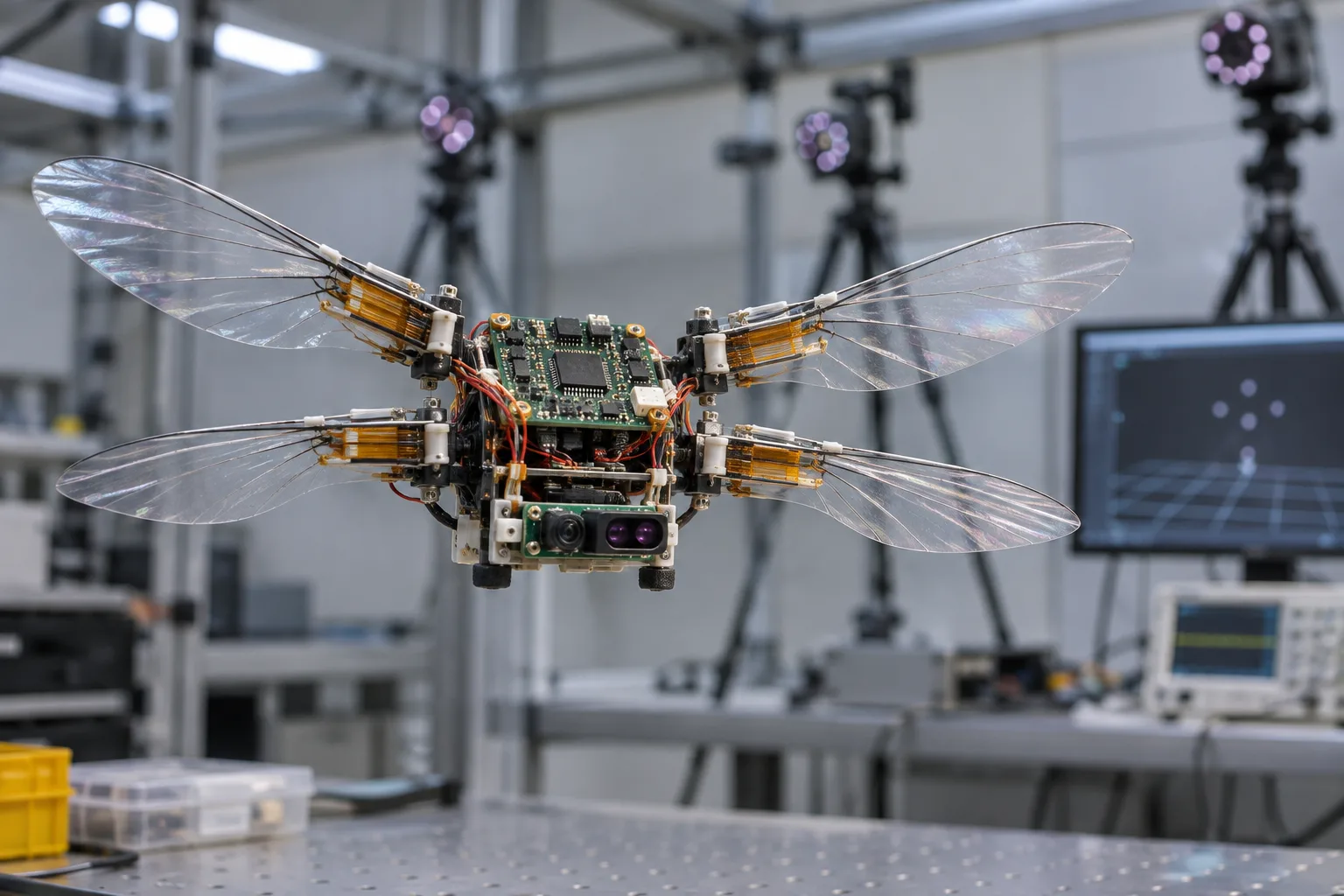
The result is not a miniature drone ready to patrol a greenhouse. The robot still receives electrical power from outside the vehicle, and its most capable demonstrations were short. It also does not yet carry a camera, battery, or a high-level navigation system. But the experiment removes one of the most awkward dependencies in microrobotics: the robot no longer needs an external motion-capture system to know enough about its orientation, height, and short-range movement to keep flying.
That distinction matters because size changes the engineering problem. A conventional drone can carry a battery, processor, camera, inertial sensors, radio, and several layers of redundancy. A robot that weighs roughly a gram has to earn every milligram and every milliwatt. Adding a useful sensor can make the vehicle too heavy to lift; adding computation can consume power that the wings need simply to stay in the air.
The new work, published in Science Robotics, is therefore best understood as a co-design result. The researchers enlarged and retuned the soft artificial muscles that drive the wings, then designed a compact avionics package and a fast estimator that fit within the new lift and power budget. The achievement is not that a tiny robot has acquired a general-purpose brain. It is that the mechanics, sensors, and controller now work together closely enough for the machine to stabilize and steer itself over short time windows.
What changed in the new demonstration
Earlier insect-scale aerial robots could be agile, robust, or even untethered in specific demonstrations, but autonomy was often divided between the vehicle and the room around it. External cameras measured the robot’s position. A computer outside the robot processed those measurements. Commands or control signals then travelled back to the actuators. That arrangement is valuable for research because it supplies accurate data, but it restricts where and how the robot can fly.
MIT’s new platform moves part of that loop onto the vehicle. The robot has four flapping-wing modules powered by dielectric-elastomer actuators, a class of soft artificial muscle. The redesigned actuators were made about 50 percent larger, increasing net lift by 46 percent. That extra lift created room for a 244-milligram flight-electronics package without sacrificing the basic flight capability.
The complete robot described in the research weighs about 1.29 grams when carrying the flight package. The system achieved a lift-to-weight ratio of 1.9, meaning that the wings could generate substantially more lift than was needed merely to support the vehicle and its electronics. That margin is important, but it is not generous by ordinary drone standards. It has to cover the actuators, structural parts, sensor boards, controller, wiring, and the power arrangement used during the tests.
The electronics combine three kinds of measurement. An inertial measurement unit tracks rotational motion and helps estimate attitude. An optical-flow sensor looks at the ground to infer lateral motion and speed. A time-of-flight sensor measures distance to the surface and provides an estimate of height. Together, these sensors give the robot enough information to estimate the short-term state needed for stabilizing flight.
The system does not have a global positioning sensor or a camera that recognizes objects. Optical flow also becomes less informative as the robot rises because the ground texture occupies fewer pixels. Small errors accumulate when lateral velocity is integrated over time, so the vehicle’s position drifts. The researchers addressed that limitation by prioritizing rapid, inexpensive state updates rather than attempting a slower calculation with greater nominal precision.
Why the estimator matters more than the word “computer”
Calling the package a computer is technically correct, but it can obscure the interesting part. The challenge was not to fit a powerful processor onto a tiny aircraft. It was to build a control loop that runs fast enough, with little memory and limited sensing, while the body is vibrating and the aerodynamics are changing hundreds of times per second.
The controller and estimator ran on a single microcontroller core at a feedback rate of 480 hertz. The electronics consumed about 120 milliwatts at the highest sensing and computation loads, roughly 6 percent of the power used by the flight actuators. The controller used less than a quarter of one core’s available computational capacity in the reported analysis, leaving possible room for a small amount of higher-level planning later.
This is a different kind of onboard autonomy from the autonomy advertised in larger robots. The current platform does not interpret a scene, identify a flower, decide where to go, and plan a route on its own. Its onboard system estimates state and performs low-level feedback control. In several demonstrations, an operator still supplied higher-level position commands through a joystick, while the robot handled the immediate stabilization and tracking tasks.
That division is sensible. Low-level control has a hard real-time deadline: if the robot’s attitude estimate arrives too late, the wings may correct the wrong motion. High-level planning can often operate more slowly. The paper estimates that a planner updating once or twice per second could be feasible on the same microcontroller, but that remains a future design direction rather than a demonstrated capability.
What the robot actually did
The strongest evidence comes from flight measurements rather than the planned applications. With onboard sensors and computation, the robot hovered about 7.5 centimetres above the ground for 10 seconds. Compared with measurements from an external motion-capture system used for evaluation, its root-mean-square altitude error was 0.32 centimetres and its lateral-position error was 2.17 centimetres.
In a second onboard-compute test, it switched between two position setpoints separated by 30 centimetres over seven seconds. The maximum lateral velocity was 19.8 centimetres per second. The altitude and lateral-position errors were 0.57 and 2.21 centimetres, respectively, according to the paper.
Those numbers describe short, controlled tests, not free-ranging flight. The researchers also ran longer demonstrations in which the robot used onboard sensing but computation was performed offboard. In a 30-second sequence outside the motion-capture arena, a human operator guided it around obstacles, over plants, and onto a sunflower. The robot used its time-of-flight sensor to regulate height and clear a curved obstacle, then performed a controlled descent toward the flower.
The sunflower landing is visually memorable, but its technical role is more specific. It shows that onboard sensing can support centimeter-scale maneuvering in an area where the external cameras cannot provide the main feedback signal. It does not show autonomous flower recognition or autonomous pollination. The operator chose the route and issued high-level commands; the robot executed the lower-level flight behavior.
The research also reports trajectory-following tests using onboard sensing and offboard computation. The robot tracked an 18-by-18-centimetre circular path and a 22-by-10-centimetre figure-eight over seven seconds. Position errors varied with the maneuver and orientation changes, reaching several centimetres. That is good enough to establish controlled flight at this scale, but it also makes clear why the team describes the work as a platform milestone rather than a finished application.
The quiet engineering win is the actuator redesign
The sensor package could not simply be attached to the previous robot. The added mass would reduce the lift margin, change the dynamics, and potentially make the vehicle too sluggish or unstable. The team therefore modified the artificial muscles as part of the same design exercise.
Dielectric-elastomer actuators are soft capacitive devices that deform when an electric field is applied. In this robot they serve as artificial muscles, driving the wings at high frequency. Their geometry can be scaled in a way that preserves useful output characteristics better than some rigid microscale actuator designs. MIT’s researchers tuned the radius and length of the actuators so the larger muscles produced more net lift rather than merely adding mass.
That mechanical change is central to the result. The electronics account for only a minority of the overall power budget; the wings and actuators dominate it. The paper reports that the flight actuators represent about 81 percent of the system’s mass and 94 percent of its power consumption. Improving the controller helps, but a large gain in autonomy will ultimately depend on the vehicle’s power source and flight muscles as much as on its processor.
It is a useful reminder about tiny robots. At a larger scale, adding a sensor may be a software integration task. At the insect scale, the same sensor can alter the aircraft’s balance, lift requirement, vibration profile, and energy use. The electronics package had to be mounted on a fiberglass substrate partly to keep vibration from corrupting the inertial measurements. The software and the structure were inseparable.
What this could make possible
The researchers point to precision agriculture, industrial inspection, and search-and-rescue as possible long-term uses. A tiny robot could enter spaces where a larger drone creates too much airflow, cannot fit between plants, or risks damaging delicate structures. A group of such vehicles might inspect confined machinery, monitor crop blossoms, or look for signs of pests without carrying the mass and noise of a conventional quadcopter.
Pollination is a particularly clear example of the scale advantage. A larger drone can move through a field, but it is poorly matched to a single blossom. An insect-scale flyer could in principle approach flowers with less disturbance and operate within dense vegetation. Yet that application would require much more than the current demonstration: autonomous recognition of flowers, reliable obstacle avoidance, safe interaction with plants, durable operation in wind, and enough energy for useful time in the field.
Industrial inspection has a similar split between promise and readiness. A small robot could reach narrow gaps or travel near sensitive components. But inspection requires sensing beyond attitude and height. A camera, illumination, storage, wireless communication, and a way to localize findings would all add payload and power demands. A vehicle that can hold position for 10 seconds is not automatically a vehicle that can produce a trustworthy inspection record.
Search-and-rescue scenarios impose even harder constraints. Dust, darkness, turbulent air, clutter, and uncertain surfaces can defeat optical-flow and time-of-flight sensing. A robot might be valuable precisely where its preferred sensors work poorly. Redundant sensing, robust communications, and a recovery strategy would be needed before the system could be trusted near people.
For now, the practical contribution is architectural. The work shows that an aerial microrobot can carry enough local state estimation and control to leave the laboratory’s motion-capture volume for short demonstrations. That expands the design space for future work. Researchers can now ask how to add one more capability—vision, planning, wireless communication, or power storage—without rebuilding the entire idea from scratch.
The battery problem has not gone away
The most important limitation is also the one that is easiest to miss in a headline: the robot is not yet untethered in this experiment. Its sensing and computation are onboard, but the power electronics and battery are not integrated into the flight vehicle. The outside power source remains part of the test setup.
This matters because a battery is not just another component. It must store enough energy, deliver the required voltage and current, fit the mass budget, survive vibration, and avoid upsetting the robot’s center of gravity. The paper estimates that integrating power electronics and onboard batteries would add approximately 1 to 1.5 grams. That is close to, or greater than, the mass of the robot platform itself.
The authors estimate that accommodating that payload could require increasing the robot’s size by roughly 15 to 35 percent. A larger vehicle may be easier to power, but it may no longer behave like the intended insect-scale platform. It may also produce more disturbance, fit into fewer spaces, or lose some of the advantages that motivated the design.
There is a useful precedent for separating the problems. In 2019, a different insect-sized flapping-wing vehicle demonstrated sustained untethered flight using lightweight solar cells and a stripped-down circuit. That work showed that power autonomy is possible in a carefully constrained configuration. It did not solve the newer problem of combining a useful onboard sensor suite, real-time estimation, and computation with the flight system described here. The current MIT study tackles the autonomy side while openly leaving the energy-storage side unfinished.
The next steps identified by the team are therefore concrete: reduce electronics power, add power electronics and a battery, place a camera onboard, and implement object recognition or obstacle avoidance. Each step could change the vehicle’s mass and dynamics. None is a simple software update.
A careful reading of the “first” claim
MIT describes the work as the first demonstration of an aerial microrobot with sensory and compute autonomy. That claim is narrower than saying it is the first autonomous flying robot of any size, the first insect-scale robot to fly untethered, or the first tiny aircraft to carry sensors. Those broader statements would be wrong or at least misleading.
The field has already demonstrated insect-scale flight, robust soft-actuated vehicles, onboard sensing in related systems, and untethered power in other configurations. What is new here is the integration of a sensor package and a microcontroller onto a very small flapping-wing platform, with the robot using onboard state estimation and control during the reported flight tests.
The distinction is worth preserving because engineering progress often consists of connecting capabilities that previously existed separately. A battery-powered vehicle may fly, but lack enough computation. A sensor-equipped robot may measure motion, but depend on external processing. A computer may run a controller, but the vehicle may not have enough lift to carry it. The advance is the demonstrated combination under a tightly constrained mass and power budget.
The study also shows why a successful laboratory result should be described with its time horizon and test conditions. The fully onboard sensing-and-compute flights lasted seconds. Longer obstacle and flower demonstrations used offboard computation and human-issued high-level commands. External motion capture remained useful for evaluating the robot, even when it was not the source of the main feedback signal. Those details do not diminish the result; they define it.
Why this is good technology news
The encouraging part is not that a tiny robot is suddenly ready to replace bees, inspection drones, or rescue teams. It is that a stubborn bottleneck has been reduced in a measurable way. The robot carries a 244-milligram sensor-and-compute package, estimates its state with inexpensive sensors, runs a high-rate controller on a microcontroller, and tracks short movements with errors of a few centimetres.
That is a real improvement over a platform that must remain inside a camera-covered arena. It gives future researchers a better starting point for testing local navigation, swarm coordination, and task-specific sensing in spaces where external tracking is unavailable. It also creates an honest engineering checklist: battery integration, vision, drift, planning, communications, endurance, weather tolerance, and safe interaction with the environment.
Good news in robotics often arrives this way. A system crosses one boundary while several others remain visible. In this case, the boundary is between a flying mechanism that depends on the room around it and a flying mechanism that can perform the first layer of perception and control by itself. The next breakthrough will not be proved by a striking landing photograph. It will be proved when the robot carries its own energy, recognizes what is around it, and remains useful for more than a short, carefully prepared flight.
Related articles
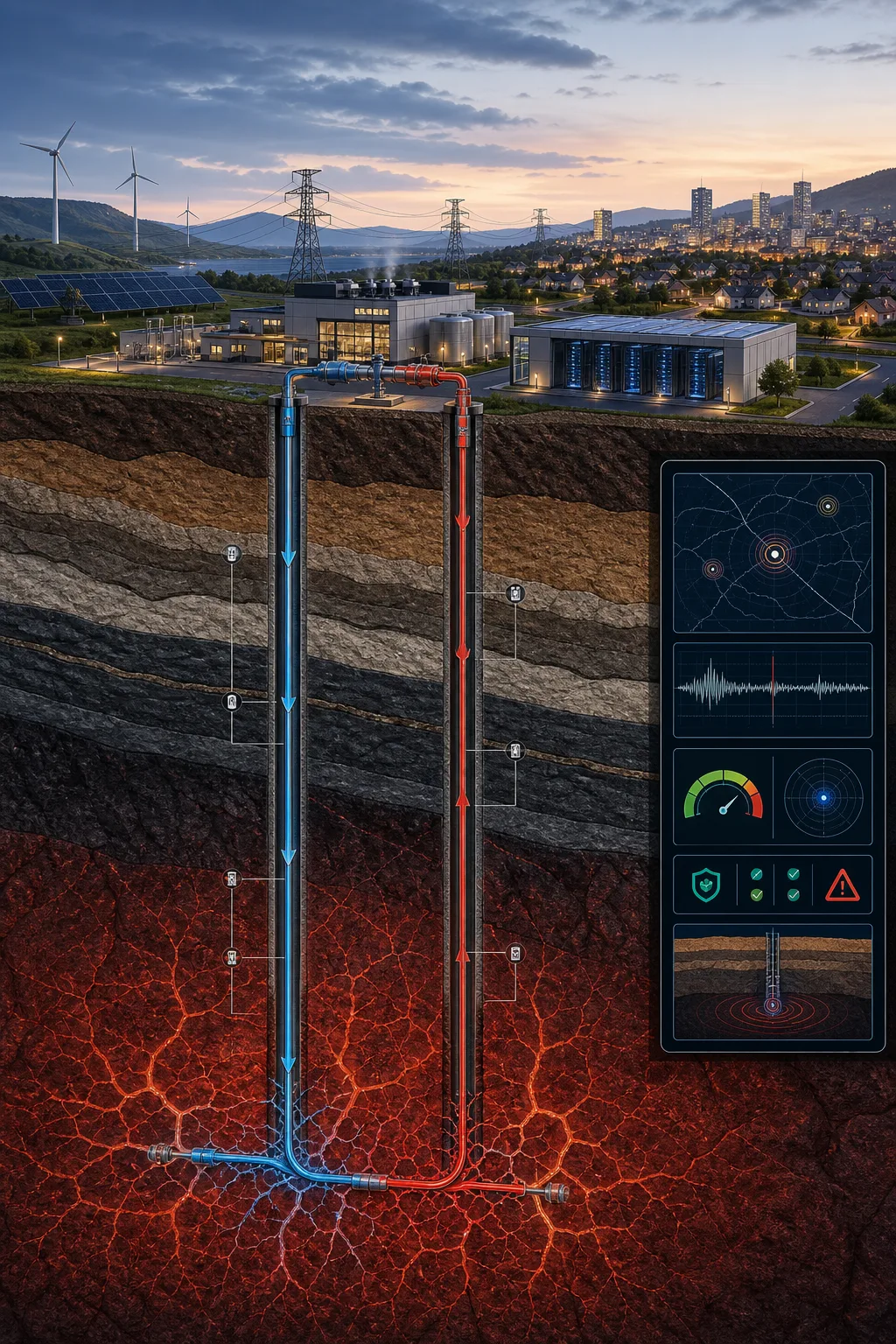
Geothermal energy is becoming good technology news because engineers made it harder
The hopeful part is not a miracle headline. New geothermal work is turning underground heat into a measurable engineering problem: drill better, model better, monitor better, and prove the economics plant by plant.
Inclusive Color Space is good tech because it makes better avatar defaults easier
A small MIT-licensed color picker turns a messy representation problem into practical design infrastructure for games, avatars and creative tools — while openly admitting what it cannot solve.

An AI-Guided Formulation Keeps mRNA Vaccine Particles Stable Through Heat — So the Cold Chain May Become Less Fragile
MIT researchers used a small-data machine-learning system to tune the additives around mRNA-carrying lipid nanoparticles. In mice, a vacuum-dried formulation retained activity after a year at room temperature or two months at 37°C, but it is still a preclinical result.


AWS buying DuckLabs moves DuckDB’s center of gravity
DuckDB stays MIT and under a foundation, but AWS acquiring DuckLabs changes the practical governance questions around one of data engineering’s favorite tools.

Comments
Sign in to comment.
No comments yet.