An Adriatic Robot-Drone Convoy Tests What Maritime Autonomy Needs Beyond a Single Vessel
A Croatian demonstration on 12 September links an autonomous surface vessel, an aerial sampling drone and a remotely operated underwater vehicle. Its real significance is the coordination problem: useful maritime autonomy depends on communication, handoffs and safe fallback behavior.

A boat, a drone and an underwater robot will work as one demonstration convoy in the waters around Kukljica, Croatia, on 12 September. The event, organized around the ELMAR University Regatta and the Robot Technologies and Applications conference, is intended to show how autonomous systems can cooperate in a real maritime setting rather than perform isolated tricks in a laboratory or exhibition hall.
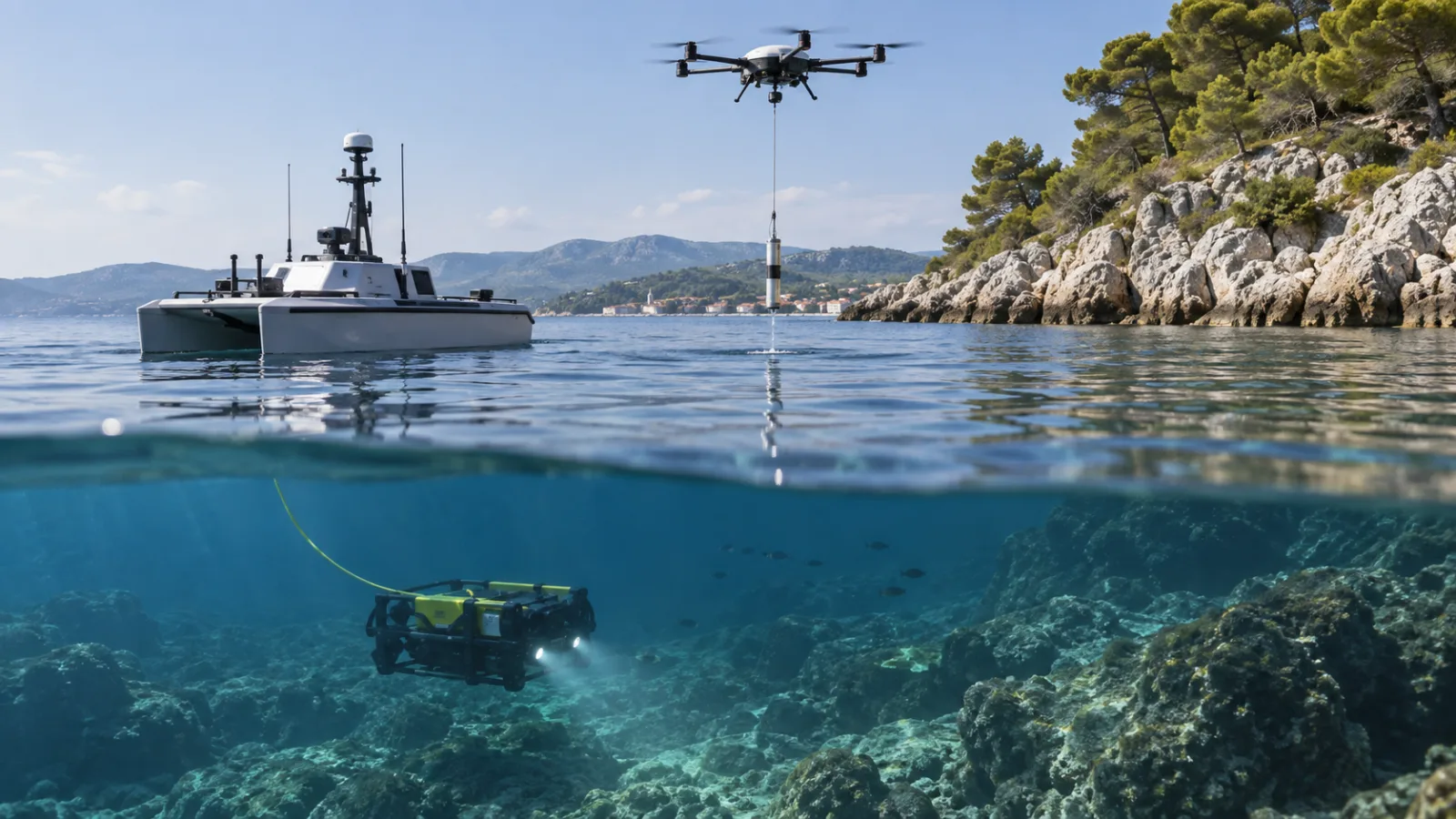
The convoy is part of the MARBLE project presentation hosted by the Ruđer Bošković Institute and its partners. The announced plan combines an autonomous surface vessel, an unmanned aerial vehicle and a remotely operated underwater vehicle. The surface craft is expected to follow a predefined route and maintain position; the aircraft is expected to travel to a location, hover, lower a sampling system and return; the underwater vehicle is expected to inspect the seafloor and underwater objects while sending video to observers on shore or aboard a support vessel.
That is a modest programme compared with the grandest claims made about autonomous transport. It is also a more revealing test. A maritime robot is rarely useful because it can navigate alone for a few minutes. It becomes useful when several machines can divide a job, exchange enough information to remain coordinated, and give a human operator a clear way to intervene when weather, communications or the environment exceed the system’s assumptions.
What is actually being demonstrated
The public schedule describes three connected demonstrations. The first is a surface-vessel exercise. The craft will use semi-autonomous navigation to maintain a planned route and position while adapting to waves and currents with limited operator intervention. The second uses a drone for marine sampling. The aircraft will fly to a predefined point, stabilize above the water, lower a sampling mechanism, collect seawater and return. The third uses a remotely operated underwater vehicle for inspection, including live transmission from an underwater camera.
The distinction between these systems matters. They do not share the same operating environment, sensors or control problem. A surface vessel can use its hull and propulsion system to tolerate some motion from waves, but it must reason about other boats, shoreline geometry and shallow water. An aerial vehicle has a much shorter endurance and must manage wind, battery state, launch and recovery, and the risks of operating over people or vessels. An underwater vehicle loses access to satellite navigation and normally depends on a tether or a specialized acoustic and inertial navigation setup.
Calling the event a “convoy” therefore points to the central engineering problem: coordination across different kinds of robots. The surface vessel may provide a moving or fixed operational base. The aircraft can reach a sampling point quickly and collect information without sending a larger boat there. The underwater vehicle can inspect a place that neither the aircraft nor the surface craft can see directly. The benefit comes from the workflow connecting those capabilities.
The institute’s announcement does not claim that the three platforms will form a fully independent swarm or that they will operate without supervision. It describes a practical demonstration of semi-autonomous navigation, autonomous flight to a predefined location, remotely operated underwater inspection, communication infrastructure and safety systems. That wording is important. A planned route and a defined sampling point are useful demonstrations, but they do not establish that the systems can handle arbitrary traffic, changing missions or unexpected hazards without human direction.
Why the handoffs are harder than the individual robots
A single robot can be tested against its own performance targets: position error, battery consumption, control latency, sensor availability or the quality of a video feed. A multi-robot mission adds another layer. Each platform has to know what the others are doing, and the team has to decide what happens when one platform cannot complete its part.
Consider the sampling sequence. The drone needs a safe launch point, an acceptable flight corridor and a location where the surface vessel or support team can recover it. The vessel needs to remain within the operating area without creating a collision risk. The sampling mechanism needs to reach the water without excessive movement from wind or waves. If the drone loses its data link while the mechanism is lowered, the correct response may be to stop the operation, retract the payload and return or land. The system’s value is not measured only by whether the sample is collected. It is also measured by whether failure produces a predictable, recoverable state.
The same logic applies underwater. A live video feed can be useful for inspecting a pier or seabed, but underwater communications are constrained and visibility can deteriorate quickly. A remotely operated vehicle may be able to continue moving while its camera view becomes unhelpful, yet continuing is not automatically the right choice. The operator needs to understand the vehicle’s position, tether condition, depth and remaining margin before deciding whether to proceed, retreat or surface.
A good demonstration should make these boundaries visible. It should record not only successful actions but also the conditions under which autonomy is reduced, paused or handed back to a person. That includes loss of communications, degraded positioning, unexpected traffic, excessive wind or waves, a low battery, a blocked route and an object that the perception system cannot classify confidently. Public events often emphasize the cleanest sequence. Operational deployments depend on the unglamorous exception handling.
The maritime environment exposes hidden assumptions
Robotics demonstrations on land can often rely on a mapped floor, stable lighting and a controlled perimeter. The sea removes many of those conveniences. A route that is safe in calm water can become unsafe when wind and current push the vessel away from its intended track. Reflections, glare and spray affect cameras. A small boat, swimmer or floating object may appear late. GPS or other positioning signals may be interrupted or inaccurate. The vehicle can be physically close to an obstacle even when the software’s map says the route is clear.
For an aerial robot, the water surface is both an operating area and a difficult visual reference. The drone must estimate its motion while the background changes with waves and reflected light. A sampling operation adds a payload interaction: lowering a probe or container changes the vehicle’s balance and creates a connection between the aircraft and the water. The safest behavior may be different before, during and after that interaction.
The underwater platform faces a different set of limitations. Radio signals do not travel through water in the same way they do through air, so the vehicle cannot assume continuous high-bandwidth communication. It may rely on a tether for power, control and video, which introduces entanglement and drag. If it is untethered, it may need a more complex navigation and recovery plan. Either way, the operator must work with less direct information than a person standing beside a terrestrial robot.
These constraints are why “autonomous” should be treated as a description of a function, not a blanket label. A vessel can be autonomous for route following while still requiring a human to approve the mission, monitor traffic and take over during an anomaly. A drone can fly autonomously to a waypoint while a person remains responsible for launch, payload handling and recovery. An underwater vehicle can execute its movement under remote control while its camera, navigation and safety logic are automated. Different functions can have different levels of autonomy in the same mission.
The International Maritime Organization’s guidance uses a similar functional approach. Its FAQ defines a Maritime Autonomous Surface Ship according to the functions that are performed autonomously or remotely, rather than treating every automated vessel as equivalent. The framework also asks operators to define the conditions in which a vessel can operate safely, including limits related to wind, sea state, visibility, water depth, weather and day or night operation.
Regulation is moving toward operational limits
The IMO adopted a non-mandatory International Code of Safety for Maritime Autonomous Surface Ships in May 2026, with the code taking effect on 1 July 2026. The code applies to relevant cargo ships covered by SOLAS and is recommended, as far as practicable, for smaller vessels as well. It is designed as a goal-based framework: operators must identify risks and demonstrate how they will manage them through design, certification and operation.
The code does not turn a research demonstration into a commercial autonomous ship. It is also not a declaration that a machine can replace the person responsible for a voyage. The IMO says the master retains overall responsibility even when not physically aboard, and it emphasizes remote operations centers, trained personnel, cybersecurity, search and rescue and fallback behavior. The organization’s current roadmap anticipates experience-building in the coming years and a future mandatory code later in the decade.
That regulatory direction matches what the Croatian demonstration can teach. The question is not simply whether a robot can steer, fly or transmit video. The question is whether the mission has a defined operational design domain and a credible response when the domain is exceeded. A system that works only in daylight, calm water and a closed demonstration zone can still be useful. It must be described honestly, with those conditions treated as part of the system rather than hidden footnotes.
The aerial segment also sits within a separate aviation safety regime. EASA’s rules for unmanned aircraft distinguish the responsibilities of the remote pilot and operator and include requirements related to operational conditions and safety information. A maritime mission does not erase the need to manage airspace, people, recovery areas or the possibility that an aircraft and vessel will interact unexpectedly. Coordinating the surface and air portions of a mission therefore requires more than a shared map. It requires a clear allocation of authority and a safe response if the aircraft cannot return to its planned landing point.
The useful unit is the mission, not the machine
Many robotics purchases begin with a platform: a boat, drone, arm or quadruped. The MARBLE-style demonstration suggests a different way to evaluate autonomy. Start with the task. In marine protection, the task might be to identify a suspicious slick, collect a sample, inspect an underwater structure and deliver evidence to a research team. In that workflow, no single robot needs to do everything. The surface vessel can provide endurance and coordination. The drone can cover distance quickly. The underwater vehicle can inspect below the surface.
This division can reduce the need to make one platform excessively capable. A large autonomous vessel does not need to carry every sensor if a smaller aircraft can temporarily provide aerial observations. A drone does not need an underwater manipulator if a remotely operated vehicle can perform the inspection. The trade-off is system integration. More platforms mean more batteries, operators, charging or launch procedures, communications links, maintenance schedules and failure modes.
The mission may be cheaper or safer when the robots are coordinated, but it may also be harder to operate. A buyer should compare the cost of the complete service, not the advertised price of the individual vehicle. That includes planning software, maritime permissions, trained personnel, insurance, spares, data handling and recovery procedures. For research teams, the value may be access to measurements that are difficult or dangerous to collect manually. For port operators, the value may come from repeatable inspection. For environmental agencies, the value may be faster sampling over a wider area. For each user, the autonomy requirement will be different.
The practical advantage of a mixed fleet is strongest when the environment is repetitive enough to define procedures but too large, hazardous or expensive for people to cover continuously. Coastal surveys, pier inspection, water-quality sampling, habitat monitoring and post-storm assessment are plausible examples. The systems do not need to behave like general-purpose intelligence. They need to perform bounded jobs reliably and report what they could not do.
What observers should look for at Kukljica
The announced programme gives the public a chance to watch the visible parts of autonomy: route keeping, hovering, sampling and underwater video. A technically informed observer should also look for the less visible details.
First, how is the operating area defined? The event is planned for waters around Kukljica and describes the location as providing safe conditions and good visibility. That is a strength of the demonstration, because a defined area makes risk management possible. It also establishes a limit: success in a prepared area does not automatically transfer to an open shipping lane, a storm response or an unfamiliar harbor.
Second, where does human authority sit? The announcement refers to control and safety systems and to limited operator intervention, but the important operational detail is the handoff. Can an operator stop the drone while it is sampling? Can the surface vessel be commanded to hold position or return? Can the underwater vehicle be recovered if its video feed fails? Are commands acknowledged, logged and visible to everyone involved?
Third, what happens when the network is imperfect? Real maritime operations cannot assume that every link remains available. The useful test is whether each vehicle has a local safe state and whether the wider mission can continue, pause or re-plan without ambiguity. A convoy in which one machine stops safely may be more mature than one that completes a flawless sequence but provides no evidence of its behavior under degraded conditions.
Fourth, what data is produced? A video feed is not the same as a usable inspection record. Environmental sampling requires location, time, depth, chain of custody and calibration details. Underwater inspection needs enough context to relate an image to a structure or seabed position. If the vehicles are coordinated but the data cannot be trusted, the mission remains a demonstration rather than an operational service.
Finally, what is the recovery plan? Boats can drift, drones can lose power and underwater vehicles can become entangled. Every platform should have a recovery procedure that is understood before launch. The most responsible autonomy demonstrations make those procedures part of the story.
Why this matters beyond Croatia
The event is regional and demonstrative, but its underlying problem is global. Coastal states, research institutions and private operators are exploring robotics for tasks that are costly, dangerous or slow when performed entirely by crews. Maritime autonomy is attractive because the environment is large, the work can be repetitive and some missions place people near pollution, damaged infrastructure or uncertain water conditions.
The path to useful deployment will probably be incremental. Operators may begin with route assistance, automated station keeping or remote inspection while people remain nearby. They may then add autonomous sampling, automated anomaly detection or longer-range remote supervision. Each step creates a new safety case. A system that can hold a position is not necessarily ready to avoid every vessel. A drone that can return to a launch point is not necessarily ready to coordinate with a moving ship. An underwater robot that can follow a tether is not necessarily ready to make independent decisions about an unfamiliar structure.
This gradual pattern is consistent with the IMO’s own description of maritime autonomy. The organization notes that fully crewless or remotely operated internationally trading cargo ships remain limited and expects more advanced operations to develop from systems in which only some functions are automated or remotely controlled. That is a more credible trajectory than a sudden transition from crewed shipping to unattended fleets.
It also changes how progress should be measured. The most valuable milestone may not be a faster robot or a more humanlike machine. It may be a clearer operating envelope, a better incident log, a more dependable communications handoff or a recovery procedure that works under pressure. Those are difficult achievements to show in a short video, but they determine whether a robot can leave the demonstration zone.
The central lesson: autonomy needs choreography
The Robot-Drone Demo Convoy is worth watching because it places three different robotic systems into one mission structure. Its importance does not depend on the machines appearing fully independent. In fact, the event is more useful if it shows exactly where autonomy ends and supervision begins.
A surface vessel, an aerial sampler and an underwater inspection robot can complement one another, but only if the system around them is designed for communication loss, uncertain perception, changing water conditions and human intervention. The hard part is choreography: deciding who acts, who observes, who has authority and what each platform does when the plan no longer fits reality.
That is the practical standard for maritime robotics in 2026. A successful demo should not be read as proof that autonomous ships have arrived. It should be read as evidence that bounded, multi-robot missions can be tested in public, under defined conditions, while the industry and regulators work out the rules for doing more. The next useful question is not whether a robot can operate alone. It is whether a group of robots can remain understandable and recoverable when the sea stops cooperating.
Related articles

An old Android phone could become a better Home Assistant voice panel — but not yet
Europe’s Android interoperability decision could fix a real smart-home nuisance: local wake words on phones without killing battery or replacing the default assistant.

An extra day before the cyclone: why WeatherNext is a real good-tech story
DeepMind’s open WeatherNext Cyclones model points to about a day more useful warning time, but its value depends on public forecasters, official alerts and careful validation.

Your smart pet feeder needs a backup plan, not just an app
Automatic feeders can make daily meals easier, but owners should test what happens when the app, Wi‑Fi, power or food flow fails.

OpenTrailPaper turns a LilyGO e-paper board into an open bike computer
A young Apache-2.0 project combines offline maps, GPX navigation, FIT recording and BLE sensors on one e-paper board. It is ready for careful experimentation, not blind reliance.
Comments
Sign in to comment.
No comments yet.